Chapter Notes: Multi-Digit Division With Partial Quotients


Division is a way to split a number into equal groups. When we divide large numbers, breaking the problem into smaller, easier parts can help us find the answer step by step. Partial quotients is a division strategy that lets you subtract groups of the divisor from the dividend until nothing is left. Instead of finding the exact answer all at once, you estimate and subtract manageable amounts, then add up what you subtracted to find the final quotient. This method is flexible and helps you understand what division really means.
What Are Partial Quotients?
Partial quotients is a division method where you subtract multiples of the divisor from the dividend, one at a time. A multiple is a number you get when you multiply the divisor by a whole number like 1, 2, 5, or 10. Each time you subtract a multiple, you write down how many groups you took away. At the end, you add up all those groups to get your answer.
Think of it like emptying a bucket of water with cups of different sizes. You don't have to use the same cup every time-you can use a big cup, then a medium cup, then a small cup, until the bucket is empty. Each cup represents a partial quotient.
Here's how it works:
- Write the division problem in a format that lets you subtract.
- Choose a multiple of the divisor that you can easily subtract from the dividend.
- Subtract that multiple and write down how many groups you subtracted.
- Repeat until you cannot subtract anymore.
- Add up all the groups you subtracted-that sum is your quotient.
- If there's a number left over, that's the remainder.
Understanding the Division Setup
To use partial quotients, we write division problems a little differently than with the traditional long division bracket. Instead, we set up the problem vertically, similar to subtraction.
For the problem 156 ÷ 12, we write:
156 ÷ 12
We will subtract multiples of 12 from 156 until we reach zero or a number smaller than 12. Each time we subtract, we keep track of how many groups of 12 we removed.
Choosing Your Partial Quotients
The beauty of partial quotients is that you can choose any multiples that are easy for you to work with. Some students like using groups of 10, some prefer groups of 5, and others might use groups of 2 or 1. All paths lead to the same answer!
Common multiples to use:
- Groups of 10: Multiply the divisor by 10 (easy and fast).
- Groups of 5: Multiply the divisor by 5 (half of 10).
- Groups of 2: Multiply the divisor by 2 (double the divisor).
- Groups of 1: Just use the divisor itself.
You can mix and match these groups as you solve the problem. The goal is to subtract until you have zero left, or a remainder that is smaller than the divisor.
Step-by-Step Example Using Partial Quotients
Example: A bakery has 156 cookies.
They want to pack them into boxes.
Each box holds 12 cookies.How many boxes can they fill?
Solution:
We need to divide 156 by 12.
Step 1: Start with 156. Think about how many groups of 12 we can subtract.
Step 2: Let's subtract 10 groups of 12 first.
10 × 12 = 120
156 - 120 = 36
We write "10" to the side to remember we subtracted 10 groups.Step 3: Now we have 36 left. Can we subtract more groups of 12?
Let's subtract 2 groups of 12.
2 × 12 = 24
36 - 24 = 12
We write "2" to the side.Step 4: We have 12 left. Can we subtract one more group of 12?
1 × 12 = 12
12 - 12 = 0
We write "1" to the side.Step 5: Now we have 0 left. Add up all the groups we subtracted:
10 + 2 + 1 = 13The bakery can fill 13 boxes completely.
Another Example with Different Choices
Example: A school has 184 students.
They need to form teams.
Each team should have 8 students.How many teams can they make?
Solution:
We need to divide 184 by 8.
Step 1: Start with 184. Let's subtract 10 groups of 8.
10 × 8 = 80
184 - 80 = 104
Record "10" on the side.Step 2: We have 104 left. Let's subtract another 10 groups of 8.
10 × 8 = 80
104 - 80 = 24
Record another "10" on the side.Step 3: We have 24 left. Let's subtract 3 groups of 8.
3 × 8 = 24
24 - 24 = 0
Record "3" on the side.Step 4: Add up all the groups:
10 + 10 + 3 = 23The school can make 23 teams.
Working with Remainders
Sometimes when you divide, you can't split the dividend into perfectly equal groups. The amount left over at the end is called the remainder. The remainder must always be smaller than the divisor. If your remainder is bigger than or equal to the divisor, you can subtract one more group!
Example: A farmer has 137 apples.
He wants to put them in baskets.
Each basket holds 15 apples.How many baskets can he fill, and how many apples will be left over?
Solution:
We need to divide 137 by 15.
Step 1: Start with 137. Subtract 5 groups of 15.
5 × 15 = 75
137 - 75 = 62
Record "5" on the side.Step 2: We have 62 left. Subtract 4 groups of 15.
4 × 15 = 60
62 - 60 = 2
Record "4" on the side.Step 3: We have 2 left. Since 2 is less than 15, we cannot subtract any more groups. This 2 is our remainder.
Step 4: Add up the groups we subtracted:
5 + 4 = 9The farmer can fill 9 baskets and will have 2 apples left over.
Using Friendly Multiples
One key to making partial quotients easier is choosing friendly multiples-numbers that are easy for you to multiply and subtract. Multiples of 10 are often the friendliest because they're simple to calculate.
Here's a helpful table of friendly multiples:
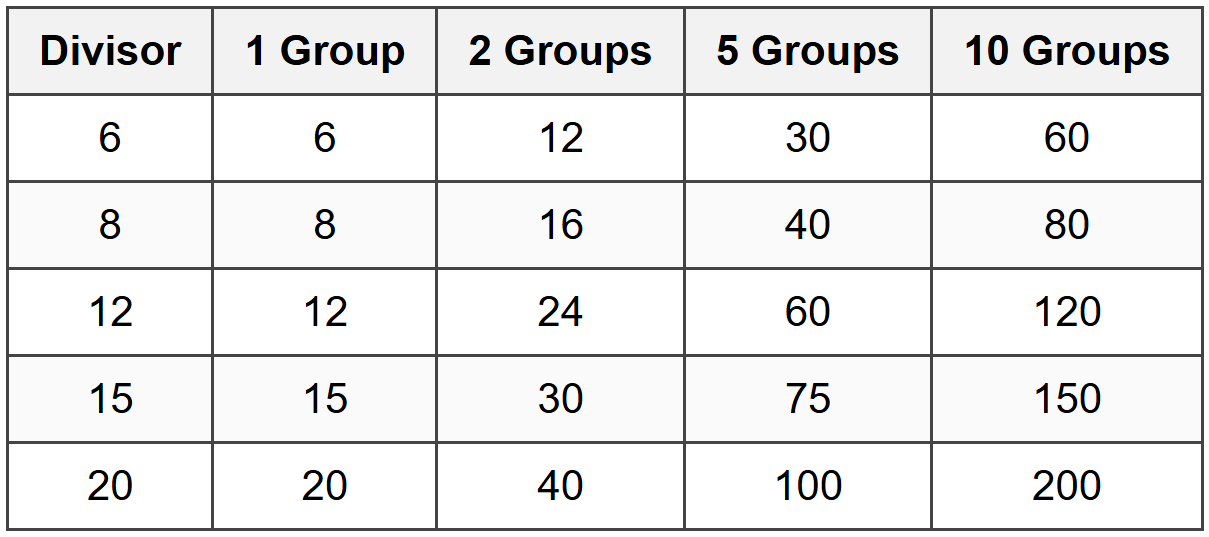
Knowing these multiples by heart makes the partial quotients method much faster!
Comparing Different Paths to the Same Answer
With partial quotients, two students can solve the same problem differently and both get the correct answer. Let's see how this works.
Example: Divide 96 by 6 using partial quotients.
What is 96 ÷ 6?
Solution (Path A):
Step 1: Subtract 10 groups of 6.
10 × 6 = 60
96 - 60 = 36
Record "10".Step 2: Subtract 5 groups of 6.
5 × 6 = 30
36 - 30 = 6
Record "5".Step 3: Subtract 1 group of 6.
1 × 6 = 6
6 - 6 = 0
Record "1".Step 4: Add: 10 + 5 + 1 = 16
The answer is 16.
Example: Divide 96 by 6 using partial quotients (another way).
What is 96 ÷ 6?
Solution (Path B):
Step 1: Subtract 10 groups of 6.
10 × 6 = 60
96 - 60 = 36
Record "10".Step 2: Subtract another 5 groups of 6.
5 × 6 = 30
36 - 30 = 6
Record "5".Step 3: Subtract 1 group of 6.
1 × 6 = 6
6 - 6 = 0
Record "1".Step 4: Add: 10 + 5 + 1 = 16
The answer is 16.
Both paths gave us 16! You could also use smaller groups like 2 + 2 + 2 + 2 + 2 + 2 + 2 + 2, and you'd still get 16. The partial quotients method is flexible and lets you work at your own comfort level.
Recording Your Work Clearly
Keeping your work organized is important. Here's one common way to record partial quotients vertically:
For 156 ÷ 12:
156 - 120 (10 groups of 12) ----- 36 - 24 (2 groups of 12) ----- 12 - 12 (1 group of 12) ----- 0 Add the groups: 10 + 2 + 1 = 13
Some students like to write the number of groups to the right of each subtraction. Others write it on the left. Either way is fine, as long as you can follow your own work and remember to add up all the groups at the end.
Why Use Partial Quotients?
Partial quotients helps you understand division more deeply. Instead of memorizing steps, you're actually thinking about what division means: "How many groups of this size fit into this total?"
Here are some benefits:
- Flexibility: You can use multiples that make sense to you.
- No memorization: You don't need to remember complex rules.
- Error-friendly: If you make a small mistake, you can usually keep going.
- Builds number sense: You practice estimating and checking your work.
- Works for all division problems: Even very large numbers!
Larger Numbers and Efficient Choices
As numbers get larger, choosing bigger multiples (like 10, 20, or even 100 groups) can save you time and steps.
Example: A factory produces 672 toys.
They pack them into boxes.
Each box holds 16 toys.How many boxes do they need?
Solution:
We need to divide 672 by 16.
Step 1: Subtract 10 groups of 16.
10 × 16 = 160
672 - 160 = 512
Record "10".Step 2: Subtract another 10 groups of 16.
10 × 16 = 160
512 - 160 = 352
Record "10".Step 3: Subtract another 10 groups of 16.
10 × 16 = 160
352 - 160 = 192
Record "10".Step 4: Subtract another 10 groups of 16.
10 × 16 = 160
192 - 160 = 32
Record "10".Step 5: Subtract 2 groups of 16.
2 × 16 = 32
32 - 32 = 0
Record "2".Step 6: Add: 10 + 10 + 10 + 10 + 2 = 42
They need 42 boxes.
Checking Your Answer
After you find your quotient using partial quotients, it's smart to check your work. You can multiply your quotient by the divisor. If you did the division correctly, you should get back the original dividend (or the dividend minus the remainder if there was one).
For 156 ÷ 12 = 13:
Check: 13 × 12 = 156 ✓
For 137 ÷ 15 = 9 R2:
Check: (9 × 15) + 2 = 135 + 2 = 137 ✓
This step helps you catch mistakes and builds confidence in your answer.
Tips for Success
- Start with multiples of 10: They're easy and take big chunks out of the dividend quickly.
- Use multiples you know well: If you know your times tables, use them!
- Don't worry about being perfect: Any correct multiples will work.
- Write clearly: Keep your work organized so you can follow your steps.
- Check your subtraction: Small subtraction errors can throw off your answer.
- Add carefully at the end: Make sure you add up all your partial quotients.
- Practice estimating: The more you practice, the faster you'll see which multiples to use.
Common Mistakes to Avoid
Even though partial quotients is a flexible method, there are a few common errors to watch out for:
- Forgetting to add up all the groups: You must add every partial quotient you wrote down.
- Stopping too early: Keep subtracting until your remainder is smaller than the divisor.
- Subtracting the wrong multiple: Double-check your multiplication before you subtract.
- Messy recording: If your work is hard to read, you might lose track of your groups.
- Not checking your work: Always multiply back to verify your answer.
Connecting to Other Division Methods
Partial quotients is closely related to traditional long division. Both methods subtract multiples of the divisor from the dividend. The main difference is that long division uses the largest possible multiple each time, while partial quotients lets you use any comfortable multiple. As you get more confident, you might naturally start choosing larger multiples, and your work will look more and more like long division.
Think of partial quotients as training wheels for division. Once you understand how division really works by using this method, you can move to faster methods with confidence.
Real-World Applications
Division with partial quotients is useful in everyday life whenever you need to split things into equal groups:
- Dividing party supplies among guests
- Figuring out how many weeks are in a certain number of days
- Splitting money equally among friends
- Determining how many bags you need to hold a certain number of items
- Calculating how many trips you need to make to move objects
Understanding division through partial quotients helps you think flexibly about numbers and solve problems in ways that make sense to you.