Chapter Notes: Adding and Subtracting Fractions With Like Denominators


Fractions are everywhere in our daily lives! We use them when we share pizza slices, measure ingredients for recipes, and divide up candy among friends. When fractions have the same bottom number, adding and subtracting them becomes easy and fun. In this chapter, you will learn how to combine fractions with like denominators, which means fractions that have the same number on the bottom. Once you master this skill, you'll be able to solve many real-world problems involving parts of a whole.
Understanding Fractions
A fraction is a number that represents part of a whole. Every fraction has two parts separated by a line. The top number is called the numerator, and it tells you how many parts you have. The bottom number is called the denominator, and it tells you how many equal parts the whole is divided into.
For example, in the fraction 3/5, the numerator is 3 and the denominator is 5. This means we have 3 parts out of 5 equal parts total.
Think of a pizza cut into 5 equal slices. If you eat 3 slices, you have eaten 3/5 of the pizza. The denominator (5) tells you how many slices the pizza was cut into, and the numerator (3) tells you how many slices you ate.
What Are Like Denominators?
When two or more fractions have the same denominator, we say they have like denominators. The word "like" means "the same." Having like denominators makes adding and subtracting fractions much simpler because all the parts are the same size.
Examples of fractions with like denominators:
- 1/4 and 3/4 (both have 4 as the denominator)
- 2/8 and 5/8 (both have 8 as the denominator)
- 1/10, 3/10, and 7/10 (all have 10 as the denominator)
Examples of fractions with unlike denominators (different bottom numbers):
- 1/2 and 1/3 (denominators are 2 and 3)
- 3/4 and 2/5 (denominators are 4 and 5)
Imagine you have two buckets of toys. In one bucket, toys are grouped into sets of 4. In another bucket, toys are grouped into sets of 6. It's hard to combine them directly. But if both buckets have toys grouped into sets of 4, combining them is easy! That's what like denominators do for fractions.
Adding Fractions With Like Denominators
When fractions have the same denominator, adding them is straightforward. You simply add the numerators (the top numbers) and keep the denominator (the bottom number) the same.
Rule for Adding Fractions With Like Denominators:
\[ \frac{a}{c} + \frac{b}{c} = \frac{a + b}{c} \]In this rule, \(a\) and \(b\) are the numerators, and \(c\) is the common denominator. You add \(a\) and \(b\) to get the new numerator, and keep \(c\) as the denominator.
Why Does This Work?
When fractions have the same denominator, they represent parts of the same size. Adding the numerators counts how many of those same-sized parts you have in total.
If you have 2 slices of an 8-slice pizza and your friend gives you 3 more slices from the same pizza, you now have 2 + 3 = 5 slices out of 8. The pizza is still cut into 8 slices total, so you have 5/8 of the pizza.
Step-by-Step Process
Follow these steps to add fractions with like denominators:
- Check that the denominators are the same.
- Add the numerators together.
- Write the sum over the common denominator.
- Simplify the answer if possible.
Example: Add the fractions 2/5 and 1/5.
What is 2/5 + 1/5?
Solution:
Step 1: Check the denominators. Both fractions have 5 as the denominator, so they are like fractions.
Step 2: Add the numerators: 2 + 1 = 3
Step 3: Keep the denominator the same: 5
Step 4: Write the answer: 3/5
The sum is 3/5.
Example: Maria ran 3/10 of a mile in the morning.
She ran 4/10 of a mile in the afternoon.How far did Maria run in total?
Solution:
Step 1: The denominators are both 10, so we can add directly.
Step 2: Add the numerators: 3 + 4 = 7
Step 3: Keep the denominator: 10
Step 4: The answer is 7/10
Maria ran 7/10 of a mile in total.
Example: Add 1/6 + 2/6 + 3/6.
What is the sum?
Solution:
Step 1: All three fractions have 6 as the denominator.
Step 2: Add all the numerators: 1 + 2 + 3 = 6
Step 3: Keep the denominator: 6
Step 4: Write the answer: 6/6
Step 5: Simplify. Since 6/6 means 6 out of 6 parts, that equals 1 whole.
The sum is 1 (or 6/6).
Subtracting Fractions With Like Denominators
Subtracting fractions with like denominators works the same way as addition, except you subtract the numerators instead of adding them. The denominator stays the same.
Rule for Subtracting Fractions With Like Denominators:
\[ \frac{a}{c} - \frac{b}{c} = \frac{a - b}{c} \]In this rule, \(a\) is the first numerator, \(b\) is the second numerator, and \(c\) is the common denominator. You subtract \(b\) from \(a\) to get the new numerator, and keep \(c\) as the denominator.
Why Does This Work?
When you subtract fractions with the same denominator, you are taking away parts of the same size. The denominator tells you what size the parts are, and the numerators tell you how many parts you start with and how many you take away.
Imagine you have 5 out of 8 pieces of a candy bar. If you give away 2 pieces, you now have 5 - 2 = 3 pieces left. The candy bar is still divided into 8 pieces, so you have 3/8 left.
Step-by-Step Process
Follow these steps to subtract fractions with like denominators:
- Check that the denominators are the same.
- Subtract the second numerator from the first numerator.
- Write the difference over the common denominator.
- Simplify the answer if possible.
Example: Subtract 5/7 - 2/7.
What is 5/7 - 2/7?
Solution:
Step 1: Check the denominators. Both fractions have 7 as the denominator.
Step 2: Subtract the numerators: 5 - 2 = 3
Step 3: Keep the denominator the same: 7
Step 4: Write the answer: 3/7
The difference is 3/7.
Example: Jason had 7/8 of a gallon of paint.
He used 3/8 of a gallon to paint his room.How much paint does Jason have left?
Solution:
Step 1: The denominators are both 8.
Step 2: Subtract the numerators: 7 - 3 = 4
Step 3: Keep the denominator: 8
Step 4: Write the answer: 4/8
Step 5: Simplify. Both 4 and 8 can be divided by 4: 4 ÷ 4 = 1 and 8 ÷ 4 = 2, so 4/8 = 1/2
Jason has 1/2 gallon of paint left.
Example: Subtract 9/10 - 5/10.
What is the difference?
Solution:
Step 1: Both denominators are 10.
Step 2: Subtract the numerators: 9 - 5 = 4
Step 3: Keep the denominator: 10
Step 4: Write the answer: 4/10
Step 5: Simplify. Both 4 and 10 can be divided by 2: 4 ÷ 2 = 2 and 10 ÷ 2 = 5, so 4/10 = 2/5
The difference is 2/5.
Simplifying Fractions
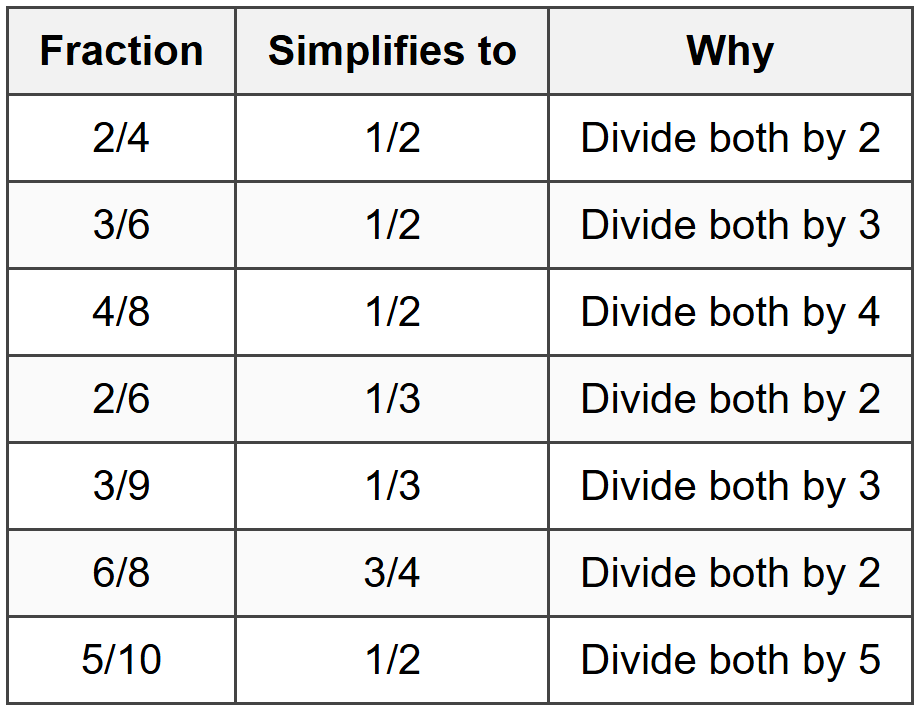
After you add or subtract fractions, your answer might be able to be simplified. A fraction is in simplest form when the numerator and denominator have no common factors other than 1. This means you cannot divide both numbers by the same number (except 1) and get whole numbers.
To simplify a fraction, find the greatest common factor (GCF) of the numerator and denominator, then divide both by that number.
Common Simplifications to Remember
Example: Simplify the fraction 6/12.
What is 6/12 in simplest form?
Solution:
Step 1: Find the greatest common factor of 6 and 12. The factors of 6 are 1, 2, 3, and 6. The factors of 12 are 1, 2, 3, 4, 6, and 12. The greatest common factor is 6.
Step 2: Divide both the numerator and denominator by 6.
6 ÷ 6 = 1 and 12 ÷ 6 = 2
Step 3: The simplified fraction is 1/2.
The fraction 6/12 simplifies to 1/2.
Mixed Numbers and Improper Fractions
Sometimes when you add fractions, the numerator becomes equal to or greater than the denominator. When the numerator is greater than or equal to the denominator, the fraction is called an improper fraction.
An improper fraction can be written as a mixed number, which is a whole number and a fraction together. For example, 5/4 is an improper fraction that equals 1 1/4 as a mixed number.
Converting Improper Fractions to Mixed Numbers
To convert an improper fraction to a mixed number:
- Divide the numerator by the denominator to find the whole number part.
- The remainder becomes the new numerator.
- The denominator stays the same.
Example: Convert 7/4 to a mixed number.
What is 7/4 as a mixed number?
Solution:
Step 1: Divide 7 by 4. The result is 1 with a remainder of 3, because 4 × 1 = 4 and 7 - 4 = 3.
Step 2: The whole number is 1.
Step 3: The remainder is 3, which becomes the new numerator.
Step 4: The denominator stays 4.
Step 5: Write the mixed number: 1 3/4
The improper fraction 7/4 equals 1 3/4.
Example: Add 3/5 + 4/5 and write the answer as a mixed number if needed.
What is 3/5 + 4/5?
Solution:
Step 1: The denominators are both 5.
Step 2: Add the numerators: 3 + 4 = 7
Step 3: Write the fraction: 7/5
Step 4: Since 7 is greater than 5, this is an improper fraction. Convert to a mixed number.
Step 5: Divide 7 by 5 to get 1 with a remainder of 2.
Step 6: Write as a mixed number: 1 2/5
The sum is 1 2/5.
Common Mistakes to Avoid
When adding and subtracting fractions with like denominators, students sometimes make these mistakes. Watch out for them!
Mistake 1: Adding or Subtracting Denominators
Remember, when fractions have like denominators, you only add or subtract the numerators. The denominator stays the same.
Wrong: 2/5 + 1/5 = 3/10 (do not add denominators!)
Correct: 2/5 + 1/5 = 3/5 (only add numerators)
Mistake 2: Forgetting to Simplify
Always check if your answer can be simplified. If it can, write it in simplest form.
Incomplete: 4/8 (this can be simplified)
Complete: 4/8 = 1/2
Mistake 3: Subtracting in the Wrong Order
In subtraction, order matters. Always subtract the second numerator from the first numerator.
Wrong: 7/10 - 3/10 = (3 - 7)/10 = -4/10 (wrong order)
Correct: 7/10 - 3/10 = (7 - 3)/10 = 4/10 = 2/5
Real-World Applications
Understanding how to add and subtract fractions with like denominators helps you solve many everyday problems.
Cooking and Recipes
Recipes often use fractions of cups, teaspoons, and tablespoons. If a recipe calls for 1/4 cup of sugar in one step and 2/4 cup in another step, you need 3/4 cup total.
Measuring Distance
When you track how far you walk or run, you might measure in fractions of a mile. If you walk 2/8 of a mile to school and 3/8 of a mile to the library, you've walked 5/8 of a mile in total.
Sharing and Dividing
When you share items equally, fractions help you keep track. If you eat 3/10 of a bag of popcorn and your friend eats 4/10, together you've eaten 7/10 of the bag, leaving 3/10 for later.
Example: A recipe needs 3/8 cup of milk for the batter and 2/8 cup of milk for the frosting.
How much milk is needed in total?
Solution:
Step 1: Both amounts are measured in eighths of a cup.
Step 2: Add the numerators: 3 + 2 = 5
Step 3: Keep the denominator: 8
Step 4: The total is 5/8 cup of milk.
You need 5/8 cup of milk in total.
Summary of Key Points
- Fractions with like denominators have the same bottom number.
- To add fractions with like denominators, add the numerators and keep the denominator the same.
- To subtract fractions with like denominators, subtract the numerators and keep the denominator the same.
- Always check if your answer can be simplified to lowest terms.
- If the numerator is greater than or equal to the denominator, you have an improper fraction that can be written as a mixed number.
- The denominator never changes when adding or subtracting fractions with like denominators.
You now have all the tools you need to add and subtract fractions with like denominators! With practice, these skills will become quick and easy, helping you solve problems in math class and in your everyday life.