Chapter Notes: Adding and Subtracting Mixed Numbers


Have you ever measured ingredients for a recipe and found that you needed 2 ½ cups of flour plus 1 ¾ cups more? Or maybe you had 3 ¼ feet of ribbon and used 1 ⅝ feet for a project? These are examples of mixed numbers in real life. A mixed number is a whole number and a fraction written together, like 2 ½ or 3 ¼. Learning to add and subtract mixed numbers will help you solve everyday problems involving measurements, time, and much more. In this chapter, you will learn step-by-step strategies to work with mixed numbers confidently and correctly.
Understanding Mixed Numbers
A mixed number has two parts: a whole number part and a fraction part. For example, in the mixed number 3 ½, the number 3 is the whole number part, and ½ is the fraction part. Mixed numbers show amounts greater than one whole. Think of it like having 3 whole pizzas and half of another pizza.
Before we add or subtract mixed numbers, we need to remember a few important ideas:
- The numerator is the top number in a fraction. It tells how many parts we have.
- The denominator is the bottom number in a fraction. It tells how many equal parts make one whole.
- Fractions must have the same denominator before we can add or subtract them. This is called having a common denominator.
Adding Mixed Numbers with Like Denominators
When the fraction parts of two mixed numbers have the same denominator, we call them like denominators. Adding mixed numbers with like denominators is easier because we can add the parts directly.
Step-by-Step Method
Follow these steps to add mixed numbers with like denominators:
- Add the whole number parts together.
- Add the fraction parts together.
- If the fraction part equals one or more, simplify by converting it to a mixed number and adding it to the whole number part.
- Write your final answer in simplest form.
Example: Sarah has 2 ⅜ yards of blue fabric.
Her friend gives her 1 ⅜ more yards of blue fabric.How much blue fabric does Sarah have now?
Solution:
Add the whole numbers: 2 + 1 = 3
Add the fractions: ⅜ + ⅜ = 6/8
Combine them: 3 + 6/8 = 3 6/8
Simplify 6/8 by dividing both numerator and denominator by 2: 6/8 = 3/4
Sarah has 3 ¾ yards of blue fabric.
Example: Marcus ran 1 ⅚ miles on Monday.
He ran 2 ⅚ miles on Tuesday.How many total miles did Marcus run?
Solution:
Add the whole numbers: 1 + 2 = 3
Add the fractions: ⅚ + ⅚ = 10/6
Combine them: 3 + 10/6
Convert the improper fraction 10/6 to a mixed number: 10/6 = 1 4/6
Add the extra whole number: 3 + 1 4/6 = 4 4/6
Simplify 4/6 by dividing both by 2: 4/6 = 2/3
Marcus ran a total of 4 ⅔ miles.
Adding Mixed Numbers with Unlike Denominators
When mixed numbers have different denominators, we call them unlike denominators. Before we can add, we must find a common denominator. The easiest common denominator to find is the least common denominator (LCD), which is the smallest number that both denominators divide into evenly.
Step-by-Step Method
- Find the least common denominator of the two fractions.
- Convert each fraction to an equivalent fraction with the common denominator.
- Add the whole number parts.
- Add the fraction parts.
- Simplify if necessary.
Example: A recipe needs 2 ½ cups of milk.
Another recipe needs 1 ⅓ cups of milk.How much milk is needed in total?
Solution:
Find the LCD of 2 and 3: The LCD is 6
Convert ½ to sixths: ½ = 3/6
Convert ⅓ to sixths: ⅓ = 2/6
Rewrite the problem: 2 3/6 + 1 2/6
Add the whole numbers: 2 + 1 = 3
Add the fractions: 3/6 + 2/6 = 5/6
Combine: 3 + 5/6 = 3 5/6
The total amount of milk needed is 3 5/6 cups.
Example: Emma practiced piano for 1 ¾ hours on Saturday.
She practiced for 2 ⅖ hours on Sunday.What is the total time Emma practiced?
Solution:
Find the LCD of 4 and 5: The LCD is 20
Convert ¾ to twentieths: ¾ = 15/20
Convert ⅖ to twentieths: ⅖ = 8/20
Rewrite the problem: 1 15/20 + 2 8/20
Add the whole numbers: 1 + 2 = 3
Add the fractions: 15/20 + 8/20 = 23/20
Convert 23/20 to a mixed number: 23/20 = 1 3/20
Add to the whole number: 3 + 1 3/20 = 4 3/20
Emma practiced for a total of 4 3/20 hours.
Subtracting Mixed Numbers with Like Denominators
Subtracting mixed numbers with like denominators follows a similar pattern to addition, but we must be careful when the fraction part we are subtracting is larger than the fraction part we are subtracting from.
Step-by-Step Method (No Regrouping Needed)
- Subtract the whole number parts.
- Subtract the fraction parts.
- Simplify if necessary.
Example: Jacob had 5 ⅞ pounds of apples.
He used 2 ⅜ pounds to make applesauce.How many pounds of apples does Jacob have left?
Solution:
Subtract the whole numbers: 5 - 2 = 3
Subtract the fractions: ⅞ - ⅜ = 4/8
Combine: 3 + 4/8 = 3 4/8
Simplify 4/8 by dividing both by 4: 4/8 = ½
Jacob has 3 ½ pounds of apples left.
Regrouping (Borrowing) When Needed
Sometimes the fraction part we need to subtract is larger than the fraction part we have. When this happens, we must regroup or borrow one whole from the whole number part and add it to the fraction part. This is like trading one dollar for four quarters when you need more coins.
Remember: One whole equals any fraction with the same numerator and denominator, such as 4/4, 5/5, or 8/8.
Example: A ribbon is 4 ¼ feet long.
You cut off 1 ¾ feet.How much ribbon is left?
Solution:
We need to subtract 4 ¼ - 1 ¾, but ¼ is smaller than ¾
Regroup: Borrow 1 from 4, so 4 ¼ becomes 3 + 1 + ¼
Convert the borrowed 1 to fourths: 1 = 4/4
Add to the fraction: 4/4 + ¼ = 5/4
Now we have: 3 5/4 - 1 ¾
Subtract the whole numbers: 3 - 1 = 2
Subtract the fractions: 5/4 - ¾ = 2/4
Combine: 2 + 2/4 = 2 2/4
Simplify 2/4 by dividing both by 2: 2/4 = ½
There is 2 ½ feet of ribbon left.
Subtracting Mixed Numbers with Unlike Denominators
When subtracting mixed numbers with different denominators, we first find a common denominator, then follow the same steps as before. We may still need to regroup if necessary.
Step-by-Step Method
- Find the least common denominator.
- Convert both fractions to equivalent fractions with the common denominator.
- Check if regrouping is needed. If the first fraction is smaller than the second, borrow from the whole number.
- Subtract the whole numbers.
- Subtract the fractions.
- Simplify the answer.
Example: A water bottle holds 5 ½ cups of water.
You drink 2 ⅓ cups.How much water is left in the bottle?
Solution:
Find the LCD of 2 and 3: The LCD is 6
Convert ½ to sixths: ½ = 3/6
Convert ⅓ to sixths: ⅓ = 2/6
Rewrite the problem: 5 3/6 - 2 2/6
Subtract the whole numbers: 5 - 2 = 3
Subtract the fractions: 3/6 - 2/6 = 1/6
Combine: 3 + 1/6 = 3 1/6
There are 3 1/6 cups of water left.
Example: A board is 6 ¼ feet long.
You need to cut off 2 ⅔ feet.How long will the remaining piece be?
Solution:
Find the LCD of 4 and 3: The LCD is 12
Convert ¼ to twelfths: ¼ = 3/12
Convert ⅔ to twelfths: ⅔ = 8/12
Rewrite the problem: 6 3/12 - 2 8/12
Since 3/12 is smaller than 8/12, we need to regroup
Borrow 1 from 6: 6 3/12 becomes 5 + 12/12 + 3/12 = 5 15/12
Now subtract: 5 15/12 - 2 8/12
Subtract whole numbers: 5 - 2 = 3
Subtract fractions: 15/12 - 8/12 = 7/12
Combine: 3 + 7/12 = 3 7/12
The remaining piece will be 3 7/12 feet long.
Tips for Success
Here are some helpful strategies to remember when adding and subtracting mixed numbers:
- Always find a common denominator first when fractions have unlike denominators. This is the most important step.
- Check if regrouping is needed before you subtract. If the first fraction is smaller than the second, borrow one whole.
- Simplify your answer at the end. Reduce fractions to lowest terms and convert improper fractions to mixed numbers.
- Label your answer with the correct unit (cups, feet, yards, hours, etc.) to make sure it makes sense in the problem.
- Estimate first to check if your answer is reasonable. For example, 3 ½ + 2 ⅓ should be close to 6.
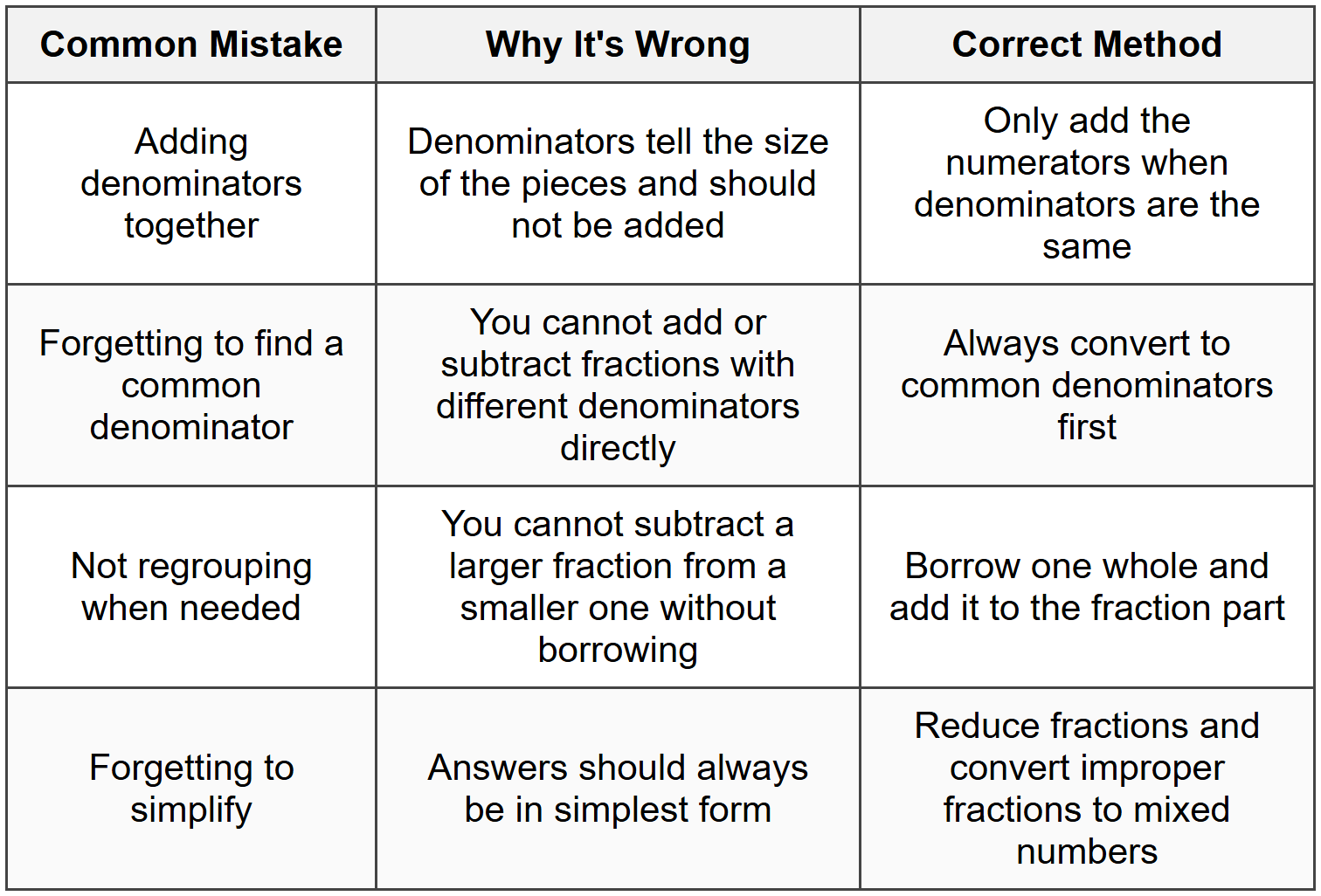
Common Mistakes to Avoid
Be careful not to make these common errors:
Alternative Method: Converting to Improper Fractions
Another way to add or subtract mixed numbers is to convert them to improper fractions first. An improper fraction has a numerator that is greater than or equal to its denominator, like 11/4 or 17/5.
How to Convert a Mixed Number to an Improper Fraction
- Multiply the whole number by the denominator.
- Add the numerator to that product.
- Write the result over the original denominator.
For example, to convert 3 ¼ to an improper fraction:
- Multiply: 3 × 4 = 12
- Add: 12 + 1 = 13
- Write as a fraction: 13/4
Example: Add 2 ⅔ + 1 ½ using improper fractions.
What is the sum?
Solution:
Convert 2 ⅔ to an improper fraction: (2 × 3) + 2 = 8, so 2 ⅔ = 8/3
Convert 1 ½ to an improper fraction: (1 × 2) + 1 = 3, so 1 ½ = 3/2
Find the LCD of 3 and 2: The LCD is 6
Convert 8/3 to sixths: 8/3 = 16/6
Convert 3/2 to sixths: 3/2 = 9/6
Add: 16/6 + 9/6 = 25/6
Convert 25/6 back to a mixed number: 25 ÷ 6 = 4 remainder 1, so 25/6 = 4 1/6
The sum is 4 1/6.
This method works well, especially when you are comfortable working with improper fractions. Some students find it easier because they do not need to regroup or keep track of whole numbers and fractions separately. Try both methods and use the one that makes the most sense to you!