Chapter Notes: Writing Fractions As Decimals


Fractions and decimals are two different ways to show parts of a whole. Sometimes it is easier to work with decimals than fractions. For example, when you use money, you see $0.25 instead of 1/4 of a dollar. Learning how to change fractions into decimals helps you understand both better and lets you choose the best way to show a number.
Understanding the Connection Between Fractions and Decimals
A fraction shows a part of a whole using two numbers: the top number (called the numerator) and the bottom number (called the denominator). The denominator tells how many equal parts the whole is divided into. The numerator tells how many of those parts you have.
A decimal also shows a part of a whole, but it uses place value. The digits to the right of the decimal point show tenths, hundredths, thousandths, and so on.
Think of a pizza cut into 10 equal slices. If you eat 3 slices, you ate 3/10 of the pizza. You can also say you ate 0.3 of the pizza. Both mean exactly the same thing!
The key idea is this: a fraction is really a division problem. The fraction bar means "divide." So 3/4 means 3 ÷ 4. When you divide the numerator by the denominator, you get a decimal.
Writing Fractions with Denominators of 10 as Decimals
Fractions with a denominator of 10 are the easiest to write as decimals. This is because our decimal system is based on tens.
When the denominator is 10, the numerator tells you how many tenths you have. In decimal form, tenths are the first place after the decimal point.
- 1/10 = 0.1 (one tenth)
- 3/10 = 0.3 (three tenths)
- 7/10 = 0.7 (seven tenths)
- 9/10 = 0.9 (nine tenths)
Example: Sarah ran 7/10 of a mile.
What is this distance as a decimal?
Solution:
The denominator is 10, so we are working with tenths.
The numerator is 7, so we have 7 tenths.
7 tenths is written as 0.7 in decimal form.
Sarah ran 0.7 miles.
Example: A bottle is filled 4/10 of the way with juice.
Write this as a decimal.
Solution:
The denominator is 10, which means tenths.
The numerator is 4, which means 4 tenths.
4 tenths = 0.4
The bottle is 0.4 full.
Writing Fractions with Denominators of 100 as Decimals
Fractions with a denominator of 100 are also easy to change into decimals. The numerator tells you how many hundredths you have. Hundredths are the second place after the decimal point.
- 1/100 = 0.01 (one hundredth)
- 25/100 = 0.25 (twenty-five hundredths)
- 50/100 = 0.50 or 0.5 (fifty hundredths)
- 99/100 = 0.99 (ninety-nine hundredths)
Think about money! One penny is 1/100 of a dollar, and we write it as $0.01. Twenty-five pennies make a quarter, which is 25/100 of a dollar, or $0.25.
Example: Marcus answered 87/100 of the questions correctly on his test.
What is this as a decimal?
Solution:
The denominator is 100, so we are working with hundredths.
The numerator is 87, so we have 87 hundredths.
87 hundredths is written as 0.87 in decimal form.
Marcus scored 0.87 on his test.
Example: A garden has 3/100 of its area planted with roses.
Write this as a decimal.
Solution:
The denominator is 100, which means hundredths.
The numerator is 3, which means 3 hundredths.
3 hundredths = 0.03 (notice the zero in the tenths place!)
The rose area is 0.03 of the garden.
Converting Fractions with Other Denominators
What if the denominator is not 10 or 100? We can still change these fractions to decimals. There are two main methods you can use.
Method 1: Finding an Equivalent Fraction
Some fractions can be changed into equivalent fractions (fractions that mean the same thing) with denominators of 10 or 100. Then you can easily write them as decimals.
This works well when the denominator is a factor of 10 or 100. Common denominators that work nicely are 2, 4, 5, 20, 25, and 50.
Example: Write 1/2 as a decimal.
Solution:
We need to find an equivalent fraction with a denominator of 10 or 100.
1/2 = ?/10
To change 2 to 10, we multiply by 5.
We must multiply both the numerator and denominator by 5.
1/2 = (1 × 5)/(2 × 5) = 5/10
5/10 = 0.5
The decimal form of 1/2 is 0.5.
Example: Write 3/4 as a decimal.
Solution:
We need an equivalent fraction with a denominator of 10 or 100.
Since 4 doesn't go into 10 evenly, let's try 100.
3/4 = ?/100
To change 4 to 100, we multiply by 25.
We multiply both top and bottom by 25.
3/4 = (3 × 25)/(4 × 25) = 75/100
75/100 = 0.75
The decimal form of 3/4 is 0.75.
Example: Write 3/5 as a decimal.
Solution:
We want a denominator of 10 or 100.
3/5 = ?/10
To change 5 to 10, we multiply by 2.
3/5 = (3 × 2)/(5 × 2) = 6/10
6/10 = 0.6
The decimal form of 3/5 is 0.6.
Method 2: Using Division
Remember that a fraction means division! The fraction bar is like a division sign. To change any fraction to a decimal, you can divide the numerator by the denominator.
For example, 1/4 means 1 ÷ 4.
When you divide, you may need to add a decimal point and zeros to the number you are dividing. Let's see how this works.
Example: Write 1/4 as a decimal using division.
Solution:
1/4 means 1 ÷ 4.
Set up the division: 4 goes into 1.
Since 4 doesn't go into 1, we write 0. and add a decimal point.
Now we have 1.0 (which equals 1).
4 goes into 10 two times (4 × 2 = 8).
10 - 8 = 2, bring down another 0 to get 20.
4 goes into 20 five times (4 × 5 = 20).
20 - 20 = 0, so we are done.
1 ÷ 4 = 0.25
The decimal form of 1/4 is 0.25.
Example: Write 1/5 as a decimal using division.
Solution:
1/5 means 1 ÷ 5.
5 doesn't go into 1, so we write 0. with a decimal point.
Now divide: 5 goes into 10 two times (5 × 2 = 10).
10 - 10 = 0
1 ÷ 5 = 0.2
The decimal form of 1/5 is 0.2.
Common Fraction and Decimal Equivalents
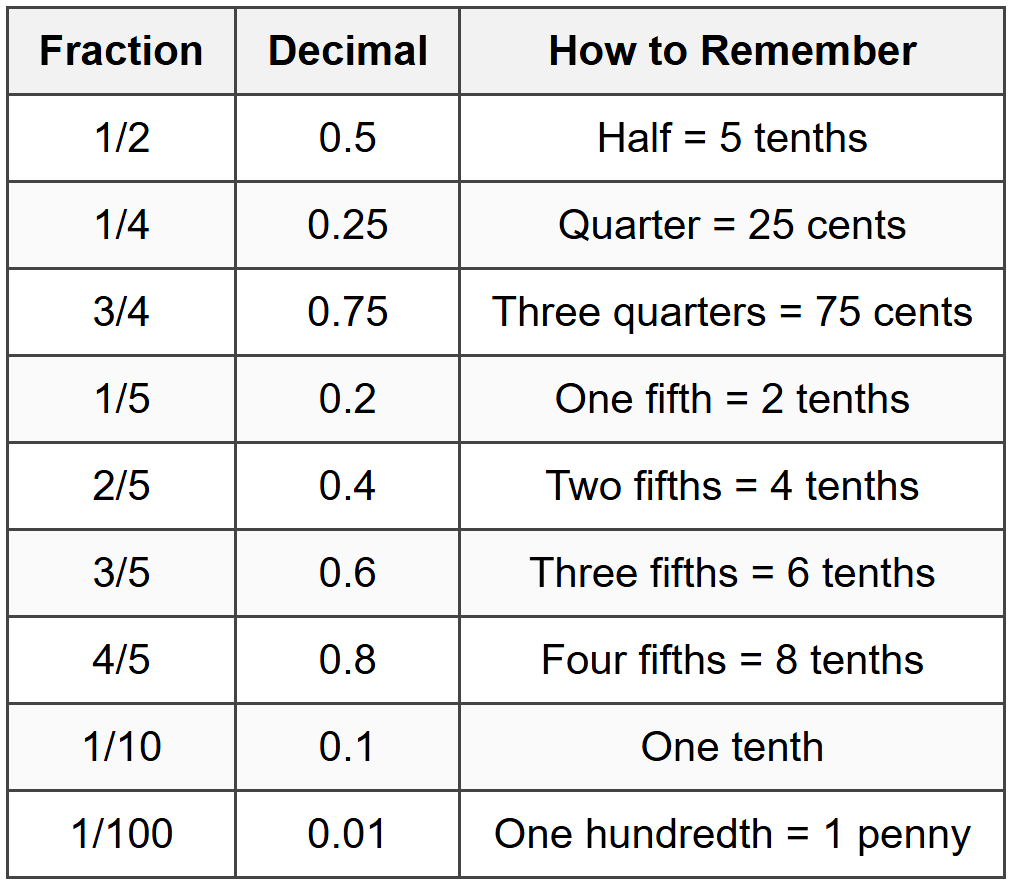
Some fractions and decimals are used so often that it helps to memorize them. Here is a table showing the most common ones:
Working with Mixed Numbers
A mixed number has a whole number part and a fraction part, like 2 1/2. To write a mixed number as a decimal, you keep the whole number and change only the fraction part.
Example: Write 2 3/10 as a decimal.
Solution:
The whole number part is 2.
The fraction part is 3/10.
3/10 = 0.3
Put them together: 2 and 0.3 = 2.3
The decimal form is 2.3.
Example: Write 5 1/4 as a decimal.
Solution:
The whole number part is 5.
The fraction part is 1/4.
1/4 = 25/100 = 0.25
Put them together: 5 and 0.25 = 5.25
The decimal form is 5.25.
Example: A recipe calls for 1 1/2 cups of flour.
Write this as a decimal.
Solution:
The whole number is 1.
The fraction is 1/2.
1/2 = 5/10 = 0.5
Combine: 1.5
The recipe needs 1.5 cups of flour.
Special Cases: When the Denominator is 25 or 50
Fractions with denominators of 25 or 50 can easily be changed to decimals because these numbers are factors of 100.
Denominators of 25
Since 25 × 4 = 100, you can multiply both the numerator and denominator by 4 to get a denominator of 100.
Example: Write 7/25 as a decimal.
Solution:
We want a denominator of 100.
25 × 4 = 100
7/25 = (7 × 4)/(25 × 4) = 28/100
28/100 = 0.28
The decimal form is 0.28.
Denominators of 50
Since 50 × 2 = 100, you can multiply both the numerator and denominator by 2 to get a denominator of 100.
Example: Write 13/50 as a decimal.
Solution:
We want a denominator of 100.
50 × 2 = 100
13/50 = (13 × 2)/(50 × 2) = 26/100
26/100 = 0.26
The decimal form is 0.26.
Choosing the Right Method
How do you know which method to use? Here are some helpful tips:
- If the denominator is 10 or 100, write the decimal directly using place value.
- If the denominator is 2, 4, 5, 20, 25, or 50, find an equivalent fraction with a denominator of 10 or 100.
- If you can't easily make 10 or 100, use division (numerator ÷ denominator).
- For mixed numbers, keep the whole number and change only the fraction part.
With practice, you will get faster at recognizing which fractions are easy to change and which method works best. Soon, changing fractions to decimals will become quick and natural!
Checking Your Work
After you change a fraction to a decimal, it's smart to check your answer. Here are two ways to check:
Method 1: Change Back to a Fraction
Take your decimal and write it as a fraction. If you get the original fraction back (or an equivalent one), your answer is correct!
For example: You changed 3/5 to 0.6. Check: 0.6 = 6/10. Simplify 6/10 by dividing both by 2: 6/10 = 3/5. ✓ Correct!
Method 2: Use a Calculator
Divide the numerator by the denominator on a calculator. The answer should match your decimal.
For example: You changed 3/4 to 0.75. Check: 3 ÷ 4 on a calculator = 0.75. ✓ Correct!