Chapter Notes: Evaluating sources


When you study history, you become a detective. Just like detectives gather clues to solve mysteries, historians gather sources to understand what happened in the past. However, not all sources are equally useful or trustworthy. Learning to evaluate sources-to examine them carefully and decide how reliable and valuable they are-is one of the most important skills you can develop as a student of history. In this chapter, you will learn how to identify different types of sources, tell the difference between facts and opinions, and analyze some of the most important documents in American history.
Identify Primary and Secondary Sources
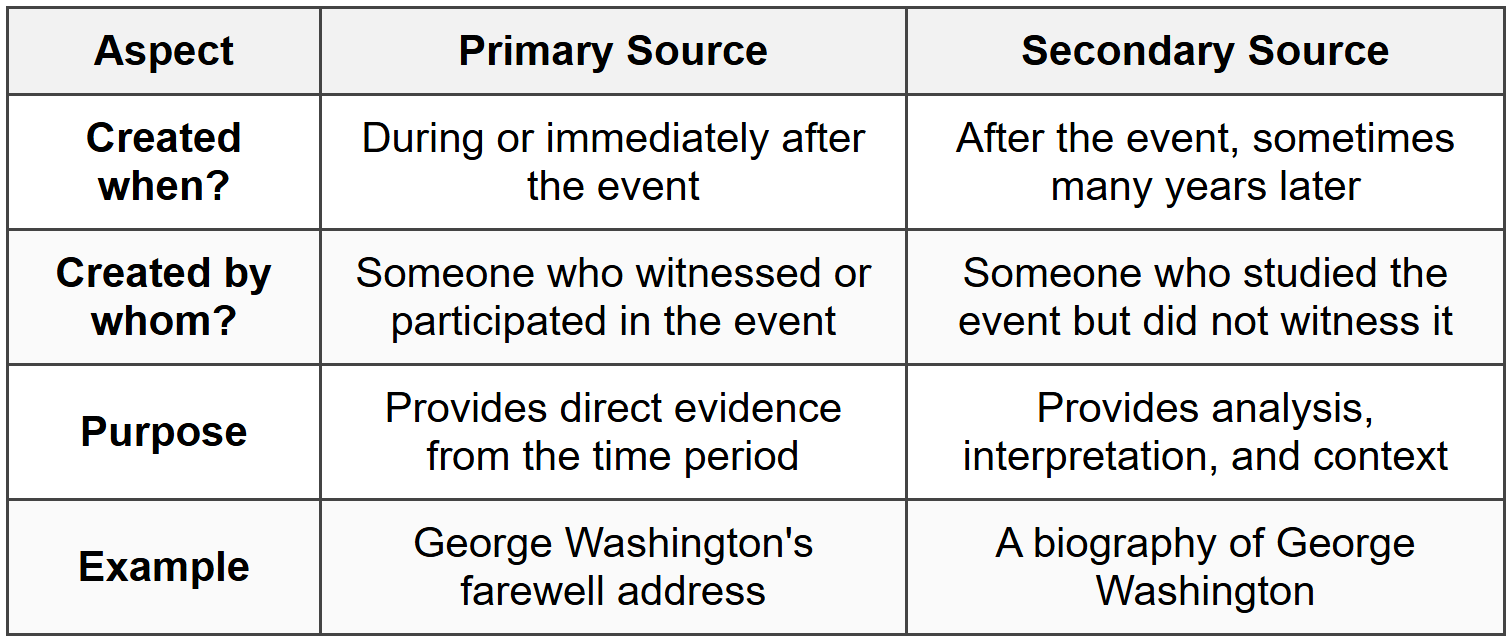
Historians rely on two main types of sources: primary sources and secondary sources. Understanding the difference between these two types of sources is essential for studying history accurately.
What Are Primary Sources?
A primary source is a document, object, or other piece of evidence created by someone who directly witnessed or participated in the event being studied. Primary sources are like firsthand accounts-they come straight from the time period you are investigating. These sources give us direct access to the past and allow us to see events through the eyes of people who were actually there.
Common examples of primary sources include:
- Letters and diaries written by people during a historical period
- Photographs taken at the time of an event
- Newspaper articles published when an event occurred
- Official documents such as laws, treaties, and government records
- Speeches given by historical figures
- Artifacts such as tools, clothing, and buildings from the past
- Artwork created during the time period being studied
Imagine you wanted to learn about what life was like for a soldier during the American Revolution. A letter written by that soldier to his family would be a primary source-it tells you directly what he thought, felt, and experienced.
What Are Secondary Sources?
A secondary source is a document or other work created by someone who did not directly witness or participate in the events being studied. Secondary sources are written after the fact, often by historians, researchers, or teachers who have studied primary sources and other evidence. These sources analyze, interpret, and summarize information about the past.
Common examples of secondary sources include:
- Textbooks about historical events and periods
- Biographies written about historical figures
- Encyclopedia entries explaining historical topics
- Documentary films that examine past events
- Magazine or newspaper articles written long after an event occurred
- History books written by scholars
Using the same example, a history textbook chapter about soldiers in the American Revolution would be a secondary source. The author was not there during the Revolution but has studied primary sources and other materials to write about it.
Why Do Both Types Matter?
Both primary and secondary sources are valuable, but they serve different purposes. Primary sources provide direct evidence and help us understand what people at the time thought and experienced. However, they can be limited in perspective-one person's letter only tells you about that one person's experience. Secondary sources help us see the bigger picture by bringing together information from many primary sources and providing analysis and context. The best historical research uses both types of sources together.
Identify Facts and Opinions
When you examine any source-whether primary or secondary-you need to distinguish between facts and opinions. This skill is crucial because it helps you understand what can be proven and what reflects someone's personal viewpoint or interpretation.
What Is a Fact?
A fact is a statement that can be proven true or false through evidence. Facts are objective, meaning they do not depend on personal feelings or beliefs. You can verify a fact by checking records, documents, measurements, or other reliable evidence.
Examples of facts:
- The Declaration of Independence was adopted on July 4, 1776.
- George Washington was the first President of the United States.
- The Battle of Gettysburg lasted three days in July 1863.
- The Constitution contains seven articles.
Notice that each of these statements can be verified by looking at historical records, official documents, or other evidence. If you check multiple reliable sources, they will all confirm these facts.
What Is an Opinion?
An opinion is a statement that reflects someone's personal belief, feeling, judgment, or interpretation. Opinions are subjective, meaning they can vary from person to person. While opinions can be supported by facts and evidence, they cannot be proven absolutely true or false because they involve personal perspective or interpretation.
Examples of opinions:
- The Declaration of Independence is the most important document in American history.
- George Washington was the greatest President.
- The Battle of Gettysburg was the most significant battle of the Civil War.
- The Constitution is difficult to understand.
Notice the words in bold-these are judgment words that signal opinions. Words like "most important," "greatest," "best," "worst," "should," and "believe" often indicate that a statement is an opinion rather than a fact.
Why Does This Matter?
Recognizing the difference between facts and opinions helps you evaluate sources more critically. When reading a historical document or account, ask yourself: Is this something that can be proven with evidence, or is this the author's personal interpretation? Both facts and opinions can be valuable, but you need to know which is which. Facts provide evidence, while opinions show you how people interpreted or felt about events.
Think of facts as ingredients in a recipe and opinions as the cook's review of how the dish tastes. Both are useful, but they serve different purposes. You need the ingredients (facts) to make the dish, and the review (opinion) might help you decide whether you want to try it-but the review is based on personal taste, not absolute truth.
Opinion Words to Watch For
When reading sources, certain words often signal that an opinion is being expressed:
- Judgment words: best, worst, greatest, most important, beautiful, ugly
- Belief words: believe, think, feel, should, ought to, must
- Comparison words (when making value judgments): better, more significant, less valuable
- Emotional words: terrible, wonderful, amazing, horrible
Source Analysis: The Boston Massacre
On the evening of March 5, 1770, in Boston, Massachusetts, a confrontation between British soldiers and colonists turned violent. British troops fired into a crowd, killing five colonists. This event became known as the Boston Massacre. However, what actually happened that night-and who was responsible-depends greatly on which sources you examine. This makes the Boston Massacre an excellent case study for learning how to analyze sources carefully.
The Event: What We Know
Here are the basic facts that most sources agree on:
- The event occurred on March 5, 1770, outside the Custom House in Boston
- A crowd of colonists confronted British soldiers
- British soldiers fired their weapons into the crowd
- Five colonists died: Crispus Attucks, Samuel Gray, James Caldwell, Samuel Maverick, and Patrick Carr
- The soldiers were later put on trial
Different Perspectives
Beyond these basic facts, accounts of the event differ significantly. This is where source analysis becomes critical. Let's examine different types of sources from the Boston Massacre:
British Soldier Accounts (Primary Sources)
British soldiers who were present claimed that the colonists were aggressive and threatening. According to their testimony, the crowd threw snowballs, ice, oyster shells, and sticks at the soldiers. The soldiers said they felt threatened and feared for their lives. One soldier claimed he heard someone shout "Fire!" and thought it was an order from his commanding officer.
When analyzing this source, consider:
- Bias: The soldiers had a clear reason to portray themselves as acting in self-defense-they were on trial for murder
- Perspective: They were outsiders in Boston, where tensions between colonists and British troops had been building for months
- Reliability: While they were eyewitnesses, their legal situation may have influenced their account
Colonist Accounts (Primary Sources)
Many colonists who witnessed the event described the British soldiers as aggressive and the shooting as unprovoked murder. Some accounts claimed the crowd was peaceful or only mildly rowdy. These sources emphasized the innocence of the victims and the cruelty of the soldiers.
When analyzing this source, consider:
- Bias: The colonists were already angry about British policies and taxes; they had reason to portray the British in the worst possible light
- Perspective: They were defending their community and friends
- Context: Anti-British sentiment was strong in Boston at this time
Paul Revere's Engraving (Primary Source)
Perhaps the most famous source related to the Boston Massacre is an engraving created by Paul Revere. This image shows British soldiers in a neat line, firing on command into a peaceful, well-dressed crowd. The engraving was widely distributed and helped turn public opinion against the British.
When analyzing this source, consider:
- Purpose: Revere created this engraving to influence public opinion and support the colonial cause-it was propaganda
- Accuracy: Historical evidence suggests the scene was much more chaotic than Revere depicted
- Impact: Regardless of its accuracy, this image powerfully shaped how colonists viewed the event
Analyzing These Sources Together
When you have conflicting sources about the same event, you need to:
- Identify each source's creator and purpose. Who made this source, and why did they make it?
- Look for bias. Does the creator have a reason to present events in a particular way?
- Find corroboration. Do multiple independent sources agree on certain details?
- Consider context. What was happening in the larger world at this time that might influence the source?
- Separate facts from interpretations. What can be proven, and what is the creator's opinion?
In the case of the Boston Massacre, both sides had strong biases. The truth likely lies somewhere between the two extreme accounts-there was probably rowdy behavior from the crowd and excessive force from the soldiers. By analyzing multiple sources carefully, historians can construct a more complete and accurate picture of what happened.
Source Analysis: The Declaration of Independence
The Declaration of Independence, adopted on July 4, 1776, is one of the most important documents in American history. When you analyze this primary source, you discover not just what it says, but why it was written, who wrote it, and what its creators hoped to accomplish.
Context and Purpose
By the summer of 1776, the thirteen American colonies had been in conflict with Great Britain for over a year. Many colonists believed that independence was necessary, but they needed to explain and justify this decision to the world. The Continental Congress appointed a committee to write a formal declaration. Thomas Jefferson drafted most of the document, with input from John Adams, Benjamin Franklin, and others.
The Declaration had multiple purposes:
- To announce to the world that the colonies were now independent states
- To explain why independence was justified
- To win support from potential allies, especially France
- To unite the colonists behind the cause of independence
Analyzing the Structure
The Declaration is organized into several clear sections. Understanding this structure helps you analyze the document:
The Preamble
"We hold these truths to be self-evident, that all men are created equal, that they are endowed by their Creator with certain unalienable Rights, that among these are Life, Liberty and the pursuit of Happiness."
This famous section presents the philosophical foundation for independence. Jefferson states that certain rights are unalienable, meaning they cannot be taken away. He argues that governments exist to protect these rights, and when a government fails to do so, people have the right to change or abolish it.
When analyzing this section, note that:
- It presents these ideas as facts ("self-evident truths"), though they are actually philosophical opinions about how government should work
- The phrase "all men are created equal" was revolutionary for its time, though Jefferson and others did not extend these rights to enslaved people or women
- These ideas came from Enlightenment thinkers like John Locke
The List of Grievances
The longest section of the Declaration lists specific complaints against King George III of Britain. Jefferson included 27 separate grievances, including:
- Imposing taxes without colonial consent
- Keeping standing armies in the colonies during peacetime
- Cutting off colonial trade
- Depriving colonists of trial by jury in some cases
When analyzing this section, consider:
- Selection of evidence: Jefferson chose to list only grievances that made the British government look tyrannical-he did not mention anything positive about British rule
- Emotional language: Words like "tyranny" and descriptions of the king as a despot were meant to persuade readers that independence was necessary
- Factual basis: Most of these grievances were based on actual British policies, though Jefferson presented them in the most negative light possible
The Conclusion
The final section formally declares independence and states that the colonies are now free and independent states with the power to make war, peace, alliances, and trade.
Evaluating the Source
When analyzing the Declaration of Independence as a historical source, consider these questions:
- Who created it and why? Colonial leaders created it to justify breaking away from Britain and to gain international support.
- What is fact and what is opinion? The list of British actions contains many facts, but the interpretation of those actions as "tyranny" is opinion. The philosophical statements about rights and government are opinions presented as facts.
- What does it reveal about the time period? It shows Enlightenment ideas were influential, that colonists valued certain rights, and that they felt British policies were unjust.
- What are its limitations? It presents only one side of the conflict. It does not mention slavery or acknowledge that not all colonists supported independence. It ignores the perspectives of loyalists, Native Americans, and enslaved people.
- How did it impact history? It inspired revolutionary movements worldwide and established principles that Americans continue to reference today.
Source Analysis: The Gettysburg Address
On November 19, 1863, President Abraham Lincoln delivered a short speech at the dedication of a cemetery for soldiers who had died at the Battle of Gettysburg. This speech, known as the Gettysburg Address, lasted only about two minutes but became one of the most famous speeches in American history. Analyzing this primary source reveals how Lincoln reframed the meaning of the Civil War.
Historical Context
By November 1863, the Civil War had been raging for over two years. The Battle of Gettysburg, fought in July 1863, was one of the bloodiest battles of the war, with over 50,000 casualties. The Union victory there marked a turning point. When Lincoln spoke at Gettysburg, the war's outcome was still uncertain, and the nation needed inspiration to continue the difficult struggle.
Analyzing the Speech
The Gettysburg Address is remarkably brief-only about 270 words. Let's examine its key sections:
Opening: Connecting to the Founding
"Four score and seven years ago our fathers brought forth on this continent, a new nation, conceived in Liberty, and dedicated to the proposition that all men are created equal."
Lincoln begins by reaching back to 1776 and the Declaration of Independence. Notice what he emphasizes: equality and liberty. By connecting the Civil War to the founding principles of the nation, Lincoln reframes the conflict. He suggests the war is not just about preserving the Union but about fulfilling the promise that "all men are created equal."
When analyzing this opening, note:
- Lincoln uses "four score and seven years" (87 years) instead of simply saying "87 years ago"-this biblical language gives the speech a solemn, sacred tone
- He references the Declaration of Independence, not the Constitution, because the Declaration emphasizes equality
- This interpretation of the war's purpose-as a struggle for equality-was Lincoln's opinion, though he presents it as if it were obviously true
Middle: Honoring the Sacrifice
"We have come to dedicate a portion of that field, as a final resting place for those who here gave their lives that that nation might live. It is altogether fitting and proper that we should do this."
Lincoln acknowledges the purpose of the ceremony-to dedicate a cemetery. However, he quickly shifts his focus, saying that the words of living people cannot truly dedicate or consecrate the ground. Instead, the brave soldiers who fought there have already consecrated it through their sacrifice.
Conclusion: A Call to Action
"It is for us the living, rather, to be dedicated here to the unfinished work which they who fought here have thus far so nobly advanced... that this nation, under God, shall have a new birth of freedom-and that government of the people, by the people, for the people, shall not perish from the earth."
Lincoln transforms the dedication ceremony into a call to action. He argues that the best way to honor the dead is to continue their work. Notice his phrase "new birth of freedom"-he is suggesting that the Civil War offers an opportunity to create a nation truly committed to freedom and equality for all people.
Evaluating This Source
When analyzing the Gettysburg Address, consider:
- Purpose and audience: Lincoln spoke to a crowd at Gettysburg, but he knew his words would be read across the nation and around the world. He needed to inspire Union supporters and explain why the terrible sacrifice of war was necessary.
- Fact versus opinion: Lincoln states facts (the battle happened, soldiers died) but his interpretation of what the war means is his opinion-though an influential one.
- Language choices: Lincoln uses powerful, memorable phrases like "government of the people, by the people, for the people." These carefully chosen words make the speech quotable and inspiring.
- What it reveals: The speech shows us how Lincoln understood the war's purpose and how he hoped to shape public understanding of the conflict.
- What it omits: Lincoln does not mention slavery directly, though his references to equality and "a new birth of freedom" clearly allude to it. He does not discuss military strategy or blame the South.
- Historical impact: The Gettysburg Address helped redefine the Civil War as a struggle not just to preserve the Union but to ensure equality and expand freedom.
Different Accounts of the Same Speech
Interestingly, we do not have a recording of Lincoln's actual delivery, and there are five different handwritten versions of the speech, each slightly different. Newspaper accounts from the day also vary in their reports of what Lincoln said and how the crowd reacted. Some newspapers reported that the crowd responded with great enthusiasm, while others suggested the speech was too short and people were disappointed.
This reminds us that even with primary sources, we must analyze carefully. Different versions of the same source exist, and we must consider why those differences occurred and which version is most reliable.
Bringing It All Together: Becoming a Critical Evaluator of Sources
Throughout this chapter, you have learned essential skills for evaluating historical sources. Whether you are examining the Boston Massacre, the Declaration of Independence, the Gettysburg Address, or any other historical source, you can now apply a systematic approach:
Key Questions for Any Source
- What type of source is this? Is it primary or secondary? What form does it take (document, image, artifact, etc.)?
- Who created it? What do you know about the creator's background, position, and perspective?
- When was it created? Was it made during the event, immediately after, or much later?
- Why was it created? What was the creator's purpose or motive?
- Who was the intended audience? Who was supposed to see, hear, or read this source?
- What does it say? Summarize the main message or content.
- What is factual? Which parts can be verified through other evidence?
- What is opinion or interpretation? Which parts reflect the creator's viewpoint?
- What bias might exist? Does the creator have reasons to present information in a particular way?
- What does it reveal? What does this source teach us about the past?
- What are its limitations? What perspectives or information are missing?
- How does it compare to other sources? Do other sources confirm or contradict this one?
Why These Skills Matter
Learning to evaluate sources is not just important for studying history-it is a critical life skill. Every day, you encounter sources of information: news articles, social media posts, advertisements, and claims from friends and family. By learning to analyze sources critically, you develop the ability to:
- Distinguish between reliable and unreliable information
- Recognize bias and perspective
- Separate facts from opinions
- Make informed decisions based on evidence
- Understand that different people can interpret the same events differently
- Build arguments supported by credible evidence
As you continue your studies, apply these skills to every source you encounter. Ask questions, look for evidence, consider multiple perspectives, and think critically. By doing so, you become not just a student of history but an informed citizen capable of understanding the complex world around you.