Chapter Notes: Regrouping Decimals


When you work with decimals, sometimes you need to rearrange them in order to add, subtract, or compare them. This is called regrouping decimals. Regrouping means changing a decimal number by moving value from one place to another place, just like when you borrow or carry with whole numbers. Learning to regroup decimals helps you work with money, measure things more carefully, and solve everyday problems. In this chapter, you will learn how to regroup tenths, hundredths, and whole numbers so that you can work with decimals confidently.
Understanding Place Value with Decimals
Before we can regroup decimals, we need to understand where each digit sits in a decimal number. A decimal is a number that has a decimal point. The decimal point separates the whole number part from the part that is less than one.
Let's look at the number 3.47:
- The digit 3 is in the ones place. It means 3 whole units.
- The digit 4 is in the tenths place. It means 4 tenths, or 4 out of 10 equal parts.
- The digit 7 is in the hundredths place. It means 7 hundredths, or 7 out of 100 equal parts.
Think of a dollar bill. If you have 3 dollars, 4 dimes, and 7 pennies, you have $3.47. The dimes are tenths of a dollar, and the pennies are hundredths of a dollar.
Here is a chart showing place values for decimals:

Each place to the left is 10 times bigger. Each place to the right is 10 times smaller.
Regrouping Tenths into Ones
Sometimes you have more than 10 tenths. When you have 10 tenths, you can regroup them to make 1 whole. This is just like having 10 dimes and trading them for 1 dollar.
Key idea: 10 tenths = 1 one
Let's say you have 2.13 (that's 2 ones, 1 tenth, and 3 hundredths). If you add 9 more tenths, you will have 2 ones and 10 tenths and 3 hundredths. But 10 tenths equals 1 one, so you can regroup:
- 2 ones + 10 tenths + 3 hundredths
- = 2 ones + 1 one + 0 tenths + 3 hundredths
- = 3 ones + 0 tenths + 3 hundredths
- = 3.03
Example: You have 4.82.
You add 0.30 to it.What is the total after adding?
Solution:
Start with 4.82 = 4 ones, 8 tenths, 2 hundredths
Add 0.30 = 0 ones, 3 tenths, 0 hundredths
Now add the parts:
Ones: 4 + 0 = 4
Tenths: 8 + 3 = 11
Hundredths: 2 + 0 = 2You have 4 ones, 11 tenths, and 2 hundredths. Since 11 tenths is more than 10 tenths, regroup 10 tenths into 1 one:
11 tenths = 10 tenths + 1 tenth = 1 one + 1 tenthNow you have:
4 ones + 1 one + 1 tenth + 2 hundredths = 5 ones + 1 tenth + 2 hundredths = 5.12The total is 5.12.
Regrouping Ones into Tenths
Sometimes you need to break apart a whole number to get more tenths. This is like trading 1 dollar for 10 dimes. You do this when you need to subtract and don't have enough tenths.
Key idea: 1 one = 10 tenths
Let's say you have 5.2, and you need to subtract 0.7. You have only 2 tenths, but you need to subtract 7 tenths. You can take 1 one and turn it into 10 tenths:
- 5.2 = 5 ones + 2 tenths
- Regroup 1 one into 10 tenths: 5 ones = 4 ones + 1 one = 4 ones + 10 tenths
- Now you have: 4 ones + 10 tenths + 2 tenths = 4 ones + 12 tenths
- Subtract 7 tenths: 12 tenths - 7 tenths = 5 tenths
- Result: 4 ones + 5 tenths = 4.5
Example: You have 6.3.
You need to subtract 0.8.What is 6.3 - 0.8?
Solution:
Start with 6.3 = 6 ones and 3 tenths
You need to subtract 8 tenths, but you only have 3 tenths. Regroup 1 one into 10 tenths:
6 ones = 5 ones + 1 one = 5 ones + 10 tenthsNow you have: 5 ones + 10 tenths + 3 tenths = 5 ones + 13 tenths
Subtract 8 tenths from 13 tenths:
13 tenths - 8 tenths = 5 tenthsResult: 5 ones + 5 tenths = 5.5
The answer is 5.5.
Regrouping Hundredths into Tenths
Just like with tenths and ones, you can also regroup hundredths and tenths. When you have 10 hundredths, you can regroup them to make 1 tenth.
Key idea: 10 hundredths = 1 tenth
For example, if you have 3.46 and you add 0.08:
- 3.46 = 3 ones + 4 tenths + 6 hundredths
- Add 8 hundredths: 6 + 8 = 14 hundredths
- 14 hundredths = 10 hundredths + 4 hundredths = 1 tenth + 4 hundredths
- Now: 3 ones + 4 tenths + 1 tenth + 4 hundredths = 3 ones + 5 tenths + 4 hundredths = 3.54
Example: Maria has 2.37 meters of ribbon.
She gets 0.85 meters more.How much ribbon does she have now?
Solution:
Start with 2.37 = 2 ones, 3 tenths, 7 hundredths
Add 0.85 = 0 ones, 8 tenths, 5 hundredths
Add each place value:
Ones: 2 + 0 = 2
Tenths: 3 + 8 = 11
Hundredths: 7 + 5 = 12Regroup 12 hundredths: 12 hundredths = 10 hundredths + 2 hundredths = 1 tenth + 2 hundredths
Now you have: 2 ones + 11 tenths + 1 tenth + 2 hundredths = 2 ones + 12 tenths + 2 hundredthsRegroup 12 tenths: 12 tenths = 10 tenths + 2 tenths = 1 one + 2 tenths
Now you have: 2 ones + 1 one + 2 tenths + 2 hundredths = 3 ones + 2 tenths + 2 hundredths = 3.22Maria has 3.22 meters of ribbon.
Regrouping Tenths into Hundredths
Sometimes when you subtract, you don't have enough hundredths. Then you can take 1 tenth and turn it into 10 hundredths. This is like breaking a dime into 10 pennies.
Key idea: 1 tenth = 10 hundredths
For example, if you have 4.52 and need to subtract 0.18:
- 4.52 = 4 ones + 5 tenths + 2 hundredths
- You need to subtract 8 hundredths, but you only have 2 hundredths
- Regroup 1 tenth into 10 hundredths: 5 tenths = 4 tenths + 1 tenth = 4 tenths + 10 hundredths
- Now: 4 ones + 4 tenths + 10 hundredths + 2 hundredths = 4 ones + 4 tenths + 12 hundredths
- Subtract: 12 hundredths - 8 hundredths = 4 hundredths, and 4 tenths - 1 tenth = 3 tenths
- Result: 4 ones + 3 tenths + 4 hundredths = 4.34
Example: A water bottle contains 1.45 liters.
You drink 0.27 liters.How much water is left?
Solution:
Start with 1.45 = 1 one, 4 tenths, 5 hundredths
Subtract 0.27 = 0 ones, 2 tenths, 7 hundredths
Hundredths: 5 - 7 won't work because 5 is less than 7. Regroup 1 tenth into 10 hundredths:
4 tenths = 3 tenths + 1 tenth = 3 tenths + 10 hundredths
Now you have: 1 one + 3 tenths + 15 hundredthsNow subtract:
Hundredths: 15 - 7 = 8
Tenths: 3 - 2 = 1
Ones: 1 - 0 = 1Result: 1 one + 1 tenth + 8 hundredths = 1.18
There are 1.18 liters left.
Regrouping Across Multiple Places
Sometimes you need to regroup more than once in a single problem. This happens when you borrow from one place but that place is zero, so you have to borrow from the next place over.
Let's look at a problem like 5.03 - 0.28. Notice that you have 0 tenths and only 3 hundredths. You need to subtract 8 hundredths and 2 tenths.
Here's how to solve it step by step:
- Start with 5.03 = 5 ones + 0 tenths + 3 hundredths
- You need to subtract 8 hundredths, but you only have 3. Try to regroup from tenths, but you have 0 tenths!
- So first regroup 1 one into 10 tenths: 5 ones = 4 ones + 10 tenths
- Now you have: 4 ones + 10 tenths + 3 hundredths
- Now regroup 1 tenth into 10 hundredths: 10 tenths = 9 tenths + 1 tenth = 9 tenths + 10 hundredths
- Now you have: 4 ones + 9 tenths + 13 hundredths
- Subtract: 13 - 8 = 5 hundredths, 9 - 2 = 7 tenths, 4 - 0 = 4 ones
- Result: 4.75
Example: A recipe needs 3.00 cups of flour.
You have already added 1.64 cups.How much more flour do you need to add?
Solution:
Find 3.00 - 1.64
Start with 3.00 = 3 ones + 0 tenths + 0 hundredths
You need to subtract 4 hundredths, but you have 0 hundredths. You need to subtract 6 tenths, but you have 0 tenths. Regroup from the ones place.
Regroup 1 one into 10 tenths:
3 ones = 2 ones + 10 tenths
Now: 2 ones + 10 tenths + 0 hundredthsRegroup 1 tenth into 10 hundredths:
10 tenths = 9 tenths + 10 hundredths
Now: 2 ones + 9 tenths + 10 hundredthsNow subtract:
Hundredths: 10 - 4 = 6
Tenths: 9 - 6 = 3
Ones: 2 - 1 = 1Result: 1 one + 3 tenths + 6 hundredths = 1.36
You need to add 1.36 more cups of flour.
Using Models to Show Regrouping
Drawing pictures can help you see what happens when you regroup decimals. You can use blocks, grids, or number lines.
Base-Ten Blocks
You can use base-ten blocks to model decimals:
- A large square (flat) = 1 one
- A long strip = 1 tenth (10 strips make 1 flat)
- A tiny square = 1 hundredth (10 tiny squares make 1 strip)
Imagine you have 1 flat, 2 strips, and 5 tiny squares. This represents 1.25. If you trade 1 flat for 10 strips, you now have 0 flats, 12 strips, and 5 tiny squares. This still equals 1.25, but now it looks like 0 ones + 12 tenths + 5 hundredths.
Place Value Chart
A place value chart helps you keep track of regrouping. You write each digit in its column and move values between columns when you regroup.
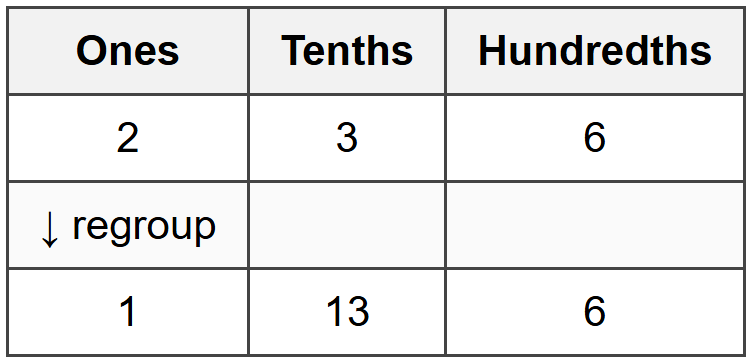
This chart shows 2.36 regrouped to 1 one + 13 tenths + 6 hundredths.
Practical Uses of Regrouping Decimals
Regrouping decimals is not just something you do in math class. You use it in real life all the time!
Money
When you count money, you often need to regroup. If you have 15 dimes, you can trade 10 dimes for 1 dollar. Now you have 1 dollar and 5 dimes, which is $1.50.
Measurement
When you measure things, you might need to regroup. If you have 2.9 meters of rope and you add 0.3 meters, you get 2.12 tenths, which regroups to 3.2 meters.
Cooking
Recipes sometimes need you to add or subtract amounts like 2.75 cups or 1.50 teaspoons. Regrouping helps you figure out how much you need.
Example: You buy a toy for $4.85.
You pay with a $5.00 bill.How much change do you get?
Solution:
Find 5.00 - 4.85
Start with 5.00 = 5 ones + 0 tenths + 0 hundredths
Regroup 1 one into 10 tenths:
5 ones = 4 ones + 10 tenths
Now: 4 ones + 10 tenths + 0 hundredthsRegroup 1 tenth into 10 hundredths:
10 tenths = 9 tenths + 10 hundredths
Now: 4 ones + 9 tenths + 10 hundredthsSubtract:
Hundredths: 10 - 5 = 5
Tenths: 9 - 8 = 1
Ones: 4 - 4 = 0Result: 0 ones + 1 tenth + 5 hundredths = $0.15
You get $0.15 in change.
Common Mistakes and How to Avoid Them
Here are some mistakes students often make when regrouping decimals, and tips for avoiding them:
Forgetting the Decimal Point
Always line up the decimal points when you add or subtract. Write extra zeros if it helps you see all the places clearly. For example, write 5 as 5.00 if you're subtracting 1.36 from it.
Regrouping the Wrong Amount
Remember: 1 one = 10 tenths, and 1 tenth = 10 hundredths. Don't accidentally regroup 1 one into 100 hundredths all at once. Go step by step.
Not Regrouping When Needed
If the digit you're subtracting from is smaller than the digit you're subtracting, you must regroup. Don't try to subtract a bigger number from a smaller one in the same place.
Losing Track of Place Value
Use a place value chart or write each step clearly. Make sure you know whether you're working with ones, tenths, or hundredths at each step.
Summary
Regrouping decimals means trading value between place values. You can regroup 10 tenths into 1 one, or break 1 one into 10 tenths. You can regroup 10 hundredths into 1 tenth, or break 1 tenth into 10 hundredths. This helps you add and subtract decimals accurately. Always remember to line up the decimal points, work carefully through each place value, and check your answer to make sure it makes sense. With practice, regrouping decimals will become quick and easy!