Chapter Notes: Writing Decimals As Fractions


Decimals are numbers that have a decimal point. They help us show parts of a whole, just like fractions do. In fact, every decimal can be written as a fraction! When you see a number like 0.5, you might think of it as five-tenths, which is the fraction 5/10. Learning to change decimals into fractions helps you understand numbers in different ways and makes you better at math. Let's explore how to write decimals as fractions step by step.
Understanding Place Value in Decimals
Before we can change decimals into fractions, we need to understand what each digit in a decimal means. Every digit in a decimal has a special place. The place tells us how big or small that part of the number is.
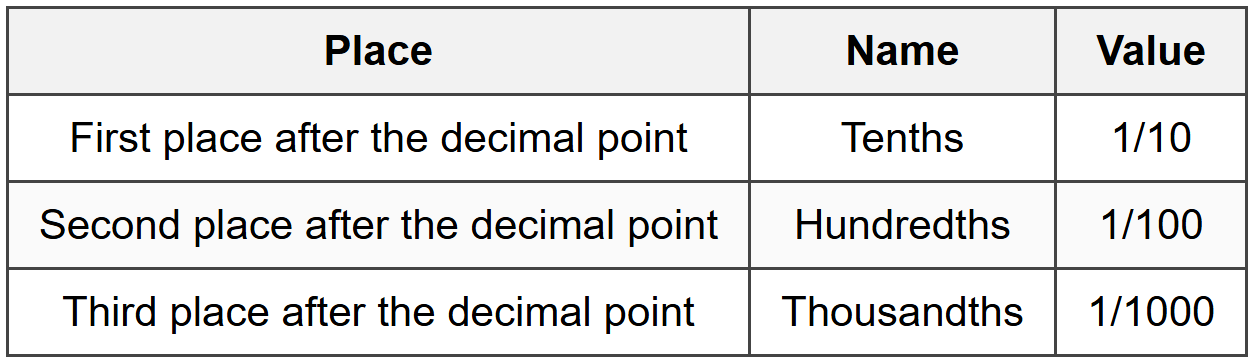
When we look at a decimal like 0.7, the digit 7 is in the tenths place. This means we have 7 parts out of 10 equal parts. So 0.7 is the same as 7/10.
When we see a decimal like 0.34, the digit 3 is in the tenths place and the digit 4 is in the hundredths place. This means we have 34 parts out of 100 equal parts. So 0.34 is the same as 34/100.
Here is a table showing the place values to the right of the decimal point:
Think of a pizza cut into 10 equal slices. If you eat 3 slices, you ate 3/10 of the pizza. We can also say you ate 0.3 of the pizza. Both ways mean the same thing!
Converting Tenths to Fractions
The easiest decimals to change into fractions are tenths. A tenth is one part out of ten equal parts. When you see a decimal with just one digit after the decimal point, that digit tells you how many tenths you have.
To write a decimal in tenths as a fraction:
- Look at the digit after the decimal point
- Put that digit on top of the fraction (the numerator)
- Put 10 on the bottom of the fraction (the denominator)
Example: Write 0.3 as a fraction.
Solution:
The digit 3 is in the tenths place.
This means we have 3 tenths.
We write this as 3/10.
The fraction form of 0.3 is 3/10.
Example: Write 0.7 as a fraction.
Solution:
The digit 7 is in the tenths place.
This means we have 7 tenths.
We write this as 7/10.
The fraction form of 0.7 is 7/10.
Example: Write 0.9 as a fraction.
Solution:
The digit 9 is in the tenths place.
This means we have 9 tenths.
We write this as 9/10.
The fraction form of 0.9 is 9/10.
Converting Hundredths to Fractions
When a decimal has two digits after the decimal point, we are working with hundredths. A hundredth is one part out of one hundred equal parts.
To write a decimal in hundredths as a fraction:
- Look at the two digits after the decimal point
- Put those digits together on top of the fraction (the numerator)
- Put 100 on the bottom of the fraction (the denominator)
Example: Write 0.25 as a fraction.
Solution:
The digits 25 come after the decimal point.
The last digit (5) is in the hundredths place.
This means we have 25 hundredths.
We write this as 25/100.
The fraction form of 0.25 is 25/100.
Example: Write 0.48 as a fraction.
Solution:
The digits 48 come after the decimal point.
The last digit (8) is in the hundredths place.
This means we have 48 hundredths.
We write this as 48/100.
The fraction form of 0.48 is 48/100.
Example: Write 0.03 as a fraction.
Solution:
The digits after the decimal point are 0 and 3.
Together they make 03, which is just 3.
The last digit (3) is in the hundredths place.
This means we have 3 hundredths.
We write this as 3/100.
The fraction form of 0.03 is 3/100.
Converting Thousandths to Fractions
When a decimal has three digits after the decimal point, we are working with thousandths. A thousandth is one part out of one thousand equal parts.
To write a decimal in thousandths as a fraction:
- Look at the three digits after the decimal point
- Put those digits together on top of the fraction (the numerator)
- Put 1000 on the bottom of the fraction (the denominator)
Example: Write 0.125 as a fraction.
Solution:
The digits 125 come after the decimal point.
The last digit (5) is in the thousandths place.
This means we have 125 thousandths.
We write this as 125/1000.
The fraction form of 0.125 is 125/1000.
Example: Write 0.008 as a fraction.
Solution:
The digits after the decimal point are 0, 0, and 8.
Together they make 008, which is just 8.
The last digit (8) is in the thousandths place.
This means we have 8 thousandths.
We write this as 8/1000.
The fraction form of 0.008 is 8/1000.
Simplifying Fractions from Decimals
Once we write a decimal as a fraction, we often need to simplify the fraction. Simplifying means writing the fraction in its smallest form. We do this by dividing both the top number (numerator) and the bottom number (denominator) by the same number.
To simplify a fraction, we look for the greatest common factor (GCF). The GCF is the largest number that divides evenly into both the numerator and the denominator.
Example: Write 0.5 as a fraction in simplest form.
Solution:
First, write 0.5 as a fraction: 5/10.
Now we simplify 5/10.
Both 5 and 10 can be divided by 5.
5 ÷ 5 = 1
10 ÷ 5 = 2
So 5/10 = 1/2.
The simplest form of 0.5 is 1/2.
Example: Write 0.25 as a fraction in simplest form.
Solution:
First, write 0.25 as a fraction: 25/100.
Now we simplify 25/100.
Both 25 and 100 can be divided by 25.
25 ÷ 25 = 1
100 ÷ 25 = 4
So 25/100 = 1/4.
The simplest form of 0.25 is 1/4.
Example: Write 0.75 as a fraction in simplest form.
Solution:
First, write 0.75 as a fraction: 75/100.
Now we simplify 75/100.
Both 75 and 100 can be divided by 25.
75 ÷ 25 = 3
100 ÷ 25 = 4
So 75/100 = 3/4.
The simplest form of 0.75 is 3/4.
Example: Write 0.125 as a fraction in simplest form.
Solution:
First, write 0.125 as a fraction: 125/1000.
Now we simplify 125/1000.
Both 125 and 1000 can be divided by 125.
125 ÷ 125 = 1
1000 ÷ 125 = 8
So 125/1000 = 1/8.
The simplest form of 0.125 is 1/8.
Working with Mixed Numbers
Sometimes we have a decimal that is greater than 1, like 2.5 or 3.75. These decimals have a whole number part and a decimal part. When we change these to fractions, we get mixed numbers. A mixed number has a whole number and a fraction together.
To write a decimal greater than 1 as a mixed number:
- Keep the whole number part as it is
- Change the decimal part into a fraction
- Write the whole number and the fraction together
Example: Write 2.3 as a mixed number.
Solution:
The whole number part is 2.
The decimal part is 0.3.
We write 0.3 as the fraction 3/10.
So 2.3 = 2 and 3/10.
The mixed number form of 2.3 is 2 3/10.
Example: Write 1.75 as a mixed number in simplest form.
Solution:
The whole number part is 1.
The decimal part is 0.75.
We write 0.75 as the fraction 75/100.
Now we simplify 75/100 by dividing both by 25.
75 ÷ 25 = 3 and 100 ÷ 25 = 4.
So 75/100 = 3/4.
Therefore, 1.75 = 1 and 3/4.
The mixed number form of 1.75 is 1 3/4.
Example: Write 4.5 as a mixed number in simplest form.
Solution:
The whole number part is 4.
The decimal part is 0.5.
We write 0.5 as the fraction 5/10.
Now we simplify 5/10 by dividing both by 5.
5 ÷ 5 = 1 and 10 ÷ 5 = 2.
So 5/10 = 1/2.
Therefore, 4.5 = 4 and 1/2.
The mixed number form of 4.5 is 4 1/2.
Special Patterns to Remember
Some decimals appear very often in everyday life. It helps to memorize their fraction forms so you can switch between decimals and fractions quickly.
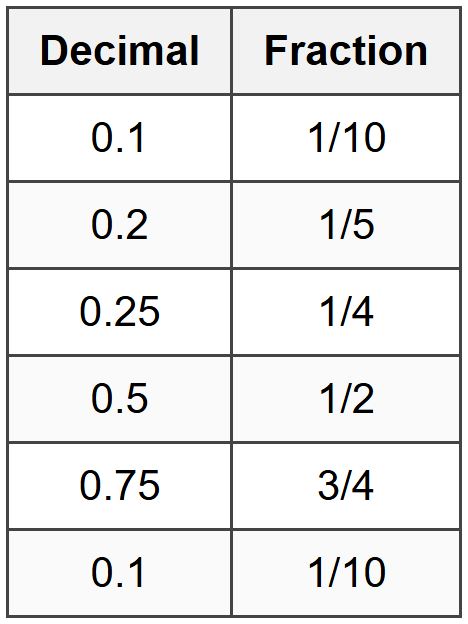
Think of money to remember these patterns. A quarter (25 cents) is 0.25 of a dollar, which is 1/4 of a dollar. A half dollar (50 cents) is 0.50 of a dollar, which is 1/2 of a dollar.
Step-by-Step Summary
Here is the complete process for changing any decimal into a fraction:
- Read the decimal carefully. Count how many digits come after the decimal point.
- Write the digits after the decimal point as the numerator. Do not include the decimal point itself.
- Write the denominator based on place value:
- One digit after the decimal point → denominator is 10
- Two digits after the decimal point → denominator is 100
- Three digits after the decimal point → denominator is 1000
- Simplify the fraction if possible. Find the greatest common factor of the numerator and denominator. Divide both by this number.
- If the decimal is greater than 1, write it as a mixed number by keeping the whole number part and changing only the decimal part into a fraction.
Example: Follow all steps to write 0.48 as a fraction in simplest form.
Solution:
Step 1: The decimal is 0.48. There are 2 digits after the decimal point.
Step 2: The digits after the decimal point are 48. This is the numerator.
Step 3: Since there are 2 digits after the decimal point, the denominator is 100. So we have 48/100.
Step 4: Now we simplify. Both 48 and 100 can be divided by 4.
48 ÷ 4 = 12
100 ÷ 4 = 25
So 48/100 = 12/25.Step 5: The decimal is less than 1, so we do not need a mixed number.
The simplest fraction form of 0.48 is 12/25.
Example: Follow all steps to write 3.6 as a mixed number in simplest form.
Solution:
Step 1: The decimal is 3.6. The whole number part is 3. There is 1 digit after the decimal point.
Step 2: The digit after the decimal point is 6. This is the numerator.
Step 3: Since there is 1 digit after the decimal point, the denominator is 10. So the decimal part is 6/10.
Step 4: Now we simplify 6/10. Both 6 and 10 can be divided by 2.
6 ÷ 2 = 3
10 ÷ 2 = 5
So 6/10 = 3/5.Step 5: The whole number is 3, and the fraction is 3/5, so the mixed number is 3 3/5.
The simplest mixed number form of 3.6 is 3 3/5.
Now you know how to change decimals into fractions! Remember to look at the place value, write the correct denominator, and simplify your answer. With practice, you will get faster and more confident at switching between decimals and fractions.