Chapter Notes: Types of Plane Figures


When you look around your classroom, you see many different shapes. Some are flat and lie on the surface of your desk or on the wall. These flat shapes are called plane figures. A plane figure is any two-dimensional shape that has length and width but no thickness. Understanding different types of plane figures helps us describe the world around us and solve problems in math, art, and design. In this chapter, we will explore many kinds of plane figures, learn their names, and discover what makes each one special.
What Are Plane Figures?
A plane figure is a flat shape that lies completely on one surface, like a piece of paper. Plane figures have two dimensions: length and width. They do not have any depth or thickness. You can draw plane figures on paper, and you can find them all around you-on signs, in books, on buildings, and in nature.
Plane figures can be divided into two big groups:
- Closed figures: Shapes where the lines connect all the way around with no openings. Examples include circles, triangles, and squares.
- Open figures: Shapes where the lines do not connect completely. These are not as common when we study geometry, so we will focus mostly on closed figures.
Most of the plane figures we study are polygons. A polygon is a closed plane figure made up of straight line segments. The word polygon comes from Greek words meaning "many angles." Each line segment is called a side, and the point where two sides meet is called a vertex (plural: vertices).
Triangles
A triangle is a polygon with exactly three sides and three vertices. Triangles are one of the most common and important shapes in geometry. Every triangle has three angles, and the sum of these three angles is always 180 degrees.
Types of Triangles by Sides
We can classify triangles by looking at the lengths of their sides:
- Equilateral triangle: All three sides have the same length. All three angles are also equal, and each one measures 60 degrees.
- Isosceles triangle: Exactly two sides have the same length. The two angles opposite those equal sides are also equal.
- Scalene triangle: All three sides have different lengths. All three angles are also different.
Types of Triangles by Angles
We can also classify triangles by looking at their angles:
- Acute triangle: All three angles are less than 90 degrees.
- Right triangle: One angle measures exactly 90 degrees. The side opposite the right angle is called the hypotenuse.
- Obtuse triangle: One angle is greater than 90 degrees.
Example: A triangle has sides that measure 5 inches, 5 inches, and 7 inches.
What type of triangle is this based on its sides?
Solution:
Look at the lengths of the three sides.
Two sides measure 5 inches each, so two sides are equal.
One side measures 7 inches, which is different from the other two.
When exactly two sides of a triangle are equal, it is an isosceles triangle.
The triangle is an isosceles triangle.
Quadrilaterals
A quadrilateral is a polygon with exactly four sides and four vertices. The word quadrilateral comes from Latin words meaning "four sides." Every quadrilateral has four angles, and the sum of these angles is always 360 degrees. There are many special types of quadrilaterals, each with unique properties.
Rectangles
A rectangle is a quadrilateral with four right angles (90-degree angles). Opposite sides of a rectangle are parallel and equal in length. Think of a rectangle like a door or a piece of notebook paper. Rectangles are very common in everyday life because they are easy to build and stack.
Example: A rectangle has a length of 8 centimeters and a width of 5 centimeters.
What are the lengths of all four sides?
Solution:
A rectangle has opposite sides that are equal.
Two sides are 8 centimeters long (the length).
Two sides are 5 centimeters long (the width).
The four sides measure 8 cm, 5 cm, 8 cm, and 5 cm.
Squares
A square is a special type of rectangle where all four sides have the same length. A square also has four right angles. Think of a square like a checkerboard square or a sticky note. Because all sides are equal and all angles are right angles, squares are very symmetrical.
Parallelograms
A parallelogram is a quadrilateral where both pairs of opposite sides are parallel and equal in length. Opposite angles in a parallelogram are also equal. Rectangles and squares are special types of parallelograms, but not all parallelograms have right angles. Think of a parallelogram like a rectangle that has been pushed to the side.
Rhombuses
A rhombus (plural: rhombuses or rhombi) is a parallelogram where all four sides have the same length. A rhombus does not need to have right angles, which makes it different from a square. However, a square is actually a special type of rhombus that does have right angles. Think of a rhombus like a diamond shape on a playing card.
Trapezoids
A trapezoid is a quadrilateral with exactly one pair of parallel sides. The parallel sides are called bases, and the non-parallel sides are called legs. Think of a trapezoid like the shape of a table seen from the side, where the top is shorter than the bottom.
Example: A quadrilateral has four sides that all measure 6 inches.
All four angles measure 90 degrees.What type of quadrilateral is this?
Solution:
All four sides are equal, so it could be a rhombus or a square.
All four angles are right angles (90 degrees).
A rhombus with four right angles is a special shape called a square.
The quadrilateral is a square.
Polygons with More Than Four Sides
Polygons can have many sides. As the number of sides increases, the shapes get more complex. We name polygons based on how many sides they have.
Pentagons
A pentagon is a polygon with exactly five sides and five vertices. The word pentagon comes from Greek words meaning "five angles." A regular pentagon has all five sides equal in length and all five angles equal. The Pentagon building in Washington, D.C., is shaped like a regular pentagon.
Hexagons
A hexagon is a polygon with exactly six sides and six vertices. The word hexagon means "six angles." A regular hexagon has all six sides equal and all six angles equal. Each angle in a regular hexagon measures 120 degrees. Honeycomb cells made by bees are shaped like regular hexagons.
Octagons
An octagon is a polygon with exactly eight sides and eight vertices. The word octagon means "eight angles." A regular octagon has all eight sides equal and all eight angles equal. Stop signs are shaped like regular octagons.
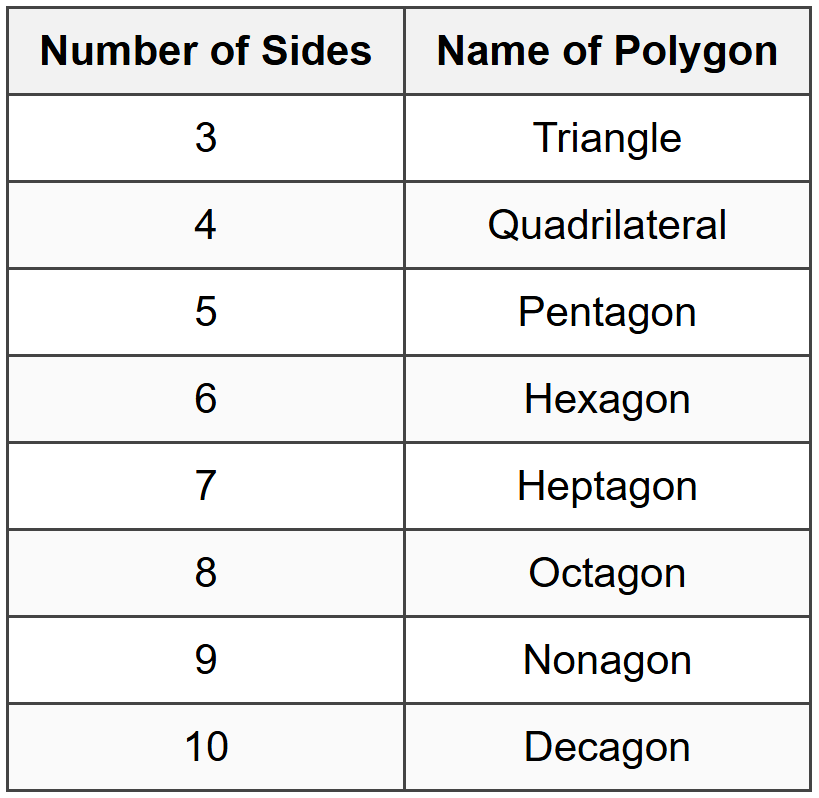
Naming Other Polygons
Here are the names for polygons with different numbers of sides:
Example: You draw a closed figure using six straight line segments.
Each segment connects to the next one to form a closed shape.What type of polygon did you draw?
Solution:
Count the number of sides: there are six straight line segments.
A polygon with six sides is called a hexagon.
You drew a hexagon.
Circles
A circle is a special plane figure that is different from polygons. A circle is not made of straight line segments. Instead, a circle is the set of all points that are the same distance from one special point called the center. Think of a circle like a perfectly round pizza or a wheel.
Parts of a Circle
Circles have several important parts that help us describe and work with them:
- Center: The point in the exact middle of the circle. Every point on the circle is the same distance from the center.
- Radius: A line segment that goes from the center to any point on the circle. All radii (plural of radius) in the same circle have the same length.
- Diameter: A line segment that passes through the center and has both endpoints on the circle. The diameter is exactly twice as long as the radius.
- Circumference: The distance all the way around the circle. This is like the perimeter of a polygon, but for circles we use the special word circumference.
Example: A circle has a radius of 4 inches.
What is the length of the diameter?
Solution:
The diameter goes all the way across the circle through the center.
The diameter is twice as long as the radius.
Diameter = 2 × radius = 2 × 4 inches = 8 inches
The diameter is 8 inches long.
Regular and Irregular Polygons
Polygons can be classified as either regular or irregular based on their sides and angles.
Regular Polygons
A regular polygon is a polygon where all sides have the same length and all angles have the same measure. Regular polygons are very symmetrical and balanced. Examples include:
- Equilateral triangle (regular triangle)
- Square (regular quadrilateral)
- Regular pentagon
- Regular hexagon
- Regular octagon
Irregular Polygons
An irregular polygon is a polygon where the sides have different lengths or the angles have different measures (or both). Most polygons we see in everyday life are irregular. Examples include:
- Scalene triangle
- Rectangle (that is not a square)
- Trapezoid
- Most pentagons, hexagons, and other polygons
Comparing and Sorting Plane Figures
When we study plane figures, we often need to compare them and sort them into groups. We can compare plane figures by looking at different properties:
Number of Sides
The most basic way to classify a polygon is by counting its sides. A triangle has 3 sides, a quadrilateral has 4 sides, a pentagon has 5 sides, and so on.
Number of Angles
The number of angles in a polygon is always the same as the number of sides. If a polygon has 6 sides, it also has 6 angles.
Types of Angles
We can look at whether a polygon has right angles (90 degrees), acute angles (less than 90 degrees), or obtuse angles (more than 90 degrees). For example, rectangles and squares always have four right angles.
Parallel Sides
Parallel lines are lines that never meet, no matter how far they extend. They stay the same distance apart. Some polygons have sides that are parallel to each other. For example:
- Rectangles have two pairs of parallel sides
- Parallelograms have two pairs of parallel sides
- Trapezoids have exactly one pair of parallel sides
- Triangles have no parallel sides
Equal Sides
We can look at whether all sides are equal, some sides are equal, or all sides are different:
- Equilateral triangles have all three sides equal
- Isosceles triangles have exactly two sides equal
- Squares and rhombuses have all four sides equal
- Rectangles have opposite sides equal
Example: Sort these shapes into two groups: shapes with at least one pair of parallel sides, and shapes with no parallel sides.
The shapes are: triangle, square, trapezoid, hexagon (irregular).How would you sort them?
Solution:
A triangle has no parallel sides, so it goes in the "no parallel sides" group.
A square has two pairs of parallel sides, so it goes in the "at least one pair" group.
A trapezoid has exactly one pair of parallel sides, so it goes in the "at least one pair" group.
An irregular hexagon might or might not have parallel sides, but without more information, we cannot tell for certain.
Shapes with parallel sides: square, trapezoid. Shapes with no parallel sides: triangle. The hexagon needs more information.
Real-World Applications of Plane Figures
Understanding plane figures is useful in many real-world situations. Here are some ways we use plane figures every day:
Architecture and Building
Buildings use many different plane figures. Windows are often rectangles or squares. Roofs sometimes form triangles. Floor tiles might be squares or hexagons. Architects need to understand plane figures to design buildings that are strong and beautiful.
Art and Design
Artists use plane figures to create paintings, quilts, logos, and decorations. Understanding shapes helps artists create balanced and interesting designs. Many patterns are made by repeating regular polygons like hexagons or triangles.
Sports and Games
Many sports fields and game boards use plane figures. A soccer field is a rectangle. A baseball diamond is actually a square. Many game boards use squares, hexagons, or triangles for spaces.
Nature
Plane figures appear in nature too. Snowflakes often have six sides like hexagons. Honeycombs are made of regular hexagons. Some flowers have petals arranged in patterns based on pentagons or other regular polygons.
Identifying Plane Figures
When you need to identify a plane figure, follow these steps:
- Check if it is open or closed: Most geometric figures we study are closed.
- Count the sides: How many straight line segments does it have? If it has a curved edge, it might be a circle.
- Count the vertices: The number of vertices should equal the number of sides.
- Look at the sides: Are any sides the same length? Are any sides parallel?
- Look at the angles: Are there any right angles? Are all angles equal?
- Name the figure: Use what you observed to give the figure its correct name.
Example: You see a plane figure with four sides.
All four sides are the same length.
It has four right angles.What is this plane figure?
Solution:
It has four sides, so it is a quadrilateral.
All four sides are equal in length.
All four angles are right angles (90 degrees).
A quadrilateral with four equal sides and four right angles is a square.
The plane figure is a square.
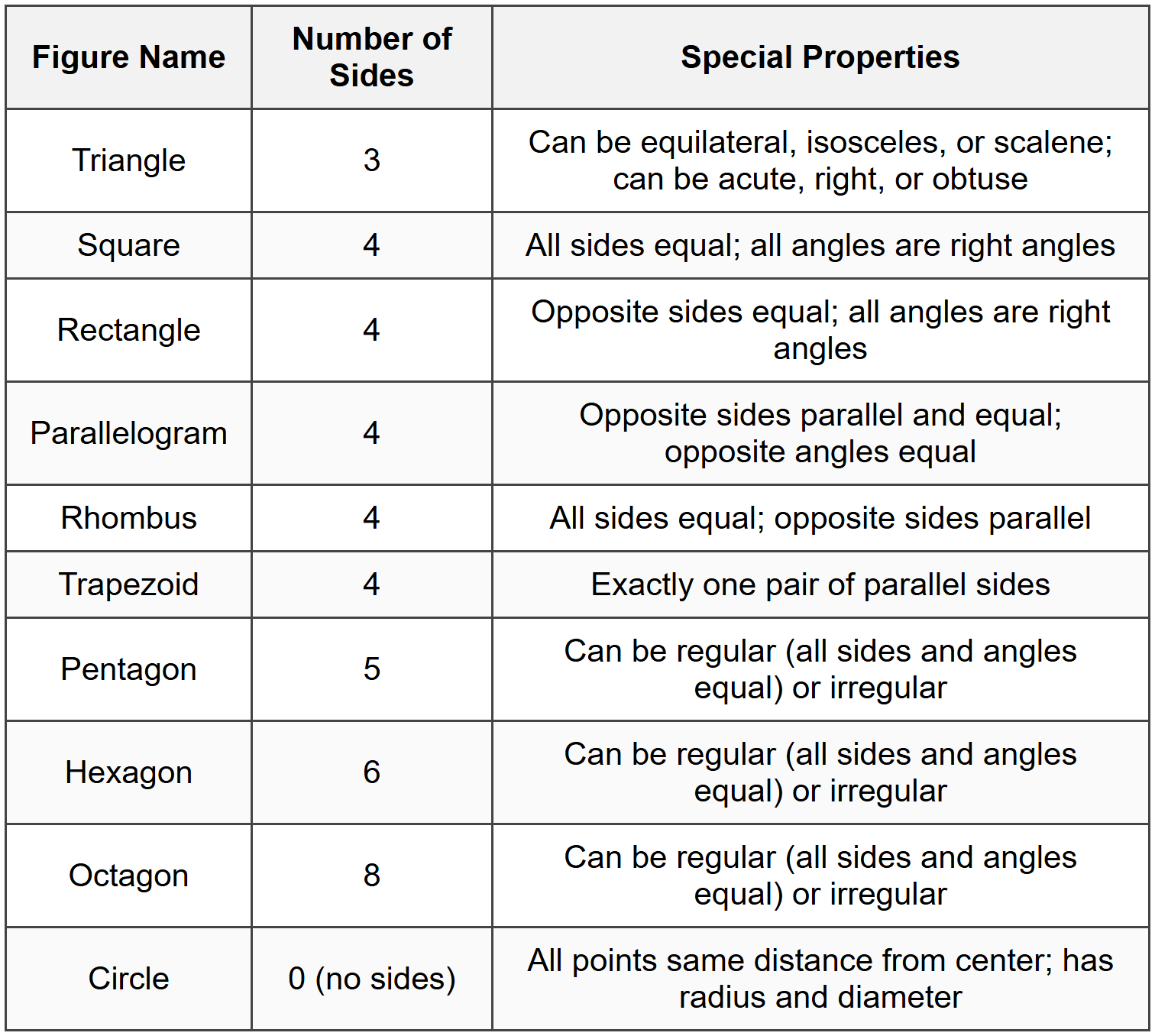
Summary of Key Plane Figures
Let us review the most important plane figures you have learned:
By learning about all these different types of plane figures, you now have the tools to describe and understand the shapes you see around you every day. Whether you are building something, creating art, or solving a math problem, knowing your plane figures will help you succeed!