Chapter Notes: Angle Introduction


When you open a door, turn a book page, or watch the hands of a clock move, you see angles all around you! An angle is formed when two lines or rays meet at a point. Understanding angles helps us describe shapes, measure turns, and solve real-world problems. In this chapter, you will learn what angles are, how they are made, how to name them, and how to recognize different types of angles.
What Is an Angle?
An angle is the amount of turn between two rays that share the same starting point. Think of it like opening a pair of scissors-the more you open them, the bigger the angle becomes!
Every angle has three important parts:
- Vertex: The point where the two rays meet. This is like the hinge of the scissors.
- Rays: The two straight lines that start at the vertex and go on forever in one direction. These form the sides of the angle.
- Opening: The space between the two rays. This tells us how big or small the angle is.
Imagine standing at a corner and turning your body to face a different direction. The amount you turned is an angle!
How Angles Are Formed
Angles are created whenever two rays share a common endpoint. This shared point is always the vertex of the angle.
Let's think about a clock. The two hands of the clock meet at the center. That center point is the vertex. The hour hand and the minute hand are like the two rays. As time passes, the hands move and create different angles.
When the clock shows 3:00, the hands form a special angle. When it shows 6:00, they form a different angle. The amount of turn between the hands changes throughout the day.
Example: Look at the corner of a book.
The two edges of the cover meet at a corner.What forms the angle?
Solution:
The two edges of the book cover are like rays.
The corner where they meet is the vertex.
The opening between the edges creates an angle.
The corner of a book shows an angle with the corner as the vertex.
Naming Angles
Just like people have names, angles have names too! We use letters to label the parts of an angle so we can talk about it clearly.
There are three ways to name an angle:
Method 1: Using Three Letters
We can name an angle using three points: one point on each ray and the vertex in the middle. The vertex letter always goes in the middle.
If we have an angle with vertex B and points A and C on the rays, we write: angle ABC or angle CBA. We can also use the symbol ∠ and write ∠ABC or ∠CBA.
Example: Three points are labeled: Point P is on one ray, point Q is the vertex, and point R is on the other ray.
How can we name this angle?
Solution:
The vertex is point Q, so Q must be in the middle of the name.
We can start with P or R.
The two correct names are ∠PQR or ∠RQP.
This angle can be called ∠PQR or ∠RQP.
Method 2: Using the Vertex Letter
When there is only one angle at a vertex, we can name it using just the vertex letter.
If vertex B has only one angle, we can simply call it angle B or ∠B.
Important: We can only use this method when there is no confusion-when only one angle is at that vertex!
Method 3: Using a Number
Sometimes we put a small number inside the angle, near the vertex. Then we can call it angle 1 or ∠1.
This method is helpful when we have many angles in one picture and want to talk about them quickly.
Measuring Angles
We measure angles to find out exactly how big the turn is. The unit we use to measure angles is called a degree, and we write it with this symbol: °
A degree is a small unit of measurement for angles. Think of a full turn around a circle-that's 360 degrees! If you stand in one spot and spin all the way around until you face the same direction again, you have turned 360°.
We use a special tool called a protractor to measure angles. A protractor is usually shaped like a half-circle and has numbers from 0 to 180 marked on it.
How to Use a Protractor
- Place the center point of the protractor exactly on the vertex of the angle.
- Line up one ray of the angle with the 0° line on the protractor.
- Read the number where the other ray crosses the protractor's scale.
- That number tells you the measure of the angle in degrees.
Using a protractor is like using a ruler, but instead of measuring length, you're measuring the amount of turn!
Example: You use a protractor to measure an angle.
One ray lines up with 0°.
The other ray points to 45° on the protractor.What is the measure of the angle?
Solution:
The first ray is at 0°.
The second ray is at 45°.
The difference shows the angle measure: 45° - 0° = 45°.
The measure of the angle is 45 degrees or 45°.
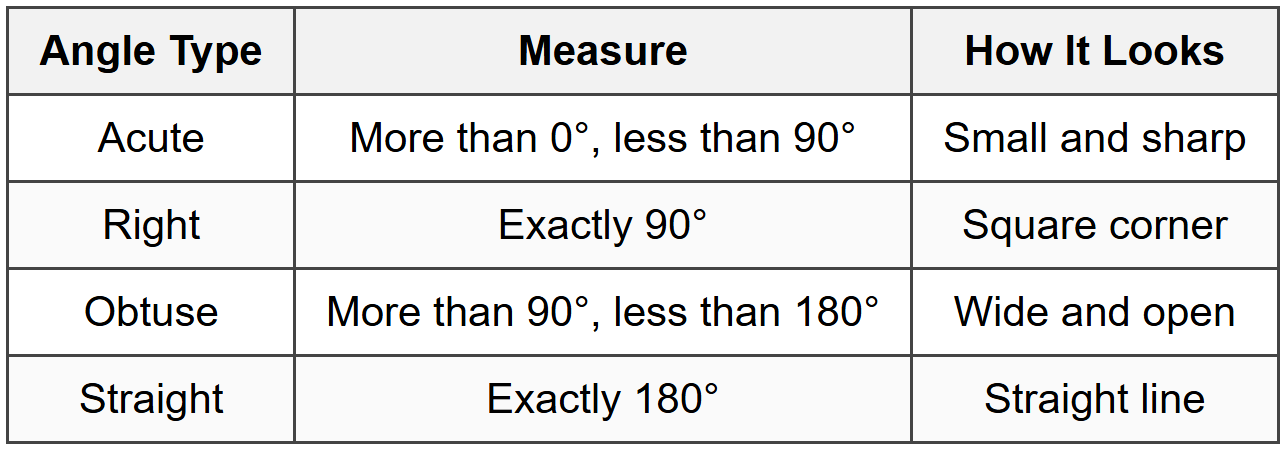
Types of Angles
Angles come in different sizes, and we give them special names based on how big they are. Learning these names helps us describe angles quickly and accurately.
Acute Angle
An acute angle measures more than 0° but less than 90°. These angles look small and sharp.
Think of the angle between the hour and minute hands at 1:00 on a clock-that's an acute angle!
Examples of acute angle measures: 30°, 45°, 60°, 89°
Right Angle
A right angle measures exactly 90°. This is one of the most important angles! A right angle looks like the corner of a square or rectangle.
We often mark right angles with a small square symbol at the vertex instead of a curve.
The corners of this page form right angles. The corner where a wall meets the floor is usually a right angle.
Obtuse Angle
An obtuse angle measures more than 90° but less than 180°. These angles look wide and open.
If you open a book partway, the angle between the covers is obtuse.
Examples of obtuse angle measures: 100°, 120°, 150°, 179°
Straight Angle
A straight angle measures exactly 180°. It looks like a straight line! The two rays point in exactly opposite directions.
Imagine a pencil lying flat on a table. If you think of the middle of the pencil as the vertex, the two ends form a straight angle.
Example: An angle measures 35°.
What type of angle is this?
Solution:
The angle measures 35°.
We know that 35° is greater than 0° and less than 90°.
Any angle between 0° and 90° is called an acute angle.
This is an acute angle.
Example: An angle measures 145°.
What type of angle is this?
Solution:
The angle measures 145°.
We know that 145° is greater than 90° and less than 180°.
Any angle between 90° and 180° is called an obtuse angle.
This is an obtuse angle.
Comparing Angle Sizes
Sometimes we need to compare two or more angles to see which one is bigger or smaller. We can do this by looking at the angles or by comparing their measurements.
Remember these rules:
- The bigger the angle measure (in degrees), the wider the opening between the rays.
- The smaller the angle measure, the narrower the opening.
- An angle measuring 60° is smaller than an angle measuring 120°.
Think about opening a door. When you open it just a little bit, the angle is small. When you open it wide, the angle is large!
Example: Angle A measures 75°.
Angle B measures 110°.
Angle C measures 45°.Which angle is the largest? Which is the smallest?
Solution:
List the measures: 75°, 110°, 45°.
Compare the numbers: 45° < 75°=""><>
The smallest measure is 45°, so Angle C is smallest.
The largest measure is 110°, so Angle B is largest.
Angle B (110°) is the largest, and Angle C (45°) is the smallest.
Angles in Everyday Life
Now that you know about angles, you can find them everywhere you look! Understanding angles helps us in many real-world situations.
In Sports
When you kick a soccer ball, the angle of your foot affects where the ball goes. Basketball players think about the angle when they shoot the ball toward the hoop.
In Buildings
Architects and builders use angles to design houses, schools, and bridges. The roof of a house forms angles with the walls. Stairs are built at specific angles so they're safe to climb.
In Art
Artists use angles to create interesting designs and patterns. When you draw a star, you create many different angles where the lines meet.
In Nature
Tree branches grow at angles from the trunk. When a river bends, it creates an angle. Even the petals of flowers can form angles!
Example: A ladder leans against a wall.
The ground and the wall form a right angle.
The ladder and the ground form an angle.If the ladder makes a 70° angle with the ground, what type of angle is it?
Solution:
The angle measures 70°.
We check: Is 70° between 0° and 90°? Yes!
An angle less than 90° is an acute angle.
The ladder forms an acute angle of 70° with the ground.
Drawing Angles
You can draw your own angles using simple tools like a ruler and a protractor. Here's how:
Steps to Draw an Angle
- Draw a straight line with your ruler. This will be one ray of your angle.
- Mark a point on the line to be your vertex.
- Place your protractor so its center is on the vertex and the 0° line matches your ray.
- Find the degree measure you want on the protractor and make a small mark.
- Use your ruler to draw a line from the vertex through your mark. This is your second ray.
- Label your angle with letters or a number.
Example: Draw an angle that measures 50°.
How would you create this angle?
Solution:
Draw a straight line and mark a point on it as the vertex.
Place the protractor's center on the vertex with 0° on the line.
Find 50° on the protractor and mark that spot.
Draw a line from the vertex through the 50° mark.
You now have an angle that measures 50°, which is an acute angle.
Important Facts About Angles
Here are some key points to remember about angles:
When you work with angles, always remember:
- The vertex is where the two rays meet.
- Angles are measured in degrees using a protractor.
- A full circle is 360°.
- A half circle (straight angle) is 180°.
- A quarter circle (right angle) is 90°.
Recognizing Angles in Shapes
Many shapes you already know contain different types of angles. Let's explore some common shapes:
Triangles
Every triangle has three angles. The three angles are where the sides of the triangle meet. Different triangles can have different types of angles.
Rectangles and Squares
Rectangles and squares have four angles, and all four angles are right angles! That means each corner measures exactly 90°.
Other Quadrilaterals
Shapes like trapezoids and parallelograms also have four angles, but these angles might be acute or obtuse, not always right angles.
Example: A triangle has three angles.
One angle measures 90°.
Another angle measures 45°.What types of angles does this triangle have?
Solution:
The first angle is 90°, which is a right angle.
The second angle is 45°, which is less than 90°, so it's an acute angle.
We don't know the third angle's measure yet, but we know the triangle has at least one right angle and one acute angle.
This triangle has one right angle and at least one acute angle.
Why Angles Matter
Learning about angles is an important step in understanding geometry and the world around you. Angles help us:
- Describe the shapes of objects accurately
- Give and follow directions (like "turn left 90 degrees")
- Create and read maps
- Design buildings, furniture, and artwork
- Understand how things move and turn
- Solve puzzles and problems
As you continue learning mathematics, you'll discover even more ways that angles are useful. For now, practice spotting angles in your classroom, at home, and outside. The more you look, the more angles you'll find!