Chapter Notes: Classifying Geometric Shapes


Shapes are everywhere! You see them in windows, doors, signs, buildings, and even in nature. Some shapes have straight sides, and some have curved sides. Some shapes are flat, and some are solid. When we study geometry, we learn how to look carefully at shapes and sort them into groups based on their special features. This skill is called classifying geometric shapes. When you can classify shapes, you can describe them clearly, compare them, and understand how they are alike and different.
Understanding Points, Lines, and Angles
Before we classify shapes, we need to understand the building blocks that make up shapes.
Points
A point is an exact location in space. It has no size, no length, and no width. We usually show a point as a small dot and name it with a capital letter, such as point A or point B. Think of a point like a tiny dot made by the tip of a sharp pencil on paper.
Lines and Line Segments
A line is a straight path that goes on forever in both directions. It has no beginning and no end. We can draw part of a line with arrows on both ends to show it continues forever.
A line segment is part of a line that has two endpoints. When we draw shapes, we use line segments to make the sides. Think of a line segment like a piece of string stretched tight between two points.
Angles
An angle is formed when two line segments or rays meet at a common point called the vertex. We measure angles in units called degrees, using the symbol °.
There are several types of angles you should know:
- Right angle: An angle that measures exactly 90°. It looks like the corner of a square or rectangle. We often mark a right angle with a small square in the corner.
- Acute angle: An angle that measures less than 90°. It is smaller and narrower than a right angle.
- Obtuse angle: An angle that measures more than 90° but less than 180°. It is wider than a right angle.
- Straight angle: An angle that measures exactly 180°. It looks like a straight line.
Example: Look at the corner where two walls meet the floor in your classroom.
What type of angle do you see?
Solution:
The corner where the walls meet the floor forms a right angle.
We can check this because the corner looks like the letter L.
The angle measures 90°.
The corner is a right angle.
Classifying Two-Dimensional Shapes
A two-dimensional shape (also called a 2D shape or a plane shape) is a flat shape that has only length and width. It does not have thickness. We can draw 2D shapes on paper. These shapes are also called polygons when they are closed figures made of straight line segments.
What is a Polygon?
A polygon is a closed figure made up of three or more straight line segments that connect end-to-end. The line segments are called sides, and the points where the sides meet are called vertices (the plural of vertex).
For a shape to be a polygon, it must follow these rules:
- It must be closed (all sides connect)
- It must be made of straight sides only (no curves)
- The sides can only touch at the vertices
A circle is not a polygon because it has a curved side. An open shape with a gap is not a polygon because it is not closed.
Triangles
A triangle is a polygon with exactly 3 sides and 3 angles. The word "tri" means three. All triangles have 3 vertices.
We can classify triangles in two different ways: by their sides or by their angles.
Classifying Triangles by Sides
- Equilateral triangle: All 3 sides are the same length. All 3 angles are equal too (each measures 60°).
- Isosceles triangle: Exactly 2 sides are the same length. The angles across from the equal sides are also equal.
- Scalene triangle: All 3 sides have different lengths. All 3 angles have different measures.
Classifying Triangles by Angles
- Right triangle: Has exactly 1 right angle (90°).
- Acute triangle: All 3 angles are acute (each angle is less than 90°).
- Obtuse triangle: Has exactly 1 obtuse angle (one angle is greater than 90°).
Example: A triangle has sides that measure 5 cm, 5 cm, and 8 cm.
How would you classify this triangle by its sides?
Solution:
Look at the lengths of the three sides: 5 cm, 5 cm, and 8 cm.
Two sides have the same length (both are 5 cm).
One side has a different length (8 cm).
When exactly two sides are equal, the triangle is isosceles.
This triangle is an isosceles triangle.
Quadrilaterals
A quadrilateral is a polygon with exactly 4 sides and 4 angles. The word "quad" means four. All quadrilaterals have 4 vertices.
There are several special types of quadrilaterals you should know:
Parallelograms
A parallelogram is a quadrilateral where both pairs of opposite sides are parallel. Parallel means the sides go in the same direction and will never meet, even if you extend them forever. In a parallelogram, opposite sides are also equal in length, and opposite angles are equal.
Rectangles
A rectangle is a special type of parallelogram. It has 4 right angles (each corner is 90°). Opposite sides are parallel and equal in length. Think of a rectangle like a door or a sheet of paper.
Squares
A square is a very special rectangle. All 4 sides are the same length, and all 4 angles are right angles. A square is both a rectangle and a special type of parallelogram. Think of a square like a checkerboard square or a window pane.
Rhombus
A rhombus is a parallelogram where all 4 sides are the same length. Unlike a square, a rhombus does not have to have right angles. Think of a rhombus like a diamond shape on a playing card.
Trapezoids
A trapezoid is a quadrilateral with exactly 1 pair of parallel sides. The parallel sides are called bases, and the other two sides are called legs.
Example: A quadrilateral has 4 sides that are all 6 inches long.
All 4 angles are right angles.What type of quadrilateral is this?
Solution:
First, notice that all 4 sides are equal (each is 6 inches).
Next, notice that all 4 angles are right angles (90°).
A quadrilateral with 4 equal sides and 4 right angles is a square.
This shape is a square.
Example: A quadrilateral has 2 sides that are 4 cm each and 2 sides that are 7 cm each.
The opposite sides are parallel, and all angles are right angles.What type of quadrilateral is this?
Solution:
The shape has opposite sides that are equal in length.
The opposite sides are parallel.
All four angles are right angles (90°).
The sides are not all the same length, so it cannot be a square.
A quadrilateral with 4 right angles and opposite sides equal is a rectangle.
This shape is a rectangle.
Other Polygons
Polygons can have more than 4 sides. We name them based on the number of sides they have:
- Pentagon: A polygon with 5 sides and 5 angles
- Hexagon: A polygon with 6 sides and 6 angles
- Heptagon: A polygon with 7 sides and 7 angles
- Octagon: A polygon with 8 sides and 8 angles
A stop sign is a good example of an octagon you see every day!
When all sides and all angles of a polygon are equal, we call it a regular polygon. For example, a regular hexagon has 6 equal sides and 6 equal angles.
Special Properties of Shapes
Parallel and Perpendicular Lines
Understanding these special relationships between lines helps us classify shapes more accurately.
Parallel lines are lines that are always the same distance apart. They never meet, no matter how far you extend them. We use a special symbol (||) to show that lines are parallel. In shapes, opposite sides of rectangles and parallelograms are parallel.
Perpendicular lines are lines that meet at a right angle (90°). We use a special symbol (⊥) to show that lines are perpendicular. In shapes, the sides of squares and rectangles are perpendicular to each other.
Symmetry
Line symmetry means a shape can be folded along a line so that both halves match exactly. The fold line is called the line of symmetry.
- A square has 4 lines of symmetry
- A rectangle has 2 lines of symmetry
- An equilateral triangle has 3 lines of symmetry
- A circle has infinite lines of symmetry
Imagine folding a paper heart down the middle. If both sides match perfectly, that fold line is a line of symmetry!
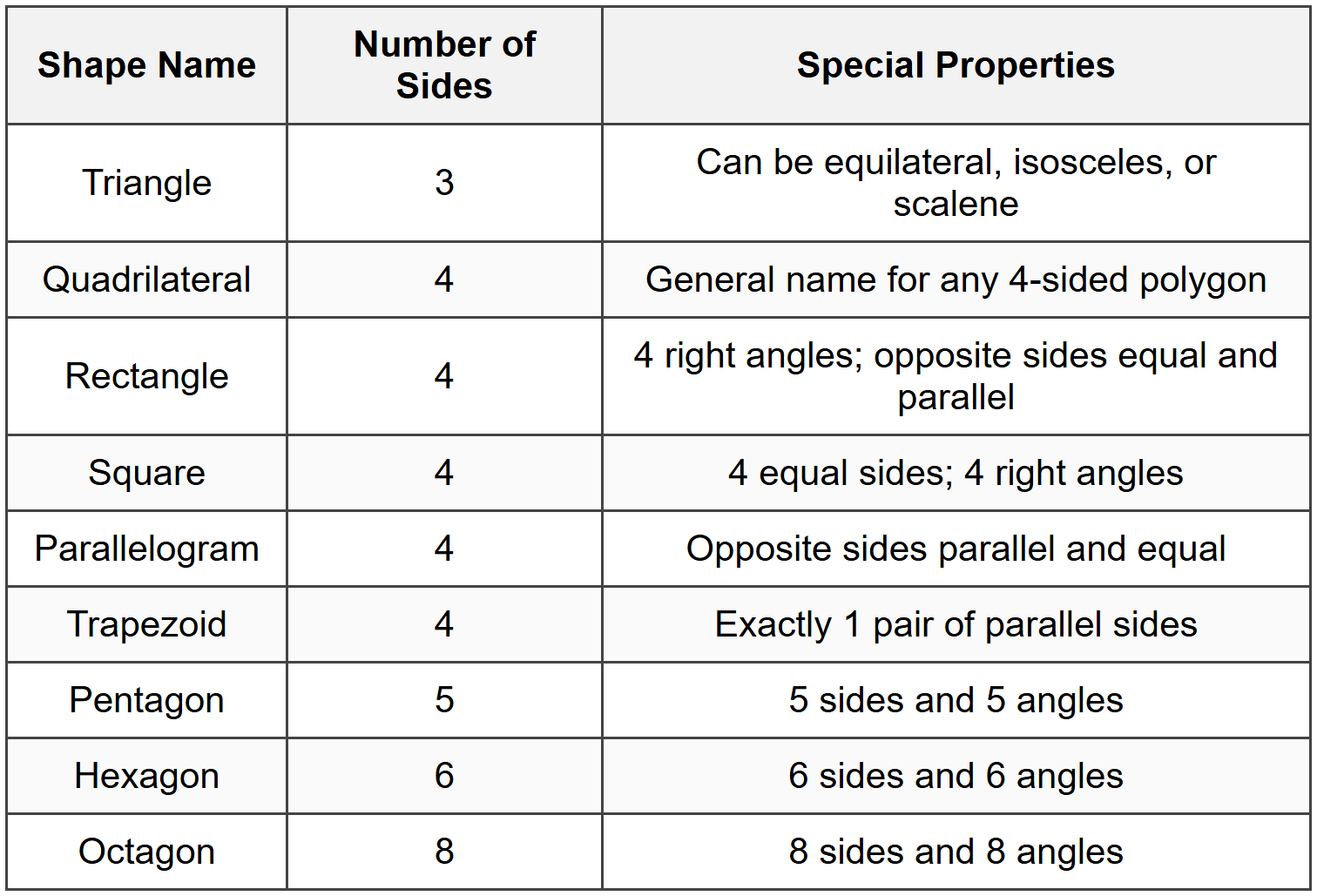
Sorting Shapes Using a Classification Chart
When we classify shapes, we look at their properties and sort them into groups. A good way to organize this information is to use a chart or table.
Relationships Between Shapes
Some shapes belong to more than one group. Understanding how shapes are related helps us classify them correctly.
Here are some important relationships:
- All squares are rectangles (because they have 4 right angles), but not all rectangles are squares.
- All rectangles are parallelograms (because opposite sides are parallel), but not all parallelograms are rectangles.
- All squares are rhombuses (because they have 4 equal sides), but not all rhombuses are squares.
- All parallelograms are quadrilaterals (because they have 4 sides), but not all quadrilaterals are parallelograms.
Think of these relationships like a family tree. A square is part of the rectangle family, the parallelogram family, and the quadrilateral family!
Example: Your teacher asks: "Is a square a rectangle?"
How would you answer and explain your reasoning?
Solution:
First, remember what makes a shape a rectangle.
A rectangle must have 4 sides and 4 right angles.
Now think about a square: it has 4 sides and 4 right angles.
A square has all the properties that a rectangle needs.
Therefore, yes, a square is a special type of rectangle.
Classifying by Sides and Angles Together
To classify shapes accurately, we often need to look at multiple properties at the same time. Let's practice using both sides and angles to identify shapes.
Example: A shape has 4 sides.
Two sides are 10 cm long and parallel to each other.
The other two sides are 5 cm long and not parallel.
There are no right angles.What shape is this?
Solution:
The shape has 4 sides, so it is a quadrilateral.
It has exactly one pair of parallel sides (the two 10 cm sides).
It does not have 4 right angles, so it is not a rectangle.
It does not have two pairs of parallel sides, so it is not a parallelogram.
A quadrilateral with exactly one pair of parallel sides is a trapezoid.
This shape is a trapezoid.
Real-World Applications
Classifying shapes is not just something we do in math class. People use this skill in many jobs and activities:
- Architects design buildings using rectangles, triangles, and other shapes. They must know the properties of each shape to make buildings strong and beautiful.
- Artists use geometric shapes to create paintings, sculptures, and designs.
- Engineers use triangles to build strong bridges because triangles are very sturdy shapes.
- Carpenters cut wood into different shapes and must measure angles carefully to make furniture and houses.
- Fashion designers use patterns made from geometric shapes to create clothing.
Next time you walk around your neighborhood, look for geometric shapes in street signs, windows, roofs, and fences. You might be surprised how many you can find!
Tips for Classifying Shapes Successfully
Here are some helpful strategies to use when you need to classify a shape:
- Count the sides first. This tells you the basic category (triangle, quadrilateral, pentagon, etc.).
- Look for right angles. Check each corner carefully. Right angles are marked with a small square.
- Measure or compare side lengths. Are all sides equal? Are some sides equal? Are all sides different?
- Check for parallel sides. Use a ruler or straight edge to see if sides go in the same direction.
- Think about special properties. Does the shape have line symmetry? Are there perpendicular sides?
- Remember shape families. Some shapes belong to more than one category.
Important Note: When you are not sure about a shape, start with what you know for certain. Count the sides, then add one observation at a time. This step-by-step approach will help you identify the shape correctly.
Common Mistakes to Avoid
Students sometimes make these mistakes when classifying shapes. Watch out for them!
- Thinking a square is not a rectangle: Remember, a square has all the properties of a rectangle, plus the extra property that all sides are equal.
- Confusing rhombus and square: A rhombus has 4 equal sides but does not need right angles. A square has 4 equal sides AND 4 right angles.
- Forgetting to check all properties: A shape might look like a square, but if you measure carefully, the sides might not all be equal.
- Mixing up parallel and perpendicular: Parallel means "never meeting" and perpendicular means "meeting at a right angle."
- Calling all quadrilaterals "squares" or "rectangles": There are many types of quadrilaterals. Check the specific properties before naming the shape.
By learning to classify geometric shapes, you develop careful observation skills and logical thinking. These skills will help you in many areas of mathematics and in solving real-world problems. Keep practicing, and soon you will be able to identify and classify shapes quickly and accurately!