Chapter Notes: Converting Units of Mass


When you go to the grocery store, you might see that a bag of apples weighs 5 pounds, or a box of cereal weighs 16 ounces. Sometimes we need to change, or convert, from one unit of mass to another so we can compare weights or solve problems. Mass tells us how heavy something is. In this chapter, we will learn how to convert between different units of mass, including ounces, pounds, and tons. Once you understand how these units are related, you can easily change from one unit to another!
Understanding Units of Mass
In the United States, we measure mass using several different units. The most common units are ounces, pounds, and tons. Each unit is useful for measuring different kinds of objects.
- Ounce (oz): A small unit used for light objects like a slice of bread or a letter.
- Pound (lb): A medium-sized unit used for things like bags of flour, books, or small pets.
- Ton (T): A very large unit used for heavy objects like cars, elephants, or large boats.
Just like we can convert between inches, feet, and yards when measuring length, we can convert between ounces, pounds, and tons when measuring mass. To do this, we need to know how these units are related to each other.
The Relationship Between Ounces and Pounds
The first important relationship to learn is between ounces and pounds. There are 16 ounces in 1 pound. This is a fact you should memorize because we will use it to convert between these two units.
1 pound = 16 ounces
This means that if you have 1 pound of cheese, it weighs the same as 16 ounces of cheese. Think of it like money: just as 1 dollar equals 100 pennies, 1 pound equals 16 ounces.
Converting Pounds to Ounces
When we convert from pounds to ounces, we are changing from a larger unit to a smaller unit. Since there are 16 ounces in every pound, we multiply the number of pounds by 16.
Number of ounces = Number of pounds × 16
Example: A watermelon weighs 3 pounds.
How many ounces does the watermelon weigh?Solution:
We know that 1 pound = 16 ounces.
To find how many ounces are in 3 pounds, we multiply:
3 pounds × 16 ounces per pound = 48 ouncesThe watermelon weighs 48 ounces.
Example: A bag of rice weighs 5 pounds.
How many ounces does the bag of rice weigh?Solution:
We know that 1 pound = 16 ounces.
To convert 5 pounds to ounces, we multiply:
5 pounds × 16 ounces per pound = 80 ouncesThe bag of rice weighs 80 ounces.
Converting Ounces to Pounds
When we convert from ounces to pounds, we are changing from a smaller unit to a larger unit. Since there are 16 ounces in 1 pound, we divide the number of ounces by 16.
Number of pounds = Number of ounces ÷ 16
Example: A book weighs 32 ounces.
How many pounds does the book weigh?Solution:
We know that 16 ounces = 1 pound.
To find how many pounds are in 32 ounces, we divide:
32 ounces ÷ 16 ounces per pound = 2 poundsThe book weighs 2 pounds.
Example: A bag of oranges weighs 48 ounces.
How many pounds does the bag of oranges weigh?Solution:
We know that 16 ounces = 1 pound.
To convert 48 ounces to pounds, we divide:
48 ounces ÷ 16 ounces per pound = 3 poundsThe bag of oranges weighs 3 pounds.
The Relationship Between Pounds and Tons
The second important relationship is between pounds and tons. There are 2,000 pounds in 1 ton. This is another fact you should memorize.
1 ton = 2,000 pounds
A ton is a very heavy unit! Most things we see every day do not weigh a whole ton. A small car weighs about 1 to 2 tons. An elephant might weigh 5 or 6 tons!
Converting Tons to Pounds
When we convert from tons to pounds, we are changing from a larger unit to a smaller unit. Since there are 2,000 pounds in every ton, we multiply the number of tons by 2,000.
Number of pounds = Number of tons × 2,000
Example: A small truck weighs 2 tons.
How many pounds does the truck weigh?Solution:
We know that 1 ton = 2,000 pounds.
To find how many pounds are in 2 tons, we multiply:
2 tons × 2,000 pounds per ton = 4,000 poundsThe truck weighs 4,000 pounds.
Example: A large boat weighs 3 tons.
How many pounds does the boat weigh?Solution:
We know that 1 ton = 2,000 pounds.
To convert 3 tons to pounds, we multiply:
3 tons × 2,000 pounds per ton = 6,000 poundsThe boat weighs 6,000 pounds.
Converting Pounds to Tons
When we convert from pounds to tons, we are changing from a smaller unit to a larger unit. Since there are 2,000 pounds in 1 ton, we divide the number of pounds by 2,000.
Number of tons = Number of pounds ÷ 2,000
Example: A pile of bricks weighs 6,000 pounds.
How many tons does the pile of bricks weigh?Solution:
We know that 2,000 pounds = 1 ton.
To find how many tons are in 6,000 pounds, we divide:
6,000 pounds ÷ 2,000 pounds per ton = 3 tonsThe pile of bricks weighs 3 tons.
Example: An elephant at the zoo weighs 10,000 pounds.
How many tons does the elephant weigh?Solution:
We know that 2,000 pounds = 1 ton.
To convert 10,000 pounds to tons, we divide:
10,000 pounds ÷ 2,000 pounds per ton = 5 tonsThe elephant weighs 5 tons.
Helpful Strategies for Converting Units
Here are some helpful tips to remember when converting units of mass:
- Going from a larger unit to a smaller unit: Multiply. For example, converting pounds to ounces means you multiply by 16.
- Going from a smaller unit to a larger unit: Divide. For example, converting ounces to pounds means you divide by 16.
- Memorize the conversion facts: 1 pound = 16 ounces and 1 ton = 2,000 pounds.
- Check if your answer makes sense: When you convert to a smaller unit, you should get a bigger number. When you convert to a larger unit, you should get a smaller number.
Think of it this way: If you have a pizza and you cut it into small slices, you have many slices. If you have many slices and put them back together, you have fewer whole pizzas. The same idea works with converting units!
Summary Table of Conversions
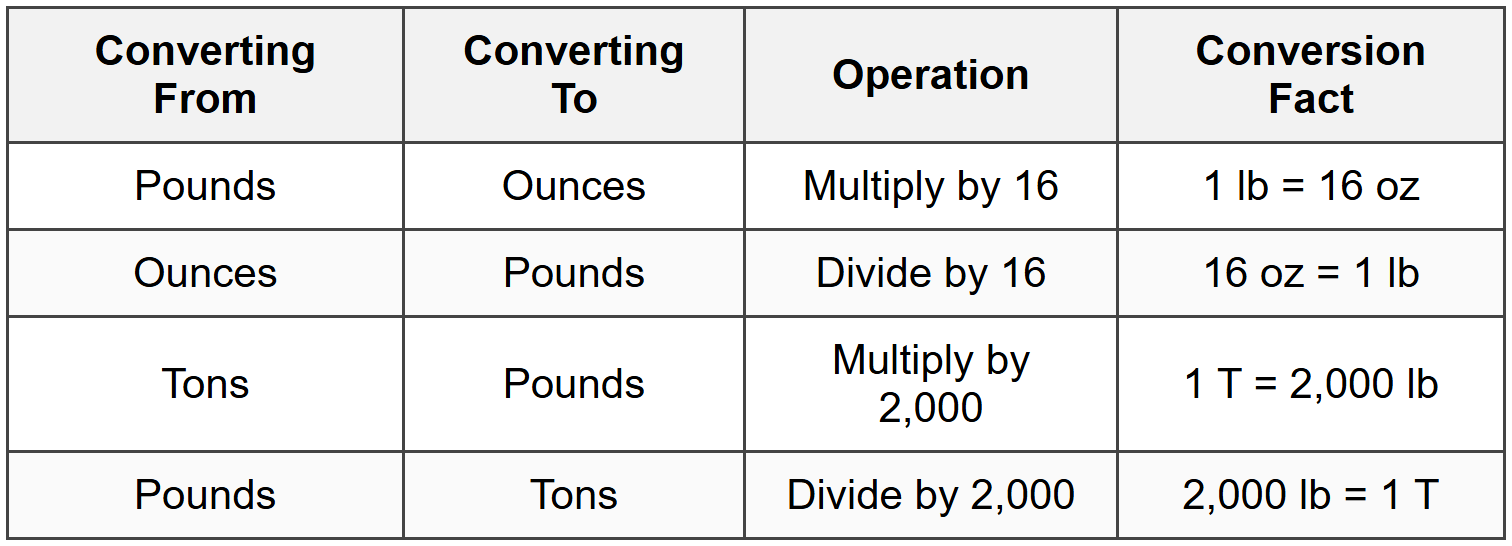
Here is a table that shows the relationships between ounces, pounds, and tons:
Solving Word Problems with Unit Conversions
Many problems ask us to convert units and then use the answer to solve a bigger problem. When solving word problems, follow these steps:
- Read the problem carefully and identify what units you have and what units you need.
- Decide whether to multiply or divide based on the conversion.
- Do the calculation.
- Write your answer with the correct unit label.
- Check if your answer makes sense.
Example: Maria bought a 4-pound bag of flour.
She used 48 ounces of flour for baking.
How many ounces of flour does she have left?Solution:
First, we need to convert 4 pounds to ounces so we can compare:
4 pounds × 16 ounces per pound = 64 ouncesMaria started with 64 ounces of flour.
She used 48 ounces.
To find how much is left, we subtract:
64 ounces - 48 ounces = 16 ouncesMaria has 16 ounces of flour left.
Example: A farmer has two bags of potatoes.
One bag weighs 80 ounces and the other weighs 3 pounds.
What is the total weight of the potatoes in pounds?Solution:
First, we convert 80 ounces to pounds:
80 ounces ÷ 16 ounces per pound = 5 poundsNow both bags are measured in pounds.
The first bag weighs 5 pounds and the second bag weighs 3 pounds.
To find the total weight, we add:
5 pounds + 3 pounds = 8 poundsThe total weight of the potatoes is 8 pounds.
Example: A zoo has 3 elephants.
Each elephant weighs 4 tons.
What is the total weight of all three elephants in pounds?Solution:
First, we find the total weight in tons:
3 elephants × 4 tons per elephant = 12 tonsNow we convert 12 tons to pounds:
12 tons × 2,000 pounds per ton = 24,000 poundsThe total weight of all three elephants is 24,000 pounds.
Common Mistakes to Avoid
When converting units of mass, students sometimes make these mistakes. Be careful to avoid them!
- Multiplying when you should divide: Remember, when you go from a smaller unit to a larger unit, you divide.
- Dividing when you should multiply: When you go from a larger unit to a smaller unit, you multiply.
- Forgetting the unit label: Always write the unit (ounces, pounds, or tons) with your answer.
- Using the wrong conversion fact: Make sure you remember that 1 pound = 16 ounces and 1 ton = 2,000 pounds.
- Not checking your answer: Always ask yourself, "Does this make sense?" If you convert 1 pound to ounces and get 2 ounces, that does not make sense because ounces are smaller than pounds!
Practice with Multi-Step Conversions
Sometimes you may need to convert more than once to solve a problem. For example, you might need to convert tons to pounds and then pounds to ounces. Take your time and do one step at a time.
Example: A truck is carrying 2 tons of sand.
How many ounces of sand is the truck carrying?Solution:
Step 1: Convert tons to pounds.
2 tons × 2,000 pounds per ton = 4,000 poundsStep 2: Convert pounds to ounces.
4,000 pounds × 16 ounces per pound = 64,000 ouncesThe truck is carrying 64,000 ounces of sand.
By understanding how to convert between ounces, pounds, and tons, you can solve many real-world problems involving mass. Whether you are measuring ingredients for a recipe, weighing packages to mail, or learning about large animals, knowing how to convert units of mass is a valuable skill!