Chapter Notes: Converting Units of Length


Every day we measure things around us using different units. Sometimes we measure short distances like the length of a pencil in inches. Other times we measure longer distances like the length of a football field in yards or even miles for a road trip. When we work with measurements, we often need to change from one unit to another. This is called converting units. Learning to convert units of length helps us compare measurements, solve problems, and understand the world better.
Understanding Units of Length
A unit of length is a standard amount we use to measure how long, wide, or tall something is. In the United States, we use the customary system of measurement. This system has several units of length that we use for different purposes.
The most common customary units of length are:
- Inch (in) - A small unit, about the width of your thumb
- Foot (ft) - A medium unit, about the length of a large adult's foot
- Yard (yd) - A larger unit, about the distance from your nose to your fingertip when you stretch your arm out
- Mile (mi) - A very large unit used for long distances like driving or running races
Each of these units is useful for different situations. You wouldn't measure the length of your pencil in miles, and you wouldn't measure the distance between two cities in inches!
Relationships Between Units
To convert units of length, we need to know how the units relate to each other. These relationships are fixed and never change. Learning these relationships is like learning a special set of math facts.
Key Conversion Facts
Here are the most important relationships between customary units of length:
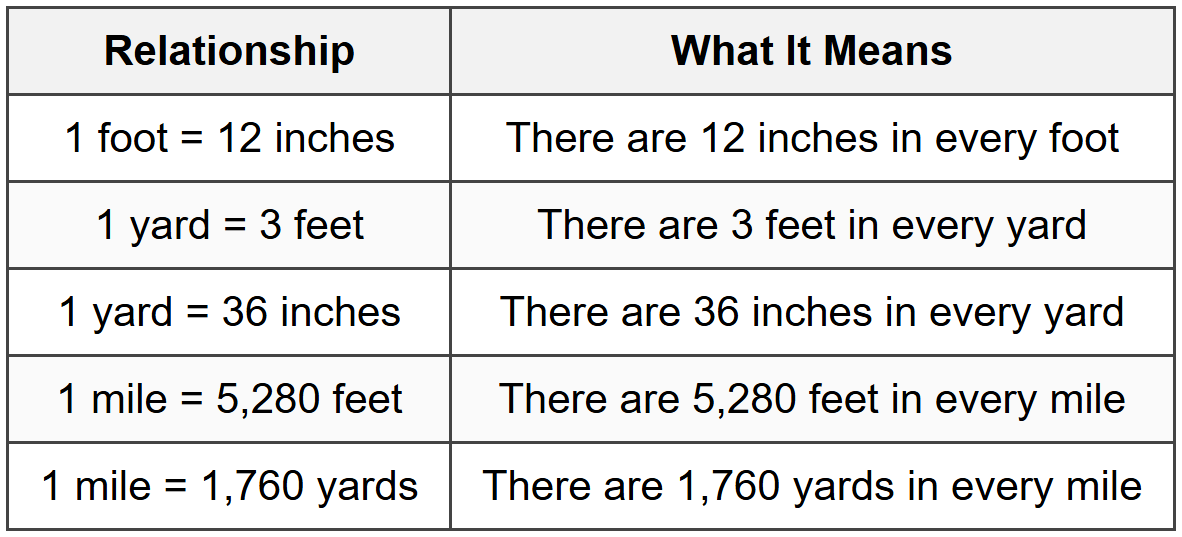
Important Note: You should memorize the first three relationships. They are used most often. The mile conversions are good to know, but you can always look them up when needed.
Converting Larger Units to Smaller Units
When we convert from a larger unit to a smaller unit, we need to multiply. This makes sense because it takes many small units to equal one large unit. Think of it like trading one dollar bill for many pennies-you end up with a bigger number of coins!
Why We Multiply
If you have 1 foot, that equals 12 inches. So if you have 2 feet, you would have 2 groups of 12 inches, which is 2 × 12 = 24 inches. Every time you have one more foot, you add 12 more inches. That's why we multiply.
Steps to Convert Larger Units to Smaller Units
- Identify what unit you are starting with and what unit you want to end with
- Find the conversion fact that connects these two units
- Multiply the number you have by the conversion number
- Write your answer with the correct unit label
Example: Sarah has a ribbon that is 4 feet long.
She wants to know how many inches long the ribbon is.How many inches is 4 feet?
Solution:
We are converting from feet (larger unit) to inches (smaller unit).
The conversion fact is: 1 foot = 12 inches
We multiply: 4 × 12 = 48
Sarah's ribbon is 48 inches long.
Example: A basketball court is 5 yards wide.
The coach wants to mark the width using a tape measure that shows feet.How many feet is 5 yards?
Solution:
We are converting from yards (larger unit) to feet (smaller unit).
The conversion fact is: 1 yard = 3 feet
We multiply: 5 × 3 = 15
The basketball court is 15 feet wide.
Example: A rope in the gym is 7 yards long.
The teacher wants to know the length in inches.How many inches is 7 yards?
Solution:
We are converting from yards (larger unit) to inches (smaller unit).
The conversion fact is: 1 yard = 36 inches
We multiply: 7 × 36 = 252
The rope is 252 inches long.
Converting Smaller Units to Larger Units
When we convert from a smaller unit to a larger unit, we need to divide. This makes sense because we are grouping many small units together to make fewer large units. Think of it like trading many pennies for dollar bills-you end up with a smaller number of bills!
Why We Divide
If you have 24 inches, you can group them into sets of 12 inches. Since 12 inches equals 1 foot, you would have 24 ÷ 12 = 2 feet. We divide to find out how many groups we can make.
Steps to Convert Smaller Units to Larger Units
- Identify what unit you are starting with and what unit you want to end with
- Find the conversion fact that connects these two units
- Divide the number you have by the conversion number
- Write your answer with the correct unit label
Example: Marcus has a string that is 60 inches long.
He wants to know the length in feet.How many feet is 60 inches?
Solution:
We are converting from inches (smaller unit) to feet (larger unit).
The conversion fact is: 1 foot = 12 inches
We divide: 60 ÷ 12 = 5
The string is 5 feet long.
Example: A football field is 300 feet long.
The announcer wants to describe the length in yards.How many yards is 300 feet?
Solution:
We are converting from feet (smaller unit) to yards (larger unit).
The conversion fact is: 1 yard = 3 feet
We divide: 300 ÷ 3 = 100
The football field is 100 yards long.
Example: A piece of fabric is 144 inches long.
The store wants to sell it by the yard.How many yards is 144 inches?
Solution:
We are converting from inches (smaller unit) to yards (larger unit).
The conversion fact is: 1 yard = 36 inches
We divide: 144 ÷ 36 = 4
The fabric is 4 yards long.
Two-Step Conversions
Sometimes we need to convert units that don't have a direct conversion fact we've memorized. For example, you might need to convert feet to yards, but your measurement is first given in inches. In these cases, we do two-step conversions. We convert to an in-between unit first, then convert again to reach our final unit.
When to Use Two-Step Conversions
Use two-step conversions when:
- You need to convert between units that don't have a simple conversion fact
- The numbers are easier to work with if you break the problem into smaller parts
- You want to check your work by converting a different way
Example: A hallway is 180 inches long.
The school wants to report the length in yards.How many yards is 180 inches?
Solution:
We don't have 180 ÷ 36 memorized easily. We can convert in two steps instead.
Step 1: Convert inches to feet.
180 ÷ 12 = 15 feetStep 2: Convert feet to yards.
15 ÷ 3 = 5 yardsThe hallway is 5 yards long.
Example: A garden path is 8 yards long.
A builder needs to know the measurement in inches to order materials.How many inches is 8 yards?
Solution:
We can convert in two steps.
Step 1: Convert yards to feet.
8 × 3 = 24 feetStep 2: Convert feet to inches.
24 × 12 = 288 inchesThe garden path is 288 inches long.
Quick Reference Guide
Use this guide to remember which operation to use when converting units of length:
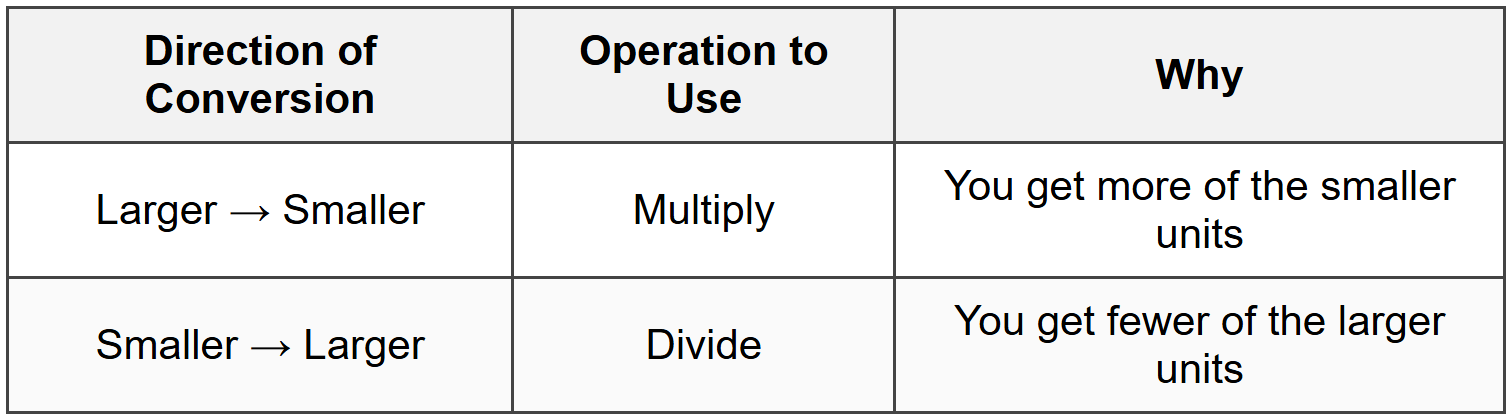
Memory Tip: Think "Large to Small, Multiply by all" and "Small to Large, Divide to enlarge."
Common Conversion Patterns
Here are the most common conversions you'll encounter, organized by what you're converting:
Feet and Inches
- Feet to inches: Multiply by 12
- Inches to feet: Divide by 12
This is the most common conversion you'll use because many objects are measured in these units.
Yards and Feet
- Yards to feet: Multiply by 3
- Feet to yards: Divide by 3
This conversion is often used in sports, construction, and fabric measurement.
Yards and Inches
- Yards to inches: Multiply by 36
- Inches to yards: Divide by 36
This conversion can be tricky because 36 is a larger number. You can always break it into two steps if needed.
Solving Word Problems with Unit Conversions
Many real-world problems require you to convert units before you can solve them. Here's how to approach these problems:
- Read the problem carefully and identify what information you're given
- Determine what unit your answer needs to be in
- Decide if you need to convert units to solve the problem
- Do the conversion first, then solve the problem
- Check that your answer makes sense and has the correct unit label
Example: Tanya is making a picture frame.
She has a piece of wood that is 6 feet long.
She needs 80 inches of wood for her project.Does she have enough wood?
Solution:
First, we need to convert so both measurements are in the same unit. Let's convert feet to inches.
6 feet = 6 × 12 = 72 inches
Now we compare: She has 72 inches but needs 80 inches.
72 < 80,="" so="">no, she does not have enough wood.
Example: A relay race has four runners.
Each runner runs 440 yards.
The coach wants to know the total distance in feet.How many feet do all four runners cover together?
Solution:
First, find the total distance in yards: 4 × 440 = 1,760 yards
Now convert yards to feet: 1,760 × 3 = 5,280 feet
The four runners together cover 5,280 feet.
Example: A carpenter cuts a board that is 144 inches long into 4 equal pieces.
How long is each piece in feet?
Solution:
First, find the length of each piece in inches: 144 ÷ 4 = 36 inches
Now convert inches to feet: 36 ÷ 12 = 3 feet
Each piece is 3 feet long.
Helpful Strategies
Here are some useful strategies to help you convert units accurately:
Use What You Know
If you forget a conversion fact, you can often figure it out from other facts you know. For example, if you know 1 yard = 3 feet and 1 foot = 12 inches, you can find that 1 yard = 3 × 12 = 36 inches.
Draw a Picture
Drawing a simple diagram can help you visualize the conversion. For example, draw a yard stick and divide it into 3 equal parts to show 3 feet.
Check Your Answer
After converting, ask yourself: Does my answer make sense? If you converted from feet to inches, your number should be larger. If you converted from inches to feet, your number should be smaller.
Write the Unit
Always write the unit with your answer. This helps you keep track of what you're measuring and catches mistakes. An answer of "12" doesn't tell you much, but "12 inches" or "12 feet" gives important information.
Practice with Real Measurements
Understanding unit conversions becomes easier when you connect them to real objects around you:
- A standard ruler is usually 12 inches long, which equals 1 foot
- A yard stick is 36 inches long, which equals 3 feet or 1 yard
- A door is usually about 7 feet tall, which is 84 inches
- A football field is 100 yards long, which is 300 feet
The more you connect these conversions to real things you can see and touch, the easier they become to remember and use.