Chapter Notes: Decimal Place Value


Numbers can be written in many different ways. When we count whole things like apples or books, we use whole numbers. But what happens when we need to measure something more exact, like the weight of a package or the length of a pencil? That's where decimals come in! A decimal is a way to show parts of a whole number using a special dot called a decimal point. Understanding how decimals work helps us measure more precisely, work with money, and solve real-world problems.
Understanding Place Value
Before we dive into decimals, let's remember what we know about place value with whole numbers. Every digit in a number has a special place that tells us its value. The place where a digit sits determines how much it is worth.
Think about the number 345. Each digit has a different value:
- The 3 is in the hundreds place, so it means 300
- The 4 is in the tens place, so it means 40
- The 5 is in the ones place, so it means 5
When we add these values together (300 + 40 + 5), we get 345. This is how place value works for whole numbers. Now we'll see how this idea extends to decimal numbers!
What Is a Decimal?
A decimal is a number that has a whole number part and a fractional part separated by a decimal point. The decimal point is a small dot that shows where the whole number ends and the fractional part begins.
Think of the decimal point like a fence that separates a whole pizza from the slices you cut from another pizza.
For example, in the number 3.75:
- The 3 is to the left of the decimal point-this is the whole number part
- The decimal point is the dot between 3 and 7
- The 7 and 5 are to the right of the decimal point-this is the fractional part
The number 3.75 means 3 whole units plus 75 hundredths of another unit.
Decimal Place Value Chart
Just like whole numbers, decimals use place value. But the places to the right of the decimal point have special names. Let's look at a place value chart that shows both whole number places and decimal places:

Notice how the decimal point sits between the ones place and the tenths place. This is always true for every decimal number.
The Tenths Place
The first place to the right of the decimal point is called the tenths place. A digit in the tenths place tells us how many parts out of ten we have.
For example, in the number 5.3:
- The 5 is in the ones place
- The 3 is in the tenths place, which means 3 out of 10 parts, or \( \frac{3}{10} \)
We read 5.3 as "five and three tenths."
Example: A ribbon is 2.7 meters long.
What does the digit 7 mean?
Solution:
Look at the place value chart. The 2 is in the ones place, which means 2 whole meters.
The 7 is in the tenths place, which means 7 tenths of a meter, or \( \frac{7}{10} \) of a meter.
The digit 7 means 7 tenths or 0.7 meters.
The Hundredths Place
The second place to the right of the decimal point is called the hundredths place. A digit in the hundredths place tells us how many parts out of one hundred we have.
For example, in the number 4.26:
- The 4 is in the ones place
- The 2 is in the tenths place, which means \( \frac{2}{10} \)
- The 6 is in the hundredths place, which means \( \frac{6}{100} \)
We read 4.26 as "four and twenty-six hundredths."
Example: A baseball player has a batting average of 0.38.
What is the place value of each digit?
Solution:
The 0 is in the ones place. This means there are zero whole units.
The 3 is in the tenths place. This means 3 tenths, or \( \frac{3}{10} \).
The 8 is in the hundredths place. This means 8 hundredths, or \( \frac{8}{100} \).
We read this number as thirty-eight hundredths.
The Thousandths Place
The third place to the right of the decimal point is called the thousandths place. A digit in the thousandths place tells us how many parts out of one thousand we have.
For example, in the number 1.456:
- The 1 is in the ones place
- The 4 is in the tenths place, which means \( \frac{4}{10} \)
- The 5 is in the hundredths place, which means \( \frac{5}{100} \)
- The 6 is in the thousandths place, which means \( \frac{6}{1000} \)
We read 1.456 as "one and four hundred fifty-six thousandths."
Reading and Writing Decimal Numbers
There are two common ways to read decimal numbers aloud:
Method 1: Using "And" for the Decimal Point
Say the whole number part, say "and" for the decimal point, then say the decimal part as if it were a whole number followed by the place value of the last digit.
- 3.4 → "three and four tenths"
- 12.58 → "twelve and fifty-eight hundredths"
- 0.125 → "one hundred twenty-five thousandths" (notice we don't say "zero and" at the beginning)
- 45.009 → "forty-five and nine thousandths"
Method 2: Using "Point" (Less Formal)
Say the whole number part, say "point," then say each digit of the decimal part separately.
- 3.4 → "three point four"
- 12.58 → "twelve point five eight"
- 0.125 → "zero point one two five"
The first method is more mathematically precise, but both are correct. You'll often hear money amounts read the first way: $3.45 is "three dollars and forty-five cents," which is really "three and forty-five hundredths dollars."
Expanded Form with Decimals
Just like whole numbers, we can write decimals in expanded form. This means we write out the value of each digit separately.
Example: Write 52.34 in expanded form.
What is the value of each digit?
Solution:
Start with the leftmost digit and work right:
5 is in the tens place = 50
2 is in the ones place = 2
3 is in the tenths place = 0.3 or \( \frac{3}{10} \)
6 is in the hundredths place = 0.04 or \( \frac{4}{100} \)
Expanded form: 50 + 2 + 0.3 + 0.04
The expanded form of 52.34 is 50 + 2 + 0.3 + 0.04.
We can also write the decimal parts as fractions:
52.34 = 50 + 2 + \( \frac{3}{10} \) + \( \frac{4}{100} \)
Example: Write 6.208 in expanded form.
Show both decimal and fraction notation.
Solution:
6 is in the ones place = 6
2 is in the tenths place = 0.2 or \( \frac{2}{10} \)
0 is in the hundredths place = 0 or \( \frac{0}{100} \)
8 is in the thousandths place = 0.008 or \( \frac{8}{1000} \)
Expanded form with decimals: 6 + 0.2 + 0 + 0.008
We can also write: 6 + 0.2 + 0.008 (we can skip the zero)
Expanded form with fractions: 6 + \( \frac{2}{10} \) + \( \frac{8}{1000} \)
The expanded form is 6 + 0.2 + 0.008 or 6 + \( \frac{2}{10} \) + \( \frac{8}{1000} \).
Comparing Decimals Using Place Value
Place value helps us compare decimal numbers to see which is larger or smaller. When comparing decimals, follow these steps:
- Line up the decimal points
- Compare digits from left to right, starting with the largest place value
- Stop when you find digits that are different
- The number with the larger digit in that place is the larger number
Example: Which is greater: 3.45 or 3.8?
Compare the two numbers.
Solution:
Line up the decimal points:
3.45
3.8Compare the ones place: Both have 3, so they're equal so far.
Compare the tenths place: 4 tenths versus 8 tenths.
Since 8 > 4, we know that 3.8 > 3.45.
3.8 is greater than 3.45.
A helpful tip: You can add zeros to the end of a decimal without changing its value. So 3.8 is the same as 3.80, which makes it easier to compare with 3.45.
Example: Order these numbers from least to greatest: 0.6, 0.58, 0.602
What is the correct order?
Solution:
Add zeros to make all numbers have the same number of decimal places:
0.600
0.580
0.602Now compare from left to right. The ones place: all have 0.
The tenths place: 6, 5, and 6. The number 0.580 has the smallest digit (5) in the tenths place.
Between 0.600 and 0.602, compare hundredths: 0 versus 0, still equal.
Compare thousandths: 0 versus 2. So 0.600 <>
The order from least to greatest is 0.58, 0.6, 0.602.
Decimals and Fractions Connection
Every decimal can be written as a fraction, and understanding this connection helps us see what decimals really mean.
Tenths as Fractions
A number in the tenths place can be written with a denominator of 10:
- 0.3 = \( \frac{3}{10} \)
- 0.7 = \( \frac{7}{10} \)
- 0.9 = \( \frac{9}{10} \)
Hundredths as Fractions
A number in the hundredths place can be written with a denominator of 100:
- 0.25 = \( \frac{25}{100} \)
- 0.08 = \( \frac{8}{100} \)
- 0.50 = \( \frac{50}{100} \)
Thousandths as Fractions
A number in the thousandths place can be written with a denominator of 1000:
- 0.125 = \( \frac{125}{1000} \)
- 0.004 = \( \frac{4}{1000} \)
- 0.750 = \( \frac{750}{1000} \)
Example: Write 0.36 as a fraction.
What fraction equals 0.36?
Solution:
The last digit (6) is in the hundredths place.
This means the denominator is 100.
Read the decimal as a whole number: 36.
Write it as a fraction: \( \frac{36}{100} \).
We can simplify by dividing both numerator and denominator by 4: \( \frac{36 ÷ 4}{100 ÷ 4} = \frac{9}{25} \).
The decimal 0.36 equals \( \frac{36}{100} \) or \( \frac{9}{25} \) in simplest form.
Money and Decimal Place Value
One of the most common places we see decimals is with money. The United States dollar uses decimal notation:
- The whole number part represents dollars
- The decimal point separates dollars from cents
- The tenths place represents dimes (10 cents)
- The hundredths place represents pennies (1 cent)
For example, $4.35 means:
- 4 dollars (ones place)
- 3 dimes or 30 cents (tenths place)
- 5 pennies or 5 cents (hundredths place)
Total: 4 dollars and 35 cents
Example: Maria has $12.08 in her wallet.
How many dollars, dimes, and pennies does this represent?
Solution:
Look at each place value in 12.08.
The 12 is the whole number part = 12 dollars.
The 0 is in the tenths place = 0 dimes.
The 8 is in the hundredths place = 8 pennies or 8 cents.
Maria has 12 dollars, 0 dimes, and 8 pennies, which equals $12.08.
Zeros in Decimal Numbers
Zeros in decimal numbers can be tricky! Where the zero is located matters a lot.
Zeros at the End (After the Last Non-Zero Digit)
Zeros at the end of a decimal, after all other digits, do not change the value of the number:
- 3.5 = 3.50 = 3.500 (all equal)
- 0.7 = 0.70 = 0.700 (all equal)
Think of it like saying "5 tenths" or "50 hundredths"-they mean the same amount!
Zeros in the Middle
Zeros in the middle of a decimal are important placeholders. They must stay there:
- 3.05 means 3 and 5 hundredths
- 3.5 means 3 and 5 tenths
- These are NOT equal! 3.5 = 3.50, which is greater than 3.05
Zeros at the Beginning (Before the Decimal Point)
A zero before the decimal point just shows there are no whole units:
- 0.8 means 8 tenths, no whole units
- We could write .8, but 0.8 is clearer
Rounding Decimals
Sometimes we need to round decimals to make them simpler or to estimate. The rules for rounding decimals are the same as for whole numbers:
- Find the place you're rounding to
- Look at the digit immediately to the right
- If that digit is 5 or greater, round up
- If that digit is less than 5, round down (keep the digit the same)
Example: Round 4.67 to the nearest tenth.
What is 4.67 rounded to the nearest tenth?
Solution:
The tenths place has a 6.
Look at the digit to the right: 7 (in the hundredths place).
Since 7 ≥ 5, we round up.
Increase the 6 to 7: 4.7.
Rounded to the nearest tenth, 4.67 is 4.7.
Example: Round 12.834 to the nearest hundredth.
What is 12.834 rounded to the nearest hundredth?
Solution:
The hundredths place has a 3.
Look at the digit to the right: 4 (in the thousandths place).
Since 4 < 5,="" we="" round="" down="" (keep="" the="">
The result is 12.83.
Rounded to the nearest hundredth, 12.834 is 12.83.
Place Value Patterns
There's a beautiful pattern in our place value system. Each place is worth ten times the place to its right, and one-tenth the place to its left. This works for both whole numbers and decimals:
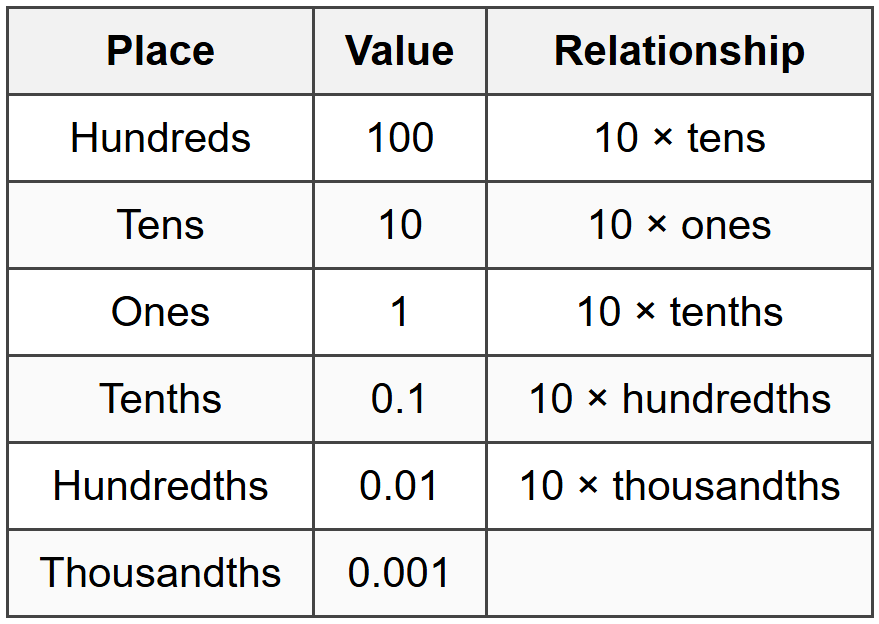
This pattern continues forever in both directions! Understanding this pattern helps us multiply and divide decimals by 10, 100, or 1000:
- When we multiply by 10, every digit moves one place to the left (becomes 10 times larger)
- When we divide by 10, every digit moves one place to the right (becomes 10 times smaller)
For example:
- 3.45 × 10 = 34.5 (decimal point moves one place right)
- 3.45 ÷ 10 = 0.345 (decimal point moves one place left)
Understanding decimal place value is an essential skill that connects to money, measurement, science, and many other real-world applications. By knowing the value of each place, you can read, write, compare, and work with decimal numbers confidently!