Chapter Notes: Multiplying and Dividing With Powers of 10


Have you ever noticed how easy it is to multiply or divide by 10? When you have 3 apples and someone gives you 10 times as many, you suddenly have 30 apples! Working with powers of 10 makes math faster and helps us understand very large and very small numbers. Powers of 10 are special numbers like 10, 100, 1,000, and even 10,000. They follow patterns that make multiplying and dividing simple once you learn the rules. In this chapter, you will discover these patterns and use them to solve problems quickly and accurately.
Understanding Powers of 10
A power of 10 is a number you get when you multiply 10 by itself a certain number of times. We write powers of 10 using an exponent, which is a small number written above and to the right of the 10. The exponent tells us how many times to use 10 as a factor in multiplication.
Here are some powers of 10 written in exponent form and in standard form:
- \( 10^1 = 10 \) (10 used as a factor 1 time)
- \( 10^2 = 10 \times 10 = 100 \) (10 used as a factor 2 times)
- \( 10^3 = 10 \times 10 \times 10 = 1{,}000 \) (10 used as a factor 3 times)
- \( 10^4 = 10 \times 10 \times 10 \times 10 = 10{,}000 \) (10 used as a factor 4 times)
- \( 10^5 = 10 \times 10 \times 10 \times 10 \times 10 = 100{,}000 \) (10 used as a factor 5 times)
Notice the pattern: the exponent tells you how many zeros follow the 1 in the standard form. For example, \( 10^3 \) has 3 zeros, so it equals 1,000.
Think of the exponent as a counting tool. It counts how many zeros come after the 1.
Multiplying Whole Numbers by Powers of 10
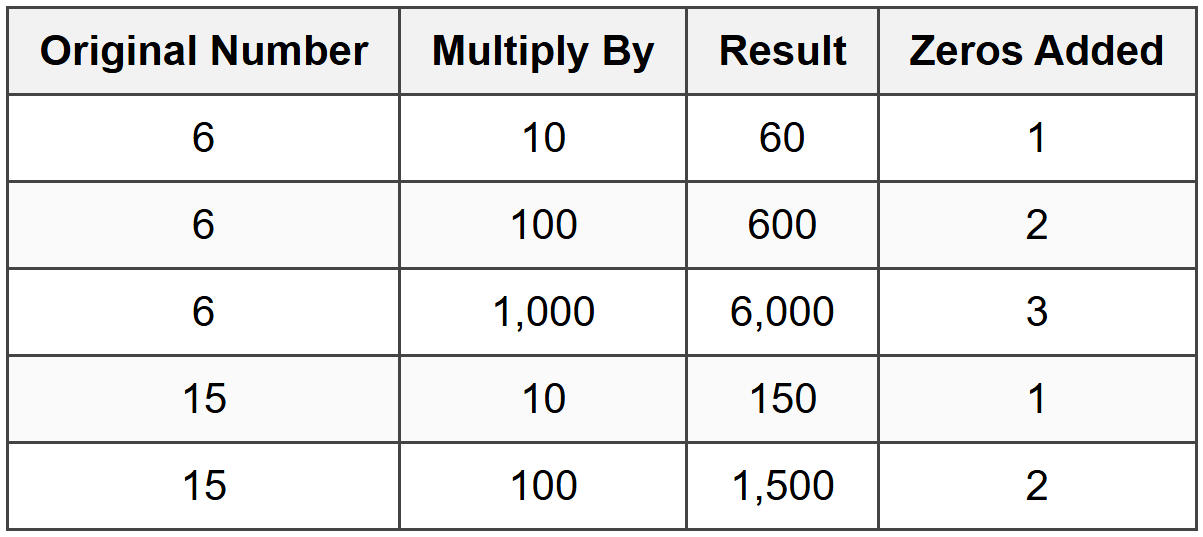
When you multiply a whole number by a power of 10, you can use a shortcut. Instead of doing the full multiplication, you simply add zeros to the end of the number. The number of zeros you add equals the exponent on the 10.
The Pattern for Multiplying
Let's see how this works:
- \( 4 \times 10 = 4 \times 10^1 = 40 \) (add 1 zero)
- \( 4 \times 100 = 4 \times 10^2 = 400 \) (add 2 zeros)
- \( 4 \times 1{,}000 = 4 \times 10^3 = 4{,}000 \) (add 3 zeros)
The number 4 stays the same, but we attach zeros to the end based on the power of 10.
Example: A bakery makes 8 trays of cookies each day.
Each tray holds 10 cookies.How many cookies does the bakery make each day?
Solution:
We need to multiply 8 by 10.
\( 8 \times 10 = 8 \times 10^1 \)
Add 1 zero to 8: \( 8 \times 10 = 80 \)
The bakery makes 80 cookies each day.
Example: A school has 7 classrooms.
Each classroom has 100 books.How many books does the school have in total?
Solution:
We need to multiply 7 by 100.
\( 7 \times 100 = 7 \times 10^2 \)
Add 2 zeros to 7: \( 7 \times 100 = 700 \)
The school has 700 books in total.
Example: A factory produces 25 bicycles each hour.
How many bicycles does it produce in 1,000 hours?Solution:
We need to multiply 25 by 1,000.
\( 25 \times 1{,}000 = 25 \times 10^3 \)
Add 3 zeros to 25: \( 25 \times 1{,}000 = 25{,}000 \)
The factory produces 25,000 bicycles in 1,000 hours.
Why This Pattern Works
When you multiply by 10, each digit in the original number moves one place to the left on the place value chart. This creates an empty space in the ones place, which we fill with a zero. Multiplying by 100 moves each digit two places to the left, creating two empty spaces that we fill with two zeros. The pattern continues for larger powers of 10.
Multiplying Decimals by Powers of 10
When you multiply a decimal number by a power of 10, the digits don't change, but the decimal point moves to the right. The number of places the decimal point moves equals the exponent on the 10.
The Pattern for Decimals
Let's look at examples:
- \( 3.5 \times 10 = 35 \) (decimal point moves 1 place right)
- \( 3.5 \times 100 = 350 \) (decimal point moves 2 places right)
- \( 3.5 \times 1{,}000 = 3{,}500 \) (decimal point moves 3 places right)
Imagine the decimal point as a slider that glides to the right, making the number bigger each time it moves.
Example: A piece of ribbon is 4.2 meters long.
If you need a ribbon 10 times as long, how long will it be?Solution:
We need to multiply 4.2 by 10.
\( 4.2 \times 10 \)
Move the decimal point 1 place to the right: \( 4.2 \) becomes \( 42 \)
The ribbon will be 42 meters long.
Example: A grain of sand has a mass of 0.08 grams.
What is the mass of 100 grains of sand?Solution:
We need to multiply 0.08 by 100.
\( 0.08 \times 100 \)
Move the decimal point 2 places to the right: \( 0.08 \) becomes \( 8.0 \) or \( 8 \)
The mass of 100 grains of sand is 8 grams.
Example: The distance from a tree to a house is 1.75 kilometers.
How many meters is that?
(Remember: 1 kilometer = 1,000 meters)Solution:
We need to multiply 1.75 by 1,000.
\( 1.75 \times 1{,}000 \)
Move the decimal point 3 places to the right: \( 1.75 \) becomes \( 1{,}750 \)
The distance is 1,750 meters.
Adding Placeholder Zeros
Sometimes when you move the decimal point to the right, you need to add extra zeros as placeholders.
Example: Multiply 2.3 by 1,000.
Solution:
We need to move the decimal point 3 places to the right.
Start with 2.3
Move 1 place: 23.
Move 2 places: 230.
Move 3 places: 2,300 (we added a zero as a placeholder)
The answer is 2,300.
Dividing Whole Numbers by Powers of 10
When you divide a whole number by a power of 10, the decimal point moves to the left. The number of places it moves equals the exponent on the 10. Dividing by a power of 10 makes the number smaller.
The Pattern for Dividing Whole Numbers
Let's see examples:
- \( 80 \div 10 = 8 \) (decimal point moves 1 place left)
- \( 800 \div 100 = 8 \) (decimal point moves 2 places left)
- \( 8{,}000 \div 1{,}000 = 8 \) (decimal point moves 3 places left)
Even though 80 looks like a whole number, we can think of it as 80.0 with the decimal point at the end. When we divide by 10, the decimal point moves one place to the left, giving us 8.0 or just 8.
Example: A farmer has 350 apples.
He wants to pack them into bags with 10 apples in each bag.How many bags can he fill?
Solution:
We need to divide 350 by 10.
\( 350 \div 10 \)
Move the decimal point 1 place to the left: \( 350.0 \) becomes \( 35.0 \) or \( 35 \)
The farmer can fill 35 bags.
Example: A stadium has 6,000 seats.
The seats are divided into sections of 100 seats each.How many sections are there?
Solution:
We need to divide 6,000 by 100.
\( 6{,}000 \div 100 \)
Move the decimal point 2 places to the left: \( 6{,}000.0 \) becomes \( 60.0 \) or \( 60 \)
There are 60 sections in the stadium.
Example: A school raised $45,000 for charity.
They want to donate equal amounts to 1,000 families.How much money will each family receive?
Solution:
We need to divide 45,000 by 1,000.
\( 45{,}000 \div 1{,}000 \)
Move the decimal point 3 places to the left: \( 45{,}000.0 \) becomes \( 45.0 \) or \( 45 \)
Each family will receive $45.
Dividing Decimals by Powers of 10
When you divide a decimal number by a power of 10, the decimal point moves to the left. This is the same rule as for whole numbers. Moving the decimal point to the left makes the number smaller.
The Pattern for Dividing Decimals
Examples:
- \( 42.5 \div 10 = 4.25 \) (decimal point moves 1 place left)
- \( 42.5 \div 100 = 0.425 \) (decimal point moves 2 places left)
- \( 42.5 \div 1{,}000 = 0.0425 \) (decimal point moves 3 places left)
Example: A bottle contains 8.4 liters of juice.
You pour the juice equally into 10 glasses.How much juice is in each glass?
Solution:
We need to divide 8.4 by 10.
\( 8.4 \div 10 \)
Move the decimal point 1 place to the left: \( 8.4 \) becomes \( 0.84 \)
Each glass contains 0.84 liters of juice.
Example: A string is 75.0 centimeters long.
You need to convert this length to meters.
(Remember: 100 centimeters = 1 meter)Solution:
We need to divide 75.0 by 100.
\( 75.0 \div 100 \)
Move the decimal point 2 places to the left: \( 75.0 \) becomes \( 0.75 \)
The string is 0.75 meters long.
Example: A scientist measures 32.0 grams of a substance.
She needs to divide it into 1,000 equal samples.How much will each sample weigh?
Solution:
We need to divide 32.0 by 1,000.
\( 32.0 \div 1{,}000 \)
Move the decimal point 3 places to the left: \( 32.0 \) becomes \( 0.032 \)
Each sample will weigh 0.032 grams.
Adding Placeholder Zeros When Dividing
Sometimes when you move the decimal point to the left, you need to add zeros in front of the number as placeholders.
Example: Divide 6 by 100.
Solution:
We need to move the decimal point 2 places to the left.
Start with 6.0
Move 1 place: 0.6
Move 2 places: 0.06 (we added a zero as a placeholder)
The answer is 0.06.
Summary of Patterns
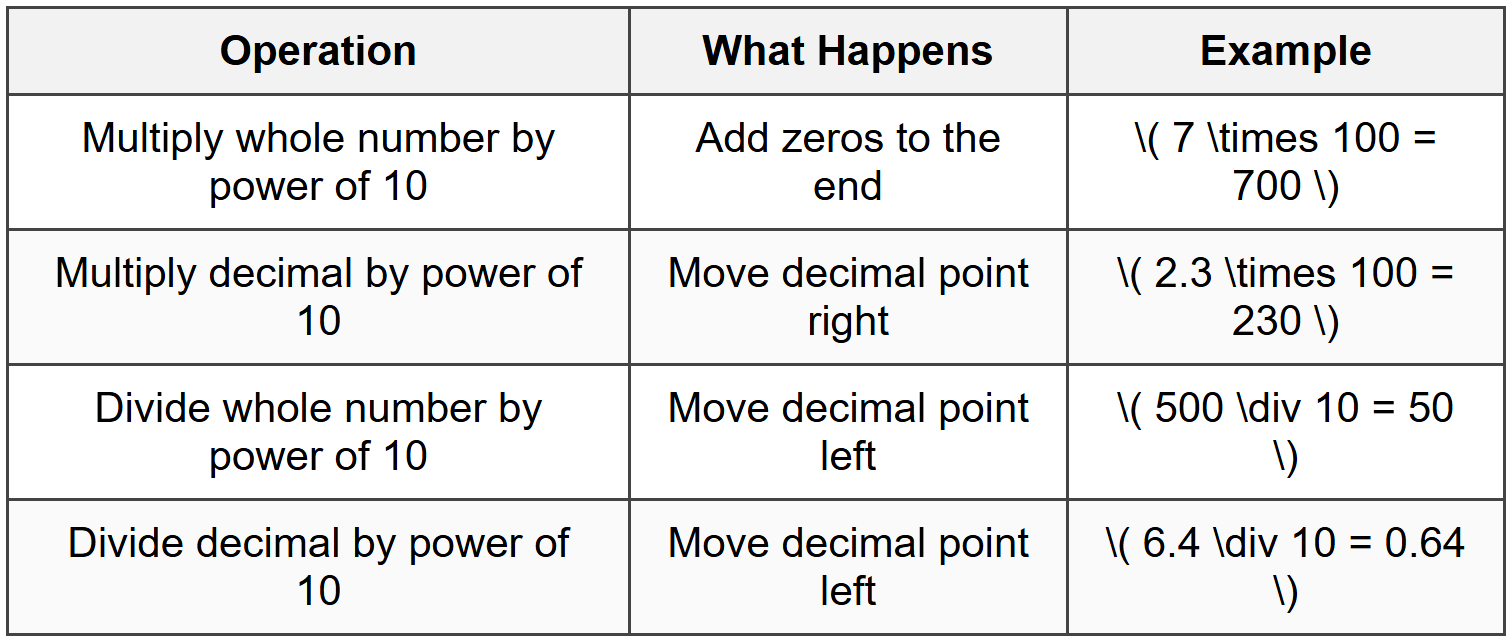
Here is a helpful table summarizing all the patterns you have learned:
Using Powers of 10 in Real Life
Powers of 10 are very useful in everyday situations. We use them when converting measurements, working with money, and understanding large quantities.
Converting Metric Units
The metric system is built on powers of 10. This makes converting between units very easy.
- 1 meter = 100 centimeters, so to convert meters to centimeters, multiply by 100
- 1 kilometer = 1,000 meters, so to convert kilometers to meters, multiply by 1,000
- To convert centimeters to meters, divide by 100
- To convert meters to kilometers, divide by 1,000
Example: A race track is 3.2 kilometers long.
How many meters is that?Solution:
Since 1 kilometer = 1,000 meters, we multiply by 1,000.
\( 3.2 \times 1{,}000 \)
Move the decimal point 3 places to the right: \( 3.2 \) becomes \( 3{,}200 \)
The race track is 3,200 meters long.
Working With Money
Money often involves powers of 10 because 100 cents equal 1 dollar.
Example: You have 850 cents.
How many dollars is that?Solution:
Since 100 cents = 1 dollar, we divide by 100.
\( 850 \div 100 \)
Move the decimal point 2 places to the left: \( 850.0 \) becomes \( 8.50 \)
You have $8.50.
Quick Mental Math Tricks
Once you understand the patterns with powers of 10, you can do many calculations in your head without writing anything down.
To multiply by 10, just slide the decimal point one place to the right. To divide by 10, slide it one place to the left. For 100, slide two places. For 1,000, slide three places!
These shortcuts work because our number system is based on groups of 10. Each place in a number is 10 times larger than the place to its right. Understanding powers of 10 helps you see this structure clearly and use it to solve problems faster.
When you practice these patterns, you will notice that working with powers of 10 becomes automatic. You won't need to think about the steps anymore-you'll just know the answer. This skill will help you with more advanced math topics in the future, including scientific notation, exponents, and algebra.