Marketing Basics

Marketing is the process of creating, communicating, delivering, and exchanging value to customers in ways that benefit both the organization and its stakeholders. For the entrepreneurship component of TLE/TVL exams, you must understand marketing fundamentals including the marketing mix, market segmentation, consumer behavior, and promotional strategies. This topic tests your ability to apply marketing principles to actual business scenarios and recognize effective marketing decisions.
Core Concepts
Marketing Defined
Marketing is the activity, set of institutions, and processes for creating, communicating, delivering, and exchanging offerings that have value for customers, clients, partners, and society. It involves identifying customer needs, developing products or services to meet those needs, and communicating the value proposition effectively.
Marketing differs from selling in that marketing begins with understanding customer needs before creating the product, while selling focuses on convincing customers to buy what already exists. An entrepreneur who conducts market research to discover that students need affordable tutoring services before launching a tutoring business is practicing marketing. An entrepreneur who creates a product first and then tries to convince people to buy it is simply selling.
- Marketing is a continuous process, not a one-time activity
- Effective marketing creates customer satisfaction and loyalty
- Marketing includes market research, product development, pricing, distribution, and promotion
- Customer orientation is central to modern marketing philosophy
When to Use This
- When exam questions ask you to identify the difference between marketing and selling
- When distinguishing between customer-focused versus product-focused business approaches
- When identifying the correct sequence of business activities in entrepreneurial scenarios
- When evaluating whether a business decision reflects true marketing orientation
The Marketing Mix (4Ps)
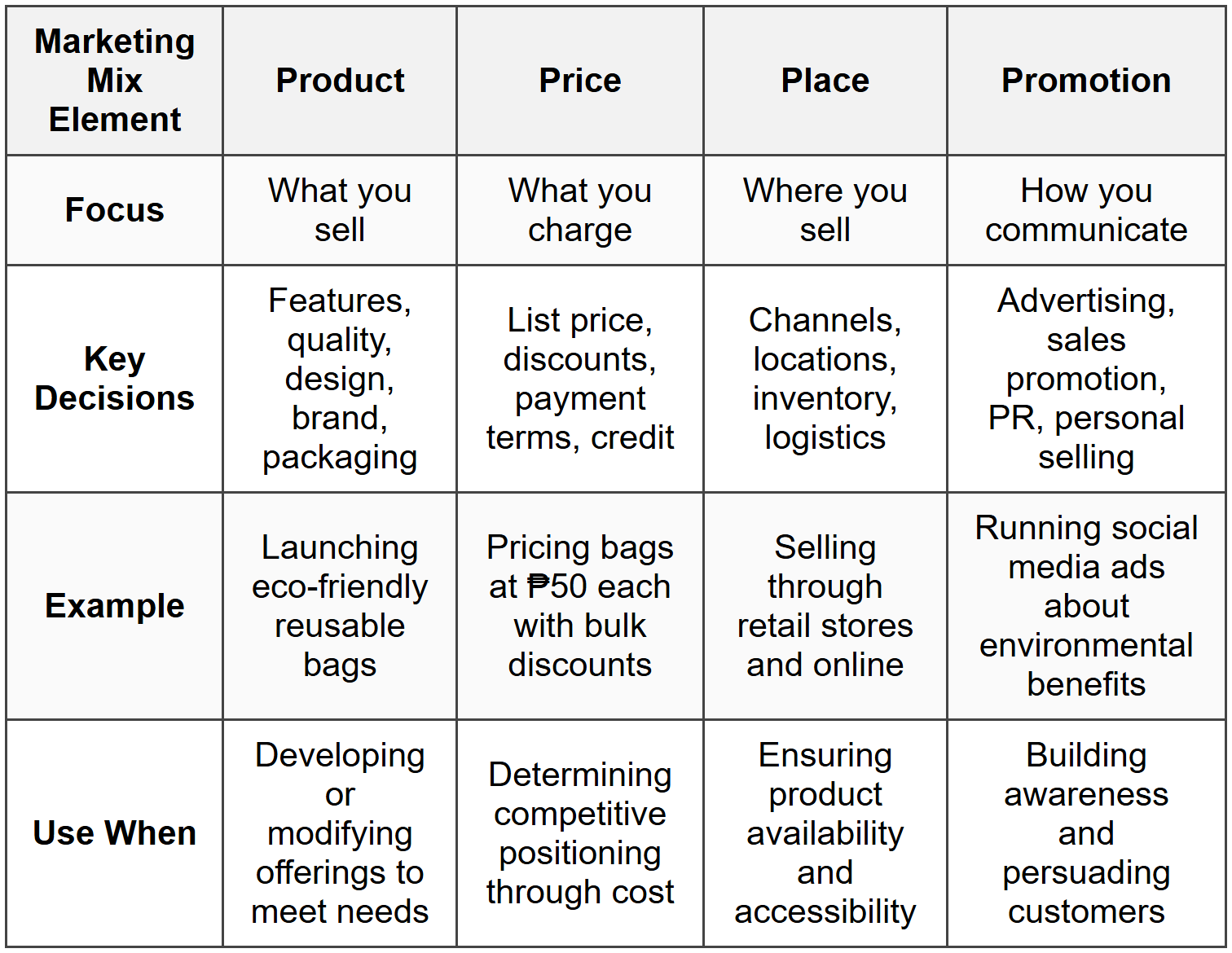
The marketing mix consists of four controllable elements that businesses use to satisfy customer needs and achieve organizational goals: Product, Price, Place, and Promotion. These elements must work together cohesively to create an effective marketing strategy.
Product refers to the goods or services offered to satisfy customer needs. This includes not just the physical item but also features, quality, design, packaging, brand name, and after-sales service. A smartphone as a product includes its technical specifications, design, brand reputation, warranty, and customer support.
- Product decisions include variety, quality, design, features, brand name, packaging, sizes, services, warranties, and returns
- Product life cycle stages affect marketing decisions: introduction, growth, maturity, decline
- New product development is essential for business sustainability
Price is the amount customers pay to obtain the product. It is the only element of the marketing mix that generates revenue; all others represent costs. Pricing strategies include cost-based pricing, competition-based pricing, and value-based pricing.
- Price must reflect perceived value to customers
- Common pricing strategies: penetration pricing (low initial price), skimming (high initial price), competitive pricing, psychological pricing
- Discounts, allowances, payment periods, and credit terms are part of pricing decisions
- Price affects brand positioning and market perception
Place (distribution) involves making products available where and when customers want them. This includes channels of distribution, location, inventory, transportation, and logistics. A bakery choosing a location near a school to sell affordable snacks is making a place decision.
- Distribution channels: direct (manufacturer to consumer) or indirect (using intermediaries)
- Intermediaries include wholesalers, retailers, and agents
- Channel decisions affect market coverage, cost, and control
- Physical distribution includes warehousing, inventory management, and transportation
Promotion encompasses all communication activities used to inform, persuade, and remind customers about products. This includes advertising, sales promotion, public relations, personal selling, and direct marketing.
- Advertising: paid, non-personal communication through media (TV, radio, print, online)
- Sales promotion: short-term incentives like discounts, coupons, contests, free samples
- Public relations: building good relationships with publics through favorable publicity
- Personal selling: direct interaction between salespeople and customers
- Direct marketing: direct communication with targeted individual consumers (email, SMS, mail)
When to Use This
- When exam scenarios ask you to identify which element of the marketing mix a business decision relates to
- When evaluating whether a marketing strategy has all four elements properly coordinated
- When distinguishing between pricing decisions versus promotional decisions in case studies
- When identifying gaps in a business plan that lacks one of the 4Ps
Market Segmentation
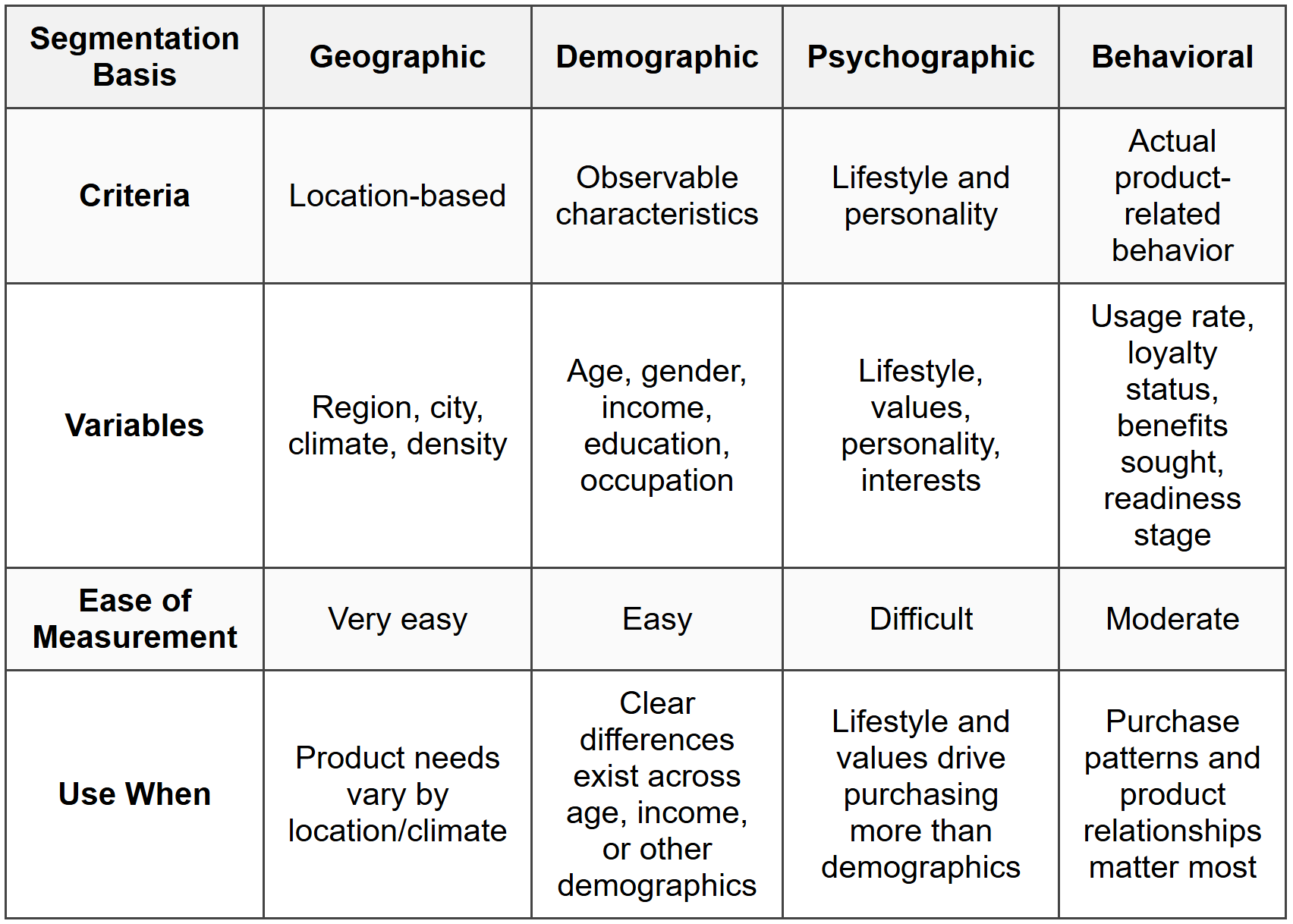
Market segmentation is the process of dividing a broad market into distinct groups of customers with similar needs, characteristics, or behaviors who might require separate marketing strategies. Instead of treating all customers the same, segmentation allows businesses to target specific groups more effectively.
Four main bases for segmentation exist:
- Geographic segmentation: dividing markets by location (region, city size, climate, urban/rural). A clothing business might sell heavy jackets in Baguio but light clothing in Manila.
- Demographic segmentation: dividing by age, gender, income, education, occupation, family size, religion. A toy company targets children aged 3-7 for certain products and teenagers for others.
- Psychographic segmentation: dividing by lifestyle, personality, values, interests. A fitness brand targets health-conscious consumers who value active lifestyles.
- Behavioral segmentation: dividing by knowledge, attitudes, uses, responses to products. Software companies offer different packages for casual users versus power users.
After segmentation, businesses select a target market-the specific segment(s) they will serve. Three targeting strategies exist: undifferentiated (mass marketing to everyone), differentiated (separate strategies for multiple segments), and concentrated (focusing on one segment only).
When to Use This
- When exam questions present a business scenario and ask which customer group to target
- When identifying the most appropriate basis for dividing a specific market
- When evaluating whether a business has properly identified its target market
- When distinguishing between different segmentation approaches in case studies
Consumer Buying Behavior
Consumer buying behavior refers to the actions and decision processes of individuals purchasing products for personal use. Understanding why and how consumers make purchase decisions helps entrepreneurs create effective marketing strategies.
The consumer decision-making process involves five stages:
- Problem recognition: The buyer recognizes a need or problem (hunger, broken phone, desire for entertainment)
- Information search: The buyer seeks information about solutions (asking friends, searching online, visiting stores)
- Evaluation of alternatives: The buyer compares different products or brands based on important attributes
- Purchase decision: The buyer decides which product to buy, where to buy it, and when to buy it
- Post-purchase behavior: After purchase, the buyer evaluates satisfaction, which affects future purchases and word-of-mouth
Several factors influence consumer behavior:
- Cultural factors: culture, subculture, social class shape values and preferences
- Social factors: reference groups, family, social roles and status influence choices
- Personal factors: age, occupation, economic situation, lifestyle, personality affect buying behavior
- Psychological factors: motivation, perception, learning, beliefs, and attitudes drive decisions
When to Use This
- When exam scenarios describe a customer journey and ask which stage they are in
- When identifying what influences a consumer's specific purchase decision in a case study
- When determining the most effective marketing intervention at different decision stages
- When evaluating why a marketing strategy succeeded or failed based on consumer behavior principles
Marketing Research
Marketing research is the systematic design, collection, analysis, and reporting of data relevant to marketing decisions. It helps reduce uncertainty and risk in business decisions by providing factual information about markets, customers, and competition.
The marketing research process follows these steps:
- Define the problem: Clearly state what you need to know (e.g., "Why are sales declining?")
- Develop research objectives: Specify what information will help solve the problem
- Design the research: Choose research approach (exploratory, descriptive, causal) and methods
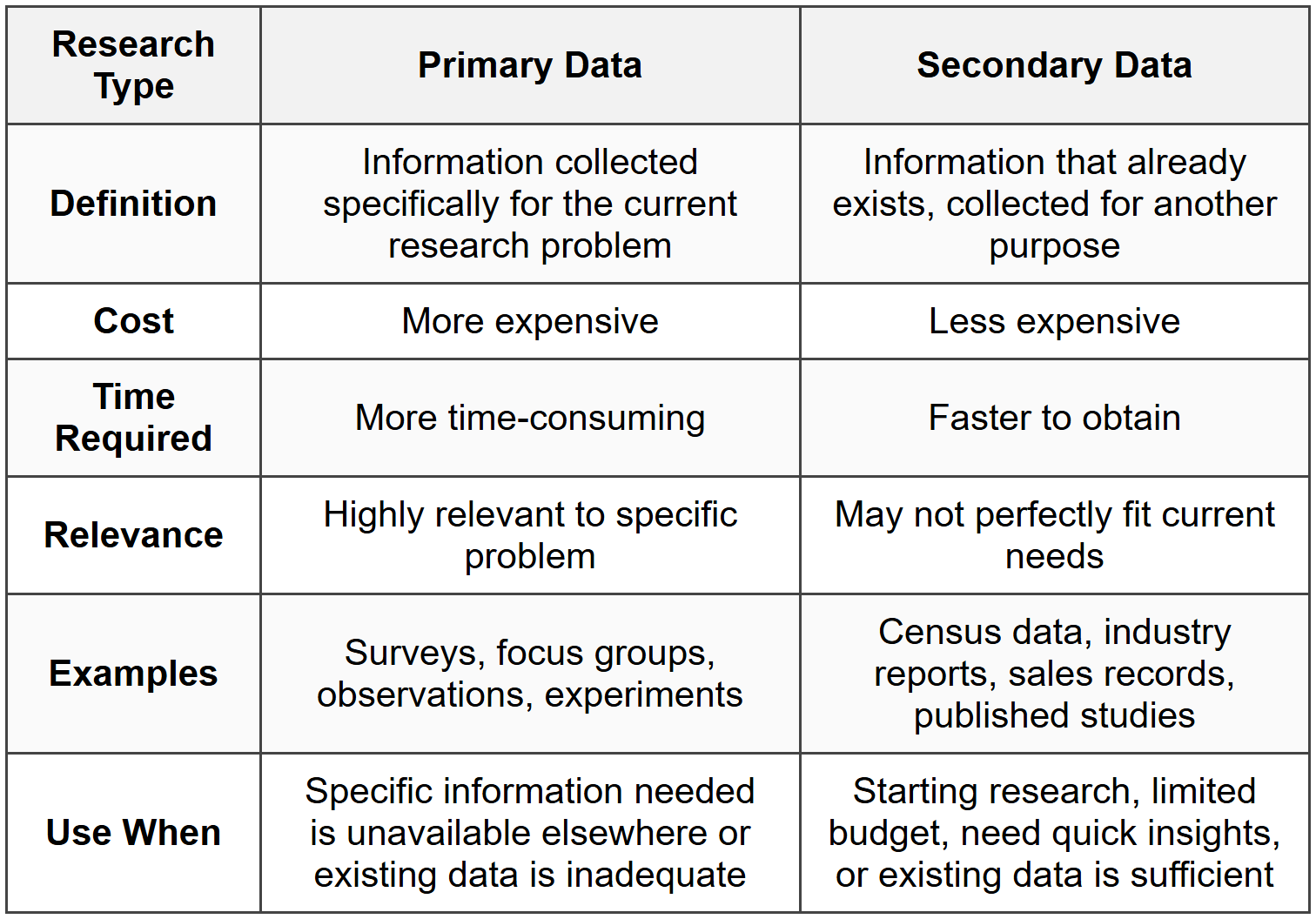
- Collect data: Gather primary data (new data collected specifically) or secondary data (existing data from other sources)
- Analyze data: Process and interpret information to find patterns and insights
- Present findings: Report conclusions and recommendations for decision-making
Primary data collection methods include:
- Surveys: questionnaires administered in person, by phone, mail, or online
- Observations: watching how consumers behave in natural or controlled settings
- Experiments: manipulating variables to determine cause-and-effect relationships
- Focus groups: small group discussions guided by a moderator
Secondary data sources include:
- Internal records (sales reports, customer databases, financial statements)
- Government publications (census data, industry reports, economic statistics)
- Trade associations and industry publications
- Commercial research firms
- Internet sources and databases
When to Use This
- When exam questions ask what type of research method is most appropriate for a specific situation
- When distinguishing between primary and secondary data in scenarios
- When identifying the correct sequence of research steps in a business case
- When evaluating whether a business has properly conducted market research before launching
Product Life Cycle
The product life cycle (PLC) describes the stages a product goes through from introduction to withdrawal from the market. Each stage requires different marketing strategies and presents different challenges and opportunities.
Four stages exist:
Introduction stage: Product is launched, sales grow slowly, profits are negative or low due to high development and promotion costs. Marketing focuses on building awareness and encouraging trial. Prices may be high (skimming) or low (penetration) depending on strategy.
- Sales: Low and slow-growing
- Costs: High per customer
- Profits: Negative or low
- Customers: Innovators and early adopters
- Competition: Few or none
- Marketing objectives: Create awareness and trial
Growth stage: Product gains acceptance, sales rise rapidly, profits increase as costs are spread over larger volume. More competitors enter. Marketing focuses on building brand preference and increasing market share.
- Sales: Rapidly rising
- Costs: Average cost per customer
- Profits: Rising
- Customers: Early majority
- Competition: Growing number
- Marketing objectives: Maximize market share
Maturity stage: Sales growth slows or plateaus, market becomes saturated, intense competition, profits stabilize or decline. Marketing focuses on differentiation and defending market share.
- Sales: Peak but slow or no growth
- Costs: Low per customer
- Profits: High but may decline due to competition
- Customers: Late majority
- Competition: Many competitors
- Marketing objectives: Defend market share, maximize profit
Decline stage: Sales fall, profits erode, some competitors exit. Businesses must decide whether to maintain, harvest (reduce costs and milk remaining profits), or discontinue the product.
- Sales: Declining
- Costs: Low per customer
- Profits: Declining
- Customers: Laggards
- Competition: Declining number
- Marketing objectives: Reduce expenditure, harvest or discontinue
When to Use This
- When exam scenarios describe sales and profit patterns and ask which stage a product is in
- When identifying the most appropriate marketing strategy for a product at a specific life cycle stage
- When evaluating whether a business decision matches the product's current stage
- When predicting what will likely happen next based on current stage characteristics
Branding
A brand is a name, term, sign, symbol, design, or combination that identifies products or services and differentiates them from competitors. Branding is the process of creating and maintaining a brand identity that resonates with target customers.
Strong brands provide several benefits:
- Make products easier to identify and repurchase
- Allow premium pricing due to perceived value
- Build customer loyalty and emotional connections
- Facilitate new product introductions under the same brand
- Protect against competition through distinct identity
Brand elements include:
- Brand name: the word or words used to identify the product (Jollibee, Nike, Apple)
- Brand mark/logo: the visual symbol or design (McDonald's golden arches, Apple's apple)
- Trademark: legal protection for brand name and mark
- Slogan/tagline: phrase that communicates brand essence ("I'm lovin' it," "Just do it")
Branding strategies include:
- Individual branding: different brands for different products (Procter & Gamble uses Tide, Pampers, Gillette)
- Family branding: same brand for multiple products (Honda cars, motorcycles, generators)
- Co-branding: two brands partnering on one product (Nestlé and Nescafé partnering with coffee shops)
- Private branding: retailers creating their own brands (SM Bonus, Shopwise)
When to Use This
- When exam questions ask about the benefits of establishing a strong brand
- When identifying which branding strategy a business scenario represents
- When evaluating brand elements in case studies
- When distinguishing between effective and ineffective brand positioning decisions
Commonly Tested Scenarios / Pitfalls
1. Scenario: An exam question describes a business owner who created an excellent product but is struggling with sales because customers don't know about it. The question asks which element of the marketing mix needs improvement.
Correct Approach: The answer is Promotion (the 4th P). The business has the product but lacks communication activities to inform and persuade customers.
Check first: Identify which of the 4Ps is being described or is missing in the scenario. Look for keywords: product features = Product, pricing decisions = Price, distribution/location = Place, advertising/communication = Promotion.
Do NOT do first: Do not assume the problem is with the product itself just because sales are low. Low sales can result from problems with any of the 4Ps. Many students incorrectly choose "Product" when the issue is actually poor promotion or wrong pricing.
Why other options are wrong: Product is already good (stated), Price isn't mentioned as an issue, Place assumes customers can access it-the specific problem identified is lack of customer awareness, which is exclusively a Promotion concern.
2. Scenario: The exam presents a business targeting teenagers aged 13-19 with trendy clothing and asks what type of market segmentation is being used.
Correct Approach: This is Demographic segmentation because age is a demographic variable-an observable, measurable characteristic of the population.
Check first: Identify what characteristic is being used to divide the market. Age, gender, income, education = demographic; location = geographic; lifestyle, values = psychographic; purchase behavior = behavioral.
Do NOT do first: Do not confuse "trendy" (a product characteristic appealing to a lifestyle) with the segmentation basis. The market is divided BY age, even though the product style appeals to a certain lifestyle. The segmentation criterion is how you identify the group, not what you sell them.
Why other options are wrong: Geographic focuses on location not age; psychographic would require dividing by lifestyle or values as the primary criterion; behavioral would focus on usage patterns or buying behavior, not age groups.
3. Scenario: A question describes a customer who realizes his phone is broken, searches for replacement options online, compares different brands, then buys one. It asks which stage the customer is in when comparing brands.
Correct Approach: The customer is in the Evaluation of Alternatives stage-the third stage where buyers compare different options based on important criteria.
Check first: Match the described action to the correct stage: recognizing a need = Problem Recognition; seeking information = Information Search; comparing options = Evaluation of Alternatives; making the purchase = Purchase Decision; feeling satisfied/dissatisfied = Post-Purchase Behavior.
Do NOT do first: Do not jump to "Purchase Decision" just because the scenario eventually mentions buying. The question specifically asks about the comparing phase, which occurs before the actual purchase decision.
Why other options are wrong: Problem Recognition already happened (phone broke); Information Search was the online searching; Purchase Decision comes after comparing; Post-Purchase Behavior happens after buying-the comparing action specifically defines the Evaluation stage.
4. Scenario: An exam question states a new product has slow sales, negative profits, and few competitors, then asks which product life cycle stage it represents.
Correct Approach: This is the Introduction stage, characterized by slow sales growth, high costs leading to negative or low profits, and few competitors.
Check first: Identify the combination of indicators: sales trend (slow/rapid/peak/declining), profit level (negative/rising/high/declining), and number of competitors (few/growing/many/declining). Each stage has a distinct pattern.
Do NOT do first: Do not choose Decline stage just because profits are negative. Decline has falling sales from a previous peak, while Introduction has low but potentially growing sales from launch. Negative profits in early stages are due to high development costs, not market rejection.
Why other options are wrong: Growth has rapidly rising sales and increasing profits; Maturity has peak sales and high profits despite competition; Decline has falling sales and competitors exiting-none match the slow initial sales pattern described.
5. Scenario: A business wants to understand why customers stopped buying their product. The exam asks whether they should use primary or secondary data first.
Correct Approach: Start with Secondary data-check existing sales records, customer feedback, industry reports, and competitor information first. This is faster, cheaper, and may provide sufficient insights before investing in expensive primary research.
Check first: Determine if existing information might answer the question adequately. Secondary data should generally be consulted first unless the problem is so unique or specific that no existing data could possibly address it.
Do NOT do first: Do not immediately launch surveys or focus groups (primary data collection) without first examining what information is already available. This wastes time and resources on questions that existing data might answer.
Why other options are wrong: While primary data will likely be needed eventually for specific customer insights, starting with it ignores the efficiency principle-always check existing sources first before collecting new data, especially for exploratory questions where you're still defining the problem.
Step-by-Step Procedures or Methods
Developing a Marketing Plan
Task: Creating a basic marketing plan for a new product or business
- Conduct a situation analysis-analyze the current market, competition, customer needs, and your business capabilities using SWOT analysis (Strengths, Weaknesses, Opportunities, Threats)
- Define marketing objectives-set specific, measurable goals such as "achieve 500 customers in 6 months" or "capture 10% market share in first year"
- Identify your target market-determine which customer segment(s) you will serve based on segmentation analysis (demographic, geographic, psychographic, or behavioral)
- Develop your positioning strategy-decide how you want customers to perceive your product relative to competitors (e.g., "most affordable," "highest quality," "most convenient")
- Create your marketing mix strategy-make decisions for each of the 4Ps:
- Product: features, quality, design, packaging, brand
- Price: pricing strategy, discounts, payment terms
- Place: distribution channels, locations, logistics
- Promotion: advertising, sales promotion, personal selling, PR mix
- Set a marketing budget-allocate financial resources across different marketing activities based on priorities and expected returns
- Develop an action plan-specify what will be done, by whom, when, and at what cost; create a timeline with milestones
- Establish control measures-determine how you will monitor performance (metrics like sales, market share, customer satisfaction) and adjust strategies as needed
Conducting Primary Market Research Using Surveys
Task: Gathering information directly from potential customers through questionnaires
- Define your research objectives-clearly state what information you need (e.g., "determine preferred product features," "identify price sensitivity," "assess brand awareness")
- Identify your target population-specify exactly who should respond (e.g., "women aged 25-40 living in Metro Manila with household income above ₱50,000")
- Determine sample size-decide how many respondents you need for reliable results (larger samples are more reliable but more costly; minimum typically 30-100 for small studies)
- Design your questionnaire-create clear, unbiased questions:
- Use simple language appropriate to respondents
- Start with easy, non-threatening questions
- Group related questions together
- Use a mix of open-ended (free response) and closed-ended (multiple choice, rating scales) questions
- Avoid leading questions that suggest a desired answer
- Keep it reasonably short to maintain attention
- Choose your survey method-select how you'll administer surveys (face-to-face interviews, telephone, mail, online/email, mobile apps) based on budget, time, and target market accessibility
- Conduct a pilot test-test your questionnaire with a small group (5-10 people) to identify confusing questions, timing issues, or technical problems before full deployment
- Collect the data-administer surveys to your sample, ensuring proper coverage and response rate (aim for at least 30-40% response rate)
- Analyze the results-tabulate responses, calculate percentages, identify patterns, and summarize findings in relation to your original research objectives
- Report findings and recommendations-present conclusions clearly with supporting data and suggest specific actions based on what you learned
Practice Questions
Q1: Maria owns a small bakery and wants to increase sales. She decides to offer a "buy 3, get 1 free" promotion for one week. Which element of the marketing mix is Maria primarily using?
(a) Product
(b) Price
(c) Place
(d) Promotion
Ans: (d)
Sales promotions like "buy 3, get 1 free" are short-term incentives that fall under Promotion-they communicate value and encourage immediate purchase. While this affects the effective price customers pay, its primary purpose is promotional communication to stimulate sales. Option (a) is wrong because the product itself hasn't changed. Option (b) is wrong because although this affects perceived value, it's a promotional tactic rather than a base pricing strategy. Option (c) is wrong because distribution channels haven't changed.
Q2: A clothing retailer divides its market into groups based on locations: NCR, Luzon, Visayas, and Mindanao, then creates different product assortments for each region based on climate and cultural preferences. What type of market segmentation is being used?
(a) Demographic segmentation
(b) Psychographic segmentation
(c) Geographic segmentation
(d) Behavioral segmentation
Ans: (c)
Geographic segmentation divides markets based on location-regions, cities, climate zones, urban/rural areas. The retailer is organizing markets by geographic regions and responding to location-based differences. Option (a) is wrong because demographics refer to age, gender, income, education-not location. Option (b) is wrong because psychographic segmentation focuses on lifestyle, values, and personality. Option (d) is wrong because behavioral segmentation focuses on purchase behaviors, usage patterns, or benefits sought, not geographic location.
Q3: A smartphone model currently has rapidly increasing sales, growing profits, and several new competitors entering the market. According to the product life cycle, which stage is this product most likely in?
(a) Introduction
(b) Growth
(c) Maturity
(d) Decline
Ans: (b)
The Growth stage is characterized by rapidly rising sales, increasing profits, and growing competition as more companies enter the market. These three indicators together clearly point to Growth. Option (a) is wrong because Introduction has slow sales growth and few/no competitors. Option (c) is wrong because Maturity has slowing or plateauing sales growth, not rapidly increasing sales. Option (d) is wrong because Decline has falling sales and competitors exiting, not entering.
Q4: Juan is planning to open a tutoring center. Before making major investments, he checks public school enrollment statistics from DepEd, reviews published reports on the education services industry, and examines competitors' websites. What type of data is Juan primarily using?
(a) Primary data
(b) Secondary data
(c) Experimental data
(d) Observational data
Ans: (b)
Secondary data is information that already exists, collected by others for different purposes-government statistics, published reports, websites, existing records. Juan is using existing sources rather than collecting new data himself. Option (a) is wrong because primary data is information collected specifically for your current research problem through surveys, interviews, experiments, or direct observation. Option (c) is wrong because experiments are a method of collecting primary data by manipulating variables. Option (d) is wrong because observation is also a primary data collection method involving watching behavior directly.
Q5: A customer realizes she needs a new laptop because her old one broke. She then searches online for different laptop brands, reads reviews, visits several stores to compare features and prices, and finally purchases a laptop from an authorized dealer. At which stage was the customer when she was reading reviews and comparing features?
(a) Problem recognition
(b) Information search
(c) Evaluation of alternatives
(d) Post-purchase behavior
Ans: (c)
Evaluation of alternatives is when buyers compare different brands and options based on important attributes like features, price, reviews, and quality. Reading reviews to compare and visiting stores to compare features and prices are evaluation activities. Option (a) is wrong because problem recognition (realizing the need) already occurred when she noticed her laptop broke. Option (b) is wrong because information search is the initial gathering of information about potential solutions-while reading reviews involves information, the emphasis on comparing different options signals the evaluation stage. Option (d) is wrong because post-purchase behavior happens after buying, not before.
Q6: Which of the following scenarios best demonstrates a business using demographic segmentation?
(a) A restaurant targeting customers who value organic, healthy eating
(b) A toy store focusing on children aged 3-10 years old
(c) A clothing brand targeting customers in urban areas
(d) A coffee shop targeting customers who visit daily
Ans: (b)
Demographic segmentation uses measurable population characteristics like age, gender, income, or education. Targeting children aged 3-10 is clearly age-based demographic segmentation. Option (a) is wrong because valuing healthy eating is a psychographic variable (lifestyle/values), not demographic. Option (c) is wrong because urban areas represent geographic segmentation (location-based), not demographic. Option (d) is wrong because visiting daily is behavioral segmentation based on usage rate, not demographic characteristics.
Quick Review
- Marketing is identifying and satisfying customer needs profitably; it starts before product creation, while selling starts after
- The 4Ps of marketing mix are Product (what you offer), Price (what you charge), Place (where/how you distribute), and Promotion (how you communicate)
- Market segmentation divides markets into groups: Geographic (location), Demographic (age, gender, income), Psychographic (lifestyle, values), Behavioral (usage, loyalty)
- Consumer buying process: Problem Recognition → Information Search → Evaluation of Alternatives → Purchase Decision → Post-Purchase Behavior
- Primary data is collected specifically for your research (surveys, focus groups, experiments); Secondary data already exists (government reports, published studies, internal records)
- Always start with secondary data before collecting expensive primary data-it's faster, cheaper, and may be sufficient
- Product Life Cycle stages: Introduction (slow sales, negative profits, few competitors) → Growth (rapid sales, rising profits, growing competition) → Maturity (peak sales, high profits, intense competition) → Decline (falling sales, declining profits, competitors exiting)
- Strong brands create customer loyalty, allow premium pricing, facilitate new product launches, and protect against competition
- Target market selection follows segmentation; businesses can use undifferentiated (mass market), differentiated (multiple segments), or concentrated (single segment) targeting
- Marketing research follows: Define problem → Develop objectives → Design research → Collect data → Analyze data → Present findings