Chapter Notes: Inheritance and Variation of Traits


Have you ever wondered why you share some traits with your parents but not all of them? Why do siblings often look similar yet distinctly different? The answers lie in the fascinating mechanisms of heredity and the variation of traits that make each organism unique. Understanding how traits are inherited from parents to offspring, and why variation exists even among closely related individuals, reveals fundamental principles of biology that explain the diversity of life on Earth. This chapter explores the molecular basis of inheritance, the patterns discovered by early geneticists, and the mechanisms that generate the remarkable variation we observe in nature.
The Molecular Basis of Inheritance
At the core of inheritance is DNA (deoxyribonucleic acid), the molecule that carries genetic information in nearly all living organisms. DNA consists of two long strands twisted into a double helix structure, with each strand made of repeating units called nucleotides. Each nucleotide contains a sugar molecule (deoxyribose), a phosphate group, and one of four nitrogenous bases: adenine (A), thymine (T), guanine (G), or cytosine (C).
The sequence of these bases encodes genetic information, much like letters form words and sentences. The two strands of DNA are complementary, meaning adenine always pairs with thymine (A-T), and guanine always pairs with cytosine (G-C). This complementary base pairing is crucial for DNA replication and for passing genetic information from parent to offspring.
A gene is a segment of DNA that contains the instructions for making a specific protein or functional RNA molecule. Proteins perform most of the work in cells, determining traits such as eye color, blood type, enzyme function, and countless other characteristics. The complete set of genetic information in an organism is called its genome.
Humans have approximately 20,000-25,000 genes distributed across 23 pairs of chromosomes. Chromosomes are long, organized structures of DNA and proteins found in the nucleus of eukaryotic cells. Each chromosome contains hundreds to thousands of genes arranged in a linear sequence.
DNA Replication and Cell Division
Before a cell divides, it must copy its entire genome so that each daughter cell receives a complete set of genetic instructions. This process is called DNA replication. During replication, the double helix unwinds, and each strand serves as a template for building a new complementary strand. The enzyme DNA polymerase adds nucleotides to the growing strand, following the base-pairing rules.
Two types of cell division are central to inheritance:
- Mitosis produces two genetically identical daughter cells, each with the same number of chromosomes as the parent cell. This type of division is used for growth, repair, and asexual reproduction.
- Meiosis produces four genetically unique daughter cells (gametes), each with half the number of chromosomes as the parent cell. In humans, meiosis produces sperm and egg cells with 23 chromosomes each, rather than the usual 46.
Meiosis is essential for sexual reproduction and introduces genetic variation through two key mechanisms: crossing over (where homologous chromosomes exchange segments of DNA) and independent assortment (where chromosomes are randomly distributed to gametes).
Mendelian Genetics: Patterns of Inheritance
The foundational principles of heredity were discovered by Gregor Mendel, an Austrian monk who conducted experiments with pea plants in the mid-1800s. Although Mendel knew nothing about DNA or chromosomes, his careful observations revealed predictable patterns in how traits are passed from parents to offspring.
Key Concepts in Mendelian Genetics
Mendel worked with traits that had two distinct forms, such as seed color (yellow or green) and plant height (tall or short). He discovered that these traits are controlled by discrete units of inheritance, which we now call genes. Each individual inherits two copies of each gene, one from each parent. These alternative forms of a gene are called alleles.
An organism's genotype refers to its genetic makeup-the specific alleles it carries. The phenotype is the observable trait or characteristic that results from the interaction between the genotype and the environment. For example, a pea plant might have a genotype of two alleles for tallness and exhibit the phenotype of being tall.
Alleles can be dominant or recessive. A dominant allele masks the effect of a recessive allele when both are present. By convention, dominant alleles are represented with uppercase letters (such as T for tall) and recessive alleles with lowercase letters (such as t for short). An individual with two identical alleles (TT or tt) is homozygous for that trait, while an individual with two different alleles (Tt) is heterozygous.
Mendel's Law of Segregation
The Law of Segregation states that the two alleles for each gene separate during gamete formation, so each gamete receives only one allele for each gene. When fertilization occurs, offspring receive one allele from each parent, restoring the pair. This explains why offspring can inherit different combinations of alleles than either parent alone.
Example: A heterozygous tall pea plant (Tt) is crossed with another heterozygous tall pea plant (Tt).
Tallness (T) is dominant over shortness (t).What are the expected genotypes and phenotypes of the offspring?
Solution:
Each parent can produce two types of gametes: T or t
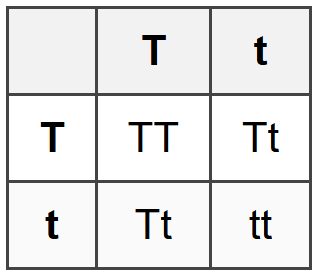
Using a Punnett square to show all possible combinations:
Genotype ratio: 1 TT : 2 Tt : 1 tt
Phenotype ratio: 3 tall : 1 short (since TT and Tt both produce tall plants)
The offspring have a 3:1 phenotypic ratio of tall to short plants.
Mendel's Law of Independent Assortment
The Law of Independent Assortment states that alleles for different genes are distributed to gametes independently of one another. This means that inheriting a particular allele for one trait (such as seed color) does not influence which allele is inherited for another trait (such as seed shape), provided the genes are on different chromosomes or far apart on the same chromosome.
When considering two traits simultaneously (a dihybrid cross), the offspring show a 9:3:3:1 phenotypic ratio if both traits follow simple dominant-recessive patterns. This ratio reflects all possible combinations of the two traits.
Example: A pea plant heterozygous for both seed color (Yy, yellow dominant) and seed shape (Rr, round dominant) is crossed with another plant with the same genotype.
What is the probability of producing offspring with yellow, wrinkled seeds?
Solution:
For yellow seeds: Y is dominant, so genotypes YY or Yy produce yellow seeds. Probability = 3/4
For wrinkled seeds: r is recessive, so only genotype rr produces wrinkled seeds. Probability = 1/4
Since the traits assort independently, multiply the probabilities: \( \frac{3}{4} \times \frac{1}{4} = \frac{3}{16} \)
The probability of yellow, wrinkled seeds is 3/16 or approximately 18.75%.
Extensions of Mendelian Genetics
While Mendel's principles provide a foundation for understanding inheritance, many traits exhibit patterns more complex than simple dominant-recessive relationships.
Incomplete Dominance
In incomplete dominance, the heterozygous phenotype is intermediate between the two homozygous phenotypes. Neither allele is completely dominant over the other. For example, when red-flowered snapdragons (RR) are crossed with white-flowered snapdragons (WW), the heterozygous offspring (RW) have pink flowers-a blend of the two parental phenotypes.
Codominance
Codominance occurs when both alleles are fully expressed in the heterozygous condition, with no blending. Human blood type provides a classic example. The IA and IB alleles are codominant; individuals with genotype IAIB express both A and B antigens on their red blood cells, resulting in blood type AB.
Multiple Alleles
While any individual can carry only two alleles for a given gene (one from each parent), some genes exist in more than two forms in the population. The ABO blood group system involves three alleles: IA, IB, and i. IA and IB are codominant to each other, and both are dominant over i, which is recessive.
Polygenic Inheritance
Many traits are influenced by multiple genes, a pattern called polygenic inheritance. These traits typically show continuous variation rather than discrete categories. Human height, skin color, and eye color are examples of polygenic traits. The combined effects of multiple genes, each contributing a small amount to the phenotype, produce a wide range of variation.
Pleiotropy
Pleiotropy occurs when a single gene influences multiple, seemingly unrelated phenotypic traits. For example, the gene responsible for sickle cell disease affects the shape of red blood cells, but also influences resistance to malaria, organ function, and overall health.
Chromosomal Basis of Inheritance
The discovery that genes are located on chromosomes provided a physical basis for Mendel's laws and revealed additional inheritance patterns.
Sex-Linked Inheritance
In many organisms, including humans, biological sex is determined by sex chromosomes. Humans have two sex chromosomes: X and Y. Females typically have two X chromosomes (XX), while males have one X and one Y chromosome (XY). The Y chromosome is much smaller than the X and carries fewer genes.
Genes located on the sex chromosomes show sex-linked inheritance patterns. Traits controlled by genes on the X chromosome are called X-linked traits. Because males have only one X chromosome, they express X-linked recessive traits more frequently than females. If a male inherits a recessive allele on his X chromosome, he will express that trait because he has no second X chromosome to potentially carry a dominant allele.
Classic examples of X-linked recessive traits in humans include red-green color blindness and hemophilia A (a blood clotting disorder). Females can be carriers of these conditions without expressing them if they have one normal allele and one recessive allele.
Example: A woman who is a carrier for hemophilia (XHXh) has children with a man who does not have hemophilia (XHY).
H represents the normal allele, and h represents the hemophilia allele.What is the probability that their son will have hemophilia?
Solution:
Mother's possible gametes: XH or Xh
Father's possible gametes: XH or Y
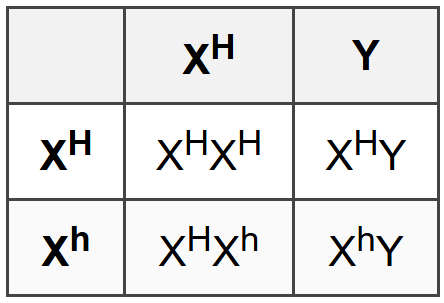
Punnett square for sex-linked inheritance:
Sons are XHY (unaffected) or XhY (hemophilia)
The probability that a son will have hemophilia is 50% or 1/2.
Linked Genes and Genetic Recombination
Genes located on the same chromosome are linked genes and tend to be inherited together. This violates Mendel's Law of Independent Assortment, which applies only to genes on different chromosomes. However, linked genes are not always inherited as a unit because of crossing over during meiosis.
Crossing over is the exchange of chromosomal segments between homologous chromosomes during prophase I of meiosis. This process produces recombinant chromosomes with new combinations of alleles. The frequency of recombination between two genes is proportional to the distance between them on the chromosome. Genes that are far apart are more likely to be separated by crossing over than genes that are close together.
Sources of Genetic Variation
Genetic variation is the raw material for evolution and allows populations to adapt to changing environments. Several mechanisms generate and maintain genetic diversity within populations.
Mutations
Mutations are changes in the DNA sequence. They are the ultimate source of all new alleles and genetic variation. Mutations can occur spontaneously due to errors during DNA replication or be induced by environmental factors such as radiation, chemicals, or viruses.
Types of mutations include:
- Point mutations: Changes in a single nucleotide base pair. These can be silent (no change in amino acid), missense (different amino acid), or nonsense (premature stop codon).
- Insertions and deletions: Addition or removal of nucleotides. If not in multiples of three, these cause frameshift mutations that alter all downstream amino acids.
- Chromosomal mutations: Large-scale changes including deletions, duplications, inversions, or translocations of chromosome segments.
Most mutations are neutral or harmful, but occasionally a mutation provides a beneficial trait that improves an organism's survival or reproductive success.
Sexual Reproduction
Sexual reproduction generates genetic variation through three key processes:
- Independent assortment of chromosomes: During metaphase I of meiosis, homologous chromosome pairs align randomly, producing gametes with different combinations of maternal and paternal chromosomes. In humans, this alone can produce over 8 million different gamete combinations.
- Crossing over: Exchange of genetic material between homologous chromosomes creates recombinant chromosomes with new allele combinations.
- Random fertilization: Any sperm can fertilize any egg, combining genetic material from two parents in unique ways.
These mechanisms ensure that each offspring (except identical twins) is genetically unique, even within the same family.
Gene Flow and Genetic Drift
While not mechanisms of generating new mutations, gene flow (movement of alleles between populations through migration) and genetic drift (random changes in allele frequencies, especially in small populations) affect the distribution of genetic variation within and between populations.
Environmental Influences on Phenotype
While genotype provides the genetic instructions, phenotype results from the interaction between genes and environment. The same genotype can produce different phenotypes under different environmental conditions, a concept called phenotypic plasticity.
Environmental factors that can influence phenotype include:
- Temperature: The fur color of Himalayan rabbits is temperature-sensitive; cooler body parts develop darker fur.
- Nutrition: Adequate nutrition during development is essential for reaching genetic height potential in humans.
- Light: Plants grown in darkness are pale and spindly compared to those grown in light, even with identical genotypes.
- Chemical exposure: Certain chemicals can alter gene expression patterns without changing DNA sequence (epigenetic modifications).
The norm of reaction describes the range of phenotypes a single genotype can produce across different environments. Some traits have a narrow norm of reaction (ABO blood type is largely unaffected by environment), while others have a broad norm of reaction (height and weight are significantly influenced by nutrition and other factors).
Human Genetic Disorders
Understanding inheritance patterns helps explain how genetic disorders are transmitted through families and informs genetic counseling.
Autosomal Recessive Disorders
These disorders require two copies of the recessive allele for expression. Affected individuals are homozygous recessive. Examples include:
- Cystic fibrosis: Affects mucus production in lungs and digestive system
- Sickle cell disease: Causes red blood cells to become sickle-shaped, reducing oxygen transport
- Tay-Sachs disease: Fatal disorder affecting nerve cell function
Parents who are both heterozygous carriers have a 25% chance with each pregnancy of having an affected child.
Autosomal Dominant Disorders
These disorders require only one copy of the dominant allele for expression. Affected individuals are either heterozygous or homozygous dominant. Examples include:
- Huntington's disease: Progressive neurological disorder typically appearing in middle age
- Achondroplasia: Most common form of dwarfism
An affected parent who is heterozygous has a 50% chance of passing the disorder to each child.
Sex-Linked Disorders
As discussed earlier, X-linked recessive disorders disproportionately affect males. Other examples beyond hemophilia and color blindness include Duchenne muscular dystrophy (progressive muscle weakness and degeneration).
Chromosomal Disorders
Abnormalities in chromosome number or structure can cause serious disorders:
- Down syndrome (Trisomy 21): Three copies of chromosome 21 cause intellectual disability and characteristic physical features
- Turner syndrome (45,X): Females with only one X chromosome have short stature and infertility
- Klinefelter syndrome (47,XXY): Males with an extra X chromosome may have reduced fertility and other symptoms
Pedigree Analysis
A pedigree is a diagram showing the inheritance pattern of a trait through multiple generations of a family. Pedigrees use standard symbols: squares represent males, circles represent females, shaded symbols indicate affected individuals, and horizontal lines connect mating pairs while vertical lines show offspring.
Analyzing pedigrees helps determine whether a trait is dominant or recessive, autosomal or sex-linked:
- If affected individuals appear in every generation, the trait is likely dominant
- If the trait skips generations, it is likely recessive
- If significantly more males than females are affected, the trait may be X-linked recessive
- If two unaffected parents have an affected child, the trait is recessive and both parents are carriers
Biotechnology and Genetic Testing
Modern biotechnology provides powerful tools for analyzing inheritance and detecting genetic disorders.
Karyotyping is a technique that produces an image of all chromosomes in a cell, arranged by size and banding pattern. This can detect chromosomal abnormalities such as extra or missing chromosomes.
DNA sequencing determines the exact order of nucleotides in DNA. Advances in sequencing technology now allow rapid, affordable analysis of individual genes or entire genomes.
Genetic screening tests individuals for the presence of specific alleles associated with genetic disorders. This can identify carriers who are heterozygous for recessive conditions, detect genetic disorders before symptoms appear, or provide prenatal diagnosis.
Gene therapy is an emerging approach that attempts to treat genetic disorders by introducing normal genes into cells to replace or supplement defective genes. While still largely experimental, gene therapy has shown promise for treating certain inherited disorders.
Inheritance and Evolution
The principles of inheritance directly connect to evolutionary biology. Genetic variation generated by mutation, sexual reproduction, and recombination provides the diversity upon which natural selection acts. Traits that enhance survival and reproduction become more common in populations over generations, while disadvantageous traits decrease in frequency.
Understanding inheritance patterns helps explain how populations evolve and adapt. For example, the sickle cell allele persists in populations where malaria is common because heterozygous individuals have increased malaria resistance while suffering minimal negative effects from the sickle cell trait-a phenomenon called heterozygote advantage.
The modern synthesis of genetics and evolution recognizes that inheritance mechanisms discovered at the molecular and cellular level explain the patterns of variation and change observed at the population and species level, unifying our understanding of life's diversity.



