Chapter Notes: Kinetic and Potential Energy


Energy is one of the most fundamental concepts in all of physics. It represents the ability to do work or cause change in a system. Energy exists in many forms, but two of the most important and commonly encountered forms are kinetic energy and potential energy. Kinetic energy is the energy of motion-any object that is moving possesses kinetic energy. Potential energy is stored energy that depends on the position or configuration of an object. Understanding these two forms of energy and how they transform from one to another is essential for analyzing everything from falling objects to roller coasters to planetary orbits.
What Is Energy?
Before exploring specific types of energy, we need to establish what energy actually is. Energy is defined as the capacity to do work or produce change. In physics, work occurs when a force acts on an object and causes it to move through a distance. Energy and work are measured in the same unit: the joule (J) in the SI system.
One joule is equivalent to one newton-meter (N·m), which represents the work done when a force of one newton moves an object one meter in the direction of the force. To give you a sense of scale, lifting a small apple (about 100 grams) one meter requires approximately one joule of work.
Energy has several important characteristics:
- Energy is a scalar quantity-it has magnitude but no direction
- Energy can be transferred from one object to another
- Energy can be transformed from one form to another
- Energy is conserved in isolated systems-it cannot be created or destroyed, only converted
Kinetic Energy
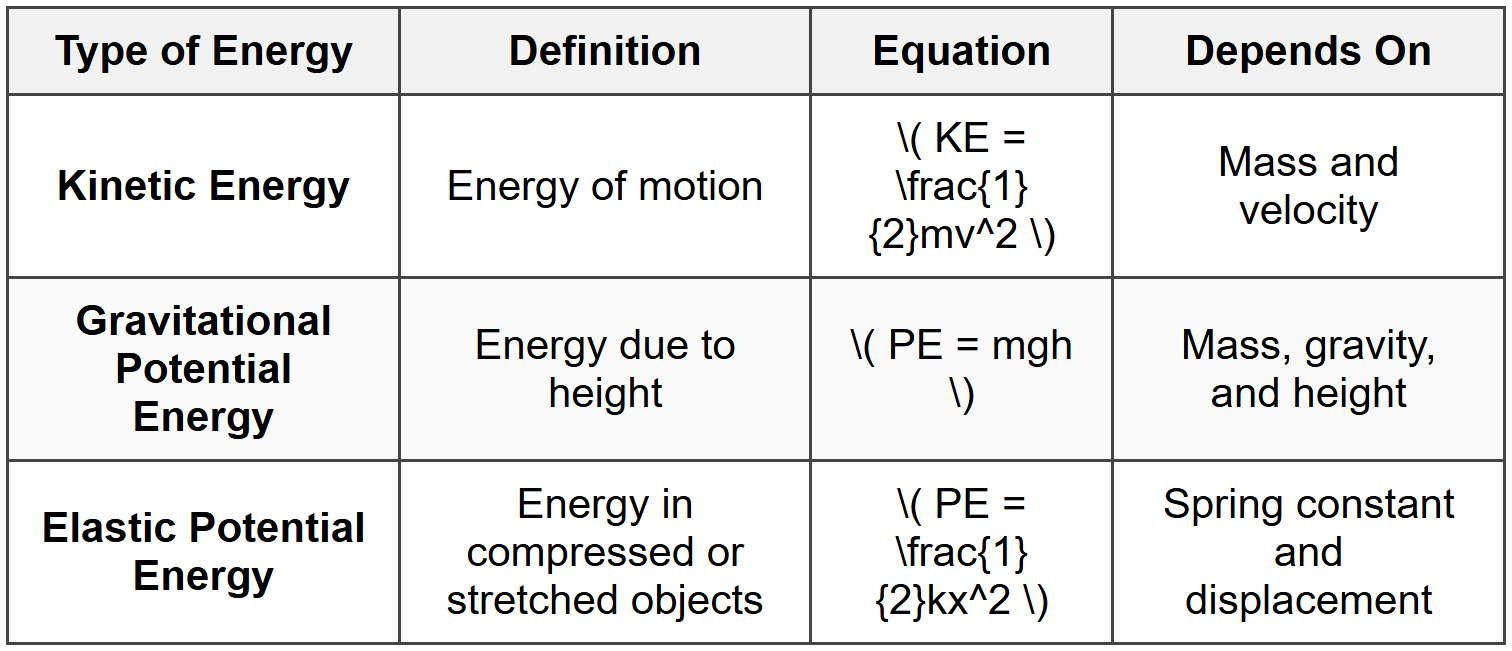
Kinetic energy (KE) is the energy an object possesses due to its motion. Any object that is moving-whether it's a car on the highway, a thrown baseball, a flowing river, or air molecules vibrating in place-has kinetic energy. The faster an object moves, the more kinetic energy it has. Similarly, the more massive an object is, the more kinetic energy it has at a given speed.
The Kinetic Energy Equation
The kinetic energy of an object is calculated using the following equation:
\[ KE = \frac{1}{2}mv^2 \]where KE is kinetic energy measured in joules (J), m is the mass of the object measured in kilograms (kg), and v is the speed (or velocity magnitude) of the object measured in meters per second (m/s).
Notice that velocity is squared in this equation. This means that kinetic energy increases with the square of the speed. If you double an object's speed, its kinetic energy increases by a factor of four. If you triple the speed, kinetic energy increases by a factor of nine. This quadratic relationship has important practical consequences-for example, it explains why high-speed car crashes are so much more dangerous than low-speed collisions.
Example: A 1200 kg car is traveling at 25 m/s along a highway.
What is the car's kinetic energy?
Solution:
Given: \( m = 1200 \) kg, \( v = 25 \) m/s
Using the kinetic energy equation:
\[ KE = \frac{1}{2}mv^2 = \frac{1}{2}(1200)(25)^2 \]Calculating step by step:
\( v^2 = 25 \times 25 = 625 \) m²/s²
\( \frac{1}{2} \times 1200 = 600 \) kg
\( KE = 600 \times 625 = \) 375,000 J or 375 kJThe car's kinetic energy is 375,000 joules.
Example: A 0.145 kg baseball is pitched at 40 m/s.
Calculate the kinetic energy of the baseball.
Solution:
Given: \( m = 0.145 \) kg, \( v = 40 \) m/s
Applying the equation:
\[ KE = \frac{1}{2}mv^2 = \frac{1}{2}(0.145)(40)^2 \]\( v^2 = 1600 \) m²/s²
\( KE = 0.0725 \times 1600 = \) 116 J
The pitched baseball has a kinetic energy of 116 joules.
Understanding the Kinetic Energy Relationship
The relationship between kinetic energy, mass, and velocity reveals important physical insights. Since kinetic energy depends on mass, a heavy truck moving at 20 m/s has much more kinetic energy than a bicycle moving at the same speed. Since kinetic energy depends on the square of velocity, a small object moving very fast can have significant kinetic energy despite its low mass-this is why bullets are so destructive.
Potential Energy
Potential energy (PE) is stored energy that depends on the position or configuration of an object relative to other objects. Unlike kinetic energy, which requires motion, potential energy exists even when objects are stationary. There are several types of potential energy, but we will focus primarily on gravitational potential energy and briefly discuss elastic potential energy.
Gravitational Potential Energy
Gravitational potential energy is energy stored in an object due to its height above a reference level. When you lift a book off the floor and place it on a shelf, you do work against gravity. That work is stored as gravitational potential energy. If the book falls, that stored energy converts to kinetic energy.
The gravitational potential energy near Earth's surface is calculated with:
\[ PE = mgh \]where PE is gravitational potential energy in joules (J), m is mass in kilograms (kg), g is the acceleration due to gravity (9.8 m/s² on Earth's surface), and h is the height above a chosen reference level in meters (m).
The choice of reference level is arbitrary-you can set \( h = 0 \) at ground level, at sea level, or at any convenient point. What matters physically is the change in potential energy when an object moves from one height to another.
Example: A 2.5 kg textbook sits on a shelf 1.8 m above the floor.
What is the book's gravitational potential energy relative to the floor?
Solution:
Given: \( m = 2.5 \) kg, \( g = 9.8 \) m/s², \( h = 1.8 \) m
Using the gravitational potential energy equation:
\[ PE = mgh = (2.5)(9.8)(1.8) \]Calculating: \( PE = 2.5 \times 9.8 \times 1.8 = \) 44.1 J
The textbook has 44.1 joules of gravitational potential energy relative to the floor.
Example: A 65 kg student stands on a diving platform 10 m above the water surface.
Calculate the student's gravitational potential energy relative to the water.
Solution:
Given: \( m = 65 \) kg, \( g = 9.8 \) m/s², \( h = 10 \) m
Applying the equation:
\[ PE = mgh = (65)(9.8)(10) \]\( PE = 65 \times 98 = \) 6370 J or 6.37 kJ
The student possesses 6370 joules of gravitational potential energy relative to the water.
Elastic Potential Energy
Elastic potential energy is energy stored in objects that can be stretched or compressed, such as springs, rubber bands, and bow strings. When you compress a spring or stretch a rubber band, you do work on the object. That work is stored as elastic potential energy. When released, the object returns to its original shape and the stored energy is converted to kinetic energy or other forms.
For an ideal spring that obeys Hooke's Law, the elastic potential energy is:
\[ PE_{elastic} = \frac{1}{2}kx^2 \]where k is the spring constant in newtons per meter (N/m), which measures the stiffness of the spring, and x is the displacement from the equilibrium position in meters (m).
A stiffer spring has a larger spring constant and stores more energy for a given compression or extension. Like kinetic energy, elastic potential energy depends on the square of a variable-in this case, the displacement. Doubling the compression quadruples the stored energy.
Conservation of Mechanical Energy
One of the most powerful principles in physics is the law of conservation of energy, which states that energy cannot be created or destroyed-it can only be transformed from one form to another or transferred from one object to another. In mechanical systems where we can neglect friction and air resistance, mechanical energy-the sum of kinetic and potential energy-remains constant.
\[ E_{mechanical} = KE + PE = \text{constant} \]This means that as an object moves within a conservative force field (like gravity), kinetic energy and potential energy can interchange, but their sum remains the same. When potential energy decreases, kinetic energy increases by exactly the same amount, and vice versa.
Energy Transformations in a Falling Object
Consider a ball dropped from rest at a height. Initially, the ball has maximum gravitational potential energy and zero kinetic energy (since it's not moving yet). As the ball falls:
- Gravitational potential energy decreases (height decreases)
- Kinetic energy increases (speed increases)
- The sum of PE and KE remains constant
Just before impact with the ground, the ball has minimum potential energy (nearly zero if we set ground level as our reference) and maximum kinetic energy. All the initial potential energy has converted to kinetic energy.
Example: A 0.5 kg rock is dropped from rest from a cliff 45 m high.
Assume no air resistance.What is the rock's speed just before it hits the ground?
Solution:
Initial state: \( h_i = 45 \) m, \( v_i = 0 \) m/s
Final state: \( h_f = 0 \) m, \( v_f = ? \)
Initial energy: \( E_i = PE_i + KE_i = mgh_i + 0 = (0.5)(9.8)(45) = 220.5 \) J
Final energy: \( E_f = PE_f + KE_f = 0 + \frac{1}{2}mv_f^2 \)
By conservation of energy: \( E_i = E_f \)
\[ 220.5 = \frac{1}{2}(0.5)v_f^2 \]\( 220.5 = 0.25v_f^2 \)
\( v_f^2 = 882 \)
\( v_f = \sqrt{882} \approx \) 29.7 m/s
The rock's speed just before impact is approximately 29.7 meters per second.
Energy Transformations on a Pendulum
A pendulum beautifully demonstrates the continuous transformation between kinetic and potential energy. At the highest points of its swing, the pendulum bob momentarily stops-it has maximum potential energy and zero kinetic energy. As it swings down toward the lowest point, potential energy converts to kinetic energy. At the bottom of the swing, the bob moves fastest-it has maximum kinetic energy and minimum potential energy. As it swings back up the other side, kinetic energy converts back to potential energy.
In an ideal pendulum with no friction or air resistance, this energy transformation continues indefinitely, with the total mechanical energy remaining constant throughout the motion.
Energy Transformations on a Roller Coaster
Roller coasters are excellent real-world examples of energy conservation. The initial climb up the first hill requires work from a motor or chain lift, which gives the cars gravitational potential energy. After reaching the top, the cars are released, and from that point forward, the motion is governed primarily by energy conservation (though real coasters do experience friction and air resistance).
As the coaster descends from a high point:
- Potential energy decreases
- Kinetic energy increases
- The coaster speeds up
As the coaster climbs toward the next peak:
- Kinetic energy decreases
- Potential energy increases
- The coaster slows down
The first hill is always the tallest because some mechanical energy is inevitably lost to friction and air resistance. Subsequent hills must be lower to ensure the coaster has enough kinetic energy to reach the top.
Example: A 500 kg roller coaster car starts from rest at the top of a 50 m high hill.
Assuming negligible friction, what is its speed at the bottom of the hill where the height is 5 m above the reference level?What is the car's speed at that point?
Solution:
Initial position: \( h_i = 50 \) m, \( v_i = 0 \) m/s
Final position: \( h_f = 5 \) m, \( v_f = ? \)
Initial total energy:
\[ E_i = mgh_i + \frac{1}{2}mv_i^2 = (500)(9.8)(50) + 0 = 245,000 \text{ J} \]Final total energy:
\[ E_f = mgh_f + \frac{1}{2}mv_f^2 = (500)(9.8)(5) + \frac{1}{2}(500)v_f^2 \]\( E_f = 24,500 + 250v_f^2 \)
By conservation of energy: \( E_i = E_f \)
\( 245,000 = 24,500 + 250v_f^2 \)
\( 220,500 = 250v_f^2 \)
\( v_f^2 = 882 \)
\( v_f = \sqrt{882} \approx \) 29.7 m/s
The roller coaster car's speed at 5 m height is approximately 29.7 meters per second.
Work-Energy Theorem
The work-energy theorem establishes a direct connection between work and kinetic energy. It states that the net work done on an object equals the change in its kinetic energy:
\[ W_{net} = \Delta KE = KE_f - KE_i \]where \( W_{net} \) is the net work done on the object in joules, \( KE_f \) is the final kinetic energy, and \( KE_i \) is the initial kinetic energy.
This theorem tells us that if you do positive work on an object (pushing it in the direction it moves), you increase its kinetic energy-it speeds up. If you do negative work on an object (pushing against its motion), you decrease its kinetic energy-it slows down.
Example: A 1000 kg car traveling at 20 m/s applies its brakes.
Friction does -200,000 J of work on the car.What is the car's final speed?
Solution:
Initial kinetic energy:
\[ KE_i = \frac{1}{2}mv_i^2 = \frac{1}{2}(1000)(20)^2 = 200,000 \text{ J} \]Work done by friction: \( W = -200,000 \) J (negative because friction opposes motion)
Using the work-energy theorem:
\[ W = KE_f - KE_i \]\( -200,000 = KE_f - 200,000 \)
\( KE_f = 0 \) J
Since \( KE_f = \frac{1}{2}mv_f^2 = 0 \), we have \( v_f = \) 0 m/s
The car comes to a complete stop with a final speed of zero meters per second.
Non-Conservative Forces and Energy Dissipation
In real-world situations, mechanical energy is not perfectly conserved because non-conservative forces like friction and air resistance are present. These forces convert mechanical energy into thermal energy (heat) and sometimes sound. When you slide a book across a table, it slows down and eventually stops. The kinetic energy hasn't disappeared-it has been transformed into thermal energy that slightly warms the book and table surface.
When non-conservative forces are present, the mechanical energy decreases:
\[ E_{mechanical,f} = E_{mechanical,i} - E_{dissipated} \]The energy dissipated equals the work done by friction and other non-conservative forces. While mechanical energy is not conserved in these situations, total energy (including thermal energy, sound, etc.) is still conserved when we account for all forms of energy.
Power: The Rate of Energy Transfer
Power is the rate at which energy is transferred or transformed. It measures how quickly work is done or how rapidly energy changes form. The SI unit of power is the watt (W), where one watt equals one joule per second.
\[ P = \frac{E}{t} = \frac{W}{t} \]where P is power in watts (W), E is energy in joules (J), W is work in joules, and t is time in seconds (s).
Two machines might do the same amount of work, but the one that completes the work in less time has greater power output. A sports car and a large truck might both climb the same hill (same change in potential energy), but the car does it much faster-it has greater power.
Example: A 60 kg student runs up a flight of stairs, climbing a vertical height of 5 m in 4 seconds.
What is the student's power output?
Solution:
The work done equals the change in gravitational potential energy:
\[ W = \Delta PE = mgh = (60)(9.8)(5) = 2940 \text{ J} \]Time taken: \( t = 4 \) s
Power output:
\[ P = \frac{W}{t} = \frac{2940}{4} = \text{ } 735 W \]The student's power output is 735 watts.
Summary and Connections
Kinetic and potential energy are two fundamental forms of mechanical energy. Kinetic energy depends on mass and the square of velocity, while gravitational potential energy depends on mass, gravitational field strength, and height. In the absence of friction and other dissipative forces, mechanical energy is conserved-kinetic and potential energy transform into one another, but their sum remains constant.
These concepts extend far beyond simple mechanics. In chemistry, potential energy stored in chemical bonds can be released as kinetic energy of molecules (heat). In electricity, potential energy differences drive current flow. In biology, organisms store chemical potential energy in molecules like glucose and ATP, then release it as needed to power cellular processes. Understanding energy transformations is essential for analyzing systems across all scientific disciplines.
By mastering these concepts, you gain the analytical tools to predict and explain a vast range of physical phenomena, from the trajectory of a basketball to the operation of hydroelectric dams to the orbits of satellites. Energy is truly one of the unifying ideas of physics and all of science.