Chapter Notes: Dependent and Independent Events


When we flip a coin, roll a die, or draw a card from a deck, we are performing an experiment with uncertain outcomes. Sometimes, the result of one event affects the chances of another event happening. Other times, events happen completely separately, with no influence on each other. Understanding the difference between dependent events and independent events is essential for calculating probabilities accurately and making good predictions in statistics and everyday life.
Understanding Events in Probability
An event is a specific outcome or set of outcomes from a probability experiment. For example, rolling a 4 on a die is an event. Drawing a red card from a deck is another event. When we perform multiple actions or trials, we often want to know the probability that two or more events will occur together.
Before we can determine whether events are dependent or independent, we need to understand what happens to probabilities when we perform multiple trials. The key question is: Does the first event change the probability of the second event?
Independent Events
Two events are independent if the occurrence of one event does not affect the probability of the other event occurring. In other words, knowing that the first event happened gives you no additional information about whether the second event will happen.
Characteristics of Independent Events
- The outcome of the first event does not change the sample space or probabilities for the second event.
- The events occur separately or with replacement.
- Knowledge about one event does not help predict the other event.
Common Examples of Independent Events
Many everyday situations involve independent events:
- Flipping a coin multiple times: Getting heads on the first flip does not affect whether you get heads or tails on the second flip. Each flip is a fresh start.
- Rolling two dice: The number shown on one die has no effect on what number appears on the other die.
- Drawing cards with replacement: If you draw a card from a deck, record it, return it to the deck, and shuffle before drawing again, the second draw is independent of the first.
- Spinning a spinner multiple times: Each spin has the same probabilities as every other spin.
Probability of Independent Events
When two events A and B are independent, the probability that both events occur is found by multiplying their individual probabilities. This is called the Multiplication Rule for Independent Events.
\[ P(A \text{ and } B) = P(A) \times P(B) \]Here, \( P(A \text{ and } B) \) represents the probability that both event A and event B occur. We read this as "the probability of A and B."
This rule extends to more than two events. If events A, B, and C are all independent, then:
\[ P(A \text{ and } B \text{ and } C) = P(A) \times P(B) \times P(C) \]Example: A coin is flipped twice.
What is the probability of getting heads on the first flip and heads on the second flip?What is the probability of two heads in a row?
Solution:
Each coin flip is independent. The result of the first flip does not affect the second flip.
The probability of heads on the first flip is \( P(\text{Heads}_1) = \frac{1}{2} \).
The probability of heads on the second flip is \( P(\text{Heads}_2) = \frac{1}{2} \).
Using the multiplication rule: \( P(\text{Heads}_1 \text{ and } \text{Heads}_2) = \frac{1}{2} \times \frac{1}{2} = \frac{1}{4} \).
The probability of getting two heads in a row is 1/4 or 0.25.
Example: A spinner has 4 equal sections colored red, blue, green, and yellow.
You spin it twice.
What is the probability of landing on red both times?Find the probability of red on both spins.
Solution:
The two spins are independent events. The first spin does not affect the second spin.
Probability of red on the first spin: \( P(\text{Red}_1) = \frac{1}{4} \).
Probability of red on the second spin: \( P(\text{Red}_2) = \frac{1}{4} \).
Multiply the probabilities: \( P(\text{Red}_1 \text{ and } \text{Red}_2) = \frac{1}{4} \times \frac{1}{4} = \frac{1}{16} \).
The probability of landing on red both times is 1/16 or 0.0625.
Example: A standard deck of 52 cards is shuffled.
You draw one card, record it, replace it, and shuffle again.
Then you draw a second card.
What is the probability that both cards are aces?What is P(first ace and second ace)?
Solution:
There are 4 aces in a deck of 52 cards, so \( P(\text{Ace}) = \frac{4}{52} = \frac{1}{13} \).
Because we replaced the first card and shuffled, the second draw is independent of the first draw.
Probability of an ace on the first draw: \( P(\text{Ace}_1) = \frac{1}{13} \).
Probability of an ace on the second draw: \( P(\text{Ace}_2) = \frac{1}{13} \).
Multiply the probabilities: \( P(\text{Ace}_1 \text{ and } \text{Ace}_2) = \frac{1}{13} \times \frac{1}{13} = \frac{1}{169} \approx 0.0059 \).
The probability that both cards are aces is 1/169, or about 0.59%.
Dependent Events
Two events are dependent if the occurrence of one event affects the probability of the other event occurring. In other words, after the first event happens, the situation has changed in a way that impacts the likelihood of the second event.
Characteristics of Dependent Events
- The outcome of the first event changes the sample space or probabilities for the second event.
- The events often occur without replacement or in sequence where one outcome influences another.
- Knowing about the first event gives you information that changes your prediction about the second event.
Common Examples of Dependent Events
Many real-world situations involve dependent events:
- Drawing cards without replacement: If you draw a card from a deck and do not put it back, there are now fewer cards in the deck. The probabilities for the second draw have changed.
- Selecting marbles from a bag without replacement: After removing one marble, the total number of marbles decreases, affecting the probability of the next draw.
- Choosing students for a committee: Once one student is chosen, that student cannot be chosen again, changing the pool of available students.
- Weather patterns: The probability of rain tomorrow may depend on whether it rained today.
Probability of Dependent Events
When two events A and B are dependent, we must account for how the first event changes the probability of the second. The probability that both events occur is:
\[ P(A \text{ and } B) = P(A) \times P(B \text{ given } A) \]Here, \( P(B \text{ given } A) \) is read as "the probability of B given that A has occurred." This is called a conditional probability because it is the probability of B under the condition that A already happened. The notation \( P(B|A) \) is often used to represent conditional probability.
The formula becomes:
\[ P(A \text{ and } B) = P(A) \times P(B|A) \]Example: A bag contains 5 red marbles and 3 blue marbles.
You draw one marble, do not replace it, and then draw a second marble.
What is the probability that both marbles are red?Find P(first red and second red).
Solution:
Total marbles in the bag initially = 5 + 3 = 8 marbles.
Probability the first marble is red: \( P(\text{Red}_1) = \frac{5}{8} \).
After drawing one red marble without replacement, there are now 4 red marbles and 3 blue marbles left, for a total of 7 marbles.
Probability the second marble is red given the first was red: \( P(\text{Red}_2|\text{Red}_1) = \frac{4}{7} \).
Multiply the probabilities: \( P(\text{Red}_1 \text{ and } \text{Red}_2) = \frac{5}{8} \times \frac{4}{7} = \frac{20}{56} = \frac{5}{14} \approx 0.357 \).
The probability that both marbles are red is 5/14, or about 35.7%.
Example: A standard deck of 52 cards is shuffled.
You draw one card and do not replace it.
Then you draw a second card.
What is the probability that both cards are aces?What is P(first ace and second ace)?
Solution:
There are 4 aces in a deck of 52 cards.
Probability the first card is an ace: \( P(\text{Ace}_1) = \frac{4}{52} = \frac{1}{13} \).
After drawing one ace without replacement, there are now 3 aces left in a deck of 51 cards.
Probability the second card is an ace given the first was an ace: \( P(\text{Ace}_2|\text{Ace}_1) = \frac{3}{51} = \frac{1}{17} \).
Multiply the probabilities: \( P(\text{Ace}_1 \text{ and } \text{Ace}_2) = \frac{1}{13} \times \frac{1}{17} = \frac{1}{221} \approx 0.0045 \).
The probability that both cards are aces is 1/221, or about 0.45%.
Example: A teacher has 10 students in a class: 6 girls and 4 boys.
She randomly selects two students to present projects.
What is the probability that both students selected are girls?Find the probability of selecting two girls in a row.
Solution:
Total students = 10.
Probability the first student is a girl: \( P(\text{Girl}_1) = \frac{6}{10} = \frac{3}{5} \).
After selecting one girl, there are 5 girls left and 9 students total.
Probability the second student is a girl given the first was a girl: \( P(\text{Girl}_2|\text{Girl}_1) = \frac{5}{9} \).
Multiply the probabilities: \( P(\text{Girl}_1 \text{ and } \text{Girl}_2) = \frac{3}{5} \times \frac{5}{9} = \frac{15}{45} = \frac{1}{3} \approx 0.333 \).
The probability that both students selected are girls is 1/3, or about 33.3%.
How to Determine if Events are Independent or Dependent
To decide whether two events are independent or dependent, ask yourself these questions:
- Does the first event change the sample space for the second event? If yes, the events are dependent. If no, they are independent.
- Is there replacement? If you replace items between trials, events are usually independent. Without replacement, events are dependent.
- Are the events physically separate? Events involving different objects or actions (like flipping two different coins) are typically independent.
- Does knowing the first outcome change the probability of the second? If yes, dependent. If no, independent.
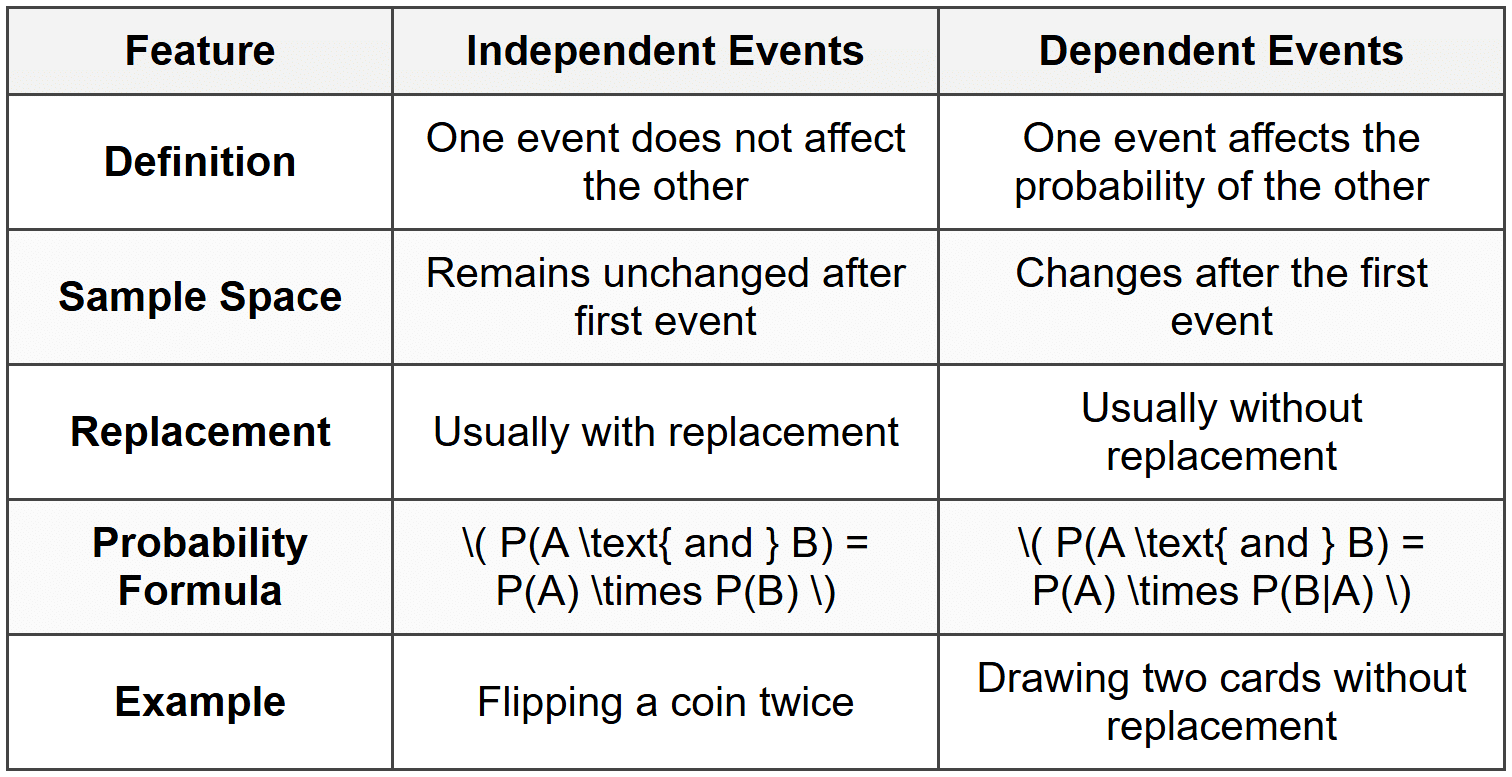
Comparison Table
Testing for Independence Mathematically
There is a mathematical test to verify whether two events are independent. Events A and B are independent if and only if:
\[ P(A \text{ and } B) = P(A) \times P(B) \]If this equation holds true, the events are independent. If it does not hold, the events are dependent.
Example: In a survey of 100 students, 60 like math, 50 like science, and 35 like both math and science.
Are the events "likes math" and "likes science" independent?Test whether these events are independent.
Solution:
Let M = likes math and S = likes science.
From the data: \( P(M) = \frac{60}{100} = 0.6 \), \( P(S) = \frac{50}{100} = 0.5 \), and \( P(M \text{ and } S) = \frac{35}{100} = 0.35 \).
If the events were independent, we would expect: \( P(M) \times P(S) = 0.6 \times 0.5 = 0.30 \).
But the actual probability is \( P(M \text{ and } S) = 0.35 \).
Since \( 0.35 \neq 0.30 \), the equation does not hold.
The events "likes math" and "likes science" are dependent.
Applications and Real-World Implications
Understanding dependent and independent events is crucial in many fields:
- Medicine: Clinical trials evaluate whether treatment outcomes are independent of patient characteristics.
- Finance: Investors analyze whether stock prices move independently or are correlated (dependent).
- Sports: Coaches consider whether a player's performance in one game affects their performance in the next.
- Quality control: Manufacturers test whether defects in products occur independently or in clusters.
- Gaming: Game designers calculate probabilities assuming independence or dependence of events to balance gameplay.
Common Misconceptions
Misconception 1: "If I flip a coin and get five heads in a row, the next flip is more likely to be tails."
Reality: Each coin flip is independent. The coin has no memory. The probability of heads or tails on the sixth flip is still exactly 1/2, regardless of previous results. This false belief is called the "gambler's fallacy."
Misconception 2: "All sequential events are dependent."
Reality: Events can occur one after another and still be independent, as long as one does not affect the probability of the other. For example, rolling a die twice involves sequential events that are independent.
Misconception 3: "With replacement always means independent, without replacement always means dependent."
Reality: While this is true in most simple situations, the full picture depends on context. For example, sampling from an extremely large population without replacement creates events that are approximately independent because the removal of one item has a negligible effect on probabilities.
Summary of Key Formulas
For quick reference, here are the essential formulas for working with dependent and independent events:
- Independent Events: \( P(A \text{ and } B) = P(A) \times P(B) \)
- Dependent Events: \( P(A \text{ and } B) = P(A) \times P(B|A) \)
- Test for Independence: Check if \( P(A \text{ and } B) = P(A) \times P(B) \)
By mastering the concepts of dependent and independent events, you gain powerful tools for analyzing uncertain situations, making predictions, and understanding the world through the lens of probability. Always begin by asking whether one event influences another, and choose your probability formula accordingly.



