Chapter Notes: Conditional Probability and Independence


Probability helps us measure how likely events are to occur. Sometimes, knowing that one event has happened changes how likely we think another event is. For example, if you know it is cloudy outside, the chance of rain seems higher than on a sunny day. Conditional probability measures the likelihood of an event occurring given that another event has already occurred. Understanding conditional probability and the related concept of independence allows us to analyze complex situations where events interact or remain unaffected by one another. These tools are essential in fields ranging from medicine and finance to weather forecasting and quality control.
Understanding Conditional Probability
Conditional probability is the probability that an event occurs given that another event has already occurred. In plain English, it answers the question: "What is the chance of event A happening if we already know event B has happened?" We write this as \( P(A \mid B) \), which is read as "the probability of A given B."
The vertical bar symbol \( \mid \) means "given" or "knowing that." The event after the bar is the condition that we know has occurred. Understanding conditional probability requires thinking about how new information changes our view of what is likely.
Think of conditional probability like updating your expectations when you receive new information. If you randomly select a card from a standard deck, the probability it is a heart is \( \frac{13}{52} \). But if someone tells you the card is red, you now know it must be either a heart or a diamond, so the probability it is a heart becomes \( \frac{13}{26} \) instead.
The Formula for Conditional Probability
The formula for conditional probability is derived from the definition of probability and the concept of intersection (both events occurring). The formula is:
\[ P(A \mid B) = \frac{P(A \text{ and } B)}{P(B)} \]In this formula:
- \( P(A \mid B) \) is the conditional probability of event A given event B
- \( P(A \text{ and } B) \) is the probability that both events A and B occur together (also written as \( P(A \cap B) \))
- \( P(B) \) is the probability that event B occurs, and it must be greater than zero (you cannot condition on an impossible event)
This formula tells us that to find the conditional probability, we focus only on the outcomes where B has occurred (the denominator), and then find what fraction of those outcomes also include A (the numerator).
Example: A high school has 500 students.
280 students take mathematics, 200 students take science, and 120 students take both mathematics and science.
A student is selected at random.What is the probability that the student takes mathematics given that the student takes science?
Solution:
Let M = the event that a student takes mathematics, and S = the event that a student takes science.
We know: P(M) = 280/500, P(S) = 200/500, and P(M and S) = 120/500.
We want to find \( P(M \mid S) \), the probability a student takes mathematics given they take science.
Using the conditional probability formula:
\[ P(M \mid S) = \frac{P(M \text{ and } S)}{P(S)} = \frac{120/500}{200/500} = \frac{120}{200} = \frac{3}{5} = 0.6 \]The probability that a student takes mathematics given that they take science is 0.6 or 60%.
Interpreting Conditional Probability
When we calculate \( P(A \mid B) \), we are restricting our sample space to only those outcomes where B occurs. Instead of considering all possible outcomes, we focus on the subset where B is true, and then ask how often A occurs within that restricted set.
Conditional probabilities can be very different from unconditional probabilities. In the example above, the overall probability a student takes mathematics is 280/500 = 0.56 or 56%. But among students who take science, the probability rises to 60%. This tells us that students who take science are somewhat more likely to also take mathematics compared to the general student population.
Example: In a medical study, 1000 people were tested for a disease.
40 people have the disease, and 960 people do not have the disease.
Of those with the disease, 36 tested positive. Of those without the disease, 48 tested positive.What is the probability that a person has the disease given that they tested positive?
Solution:
Let D = the event that a person has the disease, and + = the event that a person tests positive.
We know: 36 people have the disease AND tested positive, 48 people do not have the disease AND tested positive.
Total people who tested positive = 36 + 48 = 84
P(D and +) = 36/1000
P(+) = 84/1000
Using the conditional probability formula:
\[ P(D \mid +) = \frac{P(D \text{ and } +)}{P(+)} = \frac{36/1000}{84/1000} = \frac{36}{84} = \frac{3}{7} \approx 0.429 \]The probability that a person has the disease given that they tested positive is approximately 0.429 or 42.9%.
This example demonstrates an important concept in medical testing: even when a test is relatively accurate, the probability of having a disease given a positive test depends on how common the disease is in the population. This is known as the base rate effect.
Independent Events
Two events are independent if the occurrence of one event does not affect the probability of the other event occurring. In other words, knowing that one event happened gives you no information about whether the other event will happen.
Think of flipping a coin twice. The result of the first flip does not change the probabilities for the second flip. Getting heads on the first flip does not make heads or tails more likely on the second flip. These flips are independent events.
Mathematical Definition of Independence
Events A and B are independent if and only if:
\[ P(A \mid B) = P(A) \]This equation says that the probability of A given B equals the probability of A without any condition. Knowing B occurred does not change the probability of A.
An equivalent definition uses the multiplication rule. Events A and B are independent if and only if:
\[ P(A \text{ and } B) = P(A) \times P(B) \]These two definitions are mathematically equivalent. We can derive one from the other using the conditional probability formula.
Testing for Independence
To determine whether two events are independent, we can check either condition above. The multiplication rule is often easier to verify when we know the individual probabilities and the joint probability.
Example: A fair six-sided die is rolled, and a fair coin is flipped.
Are the events "rolling a 4" and "flipping heads" independent?
Solution:
Let D = rolling a 4, and H = flipping heads.
P(D) = 1/6 (one favorable outcome out of six possible outcomes)
P(H) = 1/2 (one favorable outcome out of two possible outcomes)
Since the die roll and coin flip are separate physical processes, P(D and H) = (1/6) × (1/2) = 1/12
We check: Does P(D and H) = P(D) × P(H)?
1/12 = (1/6) × (1/2) = 1/12 ✓
Since the multiplication rule holds, the events are independent.
Example: A bag contains 5 red marbles and 3 blue marbles.
You draw one marble, do not replace it, and draw a second marble.Are the events "first marble is red" and "second marble is red" independent?
Solution:
Let R₁ = first marble is red, and R₂ = second marble is red.
P(R₁) = 5/8 (5 red marbles out of 8 total marbles)
To find P(R₂ | R₁), we use conditional probability. If the first marble is red, there are now 4 red marbles and 3 blue marbles remaining (7 total).
P(R₂ | R₁) = 4/7
We check: Does P(R₂ | R₁) = P(R₂)?
We need P(R₂) unconditionally. Using the law of total probability: P(R₂) = P(R₂ | R₁) × P(R₁) + P(R₂ | B₁) × P(B₁) = (4/7) × (5/8) + (5/7) × (3/8) = 20/56 + 15/56 = 35/56 = 5/8
Compare: P(R₂ | R₁) = 4/7 ≈ 0.571, but P(R₂) = 5/8 = 0.625
Since 4/7 ≠ 5/8, the events are not independent.
The second example illustrates sampling without replacement, which creates dependence between draws. Removing a marble changes the composition of the bag, which affects the probabilities for the next draw.
Independent vs. Mutually Exclusive Events
It is important not to confuse independent events with mutually exclusive events. These are completely different concepts:
- Mutually exclusive events cannot both occur at the same time. If A happens, B cannot happen. For example, rolling a 2 and rolling a 5 on the same die roll are mutually exclusive.
- Independent events have no influence on each other. One occurring does not change the probability of the other. Both can occur together.
In fact, non-trivial mutually exclusive events (events with positive probability) cannot be independent. If A and B are mutually exclusive, then P(A and B) = 0. But if they are also independent, we would need P(A and B) = P(A) × P(B). This is only possible if at least one of P(A) or P(B) equals zero.
The Multiplication Rule
The multiplication rule helps us calculate the probability that two events both occur. There are two versions: one for general events and one for independent events.
General Multiplication Rule
For any two events A and B where P(B) > 0:
\[ P(A \text{ and } B) = P(B) \times P(A \mid B) \]This formula comes directly from rearranging the conditional probability formula. It tells us that to find the probability both events occur, we multiply the probability of the first event by the conditional probability of the second event given the first.
We can also write it in the reverse order:
\[ P(A \text{ and } B) = P(A) \times P(B \mid A) \]Example: A box contains 6 defective light bulbs and 14 non-defective light bulbs.
Two light bulbs are selected at random without replacement.What is the probability that both light bulbs are defective?
Solution:
Let D₁ = first bulb is defective, and D₂ = second bulb is defective.
P(D₁) = 6/20 = 3/10 (6 defective out of 20 total)
Given the first bulb is defective, there are now 5 defective bulbs and 14 non-defective bulbs remaining (19 total).
P(D₂ | D₁) = 5/19
Using the general multiplication rule:
\[ P(D₁ \text{ and } D₂) = P(D₁) \times P(D₂ \mid D₁) = \frac{3}{10} \times \frac{5}{19} = \frac{15}{190} = \frac{3}{38} \]The probability that both light bulbs are defective is 3/38 or approximately 0.079.
Multiplication Rule for Independent Events
When events A and B are independent, the multiplication rule simplifies because P(A | B) = P(A) and P(B | A) = P(B):
\[ P(A \text{ and } B) = P(A) \times P(B) \]For independent events, we simply multiply the individual probabilities. This extends to more than two independent events. If events A₁, A₂, A₃, ..., Aₙ are all mutually independent, then:
\[ P(A₁ \text{ and } A₂ \text{ and } A₃ \text{ and ... and } A_n) = P(A₁) \times P(A₂) \times P(A₃) \times ... \times P(A_n) \]Example: A student takes three independent tests.
The probability of passing the first test is 0.8, the probability of passing the second test is 0.75, and the probability of passing the third test is 0.9.What is the probability the student passes all three tests?
Solution:
Let T₁ = passing test 1, T₂ = passing test 2, and T₃ = passing test 3.
P(T₁) = 0.8, P(T₂) = 0.75, P(T₃) = 0.9
Since the tests are independent, we use the multiplication rule for independent events:
P(T₁ and T₂ and T₃) = P(T₁) × P(T₂) × P(T₃)
P(T₁ and T₂ and T₃) = 0.8 × 0.75 × 0.9 = 0.54
The probability the student passes all three tests is 0.54 or 54%.
Conditional Probability in Two-Way Tables
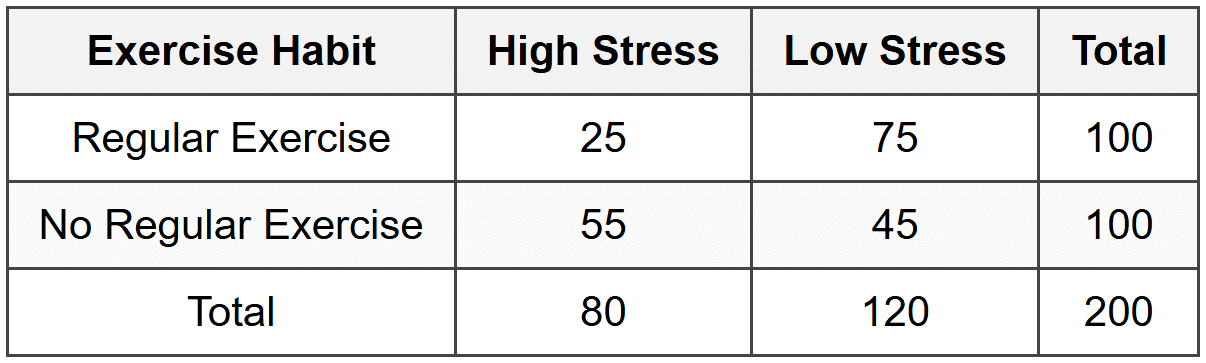
Two-way tables (also called contingency tables) organize data about two categorical variables. They are excellent tools for calculating conditional probabilities because they clearly show the relationship between events.
A two-way table displays frequencies or counts for combinations of two variables. Each cell shows how many observations fall into a particular combination of categories.
Example: A survey asked 200 people about their exercise habits and stress levels.
The results are shown in the table below:What is the probability a person has low stress given that they exercise regularly?
Solution:
Let L = low stress, and R = regular exercise.
We want P(L | R).
From the table, 100 people exercise regularly (this is our condition).
Of those 100 people who exercise regularly, 75 have low stress.
P(L | R) = 75/100 = 0.75
The probability a person has low stress given they exercise regularly is 0.75 or 75%.
When working with two-way tables, remember:
- The denominator for conditional probability is the total for the condition (the row or column corresponding to the given event)
- The numerator is the count in the cell where both events occur together
- Always verify whether events are independent by checking if P(A | B) = P(A)
Applications of Conditional Probability
Medical Testing and Diagnostics
Conditional probability is crucial in interpreting medical test results. A positive test result does not always mean a patient has the disease; we must consider the sensitivity (probability of testing positive given you have the disease) and specificity (probability of testing negative given you do not have the disease) of the test, along with the prevalence of the disease in the population.
The probability of having the disease given a positive test, P(Disease | Positive), is often much lower than patients expect, especially for rare diseases, because false positives can outnumber true positives when the disease is uncommon.
Quality Control
Manufacturing processes use conditional probability to assess product quality. If a product passes an initial inspection, what is the probability it will pass a more rigorous final inspection? Understanding these conditional relationships helps companies optimize their quality control procedures.
Weather Forecasting
Meteorologists use conditional probability constantly. The probability of rain tomorrow depends on today's weather conditions. If it is raining today, the conditional probability of rain tomorrow might be higher than if today is sunny. Weather prediction models are built on sophisticated applications of conditional probability.
Risk Assessment
Insurance companies and financial institutions use conditional probability to assess risk. What is the probability a driver will have an accident given that they have had previous accidents? What is the probability a borrower will default on a loan given their credit history? These conditional probabilities help determine premiums and interest rates.
Common Misconceptions
Several common errors occur when working with conditional probability:
- Confusing P(A | B) with P(B | A): These are generally not equal. The probability you have a fever given you have the flu is not the same as the probability you have the flu given you have a fever. Many illnesses cause fever, so the second probability is much lower.
- Assuming independence without justification: Just because two events seem unrelated does not guarantee they are independent. Always verify independence mathematically when it matters.
- Ignoring base rates: When calculating conditional probabilities, the prevalence or frequency of the conditioning event in the overall population matters significantly. Rare events behave differently than common events.
- Thinking mutually exclusive events are independent: As explained earlier, mutually exclusive events with positive probability cannot be independent. If two events cannot both occur, then knowing one occurred tells you the other definitely did not.
Summary of Key Concepts
Conditional probability and independence are interconnected concepts that help us understand how events relate to one another:
- Conditional probability P(A | B) measures the likelihood of A occurring given that B has occurred
- The formula \( P(A \mid B) = \frac{P(A \text{ and } B)}{P(B)} \) requires P(B) > 0
- Events A and B are independent if P(A | B) = P(A), or equivalently if P(A and B) = P(A) × P(B)
- Independent events have no influence on each other; dependent events do affect each other's probabilities
- The general multiplication rule is P(A and B) = P(B) × P(A | B)
- For independent events, the multiplication rule simplifies to P(A and B) = P(A) × P(B)
- Two-way tables provide an organized way to calculate conditional probabilities from data
- Conditional probability has important applications in medicine, quality control, forecasting, and risk assessment
Mastering these concepts enables you to analyze complex situations where events interact, to properly interpret statistical information in real-world contexts, and to make better decisions based on probability reasoning.



