Chapter Notes: Working With Units


When you measure something in the real world-whether it's the distance you drive, the time it takes to cook dinner, or the temperature outside-you always attach a unit to that measurement. Units tell us what kind of quantity we're dealing with. In algebra, working correctly with units is essential for solving problems accurately, especially when you need to convert between different units or combine measurements in equations. Understanding how to manipulate units will help you set up equations correctly, check your work, and communicate your results clearly.
Understanding Units and Their Importance
A unit is a standard quantity used to express a measurement. For example, when you say a road is 5 miles long, "miles" is the unit. The number 5 by itself doesn't tell you much-it could be 5 inches, 5 kilometers, or 5 light-years. The unit gives meaning to the number.
Units fall into different categories based on what they measure:
- Length or distance: inches, feet, yards, miles, millimeters, centimeters, meters, kilometers
- Time: seconds, minutes, hours, days, weeks, years
- Mass or weight: ounces, pounds, tons, grams, kilograms
- Volume: fluid ounces, cups, pints, quarts, gallons, milliliters, liters
- Temperature: degrees Fahrenheit (°F), degrees Celsius (°C), Kelvin (K)
- Speed: miles per hour (mph), feet per second (ft/s), meters per second (m/s)
In the United States, we commonly use the customary system (feet, pounds, gallons), while most of the world uses the metric system (meters, kilograms, liters). Being able to work with both systems is an important skill.
Unit Conversion Basics
Often in mathematics and science, you need to convert a measurement from one unit to another. For example, you might need to change feet to inches, or hours to minutes. The key tool for doing this is a conversion factor.
A conversion factor is a fraction that equals 1, where the numerator and denominator represent the same quantity in different units. Since multiplying by 1 doesn't change the value of something, we can use conversion factors to change units without changing the actual amount.
For example, since 1 foot equals 12 inches, we can write two conversion factors:
\[ \frac{12 \text{ inches}}{1 \text{ foot}} = 1 \quad \text{and} \quad \frac{1 \text{ foot}}{12 \text{ inches}} = 1 \]Both of these fractions equal 1 because the top and bottom represent the same length. You choose which conversion factor to use based on which units you want to cancel out.
The Unit Cancellation Method
When you multiply a measurement by a conversion factor, units cancel just like numbers do in fractions. This is called dimensional analysis or the factor-label method. The basic principle is that units in the numerator and denominator that are the same will cancel each other out.
Example: Convert 7 feet to inches.
How many inches are in 7 feet?
Solution:
Start with the measurement you have: 7 feet
Multiply by the conversion factor with inches on top and feet on the bottom, so feet will cancel:
\( 7 \text{ feet} \times \frac{12 \text{ inches}}{1 \text{ foot}} \)
The "feet" units cancel: \( 7 \times \frac{12 \text{ inches}}{1} = 84 \text{ inches} \)
Therefore, 7 feet equals 84 inches.
Example: Convert 150 minutes to hours.
How many hours are in 150 minutes?
Solution:
Start with 150 minutes
We know 60 minutes = 1 hour, so use the conversion factor \( \frac{1 \text{ hour}}{60 \text{ minutes}} \)
\( 150 \text{ minutes} \times \frac{1 \text{ hour}}{60 \text{ minutes}} = \frac{150}{60} \text{ hours} = 2.5 \text{ hours} \)
The answer is 2.5 hours.
Multi-Step Conversions
Sometimes you need to use more than one conversion factor to get from your starting unit to your ending unit. You simply multiply by several conversion factors in a row, making sure that unwanted units cancel at each step.
Example: Convert 3 miles to inches.
Use the conversions: 1 mile = 5,280 feet and 1 foot = 12 inches.How many inches are in 3 miles?
Solution:
Start with 3 miles
First convert miles to feet: \( 3 \text{ miles} \times \frac{5{,}280 \text{ feet}}{1 \text{ mile}} = 15{,}840 \text{ feet} \)
Then convert feet to inches: \( 15{,}840 \text{ feet} \times \frac{12 \text{ inches}}{1 \text{ foot}} = 190{,}080 \text{ inches} \)
Alternatively, do it in one step: \( 3 \text{ miles} \times \frac{5{,}280 \text{ feet}}{1 \text{ mile}} \times \frac{12 \text{ inches}}{1 \text{ foot}} = 190{,}080 \text{ inches} \)
There are 190,080 inches in 3 miles.
Common Conversion Factors
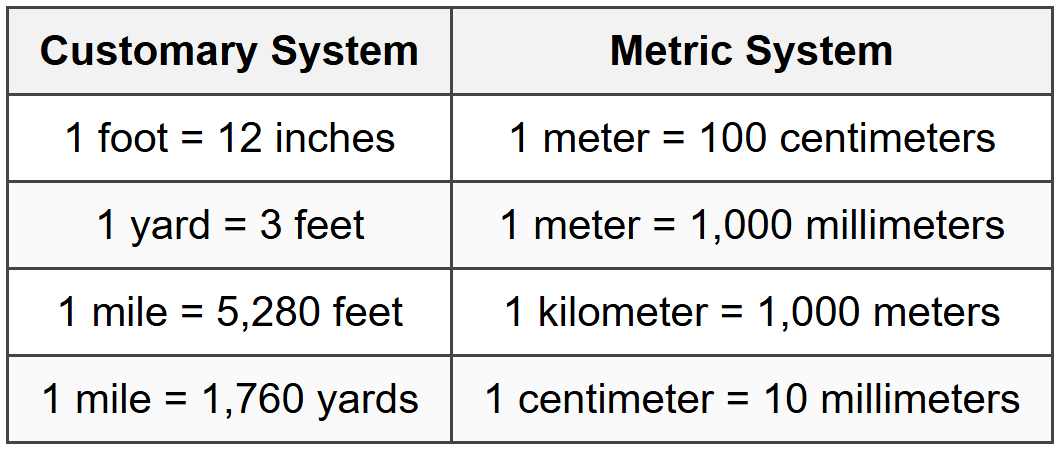
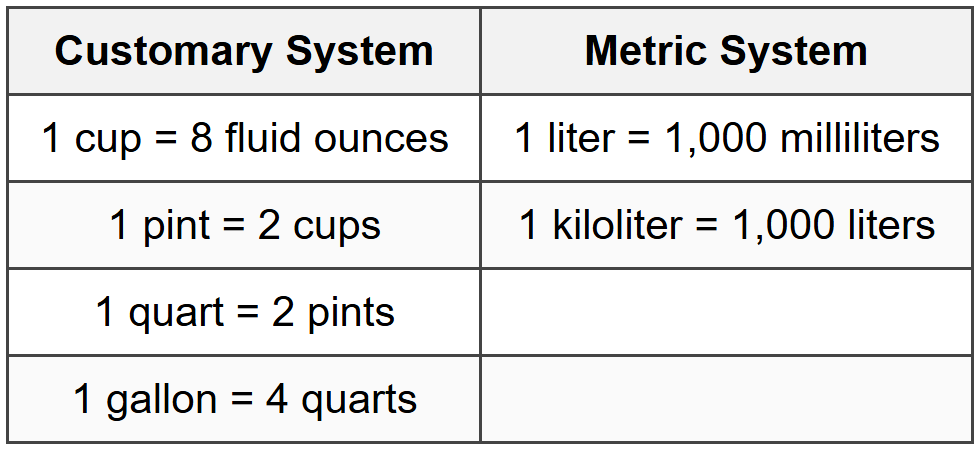
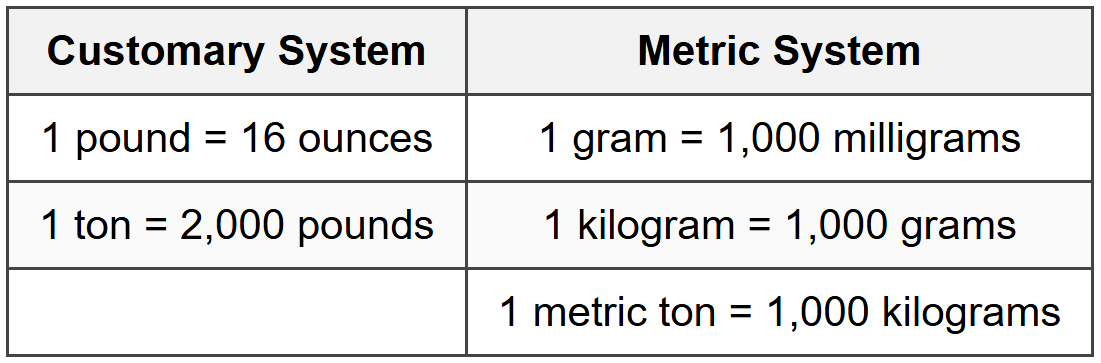
Here are some frequently used conversion factors you should know or have available:
Length Conversions
Time Conversions
- 1 minute = 60 seconds
- 1 hour = 60 minutes
- 1 hour = 3,600 seconds
- 1 day = 24 hours
- 1 week = 7 days
Volume Conversions
Mass/Weight Conversions
Working With Rates and Compound Units
Many real-world measurements involve compound units-units that combine two or more simpler units. Speed is a perfect example: miles per hour (mph) combines distance (miles) and time (hours). The word "per" means division, so miles per hour means miles divided by hours.
When working with rates, you treat the compound unit as a single entity and apply conversion factors to each part as needed.
Example: A car travels at 60 miles per hour.
Convert this speed to feet per second.What is 60 mph in feet per second?
Solution:
Start with \( \frac{60 \text{ miles}}{1 \text{ hour}} \)
Convert miles to feet: \( \frac{60 \text{ miles}}{1 \text{ hour}} \times \frac{5{,}280 \text{ feet}}{1 \text{ mile}} = \frac{316{,}800 \text{ feet}}{1 \text{ hour}} \)
Convert hours to seconds: \( \frac{316{,}800 \text{ feet}}{1 \text{ hour}} \times \frac{1 \text{ hour}}{3{,}600 \text{ seconds}} = \frac{316{,}800}{3{,}600} \text{ feet per second} \)
Divide: \( \frac{316{,}800}{3{,}600} = 88 \text{ feet per second} \)
The speed is 88 feet per second.
Unit Rates and Proportions
A unit rate is a rate where the denominator is 1. For instance, if you drive 120 miles in 2 hours, your unit rate (speed) is 60 miles in 1 hour, or 60 mph. Unit rates are useful for making comparisons and solving proportion problems.
Example: A printer prints 240 pages in 8 minutes.
What is the unit rate in pages per minute?
Solution:
The rate is \( \frac{240 \text{ pages}}{8 \text{ minutes}} \)
To find pages per 1 minute, divide both parts by 8: \( \frac{240 \div 8}{8 \div 8} = \frac{30 \text{ pages}}{1 \text{ minute}} \)
The unit rate is 30 pages per minute.
Using Units in Algebraic Equations
When you write algebraic equations involving real-world quantities, always include units. This helps you:
- Check that your equation makes sense
- Ensure you're combining like quantities
- Catch errors before you finish your calculation
- Communicate your answer clearly
The fundamental rule is: you can only add or subtract quantities that have the same units. For example, you can add 5 meters and 3 meters to get 8 meters, but you cannot directly add 5 meters and 3 seconds-they measure completely different things.
When you multiply or divide quantities, the units also multiply or divide.
Example: A rectangle has a length of 8 feet and a width of 5 feet.
What is the area of the rectangle?
Solution:
Area = length × width
Area = 8 feet × 5 feet = 40 feet × feet = 40 feet² (or square feet)
The area is 40 square feet.
Notice how the units multiplied: feet times feet gives square feet (ft²). This makes sense because area is measured in square units.
Solving Equations With Units
When solving equations, treat units like algebraic variables. They must balance on both sides of the equation, and they guide you in setting up the problem correctly.
Example: You are driving at a constant speed of 55 miles per hour.
How far will you travel in 3.5 hours?What is the distance traveled?
Solution:
Use the formula: distance = speed × time
Substitute the values with units: \( d = 55 \frac{\text{miles}}{\text{hour}} \times 3.5 \text{ hours} \)
The hours cancel: \( d = 55 \times 3.5 \text{ miles} = 192.5 \text{ miles} \)
You will travel 192.5 miles.
Example: A cyclist travels 48 miles in 4 hours at a constant speed.
What is the cyclist's speed in miles per hour?
Solution:
Use the formula: speed = distance ÷ time
Substitute: \( s = \frac{48 \text{ miles}}{4 \text{ hours}} \)
Divide: \( s = 12 \frac{\text{miles}}{\text{hour}} \)
The cyclist's speed is 12 miles per hour.
Checking Your Work With Units
One powerful way to check whether your calculation is correct is to examine the units in your answer. If the units don't match what you expect, you probably made an error in setting up the problem.
Imagine you're calculating the time it takes to drive somewhere, and your final answer comes out in square miles. That's a clear signal something went wrong, because time should be measured in hours, minutes, or seconds-not square miles!
Note: Always ask yourself: "Do the units in my answer make sense for what the problem is asking?" If you're finding a distance, your answer should be in length units (feet, miles, meters, etc.). If you're finding a time, your answer should be in time units (seconds, minutes, hours). If the units don't match, review your setup and calculations.
Unit Conversions in the Metric System
The metric system is based on powers of 10, which makes conversions much simpler than in the customary system. Each prefix indicates a specific power of 10:
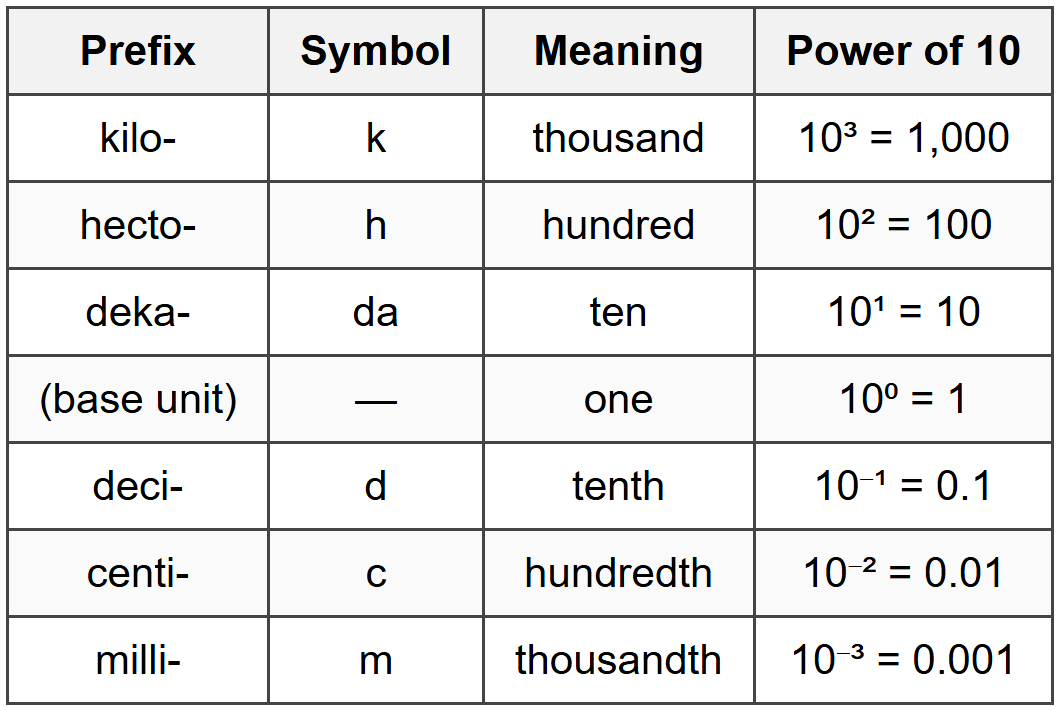
Because of this structure, converting in the metric system often just requires moving the decimal point.
Example: Convert 3.6 kilometers to meters.
How many meters are in 3.6 kilometers?
Solution:
Since 1 kilometer = 1,000 meters, multiply by the conversion factor:
\( 3.6 \text{ km} \times \frac{1{,}000 \text{ m}}{1 \text{ km}} = 3{,}600 \text{ m} \)
Alternatively, move the decimal point 3 places to the right: 3.6 → 3,600
The answer is 3,600 meters.
Example: Convert 450 centimeters to meters.
How many meters are in 450 centimeters?
Solution:
Since 100 centimeters = 1 meter, use the conversion factor:
\( 450 \text{ cm} \times \frac{1 \text{ m}}{100 \text{ cm}} = \frac{450}{100} \text{ m} = 4.5 \text{ m} \)
Or move the decimal point 2 places to the left: 450 → 4.50 → 4.5
The answer is 4.5 meters.
Working With Area and Volume Units
When you convert units of area or volume, remember that you must apply the conversion factor to each dimension. This means you'll square the conversion factor for area and cube it for volume.
Area Conversions
If 1 foot = 12 inches, then 1 square foot = 12 inches × 12 inches = 144 square inches. You must square the linear conversion factor.
Example: Convert 5 square feet to square inches.
How many square inches are in 5 square feet?
Solution:
Since 1 foot = 12 inches, then 1 ft² = 12 in × 12 in = 144 in²
Use the conversion factor: \( 5 \text{ ft}^2 \times \frac{144 \text{ in}^2}{1 \text{ ft}^2} = 720 \text{ in}^2 \)
The answer is 720 square inches.
Volume Conversions
Similarly, for volume, you cube the linear conversion factor.
Example: Convert 2 cubic feet to cubic inches.
How many cubic inches are in 2 cubic feet?
Solution:
Since 1 foot = 12 inches, then 1 ft³ = 12 in × 12 in × 12 in = 1,728 in³
Use the conversion factor: \( 2 \text{ ft}^3 \times \frac{1{,}728 \text{ in}^3}{1 \text{ ft}^3} = 3{,}456 \text{ in}^3 \)
The answer is 3,456 cubic inches.
Practical Tips for Working With Units
- Always write units: Don't drop them during calculations. Carry them through every step.
- Set up conversions so units cancel: Place the unit you want to eliminate in opposite positions (numerator vs. denominator).
- Double-check your conversion factors: Make sure you're using the correct equivalence (e.g., 1 mile = 5,280 feet, not 5,208 feet).
- Use common sense: If you convert from a larger unit to a smaller unit, your number should get bigger (e.g., 2 feet = 24 inches). If converting from smaller to larger, your number should get smaller (e.g., 100 centimeters = 1 meter).
- Keep a reference list: Until you memorize common conversions, keep a list handy.
- Practice dimensional analysis: This method works for nearly every type of unit conversion and is a valuable tool throughout science and mathematics.
Summary
Working with units correctly is a foundational skill in algebra and in everyday problem solving. Units give meaning to numbers, help you set up equations accurately, and allow you to check your work for errors. By mastering conversion factors, dimensional analysis, and the proper handling of compound units, you'll be well-equipped to solve a wide variety of real-world problems. Whether you're converting miles to feet, finding speeds, calculating areas, or checking the reasonableness of an answer, units are your guide and your safeguard. Remember: numbers tell you how much, but units tell you what you have.




