Chapter Notes: Sequences


Imagine you're standing in line at a store, or counting the days until your birthday, or watching a pattern of tiles on a floor. Each of these situations involves numbers that follow a specific order-a sequence. In mathematics, a sequence is an ordered list of numbers that follows a particular rule or pattern. Understanding sequences helps us predict what comes next, find specific values in a pattern, and model real-world situations like savings growth, population changes, or even the way objects fall. This chapter will teach you how to recognize, write, and work with different types of sequences.
What Is a Sequence?
A sequence is an ordered list of numbers called terms. Each number in the sequence has a specific position. We use the word "term" to describe each individual number in the sequence.
For example, consider the sequence: 2, 4, 6, 8, 10, ...
In this sequence:
- The first term is 2
- The second term is 4
- The third term is 6
- The fourth term is 8
- The fifth term is 10
The three dots (...) at the end indicate that the sequence continues following the same pattern.
We use special notation to represent terms in a sequence. The symbol \( a_n \) (read as "a sub n") represents the nth term of a sequence, where n is the position number. For the sequence above:
- \( a_1 = 2 \) (the first term is 2)
- \( a_2 = 4 \) (the second term is 4)
- \( a_3 = 6 \) (the third term is 6)
The subscript number tells us which position we're talking about in the sequence.
Example: Identify the first five terms of the sequence 5, 10, 15, 20, 25, ... and write them using proper notation.
What are the first five terms written with sequence notation?
Solution:
\( a_1 = 5 \) (first term)
\( a_2 = 10 \) (second term)
\( a_3 = 15 \) (third term)
\( a_4 = 20 \) (fourth term)
\( a_5 = 25 \) (fifth term)
The first five terms are 5, 10, 15, 20, and 25, written as \( a_1 \) through \( a_5 \).
Arithmetic Sequences
An arithmetic sequence is a sequence where each term after the first is found by adding the same fixed number to the previous term. This fixed number is called the common difference, represented by the letter d.
For example, in the sequence 3, 7, 11, 15, 19, ..., each term increases by 4. The common difference is \( d = 4 \).
To find the common difference, subtract any term from the term that comes right after it:
\[ d = a_2 - a_1 = a_3 - a_2 = a_4 - a_3 \]where \( d \) is the common difference, and the result should be the same no matter which consecutive pair you choose.
Example: Determine whether the sequence 8, 5, 2, -1, -4, ... is arithmetic.
If it is arithmetic, find the common difference.Is this sequence arithmetic, and what is the common difference?
Solution:
Check the difference between consecutive terms:
\( a_2 - a_1 = 5 - 8 = -3 \)
\( a_3 - a_2 = 2 - 5 = -3 \)
\( a_4 - a_3 = -1 - 2 = -3 \)
\( a_5 - a_4 = -4 - (-1) = -3 \)
Since the difference is constant at -3, this is an arithmetic sequence with common difference d = -3.
The Arithmetic Sequence Formula
Once we know the first term and the common difference of an arithmetic sequence, we can find any term in the sequence without listing all the terms before it. The explicit formula for an arithmetic sequence is:
\[ a_n = a_1 + (n - 1)d \]where:
- \( a_n \) is the term you want to find
- \( a_1 \) is the first term
- \( n \) is the position number
- \( d \) is the common difference
Think of this formula like climbing stairs: you start at the first step (\( a_1 \)), and then you take \( (n - 1) \) additional steps, each of height \( d \), to reach the nth step.
Example: An arithmetic sequence has a first term of 12 and a common difference of -5.
Find the 15th term of this sequence.
Solution:
Given: \( a_1 = 12 \), \( d = -5 \), and \( n = 15 \)
Use the formula: \( a_n = a_1 + (n - 1)d \)
Substitute the values:
\( a_{15} = 12 + (15 - 1)(-5) \)Simplify inside the parentheses:
\( a_{15} = 12 + (14)(-5) \)Multiply:
\( a_{15} = 12 + (-70) \)Add:
\( a_{15} = -58 \)The 15th term of the sequence is -58.
Finding the First Term or Common Difference
Sometimes you'll know certain terms in a sequence but not the first term or the common difference. You can use the arithmetic sequence formula along with algebra to find these missing values.
Example: In an arithmetic sequence, the 5th term is 23 and the 10th term is 48.
Find the first term and the common difference.
Solution:
Set up two equations using \( a_n = a_1 + (n - 1)d \):
For the 5th term:
\( 23 = a_1 + (5 - 1)d \)
\( 23 = a_1 + 4d \) ... (equation 1)For the 10th term:
\( 48 = a_1 + (10 - 1)d \)
\( 48 = a_1 + 9d \) ... (equation 2)Subtract equation 1 from equation 2:
\( 48 - 23 = (a_1 + 9d) - (a_1 + 4d) \)
\( 25 = 5d \)
\( d = 5 \)Substitute \( d = 5 \) back into equation 1:
\( 23 = a_1 + 4(5) \)
\( 23 = a_1 + 20 \)
\( a_1 = 3 \)The first term is 3 and the common difference is 5.
Geometric Sequences
A geometric sequence is a sequence where each term after the first is found by multiplying the previous term by the same fixed number. This fixed number is called the common ratio, represented by the letter r.
For example, in the sequence 2, 6, 18, 54, 162, ..., each term is multiplied by 3. The common ratio is \( r = 3 \).
To find the common ratio, divide any term by the term that comes right before it:
\[ r = \frac{a_2}{a_1} = \frac{a_3}{a_2} = \frac{a_4}{a_3} \]where \( r \) is the common ratio, and the result should be the same no matter which consecutive pair you choose.
Example: Determine whether the sequence 80, 40, 20, 10, 5, ... is geometric.
If it is geometric, find the common ratio.Is this sequence geometric, and what is the common ratio?
Solution:
Check the ratio between consecutive terms:
\( \frac{a_2}{a_1} = \frac{40}{80} = \frac{1}{2} \)
\( \frac{a_3}{a_2} = \frac{20}{40} = \frac{1}{2} \)
\( \frac{a_4}{a_3} = \frac{10}{20} = \frac{1}{2} \)
\( \frac{a_5}{a_4} = \frac{5}{10} = \frac{1}{2} \)
Since the ratio is constant at \( \frac{1}{2} \), this is a geometric sequence with common ratio \( r = \frac{1}{2} \).
The Geometric Sequence Formula
Just like with arithmetic sequences, we have a formula to find any term in a geometric sequence without listing all previous terms. The explicit formula for a geometric sequence is:
\[ a_n = a_1 \cdot r^{(n-1)} \]where:
- \( a_n \) is the term you want to find
- \( a_1 \) is the first term
- \( n \) is the position number
- \( r \) is the common ratio
Think of this formula like a photocopier that either enlarges or shrinks: you start with the original size (\( a_1 \)), and then multiply by the zoom factor \( r \) a total of \( (n - 1) \) times to reach the nth copy.
Example: A geometric sequence has a first term of 5 and a common ratio of 2.
Find the 8th term of this sequence.
Solution:
Given: \( a_1 = 5 \), \( r = 2 \), and \( n = 8 \)
Use the formula: \( a_n = a_1 \cdot r^{(n-1)} \)
Substitute the values:
\( a_8 = 5 \cdot 2^{(8-1)} \)Simplify the exponent:
\( a_8 = 5 \cdot 2^7 \)Calculate the power:
\( a_8 = 5 \cdot 128 \)Multiply:
\( a_8 = 640 \)The 8th term of the sequence is 640.
Geometric Sequences with Negative or Fractional Ratios
The common ratio in a geometric sequence doesn't have to be a whole number greater than 1. It can be negative, a fraction, or even a decimal.
When the common ratio is negative, the terms alternate between positive and negative values. For example, the sequence 3, -6, 12, -24, 48, ... has a common ratio of -2.
When the common ratio is a fraction between -1 and 1 (but not zero), the absolute values of the terms get smaller and smaller. For example, the sequence 100, 50, 25, 12.5, ... has a common ratio of 0.5.
Example: A geometric sequence has a first term of 64 and a common ratio of \( -\frac{1}{2} \).
Find the first five terms of this sequence.
Solution:
Start with \( a_1 = 64 \) and multiply by \( r = -\frac{1}{2} \) repeatedly:
\( a_1 = 64 \)
\( a_2 = 64 \cdot \left(-\frac{1}{2}\right) = -32 \)
\( a_3 = -32 \cdot \left(-\frac{1}{2}\right) = 16 \)
\( a_4 = 16 \cdot \left(-\frac{1}{2}\right) = -8 \)
\( a_5 = -8 \cdot \left(-\frac{1}{2}\right) = 4 \)
The first five terms are 64, -32, 16, -8, 4.
Recursive Formulas
A recursive formula defines each term of a sequence using the previous term(s). Instead of giving you a direct way to calculate the nth term like an explicit formula does, a recursive formula tells you how to get from one term to the next.
Every recursive formula needs two parts:
- The initial condition: what the first term (or first few terms) equals
- The recursive rule: how to calculate each subsequent term from the previous one(s)
Recursive Formula for Arithmetic Sequences
For an arithmetic sequence with common difference \( d \), the recursive formula is:
\[ a_1 = \text{(first term)} \] \[ a_n = a_{n-1} + d \text{ for } n \geq 2 \]This says: to get any term, take the previous term and add the common difference.
Example: Write a recursive formula for the arithmetic sequence 7, 11, 15, 19, 23, ...
What is the recursive formula?
Solution:
Identify the first term: \( a_1 = 7 \)
Find the common difference: \( d = 11 - 7 = 4 \)
Write the recursive rule: \( a_n = a_{n-1} + 4 \) for \( n \geq 2 \)
The recursive formula is \( a_1 = 7 \) and \( a_n = a_{n-1} + 4 \) for \( n \geq 2 \).
Recursive Formula for Geometric Sequences
For a geometric sequence with common ratio \( r \), the recursive formula is:
\[ a_1 = \text{(first term)} \] \[ a_n = a_{n-1} \cdot r \text{ for } n \geq 2 \]This says: to get any term, take the previous term and multiply by the common ratio.
Example: A sequence is defined recursively by \( a_1 = 3 \) and \( a_n = 2 \cdot a_{n-1} \) for \( n \geq 2 \).
Find the first five terms of this sequence.
Solution:
Start with the first term: \( a_1 = 3 \)
Use the recursive rule to find each next term:
\( a_2 = 2 \cdot a_1 = 2 \cdot 3 = 6 \)
\( a_3 = 2 \cdot a_2 = 2 \cdot 6 = 12 \)
\( a_4 = 2 \cdot a_3 = 2 \cdot 12 = 24 \)
\( a_5 = 2 \cdot a_4 = 2 \cdot 24 = 48 \)
The first five terms are 3, 6, 12, 24, 48.
Distinguishing Between Arithmetic and Geometric Sequences
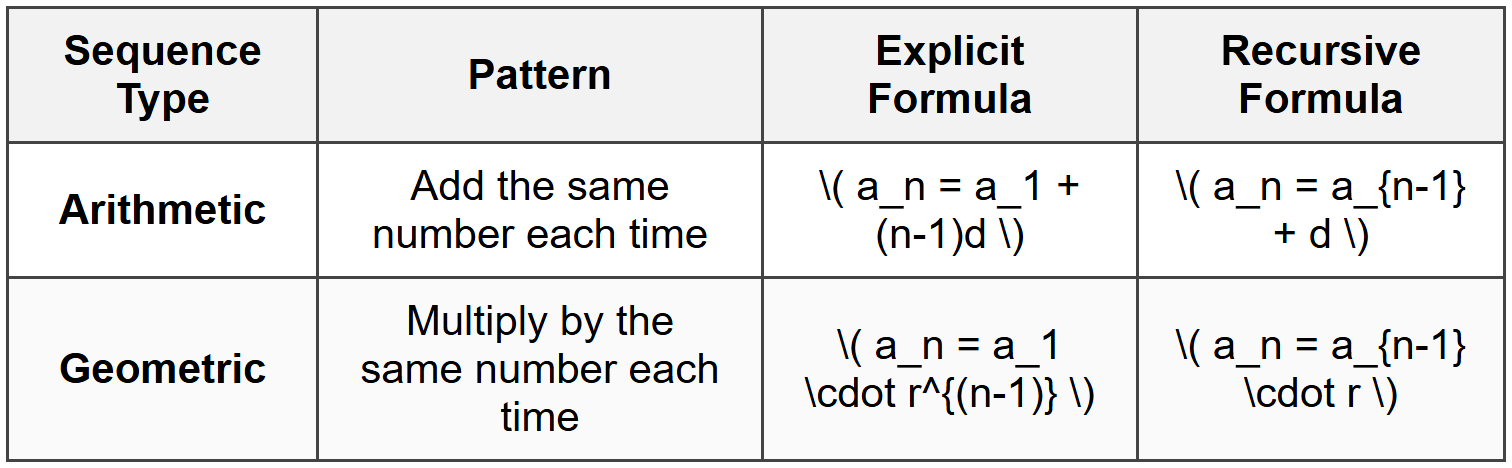
When you encounter a sequence, it's important to determine whether it's arithmetic, geometric, or neither. Here's a systematic approach:
- Check for an arithmetic sequence: Subtract consecutive terms. If the differences are constant, it's arithmetic.
- Check for a geometric sequence: Divide consecutive terms. If the ratios are constant, it's geometric.
- If neither works: The sequence is neither arithmetic nor geometric.
Example: Classify each sequence as arithmetic, geometric, or neither:
(a) 5, 9, 13, 17, 21, ...
(b) 2, 6, 18, 54, 162, ...
(c) 1, 4, 9, 16, 25, ...What type is each sequence?
Solution:
(a) Check differences: 9 - 5 = 4, 13 - 9 = 4, 17 - 13 = 4
The differences are constant, so this is arithmetic with \( d = 4 \).(b) Check ratios: \( \frac{6}{2} = 3 \), \( \frac{18}{6} = 3 \), \( \frac{54}{18} = 3 \)
The ratios are constant, so this is geometric with \( r = 3 \).(c) Check differences: 4 - 1 = 3, 9 - 4 = 5, 16 - 9 = 7 (not constant)
Check ratios: \( \frac{4}{1} = 4 \), \( \frac{9}{4} = 2.25 \) (not constant)
This sequence is neither arithmetic nor geometric. (It's actually the perfect squares.)
Applications of Sequences
Sequences appear in many real-world contexts. Understanding how to identify and work with them helps solve practical problems.
Arithmetic Sequences in Real Life
Arithmetic sequences model situations where something increases or decreases by a constant amount each time period.
Examples include:
- Saving a fixed amount of money each week
- The distance markers along a highway (every mile or every kilometer)
- The number of seats in each row of an auditorium that increases uniformly
- Temperature decreasing by the same amount each hour
Example: Sarah starts with $50 in her savings account.
She deposits $15 into her account every week.How much money will she have after 12 weeks?
Solution:
This is an arithmetic sequence where \( a_1 = 50 + 15 = 65 \) (after the first deposit) and \( d = 15 \).
Actually, let's reconsider: if she starts with $50 and adds $15 each week, after week 1 she has $65, after week 2 she has $80, etc.
Better approach: Let \( a_0 = 50 \) (initial amount), and after \( n \) weeks she has \( a_n = 50 + 15n \).
After 12 weeks:
\( a_{12} = 50 + 15(12) \)\( a_{12} = 50 + 180 \)
\( a_{12} = 230 \)
After 12 weeks, Sarah will have $230 in her account.
Geometric Sequences in Real Life
Geometric sequences model situations where something multiplies by a constant factor each time period.
Examples include:
- Population growth where the population increases by a fixed percentage each year
- Compound interest in a bank account
- The spread of a viral social media post
- Radioactive decay
- The bounce height of a ball that loses a constant percentage of height with each bounce
Example: A ball is dropped from a height of 100 feet.
After each bounce, it reaches 60% of its previous height.What height does the ball reach after the 4th bounce?
Solution:
This is a geometric sequence where \( a_1 = 100 \times 0.6 = 60 \) (height after first bounce) and \( r = 0.6 \).
We want the height after the 4th bounce, which is \( a_4 \).
Use the formula: \( a_n = a_1 \cdot r^{(n-1)} \)
\( a_4 = 60 \cdot (0.6)^{(4-1)} \)
\( a_4 = 60 \cdot (0.6)^3 \)
\( a_4 = 60 \cdot 0.216 \)
\( a_4 = 12.96 \)
After the 4th bounce, the ball reaches a height of 12.96 feet.