Chapter Notes: Forms Of Linear Equations


Linear equations are one of the most important tools in algebra because they describe relationships between two variables that change at a constant rate. You have likely already worked with linear equations in the form \( y = mx + b \), but this is just one way to express a linear relationship. In this chapter, you will learn three distinct forms of linear equations-slope-intercept form, point-slope form, and standard form-and discover when each form is most useful. Understanding how to move between these forms and choose the right one for a given situation will make solving real-world problems much easier.
Slope-Intercept Form
The slope-intercept form of a linear equation is written as:
\[ y = mx + b \]In this equation, \( m \) represents the slope of the line, and \( b \) represents the y-intercept. The slope tells you how steep the line is and in which direction it goes. Specifically, the slope \( m \) is the ratio of the vertical change (rise) to the horizontal change (run) between any two points on the line. The y-intercept \( b \) is the y-coordinate of the point where the line crosses the y-axis. This happens when \( x = 0 \).
This form is especially useful because you can immediately identify both the slope and the y-intercept just by looking at the equation. This makes it very easy to graph a line or understand its behavior without doing much calculation.
Understanding Slope
The slope \( m \) can be calculated using any two points \((x_1, y_1)\) and \((x_2, y_2)\) on the line using the formula:
\[ m = \frac{y_2 - y_1}{x_2 - x_1} \]Here, \( y_2 - y_1 \) is the change in the y-values (the rise), and \( x_2 - x_1 \) is the change in the x-values (the run). The slope can be positive, negative, zero, or undefined:
- Positive slope: The line rises from left to right.
- Negative slope: The line falls from left to right.
- Zero slope: The line is horizontal (no vertical change).
- Undefined slope: The line is vertical (no horizontal change).
Understanding the Y-Intercept
The y-intercept \( b \) is simply the value of \( y \) when \( x = 0 \). On a graph, this is where the line crosses the y-axis. For example, if a line has equation \( y = 3x + 5 \), the line crosses the y-axis at the point \((0, 5)\).
Example: A gym membership costs $30 per month plus a one-time sign-up fee of $50.
Write an equation in slope-intercept form that represents the total cost \( C \) after \( m \) months.What is the equation?
Solution:
The cost increases by $30 each month, so the slope is \( m = 30 \).
The one-time sign-up fee is $50, which is the cost when \( m = 0 \), so the y-intercept is \( b = 50 \).
Using slope-intercept form, the equation is \( C = 30m + 50 \).
The total cost after \( m \) months is given by \( C = 30m + 50 \).
Example: Graph the line represented by the equation \( y = -2x + 3 \).
How do we graph this line?
Solution:
The y-intercept is 3, so plot the point \((0, 3)\) on the y-axis.
The slope is -2, which means \( \frac{-2}{1} \), so for every 1 unit you move to the right, move 2 units down.
From \((0, 3)\), move right 1 unit to \( x = 1 \) and down 2 units to \( y = 1 \), giving the point \((1, 1)\).
Draw a straight line through the points \((0, 3)\) and \((1, 1)\).
The line passes through \((0, 3)\) and \((1, 1)\).
Converting to Slope-Intercept Form
Sometimes you are given an equation in a different form and need to rewrite it in slope-intercept form. To do this, solve the equation for \( y \).
Example: Rewrite the equation \( 4x + 2y = 10 \) in slope-intercept form.
What is the slope-intercept form?
Solution:
Start with \( 4x + 2y = 10 \).
Subtract \( 4x \) from both sides: \( 2y = -4x + 10 \).
Divide every term by 2: \( y = -2x + 5 \).
The slope-intercept form is \( y = -2x + 5 \).
Point-Slope Form
The point-slope form of a linear equation is written as:
\[ y - y_1 = m(x - x_1) \]In this equation, \( m \) is the slope of the line, and \((x_1, y_1)\) is a specific point on the line. This form is extremely useful when you know the slope of a line and one point that the line passes through, but you don't yet know the y-intercept.
Point-slope form is often the fastest way to write an equation when you are given a point and a slope, or when you are given two points (since you can calculate the slope and then use either point).
Writing Equations Using Point-Slope Form
When you know the slope and a point, you can substitute directly into the point-slope formula. This gives you an equation for the line immediately.
Example: Write an equation for the line that passes through the point \((3, 7)\) and has a slope of 4.
What is the equation in point-slope form?
Solution:
Use the point-slope form with \( m = 4 \), \( x_1 = 3 \), and \( y_1 = 7 \).
Substitute: \( y - 7 = 4(x - 3) \).
The equation in point-slope form is \( y - 7 = 4(x - 3) \).
Using Two Points
When you are given two points, first calculate the slope using the slope formula, then choose either point to use in the point-slope form.
Example: Find an equation for the line passing through the points \((2, 5)\) and \((6, 13)\).
What is the equation?
Solution:
First, find the slope: \( m = \frac{13 - 5}{6 - 2} = \frac{8}{4} = 2 \).
Use the point \((2, 5)\) and slope \( m = 2 \) in point-slope form: \( y - 5 = 2(x - 2) \).
The equation is \( y - 5 = 2(x - 2) \).
Converting Point-Slope Form to Slope-Intercept Form
You can convert an equation from point-slope form to slope-intercept form by distributing and then solving for \( y \).
Example: Convert the equation \( y - 4 = 3(x + 1) \) to slope-intercept form.
What is the slope-intercept form?
Solution:
Start with \( y - 4 = 3(x + 1) \).
Distribute the 3: \( y - 4 = 3x + 3 \).
Add 4 to both sides: \( y = 3x + 7 \).
The slope-intercept form is \( y = 3x + 7 \).
Standard Form
The standard form of a linear equation is written as:
\[ Ax + By = C \]In this form, \( A \), \( B \), and \( C \) are integers (whole numbers), and by convention, \( A \) is usually a positive number. The variables \( x \) and \( y \) are on the same side of the equation, and the constant term \( C \) is on the other side.
Standard form is useful in many real-world situations, especially when dealing with constraints or when both variables represent quantities that are easier to understand when kept together. It is also the preferred form for certain algebraic techniques and for finding intercepts quickly.
Characteristics of Standard Form
Standard form has a few important features:
- Both \( x \) and \( y \) appear on the left side of the equation.
- The coefficients \( A \), \( B \), and \( C \) are integers.
- The coefficient \( A \) should be positive (if it's negative, multiply the entire equation by -1).
- There should be no fractions in the equation.
Finding Intercepts from Standard Form
One major advantage of standard form is that it makes finding both the x-intercept and y-intercept very straightforward.
To find the x-intercept, set \( y = 0 \) and solve for \( x \).
To find the y-intercept, set \( x = 0 \) and solve for \( y \).
Example: Find the x-intercept and y-intercept of the line \( 3x + 4y = 12 \).
What are the intercepts?
Solution:
To find the x-intercept, set \( y = 0 \): \( 3x + 4(0) = 12 \), so \( 3x = 12 \), which gives \( x = 4 \). The x-intercept is \((4, 0)\).
To find the y-intercept, set \( x = 0 \): \( 3(0) + 4y = 12 \), so \( 4y = 12 \), which gives \( y = 3 \). The y-intercept is \((0, 3)\).
The x-intercept is \((4, 0)\) and the y-intercept is \((0, 3)\).
Converting to Standard Form
To convert an equation from slope-intercept or point-slope form to standard form, you need to rearrange the terms so that \( x \) and \( y \) are on one side and the constant is on the other. Then eliminate any fractions and make sure \( A \) is positive.
Example: Convert \( y = \frac{2}{3}x - 5 \) to standard form.
What is the standard form?
Solution:
Start with \( y = \frac{2}{3}x - 5 \).
Multiply every term by 3 to eliminate the fraction: \( 3y = 2x - 15 \).
Rearrange to get \( x \) and \( y \) on the left: \( -2x + 3y = -15 \).
Multiply the entire equation by -1 to make \( A \) positive: \( 2x - 3y = 15 \).
The standard form is \( 2x - 3y = 15 \).
Example: Convert \( y - 6 = -\frac{1}{2}(x - 4) \) to standard form.
What is the standard form?
Solution:
Start with \( y - 6 = -\frac{1}{2}(x - 4) \).
Distribute: \( y - 6 = -\frac{1}{2}x + 2 \).
Multiply every term by 2: \( 2y - 12 = -x + 4 \).
Rearrange: \( x + 2y = 16 \).
The standard form is \( x + 2y = 16 \).
Comparing the Three Forms
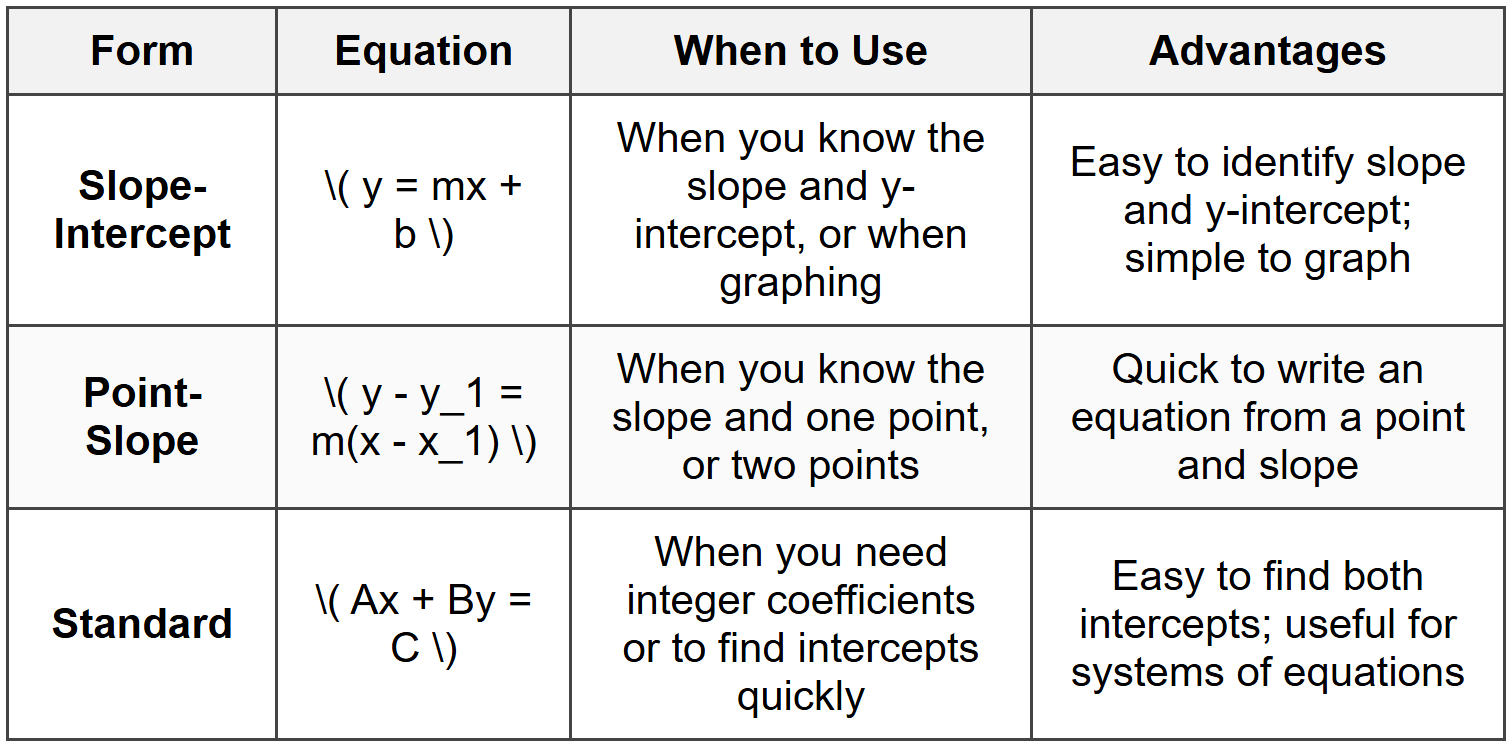
Each form of a linear equation has advantages depending on the information you have and what you need to find. The table below summarizes the three forms:
Converting Between Forms
Being able to convert a linear equation from one form to another is an essential skill. Here is a systematic approach for each type of conversion:
From Slope-Intercept to Point-Slope
If you have \( y = mx + b \), you can identify the slope \( m \) and choose any point on the line. For example, the y-intercept \((0, b)\) is always on the line, so you can write \( y - b = m(x - 0) \), which simplifies to \( y - b = mx \).
From Slope-Intercept to Standard
Starting with \( y = mx + b \), move the \( mx \) term to the left side to get \( -mx + y = b \). If \( m \) is a fraction, multiply through by the denominator. Then multiply by -1 if necessary to make the \( x \)-coefficient positive.
From Point-Slope to Slope-Intercept
Starting with \( y - y_1 = m(x - x_1) \), distribute the \( m \) on the right side, then add \( y_1 \) to both sides to isolate \( y \).
From Point-Slope to Standard
Starting with \( y - y_1 = m(x - x_1) \), distribute, then move all terms involving variables to one side. Clear any fractions and adjust signs as needed.
From Standard to Slope-Intercept
Starting with \( Ax + By = C \), solve for \( y \) by subtracting \( Ax \) from both sides and then dividing by \( B \).
From Standard to Point-Slope
First convert to slope-intercept form to find the slope \( m \), then choose any point on the line (such as an intercept) and use point-slope form.
Applications of Different Forms
Understanding when to use each form is just as important as knowing how to manipulate the equations algebraically. Here are some common situations:
Real-World Modeling
When a problem describes a starting value and a constant rate of change, slope-intercept form is natural. For example, a phone plan with a monthly fee plus a per-minute charge fits the form \( C = mx + b \), where \( C \) is total cost, \( m \) is cost per minute, \( x \) is number of minutes, and \( b \) is the monthly fee.
Example: A taxi charges a flat fee of $3.00 plus $0.50 per mile.
Write an equation for the total cost \( C \) in dollars for a trip of \( d \) miles.What is the equation?
Solution:
The rate of change is $0.50 per mile, so the slope is \( m = 0.5 \).
The flat fee is $3.00, which is the cost when \( d = 0 \), so the y-intercept is \( b = 3 \).
Using slope-intercept form, the equation is \( C = 0.5d + 3 \).
The total cost is given by \( C = 0.5d + 3 \).
Working with Constraints
Standard form is often used when working with constraints or limitations, such as budgets or combinations of items. For example, if apples cost $2 each and oranges cost $3 each, and you have $12 to spend, the equation \( 2x + 3y = 12 \) represents all possible combinations of apples \( x \) and oranges \( y \) you can buy.
Graphing Efficiently
Slope-intercept form is ideal for graphing because you can immediately plot the y-intercept and use the slope to find additional points. Standard form is useful for graphing when you want to quickly find both intercepts and draw the line through them.
Horizontal and Vertical Lines
Two special cases of linear equations deserve attention: horizontal and vertical lines.
Horizontal Lines
A horizontal line has a slope of zero because there is no vertical change as \( x \) increases. Every point on a horizontal line has the same y-coordinate. The equation of a horizontal line is:
\[ y = k \]where \( k \) is a constant. For example, \( y = 5 \) is a horizontal line passing through all points where the y-coordinate is 5.
Vertical Lines
A vertical line has an undefined slope because there is no horizontal change-all points have the same x-coordinate. The equation of a vertical line is:
\[ x = h \]where \( h \) is a constant. For example, \( x = -2 \) is a vertical line passing through all points where the x-coordinate is -2. Note that vertical lines cannot be written in slope-intercept form because they do not represent functions.
Summary of Key Concepts
To work effectively with linear equations, you should be comfortable with all three forms and know how to convert between them. Remember:
- Slope-intercept form \( y = mx + b \) is best when you know or need the slope and y-intercept.
- Point-slope form \( y - y_1 = m(x - x_1) \) is best when you know a point and the slope.
- Standard form \( Ax + By = C \) is best for finding intercepts and working with integer coefficients.
- The slope \( m \) describes the steepness and direction of the line.
- The y-intercept is where the line crosses the y-axis.
- Horizontal lines have equations of the form \( y = k \); vertical lines have equations of the form \( x = h \).
By mastering these three forms and understanding their relationships, you gain powerful tools for modeling situations, solving problems, and analyzing linear relationships in mathematics and the real world.




