Chapter Notes: Polynomial Factorization


Polynomials are algebraic expressions that appear throughout mathematics, science, and engineering. When we work with polynomials, one of the most powerful techniques we can use is factoring. Factoring a polynomial means rewriting it as a product of simpler polynomials. This skill allows us to solve equations, simplify expressions, and understand the behavior of polynomial functions. In this chapter, you will learn multiple strategies for factoring polynomials, from pulling out common factors to recognizing special patterns and using advanced techniques for higher-degree polynomials.
What Is Polynomial Factoring?
Factoring is the reverse process of multiplying polynomials. When you multiply \( (x + 2)(x + 3) \), you get \( x^2 + 5x + 6 \). Factoring means starting with \( x^2 + 5x + 6 \) and working backward to get \( (x + 2)(x + 3) \).
A polynomial is factored completely when it is written as a product of polynomials that cannot be factored further using integer coefficients. Each of these simpler polynomials is called a factor.
Think of factoring like breaking down a number into its prime factors. Just as 12 = 2 × 2 × 3, we break polynomials into their simplest building blocks.
Greatest Common Factor (GCF)
The first step in factoring any polynomial is always to look for the greatest common factor, or GCF. The GCF is the largest expression that divides evenly into every term of the polynomial.
To find the GCF:
- Find the greatest common numerical coefficient
- Find the lowest power of each variable that appears in all terms
- Multiply these together to get the GCF
Once you identify the GCF, factor it out by dividing each term by the GCF and writing the polynomial as a product.
Example: Factor the polynomial completely.
\( 6x^3 + 9x^2 - 15x \)What is the factored form?
Solution:
First, identify the GCF of the coefficients: GCF(6, 9, 15) = 3
Next, identify the lowest power of x that appears in all terms: \( x^1 \)
Therefore, the GCF is \( 3x \)
Divide each term by \( 3x \):
\( 6x^3 ÷ 3x = 2x^2 \)
\( 9x^2 ÷ 3x = 3x \)
\( -15x ÷ 3x = -5 \)Write the factored form: \( 3x(2x^2 + 3x - 5) \)
The completely factored form is \( 3x(2x^2 + 3x - 5) \).
Factoring Trinomials of the Form \( x^2 + bx + c \)
A trinomial is a polynomial with three terms. When the leading coefficient is 1, we can use a straightforward method to factor trinomials of the form \( x^2 + bx + c \).
We look for two numbers that:
- Multiply to give \( c \) (the constant term)
- Add to give \( b \) (the coefficient of the middle term)
If we find such numbers, say \( m \) and \( n \), then:
\[ x^2 + bx + c = (x + m)(x + n) \]Example: Factor the trinomial.
\( x^2 + 7x + 12 \)What is the factored form?
Solution:
We need two numbers that multiply to 12 and add to 7.
List factor pairs of 12: (1, 12), (2, 6), (3, 4)
Check which pair adds to 7: 3 + 4 = 7 ✓
Write the factored form: \( (x + 3)(x + 4) \)
Check by expanding: \( (x + 3)(x + 4) = x^2 + 4x + 3x + 12 = x^2 + 7x + 12 \) ✓
The factored form is \( (x + 3)(x + 4) \).
Example: Factor the trinomial.
\( x^2 - 5x - 24 \)What is the factored form?
Solution:
We need two numbers that multiply to -24 and add to -5.
Since the product is negative, one number must be positive and one negative.
Consider factor pairs of 24: (1, 24), (2, 12), (3, 8), (4, 6)
Try: -8 and 3 multiply to -24, and -8 + 3 = -5 ✓
Write the factored form: \( (x - 8)(x + 3) \)
The factored form is \( (x - 8)(x + 3) \).
Factoring Trinomials of the Form \( ax^2 + bx + c \)
When the leading coefficient is not 1, factoring becomes more challenging. There are two common methods: the AC method (also called factor by grouping) and trial and error.
The AC Method
The AC method works as follows:
- Multiply \( a \) and \( c \) to get \( ac \)
- Find two numbers that multiply to \( ac \) and add to \( b \)
- Rewrite the middle term using these two numbers
- Factor by grouping
Example: Factor the trinomial using the AC method.
\( 2x^2 + 7x + 3 \)What is the factored form?
Solution:
Multiply: \( a × c = 2 × 3 = 6 \)
Find two numbers that multiply to 6 and add to 7: 1 and 6
Rewrite the middle term: \( 2x^2 + 1x + 6x + 3 \)
Group the terms: \( (2x^2 + 1x) + (6x + 3) \)
Factor out the GCF from each group: \( x(2x + 1) + 3(2x + 1) \)
Factor out the common binomial: \( (2x + 1)(x + 3) \)
The factored form is \( (2x + 1)(x + 3) \).
Trial and Error Method
For trinomials with small coefficients, you can also use systematic trial and error. Write possible factor pairs and test them by multiplying until you find the correct combination.
Example: Factor the trinomial.
\( 3x^2 - 10x + 8 \)What is the factored form?
Solution:
The factors of 3 are 1 and 3, so the first terms will be \( 3x \) and \( x \).
The factors of 8 are (1, 8) and (2, 4). Since the middle term is negative and the last term positive, both signs must be negative.
Try \( (3x - 2)(x - 4) \): gives \( 3x^2 - 12x - 2x + 8 = 3x^2 - 14x + 8 \) ✗
Try \( (3x - 4)(x - 2) \): gives \( 3x^2 - 6x - 4x + 8 = 3x^2 - 10x + 8 \) ✓
The factored form is \( (3x - 4)(x - 2) \).
Special Factoring Patterns
Certain polynomial forms appear frequently and follow predictable patterns. Recognizing these patterns allows you to factor quickly without trial and error.
Difference of Two Squares
When you have two perfect squares separated by subtraction, use this pattern:
\[ a^2 - b^2 = (a + b)(a - b) \]This pattern only works for subtraction. The sum of two squares, \( a^2 + b^2 \), cannot be factored using real numbers.
Example: Factor the polynomial.
\( x^2 - 49 \)What is the factored form?
Solution:
Recognize that \( x^2 \) is a perfect square and 49 = \( 7^2 \) is a perfect square.
Apply the difference of squares pattern with \( a = x \) and \( b = 7 \).
The factored form is \( (x + 7)(x - 7) \).
Example: Factor the polynomial.
\( 4x^2 - 25y^2 \)What is the factored form?
Solution:
Recognize that \( 4x^2 = (2x)^2 \) and \( 25y^2 = (5y)^2 \).
Apply the difference of squares pattern with \( a = 2x \) and \( b = 5y \).
The factored form is \( (2x + 5y)(2x - 5y) \).
Perfect Square Trinomials
A perfect square trinomial is the result of squaring a binomial. There are two patterns:
\[ a^2 + 2ab + b^2 = (a + b)^2 \] \[ a^2 - 2ab + b^2 = (a - b)^2 \]To recognize a perfect square trinomial:
- The first and last terms must be perfect squares
- The middle term must equal twice the product of the square roots of the first and last terms
Example: Factor the trinomial.
\( x^2 + 10x + 25 \)What is the factored form?
Solution:
Check if it's a perfect square trinomial: \( x^2 \) is a perfect square (square root is \( x \)), and 25 is a perfect square (square root is 5).
Check the middle term: \( 2 × x × 5 = 10x \) ✓
Since the pattern matches \( a^2 + 2ab + b^2 \) with \( a = x \) and \( b = 5 \), the factored form is \( (x + 5)^2 \).
The factored form is \( (x + 5)^2 \).
Sum and Difference of Cubes
Cubic polynomials have their own special patterns:
\[ a^3 + b^3 = (a + b)(a^2 - ab + b^2) \] \[ a^3 - b^3 = (a - b)(a^2 + ab + b^2) \]Memory tip: "SOAP" - Same sign, Opposite sign, Always Positive. The first binomial has the same sign as the original, the trinomial starts with the opposite sign, and the last term is always positive.
Example: Factor the polynomial.
\( x^3 + 27 \)What is the factored form?
Solution:
Recognize this as a sum of cubes: \( x^3 + 3^3 \)
Apply the sum of cubes formula with \( a = x \) and \( b = 3 \).
First factor: \( (x + 3) \)
Second factor: \( (x^2 - 3x + 9) \)
The factored form is \( (x + 3)(x^2 - 3x + 9) \).
Example: Factor the polynomial.
\( 8x^3 - 125 \)What is the factored form?
Solution:
Recognize this as a difference of cubes: \( (2x)^3 - 5^3 \)
Apply the difference of cubes formula with \( a = 2x \) and \( b = 5 \).
First factor: \( (2x - 5) \)
Second factor: \( ((2x)^2 + (2x)(5) + 5^2) = (4x^2 + 10x + 25) \)
The factored form is \( (2x - 5)(4x^2 + 10x + 25) \).
Factoring by Grouping
When a polynomial has four or more terms, factoring by grouping is often effective. The strategy is to group terms in pairs, factor out the GCF from each pair, and then factor out the common binomial.
Example: Factor the polynomial by grouping.
\( 2x^3 - 3x^2 + 2x - 3 \)What is the factored form?
Solution:
Group the first two terms and the last two terms: \( (2x^3 - 3x^2) + (2x - 3) \)
Factor out the GCF from each group: \( x^2(2x - 3) + 1(2x - 3) \)
Factor out the common binomial \( (2x - 3) \): \( (2x - 3)(x^2 + 1) \)
The factored form is \( (2x - 3)(x^2 + 1) \).
Factoring Completely
A polynomial is factored completely when:
- All common factors have been removed
- Each remaining factor cannot be factored further using integers
- All special patterns have been applied
Always follow this strategy:
- Factor out the GCF first
- Look for special patterns (difference of squares, perfect square trinomials, sum/difference of cubes)
- Factor any remaining trinomials or use grouping
- Check each factor to see if it can be factored further
Example: Factor the polynomial completely.
\( 3x^4 - 48 \)What is the completely factored form?
Solution:
Factor out the GCF, which is 3: \( 3(x^4 - 16) \)
Recognize \( x^4 - 16 \) as a difference of squares: \( (x^2)^2 - 4^2 \)
Factor the difference of squares: \( 3(x^2 + 4)(x^2 - 4) \)
Check if any factor can be factored further. The term \( x^2 - 4 \) is also a difference of squares!
Factor \( x^2 - 4 \) as \( (x + 2)(x - 2) \)
Final result: \( 3(x^2 + 4)(x + 2)(x - 2) \)
The completely factored form is \( 3(x^2 + 4)(x + 2)(x - 2) \).
Using Factoring to Solve Equations
One of the most important applications of factoring is solving polynomial equations. The Zero Product Property states that if a product of factors equals zero, then at least one of the factors must equal zero.
To solve a polynomial equation by factoring:
- Move all terms to one side so the equation equals zero
- Factor the polynomial completely
- Set each factor equal to zero
- Solve each simple equation
Example: Solve the equation by factoring.
\( x^2 + 5x - 14 = 0 \)What are the solutions?
Solution:
The equation is already set equal to zero.
Factor the trinomial. We need two numbers that multiply to -14 and add to 5: those numbers are 7 and -2.
Factored form: \( (x + 7)(x - 2) = 0 \)
Apply the Zero Product Property: \( x + 7 = 0 \) or \( x - 2 = 0 \)
Solve each equation: \( x = -7 \) or \( x = 2 \)
The solutions are \( x = -7 \) and \( x = 2 \).
Example: Solve the equation by factoring.
\( 6x^2 = 13x + 5 \)What are the solutions?
Solution:
Move all terms to one side: \( 6x^2 - 13x - 5 = 0 \)
Use the AC method. Multiply: \( 6 × (-5) = -30 \). Find two numbers that multiply to -30 and add to -13: those are -15 and 2.
Rewrite: \( 6x^2 - 15x + 2x - 5 = 0 \)
Factor by grouping: \( 3x(2x - 5) + 1(2x - 5) = 0 \)
Factor out the common binomial: \( (2x - 5)(3x + 1) = 0 \)
Set each factor equal to zero: \( 2x - 5 = 0 \) or \( 3x + 1 = 0 \)
Solve: \( x = \frac{5}{2} \) or \( x = -\frac{1}{3} \)
The solutions are \( x = \frac{5}{2} \) and \( x = -\frac{1}{3} \).
Factoring Strategy Summary
When faced with any factoring problem, use this systematic approach:
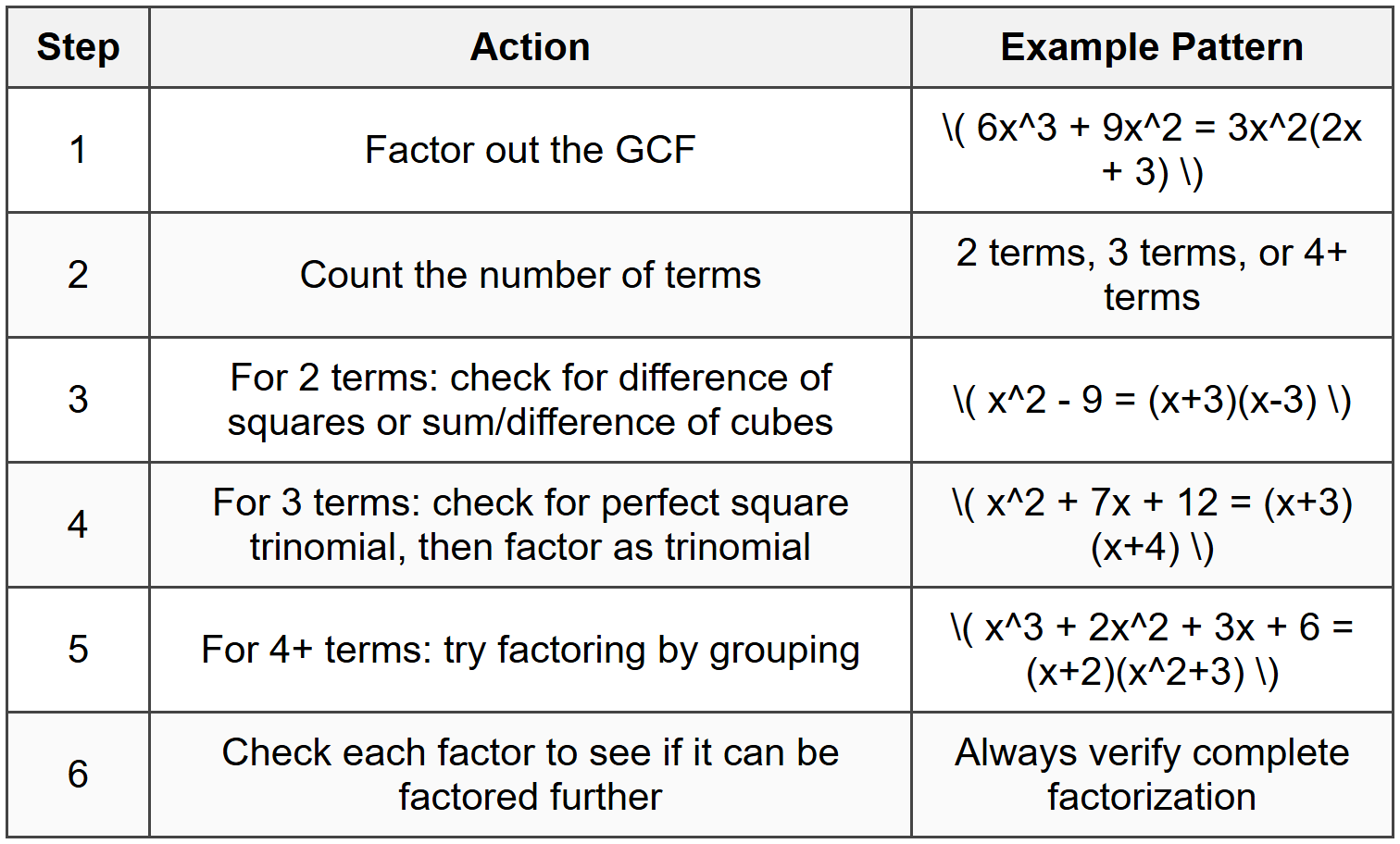
Mastering polynomial factoring requires practice and pattern recognition. The more you factor, the more quickly you will identify which method to use. Remember that factoring is a critical skill not just for solving equations, but also for simplifying rational expressions, graphing polynomial functions, and working with advanced algebraic concepts throughout your mathematical studies.




