Chapter Notes: Exponential Models


In the world around us, many things grow or shrink at rates that depend on how much is already present. A population of bacteria doesn't just add the same number of cells every hour-it doubles or triples based on how many bacteria are already there. Money in a savings account earns interest based on the current balance, not a fixed dollar amount. The temperature of hot coffee cooling in a room decreases rapidly at first, then more slowly as it approaches room temperature. All of these situations are best described by exponential models, mathematical functions where the rate of change is proportional to the current amount. Understanding exponential models allows us to predict future values, analyze trends, and make informed decisions in science, finance, and everyday life.
Understanding Exponential Functions
An exponential function is a function in which the variable appears in the exponent. The general form of an exponential function is:
\[ f(x) = ab^x \]where \( a \) is the initial value (the value when \( x = 0 \)), \( b \) is the base (a positive number not equal to 1), and \( x \) is the independent variable, often representing time.
The behavior of an exponential function depends critically on the value of the base \( b \):
- If \( b > 1 \), the function represents exponential growth. The values increase rapidly as \( x \) increases.
- If \( 0 < b="">< 1="" \),="" the="" function="" represents="">exponential decay. The values decrease rapidly at first, then level off as \( x \) increases.
Unlike linear functions where you add the same amount each time, exponential functions multiply by the same factor each time. This multiplicative pattern creates the characteristic J-shaped curve for growth or the decreasing curve for decay.
Example: A scientist starts with 50 bacteria in a petri dish.
The population doubles every hour.Write an exponential function to model the bacteria population after \( t \) hours.
Solution:
The initial value is \( a = 50 \) bacteria.
Since the population doubles every hour, the base is \( b = 2 \).
The exponential function is \( P(t) = 50 \cdot 2^t \).
The bacteria population after \( t \) hours is modeled by \( P(t) = 50 \cdot 2^t \).
Exponential Growth Models
Exponential growth occurs when a quantity increases by a fixed percentage over equal time intervals. Common examples include population growth, compound interest, and the spread of diseases or information.
The Growth Formula
When a quantity grows exponentially, we use the formula:
\[ A(t) = A_0(1 + r)^t \]where:
- \( A(t) \) is the amount after time \( t \)
- \( A_0 \) is the initial amount (when \( t = 0 \))
- \( r \) is the growth rate expressed as a decimal
- \( t \) is time
Notice that the base is \( (1 + r) \). For example, if something grows by 5% each year, \( r = 0.05 \) and the base is \( 1.05 \). Each year, you have 100% of what you had before plus 5% more.
Example: A town has a population of 12,000 people.
The population increases by 3% each year.What will the population be after 10 years?
Solution:
The initial population is \( A_0 = 12000 \).
The growth rate is \( r = 0.03 \) (3% written as a decimal).
The time is \( t = 10 \) years.
Using the growth formula: \( A(10) = 12000(1 + 0.03)^{10} = 12000(1.03)^{10} \).
Calculating: \( (1.03)^{10} \approx 1.3439 \).
Therefore: \( A(10) = 12000 \times 1.3439 \approx 16127 \).
After 10 years, the population will be approximately 16,127 people.
Compound Interest
One of the most important applications of exponential growth is compound interest, where interest is earned not only on the principal amount but also on previously earned interest.
The compound interest formula when interest is compounded annually is:
\[ A = P(1 + r)^t \]where \( P \) is the principal (initial investment), \( r \) is the annual interest rate as a decimal, and \( t \) is the number of years.
When interest is compounded more frequently than once per year, we modify the formula:
\[ A = P\left(1 + \frac{r}{n}\right)^{nt} \]where \( n \) is the number of times interest is compounded per year.
Example: You invest $2,500 in a savings account that pays 4% annual interest compounded quarterly.
How much will you have after 5 years?
Solution:
The principal is \( P = 2500 \).
The annual interest rate is \( r = 0.04 \).
Quarterly compounding means \( n = 4 \) times per year.
The time is \( t = 5 \) years.
Using the compound interest formula: \( A = 2500\left(1 + \frac{0.04}{4}\right)^{4 \times 5} = 2500(1.01)^{20} \).
Calculating: \( (1.01)^{20} \approx 1.2202 \).
Therefore: \( A = 2500 \times 1.2202 \approx 3050.50 \).
After 5 years, you will have approximately $3,050.50.
Exponential Decay Models
Exponential decay occurs when a quantity decreases by a fixed percentage over equal time intervals. Examples include radioactive decay, depreciation of assets, cooling of objects, and elimination of medications from the body.
The Decay Formula
When a quantity decays exponentially, we use the formula:
\[ A(t) = A_0(1 - r)^t \]where:
- \( A(t) \) is the amount remaining after time \( t \)
- \( A_0 \) is the initial amount
- \( r \) is the decay rate expressed as a decimal
- \( t \) is time
The base is now \( (1 - r) \), which is less than 1. For example, if something loses 8% of its value each year, \( r = 0.08 \) and the base is \( 0.92 \). Each year, you retain 92% of what you had before.
Example: A new car is purchased for $28,000.
It depreciates (loses value) at a rate of 15% per year.What will the car be worth after 6 years?
Solution:
The initial value is \( A_0 = 28000 \).
The decay rate is \( r = 0.15 \) (15% written as a decimal).
The time is \( t = 6 \) years.
Using the decay formula: \( A(6) = 28000(1 - 0.15)^6 = 28000(0.85)^6 \).
Calculating: \( (0.85)^6 \approx 0.3771 \).
Therefore: \( A(6) = 28000 \times 0.3771 \approx 10559 \).
After 6 years, the car will be worth approximately $10,559.
Half-Life
In many decay situations, we describe how quickly something decreases using its half-life-the time it takes for half of the substance to decay. Half-life is commonly used in chemistry, physics, and medicine.
If we know the half-life \( h \), we can write the decay formula as:
\[ A(t) = A_0 \left(\frac{1}{2}\right)^{t/h} \]This formula tells us how many half-lives have passed. After one half-life, half remains. After two half-lives, one-quarter remains. After three half-lives, one-eighth remains, and so on.
Example: A radioactive substance has a half-life of 8 days.
You start with 200 grams of the substance.How much will remain after 24 days?
Solution:
The initial amount is \( A_0 = 200 \) grams.
The half-life is \( h = 8 \) days.
The time is \( t = 24 \) days.
Using the half-life formula: \( A(24) = 200\left(\frac{1}{2}\right)^{24/8} = 200\left(\frac{1}{2}\right)^3 \).
Calculating: \( \left(\frac{1}{2}\right)^3 = \frac{1}{8} = 0.125 \).
Therefore: \( A(24) = 200 \times 0.125 = 25 \).
After 24 days, 25 grams of the substance will remain.
The Natural Base e
While exponential functions can have any positive base, there is one special base that appears constantly in nature, science, and finance: the number e. The value of \( e \) is approximately 2.71828, and it is an irrational number like π.
The number \( e \) arises naturally when studying continuous growth or decay. When interest is compounded continuously (infinitely many times per year), when populations grow without constraint, or when substances decay continuously, the exponential function with base \( e \) provides the model.
Continuous Growth and Decay
For continuous exponential growth or decay, we use the formula:
\[ A(t) = A_0 e^{kt} \]where:
- \( A(t) \) is the amount at time \( t \)
- \( A_0 \) is the initial amount
- \( k \) is the continuous growth rate (if \( k > 0 \)) or decay rate (if \( k < 0="">
- \( t \) is time
- \( e \) is the natural base
The value \( k \) is different from the percentage rate \( r \) used earlier. When \( k \) is positive, the quantity grows continuously. When \( k \) is negative, the quantity decays continuously.
Example: A colony of bacteria grows continuously at a rate of \( k = 0.12 \) per hour.
The initial population is 500 bacteria.How many bacteria will there be after 5 hours?
Solution:
The initial population is \( A_0 = 500 \).
The continuous growth rate is \( k = 0.12 \).
The time is \( t = 5 \) hours.
Using the continuous growth formula: \( A(5) = 500e^{0.12 \times 5} = 500e^{0.6} \).
Calculating: \( e^{0.6} \approx 1.8221 \).
Therefore: \( A(5) = 500 \times 1.8221 \approx 911 \).
After 5 hours, there will be approximately 911 bacteria.
Continuous Compounding
When money earns interest compounded continuously, we use:
\[ A = Pe^{rt} \]where \( P \) is the principal, \( r \) is the annual interest rate (as a decimal), and \( t \) is time in years. This represents the theoretical maximum amount you could earn at a given interest rate.
Example: You invest $5,000 at an annual interest rate of 6% compounded continuously.
How much will you have after 10 years?
Solution:
The principal is \( P = 5000 \).
The annual interest rate is \( r = 0.06 \).
The time is \( t = 10 \) years.
Using the continuous compounding formula: \( A = 5000e^{0.06 \times 10} = 5000e^{0.6} \).
Calculating: \( e^{0.6} \approx 1.8221 \).
Therefore: \( A = 5000 \times 1.8221 \approx 9110.50 \).
After 10 years, you will have approximately $9,110.50.
Comparing Linear and Exponential Models
It's important to recognize when a situation calls for a linear model versus an exponential model. The key distinction lies in how the quantity changes.
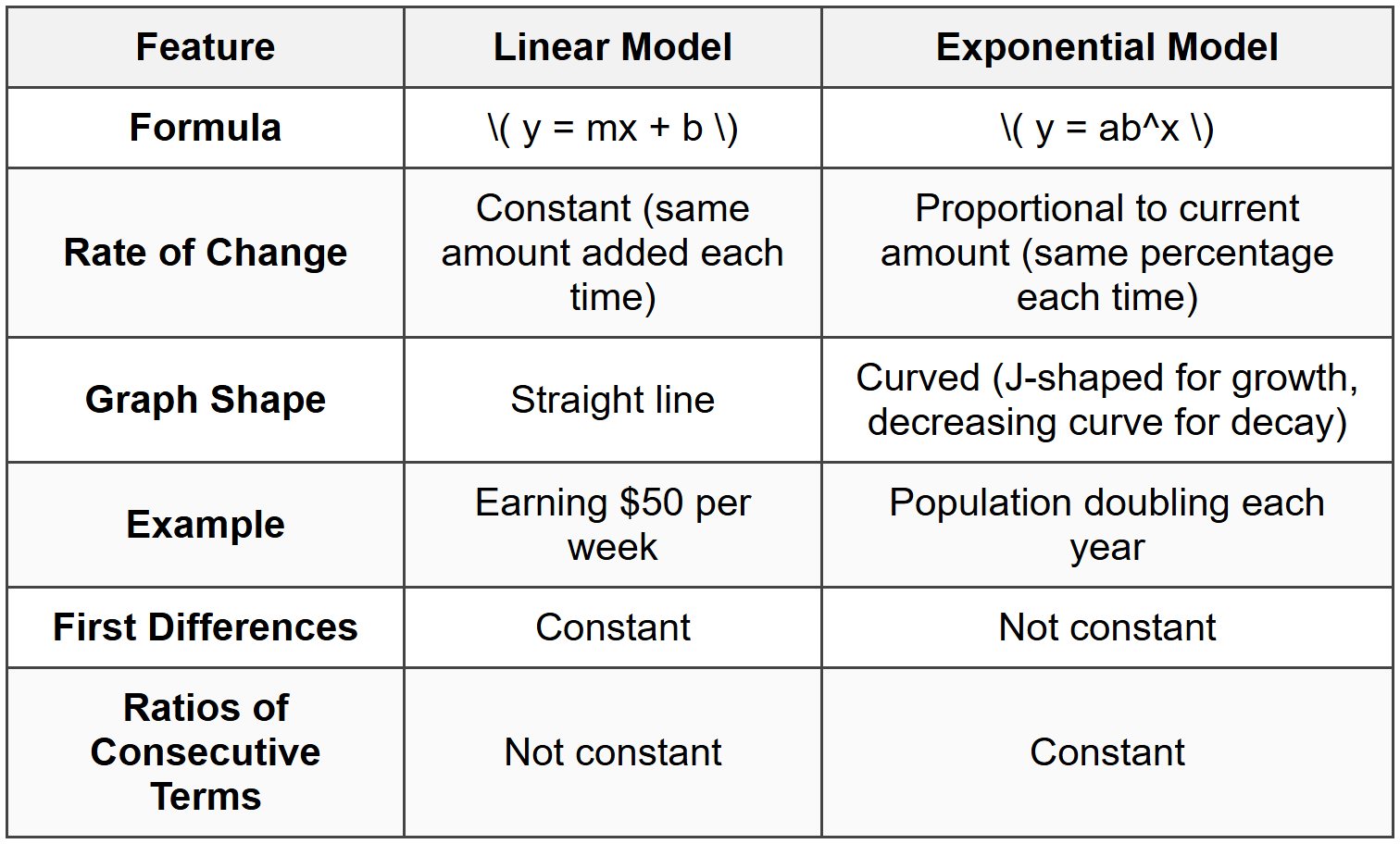
When you see data or a word problem, look for phrases like "increases by 5 each year" (linear, adding) versus "increases by 5% each year" (exponential, multiplying).
Writing Exponential Models from Data
Often you need to create an exponential model from information given in a problem. The process depends on what information you're given.
When Given Initial Value and Growth/Decay Rate
If you know the starting amount and the percentage change per time period, substitute directly into \( A(t) = A_0(1 + r)^t \) for growth or \( A(t) = A_0(1 - r)^t \) for decay.
When Given Two Points
If you know two data points \( (x_1, y_1) \) and \( (x_2, y_2) \), you can find the base \( b \) and initial value \( a \) in \( y = ab^x \).
Here's the process:
- Write two equations by substituting the two points into \( y = ab^x \).
- Divide one equation by the other to eliminate \( a \) and solve for \( b \).
- Substitute \( b \) back into either equation to solve for \( a \).
Example: An exponential function passes through the points (2, 18) and (5, 486).
Find the exponential function in the form \( y = ab^x \).
Solution:
Using point (2, 18): \( 18 = ab^2 \).
Using point (5, 486): \( 486 = ab^5 \).
Divide the second equation by the first: \( \frac{486}{18} = \frac{ab^5}{ab^2} \), which gives \( 27 = b^3 \).
Solving for \( b \): \( b = \sqrt[3]{27} = 3 \).
Substitute \( b = 3 \) into \( 18 = ab^2 \): \( 18 = a(3)^2 = 9a \).
Solving for \( a \): \( a = 2 \).
The exponential function is \( y = 2 \cdot 3^x \).
Solving Exponential Equations
Sometimes you need to find the time or input value that produces a certain output in an exponential model. This requires solving an exponential equation.
Using Common Bases
If you can rewrite both sides of an equation with the same base, you can set the exponents equal to each other and solve.
Example: Solve \( 2^{x+1} = 16 \).
Solution:
Rewrite 16 as a power of 2: \( 16 = 2^4 \).
The equation becomes \( 2^{x+1} = 2^4 \).
Since the bases are equal, set the exponents equal: \( x + 1 = 4 \).
Solving for \( x \): \( x = 3 \).
The solution is \( x = 3 \).
Using Logarithms
When you cannot easily rewrite both sides with the same base, you use logarithms. Logarithms are the inverse operation of exponentiation-they "undo" the exponential. While logarithms are studied in detail in another chapter, the basic principle is that if \( b^x = y \), then \( x = \log_b(y) \).
Most commonly, we use the common logarithm (base 10, written as log) or the natural logarithm (base \( e \), written as ln) to solve exponential equations.
The key property is: if \( b^x = c \), then \( x = \frac{\log c}{\log b} \) or \( x = \frac{\ln c}{\ln b} \).
Example: A population of 8,000 grows at 4% per year.
How long will it take for the population to reach 12,000?Solution:
The exponential model is \( A(t) = 8000(1.04)^t \).
We want to find \( t \) when \( A(t) = 12000 \): \( 12000 = 8000(1.04)^t \).
Divide both sides by 8000: \( 1.5 = (1.04)^t \).
Take the natural logarithm of both sides: \( \ln(1.5) = \ln((1.04)^t) \).
Use the power property of logarithms: \( \ln(1.5) = t \ln(1.04) \).
Solve for \( t \): \( t = \frac{\ln(1.5)}{\ln(1.04)} \approx \frac{0.4055}{0.0392} \approx 10.34 \).
It will take approximately 10.34 years for the population to reach 12,000.
Real-World Applications
Exponential models appear throughout science, finance, and social sciences. Recognizing exponential patterns helps us make predictions and understand complex systems.
Population Biology
Populations of organisms often grow exponentially when resources are abundant and there are no predators or diseases limiting growth. The model breaks down when populations reach the carrying capacity of their environment, but early growth is exponential.
Medicine
When you take medication, your body eliminates it at a rate proportional to the amount present. This is exponential decay. Doctors use exponential models to determine dosing schedules that keep drug levels within a therapeutic range.
Physics and Chemistry
Radioactive substances decay exponentially. Newton's Law of Cooling states that the temperature of an object changes exponentially as it approaches the temperature of its surroundings. Carbon-14 dating uses the exponential decay of radioactive carbon to determine the age of archaeological artifacts.
Economics and Finance
Inflation causes prices to increase exponentially over time. Investments grow exponentially with compound interest. Understanding these models helps individuals plan for retirement and make informed financial decisions.
Technology
Moore's Law observed that the number of transistors on computer chips doubled approximately every two years-exponential growth that drove decades of technological advancement. The spread of information through social media often follows exponential patterns in the early stages.
By mastering exponential models, you gain powerful tools to analyze and predict change in the world around you. Whether you're planning your financial future, understanding scientific phenomena, or interpreting data in the news, exponential thinking provides essential insight into how quantities change over time.