Chapter Notes: Transformations Of Functions


Functions are mathematical relationships that connect inputs to outputs, and their graphs provide a visual way to understand these relationships. Sometimes we need to modify or transform a function to fit a particular situation or to analyze how changes in the equation affect the graph. In this chapter, you'll learn how to shift, stretch, compress, and reflect function graphs using algebraic rules. Understanding transformations allows you to quickly sketch complex functions by starting with a simple parent function and applying a sequence of changes. These skills are essential for modeling real-world situations and analyzing how different parameters affect behavior in science, engineering, economics, and many other fields.
Parent Functions
A parent function is the simplest, most basic form of a family of functions. It serves as the starting point or template from which we create more complex functions through transformations. Each type of function has a parent function that exhibits the core characteristics of that family.
Here are some common parent functions you should know:
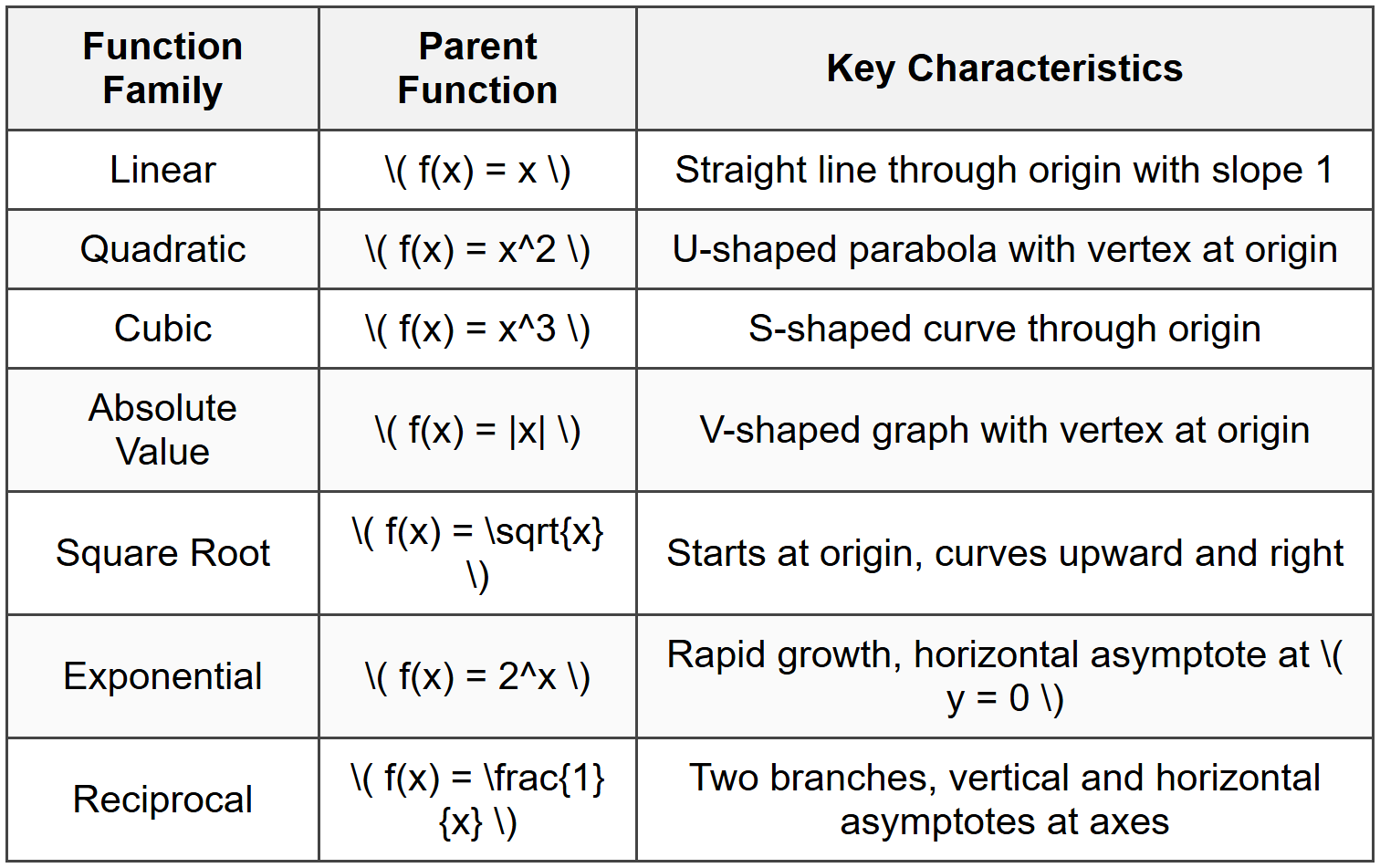
Knowing these parent functions and their graphs is crucial because all transformations start from these basic shapes. When you encounter a function like \( g(x) = (x - 3)^2 + 2 \), you recognize it as a transformation of the quadratic parent function \( f(x) = x^2 \).
Vertical Translations
A vertical translation shifts a graph up or down without changing its shape. When we add or subtract a constant outside the function, we move every point on the graph the same distance vertically.
The general form is:
\[ g(x) = f(x) + k \]where \( k \) is a constant. Here's how it works:
- If \( k > 0 \), the graph shifts upward by \( k \) units
- If \( k < 0="" \),="" the="" graph="" shifts="">downward by \( |k| \) units
Think of vertical translations like riding an elevator: adding a positive number lifts you up, while subtracting (adding a negative number) takes you down. The building's shape doesn't change-you just view it from a different floor.
Example: The parent function \( f(x) = x^2 \) is transformed to \( g(x) = x^2 + 3 \).
Describe the transformation and find the new vertex.
Solution:
The parent function \( f(x) = x^2 \) has its vertex at (0, 0).
The transformation \( g(x) = x^2 + 3 \) adds 3 to every output value.
This means the entire graph shifts upward by 3 units.
The new vertex is at (0, 3).
The graph has been shifted 3 units upward, and the vertex is now at (0, 3).
Example: Graph \( h(x) = |x| - 2 \) by transforming the parent absolute value function.
What is the vertex of the transformed graph?
Solution:
The parent function \( f(x) = |x| \) has a vertex at (0, 0).
The transformation \( h(x) = |x| - 2 \) subtracts 2 from every output.
This shifts the entire graph downward by 2 units.
The new vertex is at (0, -2).
The vertex of the transformed graph is at (0, -2).
Horizontal Translations
A horizontal translation shifts a graph left or right. This transformation occurs when we add or subtract a constant inside the function, affecting the input variable.
The general form is:
\[ g(x) = f(x - h) \]where \( h \) is a constant. Notice the transformation works opposite to what you might expect:
- If \( h > 0 \), the graph shifts right by \( h \) units
- If \( h < 0="" \),="" the="" graph="" shifts="">left by \( |h| \) units
This "opposite direction" rule confuses many students at first. Remember: \( f(x - 3) \) means we reach any particular output value when \( x \) is 3 units larger than before, so the graph moves to the right. Think of it as "compensating"-if we subtract 3 inside, we need a larger \( x \) to get the same result.
Example: The function \( f(x) = x^2 \) is transformed to \( g(x) = (x - 4)^2 \).
Describe the transformation and identify the new vertex.
Solution:
The parent function \( f(x) = x^2 \) has vertex at (0, 0).
The transformation \( g(x) = (x - 4)^2 \) subtracts 4 from the input.
Since we have \( x - 4 \), the graph shifts right by 4 units.
The new vertex is at (4, 0).
The graph shifts 4 units to the right, with the vertex now at (4, 0).
Example: Transform \( f(x) = \sqrt{x} \) to \( h(x) = \sqrt{x + 5} \).
What is the starting point of the transformed graph?
Solution:
The parent function \( f(x) = \sqrt{x} \) starts at (0, 0).
The transformation \( h(x) = \sqrt{x + 5} \) adds 5 to the input.
Since we have \( x + 5 \), which is \( x - (-5) \), the graph shifts left by 5 units.
The new starting point is at (-5, 0).
The transformed graph starts at (-5, 0), shifted 5 units to the left.
Vertical Stretches and Compressions
A vertical stretch or compression changes how steep or flat a graph appears by multiplying all output values by a constant factor.
The general form is:
\[ g(x) = a \cdot f(x) \]where \( a \) is a positive constant. The effect depends on the value of \( a \):
- If \( a > 1 \), the graph is stretched vertically (pulled away from the x-axis)
- If \( 0 < a="">< 1="" \),="" the="" graph="" is="">compressed vertically (pushed toward the x-axis)
Every point \( (x, y) \) on the original graph becomes \( (x, ay) \) on the transformed graph. Points on the x-axis stay fixed because multiplying zero by any number still gives zero.
Example: The function \( f(x) = x^2 \) is transformed to \( g(x) = 3x^2 \).
How does this affect a point like (2, 4) on the original graph?
Solution:
The transformation \( g(x) = 3x^2 \) multiplies every output by 3.
The original point (2, 4) satisfies \( f(2) = 2^2 = 4 \).
For the transformed function: \( g(2) = 3(2^2) = 3(4) = 12 \).
The new point is (2, 12).
The point (2, 4) transforms to (2, 12), three times farther from the x-axis.
Example: Transform \( f(x) = |x| \) to \( h(x) = \frac{1}{2}|x| \).
What happens to the point (4, 4)?
Solution:
The transformation multiplies every output by \( \frac{1}{2} \).
The original point is (4, 4) since \( f(4) = |4| = 4 \).
For the transformed function: \( h(4) = \frac{1}{2}|4| = \frac{1}{2}(4) = 2 \).
The new point is (4, 2), which is closer to the x-axis.
The point (4, 4) becomes (4, 2), compressed to half its original height.
Horizontal Stretches and Compressions
A horizontal stretch or compression changes how wide or narrow a graph appears by multiplying the input variable by a constant.
The general form is:
\[ g(x) = f(bx) \]where \( b \) is a positive constant. Like horizontal translations, this transformation works opposite to intuition:
- If \( b > 1 \), the graph is compressed horizontally (squeezed toward the y-axis)
- If \( 0 < b="">< 1="" \),="" the="" graph="" is="">stretched horizontally (pulled away from the y-axis)
Every point \( (x, y) \) on the original graph becomes \( \left(\frac{x}{b}, y\right) \) on the transformed graph.
The horizontal stretch/compression factor is the reciprocal of \( b \). If you multiply the input by 2, you compress the graph by a factor of \( \frac{1}{2} \). Think of it this way: to reach the same output value, you now need an input that's only half as large, so the graph gets narrower.
Example: Transform \( f(x) = x^2 \) to \( g(x) = (2x)^2 \).
What happens to the point (3, 9)?
Solution:
The transformation \( g(x) = (2x)^2 \) multiplies the input by 2.
To find where the point (3, 9) moves, we need \( 2x = 3 \).
Solving: \( x = \frac{3}{2} = 1.5 \).
Check: \( g(1.5) = (2 \times 1.5)^2 = 3^2 = 9 \).
The point (3, 9) transforms to (1.5, 9), compressed horizontally by a factor of \( \frac{1}{2} \).
Reflections
A reflection flips a graph across a line, creating a mirror image. The two most common reflections are across the x-axis and across the y-axis.
Reflection Across the x-axis
To reflect a graph across the x-axis, we multiply the entire function by -1:
\[ g(x) = -f(x) \]This changes the sign of every output value. Every point \( (x, y) \) becomes \( (x, -y) \). Points on the x-axis remain fixed.
Reflection Across the y-axis
To reflect a graph across the y-axis, we replace \( x \) with \( -x \):
\[ g(x) = f(-x) \]This changes the sign of every input value. Every point \( (x, y) \) becomes \( (-x, y) \). Points on the y-axis remain fixed.
Example: Transform \( f(x) = x^2 + 2x \) by reflecting it across the x-axis.
Write the equation of the transformed function.
Solution:
To reflect across the x-axis, multiply the entire function by -1.
\( g(x) = -(x^2 + 2x) = -x^2 - 2x \).
Every point that was above the x-axis is now below it, and vice versa.
The transformed function is \( g(x) = -x^2 - 2x \).
Example: Reflect \( f(x) = \sqrt{x - 1} \) across the y-axis.
What is the new function?
Solution:
To reflect across the y-axis, replace \( x \) with \( -x \).
\( g(x) = f(-x) = \sqrt{-x - 1} = \sqrt{-(x + 1)} \).
The domain changes: we now need \( -x - 1 \geq 0 \), so \( x \leq -1 \).
The transformed function is \( g(x) = \sqrt{-x - 1} \) with domain \( x \leq -1 \).
Combining Multiple Transformations
Real-world problems often require applying several transformations to a parent function. When multiple transformations are combined, the order matters. Following a consistent sequence helps avoid errors.
Recommended order of transformations:
- Horizontal stretch/compression and reflection (changes to the input inside the function)
- Horizontal translation (shifting left or right)
- Vertical stretch/compression and reflection (multiplying the function)
- Vertical translation (adding or subtracting outside the function)
The general combined form looks like:
\[ g(x) = a \cdot f(b(x - h)) + k \]where:
- \( a \) controls vertical stretch/compression and reflection across x-axis
- \( b \) controls horizontal stretch/compression and reflection across y-axis
- \( h \) controls horizontal translation (right if positive)
- \( k \) controls vertical translation (up if positive)
Example: Starting with \( f(x) = x^2 \), write the function that results from:
shifting right 3 units, reflecting across the x-axis, stretching vertically by a factor of 2, and shifting up 5 units.What is the transformed function and its vertex?
Solution:
Start with \( f(x) = x^2 \).
Shift right 3 units: \( (x - 3)^2 \).
Reflect across x-axis and stretch vertically by 2: \( -2(x - 3)^2 \).
Shift up 5 units: \( g(x) = -2(x - 3)^2 + 5 \).
The vertex of the parent function (0, 0) moves to (3, 5).
The transformed function is \( g(x) = -2(x - 3)^2 + 5 \) with vertex (3, 5).
Example: The function \( g(x) = -\frac{1}{2}|x + 4| - 1 \) is a transformation of \( f(x) = |x| \).
Describe all transformations in order and find the vertex.
Solution:
Start with \( f(x) = |x| \) with vertex at (0, 0).
The expression \( x + 4 \) means shift left 4 units: vertex moves to (-4, 0).
The factor \( -\frac{1}{2} \) means reflect across x-axis and compress vertically by \( \frac{1}{2} \).
The \( -1 \) at the end means shift down 1 unit: vertex moves to (-4, -1).
The vertex is at (-4, -1), and the graph is reflected, compressed, shifted left 4, and down 1.
Applications of Transformations
Understanding transformations helps you model and analyze real-world situations efficiently. Instead of plotting many points to graph a complex function, you can start with a familiar parent function and apply transformations step by step.
Temperature Modeling
Suppose the average daily temperature in a city follows a pattern modeled by a cosine function. If you know the basic cosine shape, you can apply vertical stretches to adjust the temperature range, horizontal compressions to fit the period to a year, and vertical translations to set the average temperature.
Profit Functions
In business, profit functions often build on quadratic parent functions. A company might find that its profit function is a parabola that has been shifted horizontally to reflect when production started, stretched vertically to reflect scale, and shifted vertically to account for fixed costs.
Engineering and Design
Engineers use transformations of parent functions to design objects with specific properties. For example, parabolic reflectors in satellite dishes and headlights use transformations of \( f(x) = x^2 \) to focus signals or light at particular points.
Example: A ball's height in feet after \( t \) seconds is modeled by \( h(t) = -16t^2 \).
If the ball is thrown from a platform 50 feet high, what is the new function?How does this represent a transformation?
Solution:
The original function \( h(t) = -16t^2 \) assumes the ball starts at ground level (0 feet).
Throwing from 50 feet high means adding 50 to the height at every time.
The new function is \( h(t) = -16t^2 + 50 \).
This is a vertical translation upward by 50 units.
The new height function is \( h(t) = -16t^2 + 50 \), a vertical shift up 50 feet.
Summary of Transformation Rules
Here is a comprehensive reference table summarizing all basic transformations:
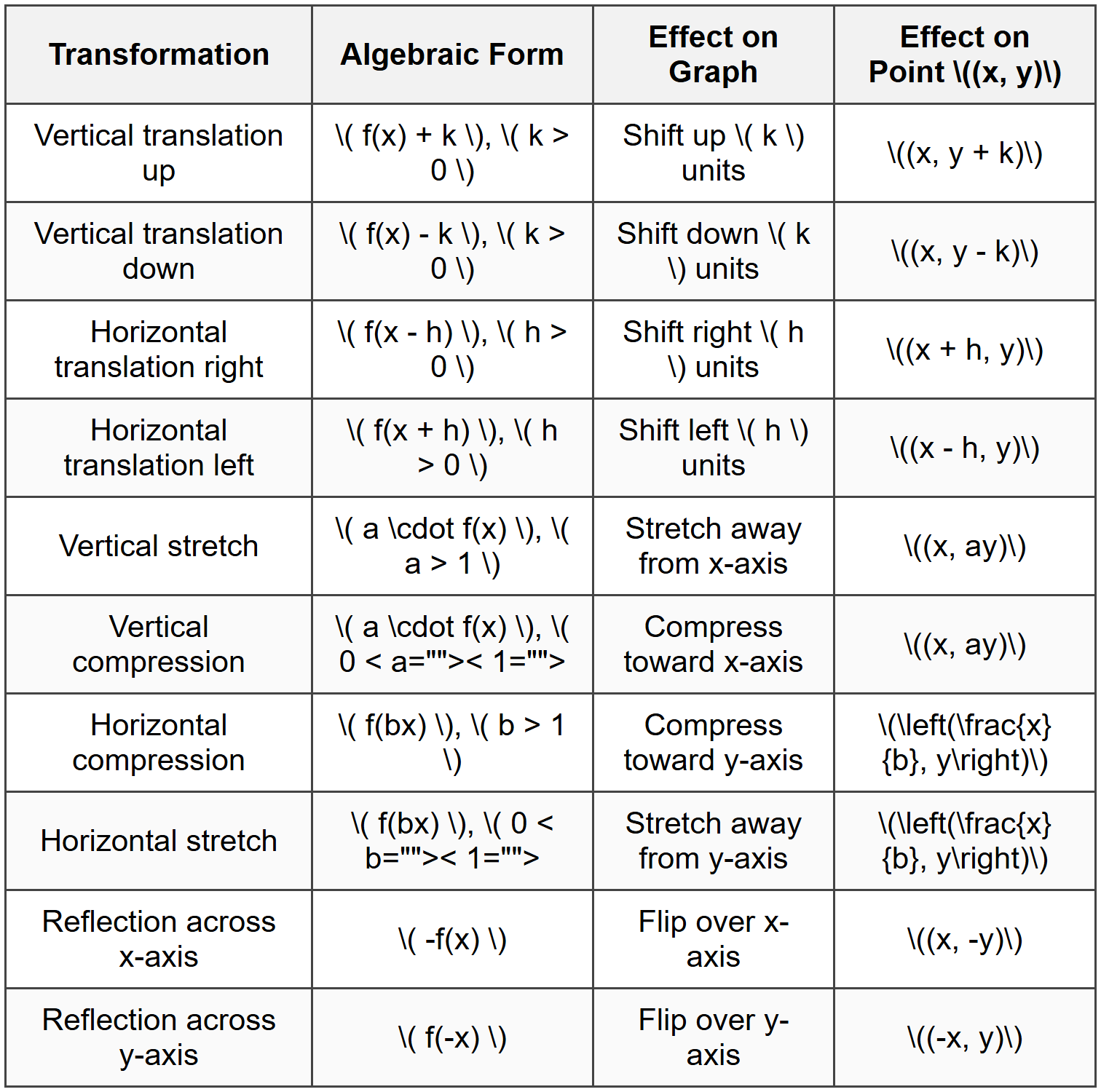
By mastering these transformation rules, you gain a powerful toolkit for understanding and graphing a wide variety of functions. Rather than memorizing individual graphs, you learn to see patterns and relationships, making mathematics more intuitive and connected. Whether you're analyzing data, solving equations, or modeling real-world phenomena, transformations provide a systematic way to adapt basic functions to fit any situation you encounter.