Ethical Standards in Law Enforcement

This topic covers the ethical principles, standards, and codes of conduct that guide law enforcement officers in their professional duties. It focuses on the application of ethical frameworks to real-world policing scenarios, the obligations of officers under the law and professional codes, and the consequences of ethical violations. Expect questions on situational judgment, identification of ethical breaches, and the proper application of ethical standards in law enforcement contexts.
Core Concepts
The Law Enforcement Code of Ethics
The Law Enforcement Code of Ethics is a formal set of principles that defines the professional standards and moral responsibilities of police officers. This code serves as the foundation for ethical behavior in law enforcement, outlining duties to the public, the law, and the profession itself.
Key Components:
- Service to humanity: Officers prioritize public service and protection of life and property above personal gain
- Safeguarding lives and property: The primary duty is protection of citizens and their belongings
- Respect for constitutional rights: Officers must uphold the rights of all individuals regardless of personal feelings
- Personal conduct standards: Officers are held to high standards both on and off duty
- Confidentiality: Information obtained during duty must be kept confidential unless disclosure is required by law
- Courage and self-restraint: Officers must act with bravery while exercising control over emotions and actions
- Impartiality: Enforcement of law must be done without bias regarding race, religion, social status, or other factors
When to Use This
- When an exam question asks what principle guides an officer's decision in a moral dilemma involving public trust versus personal benefit
- When identifying which action violates professional standards in a scenario where an officer must choose between following orders and protecting constitutional rights
- When determining the correct response to situations involving confidential information or conflicts between personal beliefs and duty to enforce the law equally
Core Ethical Principles in Policing
Integrity means adherence to moral and ethical principles, being honest and upright in all professional activities. An officer with integrity does not accept bribes, does not falsify reports, and admits mistakes rather than covering them up.
Accountability requires officers to take responsibility for their actions and decisions. Officers must answer for their conduct to supervisors, the public, and the justice system. This includes accepting consequences for mistakes and violations.
Transparency involves conducting police work in a manner that is open to scrutiny and explanation. Officers must be able to justify their actions and decisions based on legal and ethical grounds.
Fairness and Impartiality demand that officers treat all individuals equally under the law, without favoritism or discrimination. Personal feelings, relationships, or biases must not influence enforcement decisions.
When to Use This
- When a question presents a scenario where an officer witnesses a colleague engaging in misconduct and must decide whether to report it (tests accountability and integrity)
- When choosing between multiple responses to a situation involving different treatment based on social status or personal connections (tests fairness)
- When asked what an officer should do after making an error in a report or investigation (tests integrity and accountability)
Professional vs. Personal Ethics
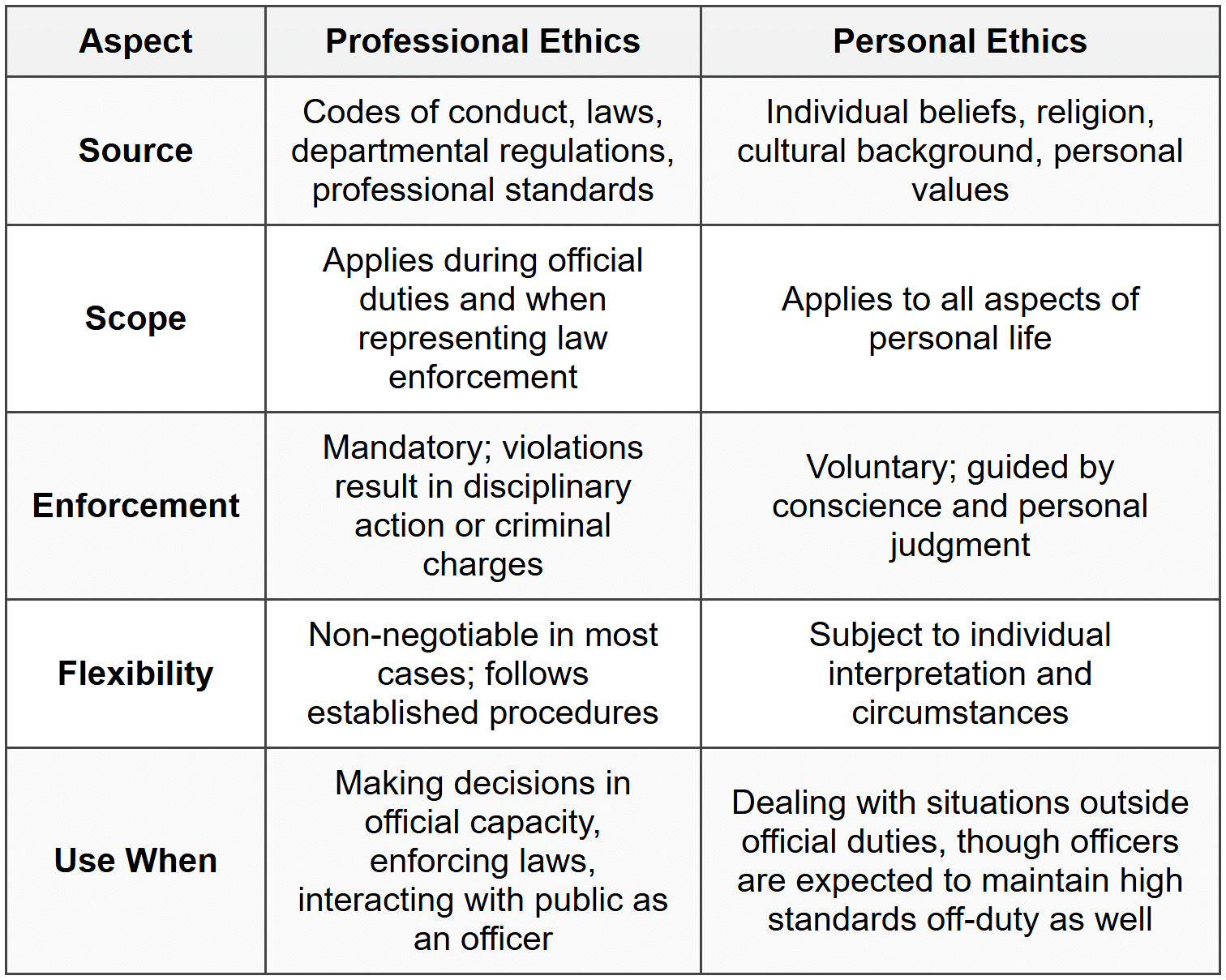
Professional ethics are the standards and obligations specific to law enforcement work, defined by codes, laws, and departmental policies. Personal ethics are individual moral beliefs that may or may not align with professional requirements.
When conflicts arise, professional ethics take precedence during official duties. For example, an officer who personally opposes certain laws must still enforce them impartially. However, an officer cannot be compelled to violate fundamental moral principles that constitute criminal behavior or human rights violations.
When to Use This
- When an exam scenario asks whether an officer can refuse to enforce a law they personally disagree with (answer: no, professional ethics require enforcement)
- When determining if off-duty conduct that violates personal values but not laws or codes constitutes an ethical violation (depends on whether it damages professional reputation)
- When choosing between following a superior's order that conflicts with regulations versus following personal judgment
Ethical Violations and Misconduct
Common forms of police misconduct that violate ethical standards include:
- Corruption: Accepting bribes, extortion, misuse of authority for personal gain
- Abuse of authority: Excessive use of force, unlawful searches, false arrests
- Discrimination: Biased treatment based on race, religion, gender, economic status, or other protected characteristics
- Dishonesty: Falsifying reports, perjury, planting evidence, tampering with evidence
- Breach of confidentiality: Unauthorized disclosure of sensitive information
- Neglect of duty: Failure to respond to calls, sleeping on duty, abandoning post
- Conduct unbecoming: Behavior that damages the reputation of law enforcement, even if not explicitly illegal
Consequences of ethical violations range from reprimands and suspension to termination, criminal prosecution, and civil liability.
When to Use This
- When identifying which action in a scenario constitutes misconduct requiring immediate reporting versus poor judgment requiring counseling
- When asked what the most serious violation is among several options (corruption and evidence tampering typically rank highest)
- When determining appropriate responses to witnessing colleague misconduct (reporting requirements vary by severity)
The Noble Cause Corruption Concept
Noble cause corruption occurs when officers violate laws or ethical standards with the intention of achieving what they believe is a "good" outcome, such as convicting a guilty person. Examples include planting evidence on a suspect the officer "knows" is guilty or lying in court to ensure conviction.
This is still corruption and violates ethical standards because:
- It undermines the justice system and rule of law
- It violates constitutional rights of the accused
- The "ends justify the means" reasoning is ethically unacceptable in law enforcement
- It can result in wrongful convictions of innocent people
- It damages public trust and the credibility of law enforcement
When to Use This
- When a scenario describes an officer breaking rules "for the greater good" or to "get a dangerous criminal off the streets" (this is wrong despite good intentions)
- When choosing between options where one involves procedural shortcuts justified by urgency or certainty of guilt (proper procedure must be followed)
- When identifying which rationale for misconduct is still unacceptable (good intentions do not excuse ethical violations)
Duty to Report and the Blue Wall of Silence
Officers have an ethical and often legal duty to report misconduct by colleagues. The "blue wall of silence" (or "code of silence") refers to the informal rule among some officers not to report misconduct by fellow officers, often rationalized as loyalty.
Professional ethics require:
- Reporting serious misconduct immediately through proper channels
- Intervening to stop violations in progress when safe to do so
- Providing truthful testimony in investigations of colleague misconduct
- Refusing to participate in cover-ups or code of silence practices
Failure to report witnessed misconduct can result in disciplinary action against the officer who remained silent, as it constitutes neglect of duty and obstruction of justice.
When to Use This
- When asked what an officer should do immediately after witnessing a colleague accept a bribe or use excessive force (report it)
- When choosing between loyalty to a partner versus adherence to professional standards (professional standards prevail)
- When determining if staying silent about minor infractions is acceptable (generally no; severity determines urgency and channel, but reporting is required)
Use of Discretion vs. Abuse of Discretion
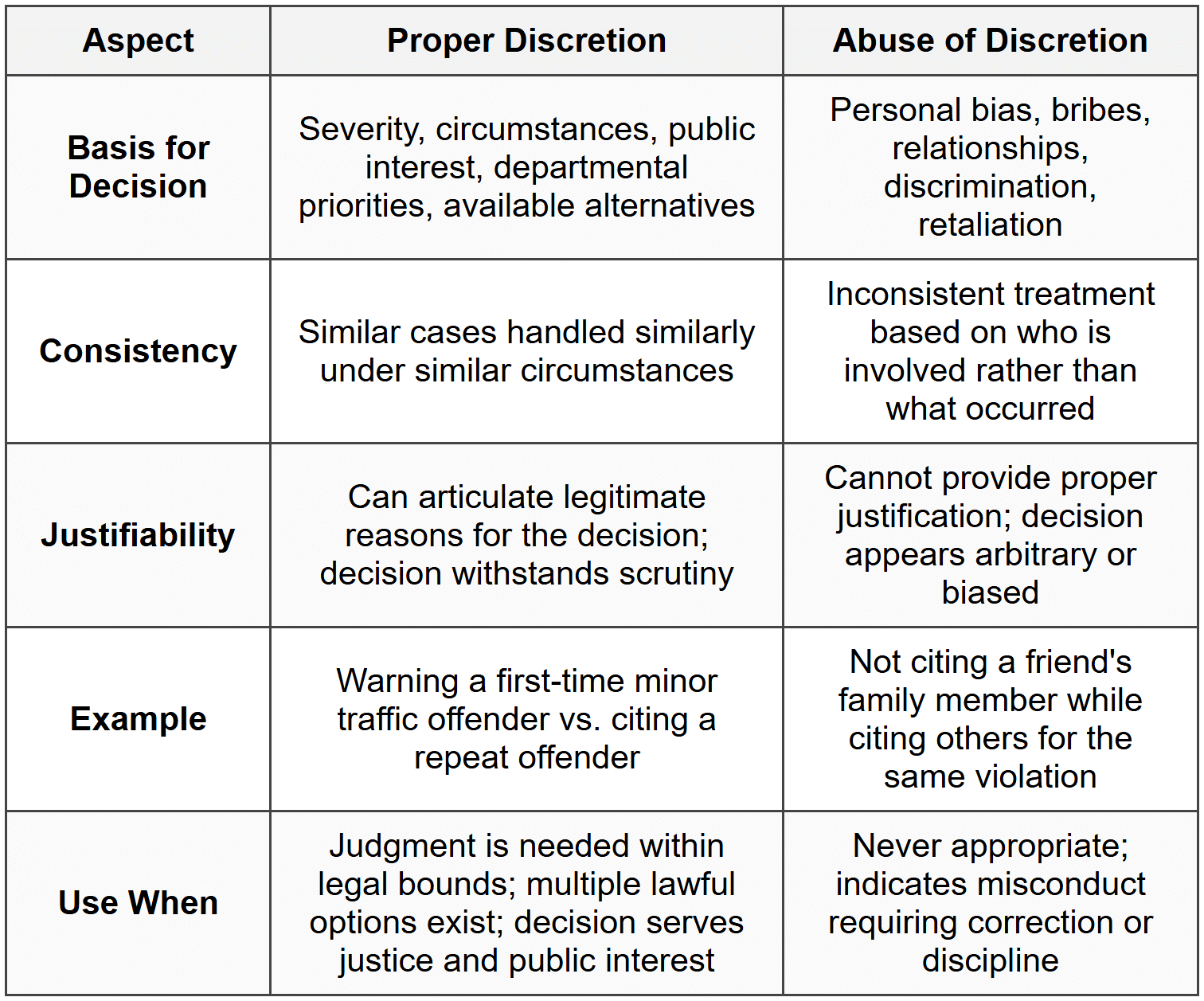
Police discretion is the authority of officers to make decisions within legal bounds about how to handle situations, such as whether to issue a warning versus a citation. Proper use of discretion considers factors like severity of offense, circumstances, public safety, and available resources while remaining within legal and policy boundaries.
Abuse of discretion occurs when decisions are based on improper factors such as personal relationships, bribes, discrimination, or revenge.
When to Use This
- When a scenario asks if an officer acted appropriately in choosing one enforcement option over another (evaluate the reasons given)
- When identifying whether different treatment of two similar offenders constitutes discrimination or proper discretion (examine the differentiating factors)
- When asked what factors an officer should NOT consider when exercising discretion (personal relationships, race, social status)
Conflict of Interest
A conflict of interest exists when an officer's personal interests interfere with or appear to interfere with their professional duties. Officers must avoid situations where personal gain, relationships, or outside activities compromise impartial performance of duties.
Examples of conflicts of interest:
- Investigating or arresting a family member or close friend
- Accepting gifts or services from individuals or businesses in the officer's jurisdiction
- Engaging in outside employment that conflicts with police duties or uses police authority
- Having financial interests in establishments subject to police regulation or oversight
- Dating or romantic relationships within chain of command or with individuals in the criminal justice system
When conflicts of interest arise, officers should immediately disclose them to supervisors and recuse themselves from the situation.
When to Use This
- When asked what an officer should do when assigned to investigate someone they know personally (disclose and request reassignment)
- When determining if accepting a gift or discount from a business owner in their patrol area is appropriate (generally no, creates obligation or appearance of bias)
- When evaluating whether outside employment is permissible (depends on whether it conflicts with police duties or uses police authority)
Ethical Decision-Making Models
When facing ethical dilemmas, officers should apply a systematic decision-making process:
- Identify the ethical issue: What is the moral or professional dilemma?
- Determine relevant facts: What actually happened? What are the circumstances?
- Identify stakeholders: Who is affected by the decision?
- Consider applicable laws, policies, and codes: What do regulations and professional standards require?
- Identify options: What are the possible courses of action?
- Evaluate each option: What are the consequences of each choice? Which aligns with professional ethics?
- Make the decision: Choose the option that best adheres to ethical standards and serves justice
- Implement and document: Act on the decision and maintain proper records
- Reflect and learn: Evaluate the outcome and apply lessons to future situations
The priority order when options conflict: constitutional rights and law → departmental policy → public safety → professional ethics → personal preference.
When to Use This
- When a complex scenario requires choosing between multiple seemingly valid options (apply the systematic process)
- When asked what the first step should be in addressing an ethical dilemma (identify the ethical issue and gather facts)
- When priorities conflict in a scenario (use the priority order: law first, then policy, then public safety considerations)
Commonly Tested Scenarios / Pitfalls
1. Scenario: An officer observes their partner accepting cash from a motorist during a traffic stop in exchange for not issuing a citation. The partner is a senior officer who has helped the newer officer adjust to the job and has been a good mentor.
Correct Approach: Report the incident immediately to a supervisor or through the chain of command, as accepting bribes is serious corruption that must be reported regardless of personal relationships. Document what was observed with specific details.
Check first: Verify that a bribe actually occurred (not a legitimate exchange misunderstood) and identify the proper reporting channel in your department.
Do NOT do first: Do not confront the partner privately or attempt to handle it informally without reporting, as this makes you complicit in the misconduct and violates your duty to report. Many candidates wrongly think loyalty to a helpful partner justifies handling it quietly.
Why other options are wrong: Waiting to gather more evidence delays reporting of a serious offense; discussing it with other officers creates gossip rather than proper investigation; ignoring it because the partner has been helpful violates professional ethics and makes you complicit.
2. Scenario: An officer is certain a suspect committed a burglary based on reliable confidential information, but lacks sufficient evidence for a search warrant. The officer considers conducting a warrantless search, reasoning that finding the stolen property will confirm guilt and serve justice.
Correct Approach: Do not conduct the warrantless search. Continue investigating through lawful means to establish probable cause for a warrant, or use other investigative techniques. Violating constitutional rights is never justified even when the officer believes the suspect is guilty.
Check first: Whether any lawful exception to the warrant requirement exists (such as exigent circumstances, plain view, or consent).
Do NOT do first: Do not conduct an illegal search hoping that finding evidence will justify it after the fact. This is noble cause corruption, and any evidence obtained will be inadmissible and the officer faces disciplinary action and potential criminal charges.
Why other options are wrong: Claiming exigent circumstances when none exist is dishonest and illegal; obtaining consent through deception or coercion invalidates the consent; the certainty of guilt does not override constitutional protections or justify illegal searches.
3. Scenario: An officer responds to a domestic disturbance at the home of a city council member. The council member's adult son has assaulted his girlfriend, and she wants to press charges. The council member asks the officer to "handle it quietly" without making an arrest, mentioning that they have influence over the police department's budget.
Correct Approach: Follow standard procedures for domestic violence cases: ensure the victim's safety, gather evidence, and make an arrest if probable cause exists, regardless of the offender's family connections. The implied threat regarding budget should be reported as attempted interference.
Check first: Whether probable cause exists for arrest based on the assault, and what departmental policy requires for domestic violence responses.
Do NOT do first: Do not agree to handle it differently because of the offender's family connections or implied threats. Treating this case differently constitutes abuse of discretion and potentially obstruction of justice.
Why other options are wrong: Calling a supervisor to "handle" it politically passes the ethical violation upward but doesn't fulfill your duty; issuing only a warning when an arrest is warranted shows favoritism; the council member's position is irrelevant to enforcement of law.
4. Scenario: An officer discovers that their detailed report from a crime scene contains an error in the time of arrival that could be significant to the case timeline. Correcting it now might raise questions about the officer's credibility or attention to detail. The error makes the officer look more responsive than they actually were.
Correct Approach: Immediately file a supplemental or corrected report noting the error and providing the accurate information. Integrity requires correcting mistakes even when it reflects poorly on you. Document the correction with an explanation.
Check first: Your department's procedure for correcting errors in reports (supplemental report, addendum, or formal correction).
Do NOT do first: Do not leave the error uncorrected hoping no one notices, as this constitutes falsification by omission. When discovered later, the failure to correct it voluntarily appears intentionally deceptive rather than an honest mistake.
Why other options are wrong: Claiming the error is insignificant avoids accountability; waiting to see if anyone notices is dishonest; changing the original report without documentation appears to be tampering; minor errors still require correction to maintain integrity.
5. Scenario: An officer's best friend is arrested for DUI by another officer. The friend calls from jail asking the officer to speak with the arresting officer to "see what can be done." The officer knows their friend was likely driving drunk as they had been drinking together earlier that evening.
Correct Approach: Refuse to intervene in the case. The friend must face the legal consequences of their actions. Any attempt to influence the case would be abuse of authority and create a conflict of interest. The officer should also consider whether they share any liability for allowing the friend to drive.
Check first: Whether you have any legal duty to report your own involvement (being with the friend while drinking) to investigators or supervisors.
Do NOT do first: Do not contact the arresting officer to request favorable treatment or discuss the case "as a friend." This is an abuse of authority and creates a conflict of interest, and could constitute obstruction or witness tampering.
Why other options are wrong: Calling to "get information" about the case is often a pretext for influencing it; suggesting the friend deserves a break because they're a good person shows favoritism; the friendship is irrelevant to enforcement of DUI laws.
Practice Questions
Q1: An officer discovers their patrol partner has been submitting overtime claims for hours not actually worked. What is the officer's primary ethical obligation?
(a) Discuss the matter privately with the partner and give them a chance to correct it before reporting
(b) Report the fraudulent claims to a supervisor or through the proper reporting channel
(c) Ignore it since overtime fraud is a minor administrative matter compared to serious crimes
(d) Wait to see if the partner continues the behavior before taking any action
Ans: (b)
Fraudulent overtime claims constitute theft and dishonesty, both serious ethical violations requiring immediate reporting. The duty to report misconduct is not contingent on giving the offender a chance to correct it first (a), as this delays reporting and makes you complicit. Overtime fraud is not minor (c) as it involves stealing public funds and violates integrity standards. Waiting to gather more evidence (d) is inappropriate when clear misconduct has been observed; immediate reporting is required.
Q2: Which situation represents an acceptable use of police discretion rather than abuse of discretion?
(a) An officer gives a verbal warning to a teenager caught shoplifting for the first time, after the store agrees not to press charges and the parents are called
(b) An officer does not cite their neighbor for a noise violation while citing others on the same street for the same offense
(c) An officer decides not to enforce a particular law because they personally disagree with it
(d) An officer reduces a traffic citation to a warning after the driver offers to make a donation to the police benevolent fund
Ans: (a)
This represents proper discretion: considering the offender's age, first-time status, parental involvement, and the victim's willingness to resolve it informally. The decision is based on legitimate factors related to rehabilitation and justice. Option (b) is abuse of discretion showing favoritism based on personal relationship. Option (c) violates the duty to enforce laws impartially regardless of personal beliefs. Option (d) constitutes corruption through accepting something of value to influence enforcement.
Q3: An officer is assigned to investigate a traffic accident involving their cousin. What is the correct action?
(a) Conduct the investigation professionally since family members deserve the same fair treatment as anyone else
(b) Immediately inform the supervisor of the relationship and request that another officer be assigned
(c) Investigate thoroughly but have another officer review the report to ensure objectivity
(d) Conduct the investigation but recuse yourself from any decisions about citations or charges
Ans: (b)
This is a clear conflict of interest that requires disclosure and recusal from the entire case, not just certain parts of it. Even if the officer could be objective, the appearance of bias or favoritism compromises public trust and professional integrity. Option (a) ignores the conflict of interest. Options (c) and (d) attempt partial solutions but don't eliminate the fundamental conflict; the officer should not be involved in any aspect of the investigation.
Q4: Which statement best describes "noble cause corruption"?
(a) Officers accepting gratuities from businesses they help through community policing
(b) Officers violating rules or laws to achieve what they believe is a just outcome, such as convicting guilty suspects
(c) Officers who refuse to report misconduct by colleagues due to loyalty and solidarity
(d) Officers using their position to gain favorable treatment for friends or family members
Ans: (b)
Noble cause corruption specifically refers to unethical or illegal actions taken with good intentions, such as planting evidence on a suspect believed to be guilty or lying in court to ensure conviction of a dangerous criminal. The "noble cause" (justice, public safety) does not justify illegal means. Option (a) describes gratuity acceptance or corruption but not specifically "noble cause." Option (c) describes the code of silence. Option (d) describes favoritism or nepotism.
Q5: An officer witnesses a colleague use excessive force during an arrest. The colleague is known to be aggressive, and other officers have privately expressed concerns but no one has reported it. What should the officer do FIRST?
(a) Intervene immediately if safe to do so to stop the use of excessive force
(b) File a written report documenting exactly what was witnessed
(c) Discuss the incident with other officers to determine if they also witnessed it
(d) Speak privately with the colleague about controlling their temper in future situations
Ans: (a)
The immediate priority is to stop the violation in progress to prevent further harm to the subject and additional liability. After intervening, the officer must report the incident through proper channels. Filing the report (b) is essential but comes after stopping ongoing harm. Discussing with other officers (c) wastes time and appears to be building consensus rather than fulfilling duty. Private discussion with the colleague (d) does not address the immediate harm or fulfill reporting obligations.
Q6: Which factor should NOT influence an officer's decision when exercising discretion in enforcement?
(a) The severity of the offense committed
(b) Whether this is a first offense or the person has a history of violations
(c) The social or economic status of the offender
(d) The availability of alternative resolutions that better serve justice and public safety
Ans: (c)
Social or economic status is an improper basis for exercising discretion and constitutes discrimination or abuse of discretion. Law enforcement must be impartial and treat all individuals equally regardless of wealth, social position, or connections. Severity of offense (a), prior history (b), and availability of appropriate alternatives (d) are all legitimate factors in exercising proper discretion.
Quick Review
- Professional ethics take precedence over personal beliefs during official duties; officers must enforce laws impartially even if they personally disagree
- Officers have a duty to report misconduct by colleagues; remaining silent violates professional standards and can result in disciplinary action
- Noble cause corruption (violating rules with good intentions) is still corruption and violates ethical standards; the ends do not justify illegal means
- Conflicts of interest require immediate disclosure and recusal from the situation; attempting to handle matters involving friends, family, or personal interests creates improper bias
- Proper discretion is based on legitimate factors (severity, circumstances, public interest); abuse of discretion involves personal relationships, bribes, or discrimination
- Integrity requires correcting mistakes in reports or testimony even when it reflects poorly on you; falsification includes failing to correct known errors
- Accepting gratuities or special treatment from businesses or individuals in your jurisdiction creates obligations and appearance of bias, violating ethical standards
- Intervene to stop misconduct in progress when safe to do so, then report through proper channels with detailed documentation
- Constitutional rights cannot be violated even to catch criminals you know are guilty; illegal searches, forced confessions, and evidence planting are never justified
- The priority order when obligations conflict: constitutional rights and law → departmental policy → public safety → professional ethics → personal preference