Chapter Notes: How Forces Affect Motion


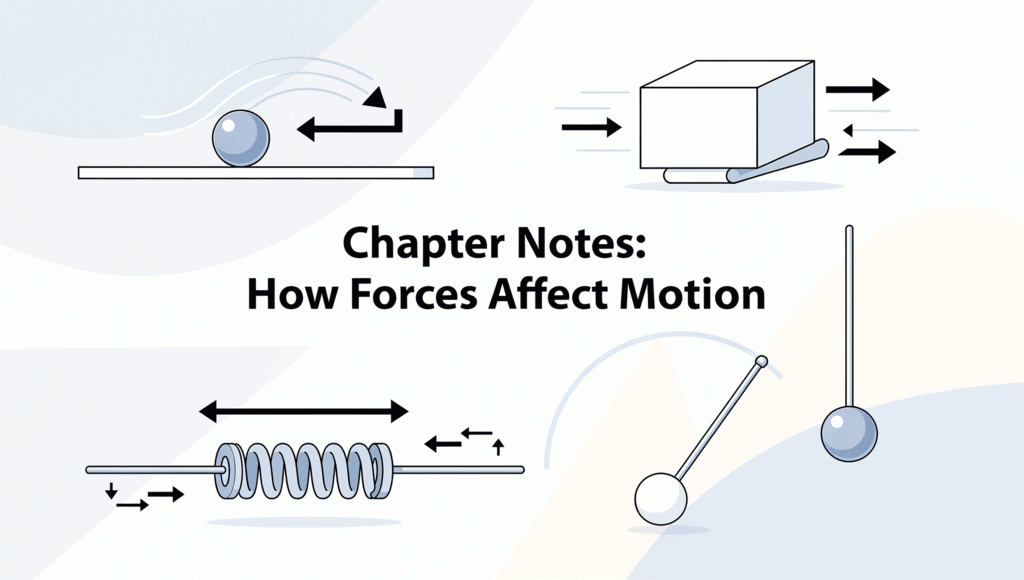
Introduction
Force is a push or pull that can change the motion, speed, direction, or shape of an object. This chapter explains how forces act and introduces Newton's laws of motion, which describe how and why objects move.
6.1 The Concept of Force
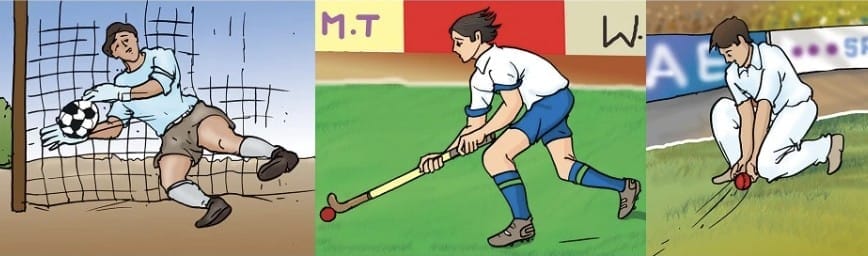
A force can:
- Make an object move from rest (e.g., kicking a ball at rest makes it move).
- Change the speed of a moving object (e.g., pushing something faster or braking it).
- Change the direction of a moving object (e.g., a cricket bat changes ball direction).
- Change the shape of an object (e.g., squeezing a lemon changes its shape).
 Important: Force is a physical quantity for which we need to specify direction along with its magnitude - just like position, displacement, velocity, and acceleration.
SI Unit of Force: Newton (symbol: N). Written with a small 'n' (newton) but symbol is capital 'N'. The magnitude of the force expresses its strength.
Note: If either the magnitude or direction, or both, of a force applied on an object changes, the effect of the force also changes.
6.1.1 Measuring the Magnitude of a Force
A spring balance is used to measure the magnitude of a force. It was earlier used to measure the weight of objects. The weight of an object is the gravitational force with which the Earth pulls the object. However, a spring balance can measure not just weight but force in general - when you pull the free end of a spring balance, it measures the force with which you pull the spring inside.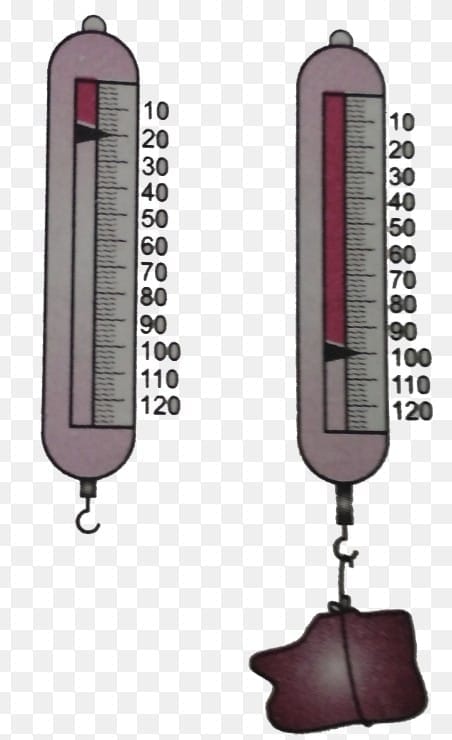
Threads of Curiosity: In everyday life, the smallest forces we can directly feel are of the order of millinewtons (10⁻³ N), such as a light touch. Scientists can measure forces far smaller, down to yoctonewtons (10⁻²⁴ N) in specialised experiments (as of 2026).
6.2 Balanced and Unbalanced Forces
In real life, more than one force usually acts on an object. For example:
- When pushing a box on a surface, both the applied force and friction act on it.
- A ball floating on water has gravitational force (downward) and buoyant force (upward) acting on it.
Balanced Forces
When two forces are equal in magnitude but opposite in direction, they are called balanced forces. The net force on the object is zero, so the object does not move (or does not change its motion).
Example: In a tug of war, if both teams pull the rope with equal force, the rope does not move. The forces are balanced.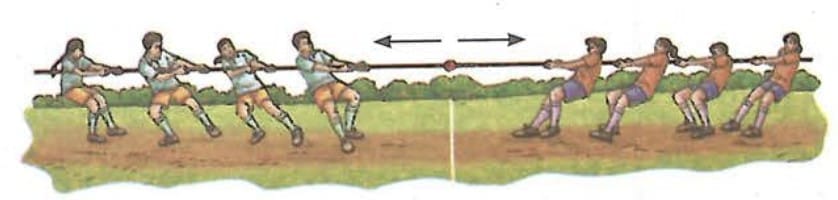
Unbalanced Forces
When the forces acting on an object are not equal, a non-zero net force acts on the object. The object moves in the direction of the larger force (or accelerates).
Example: If one team in a tug of war pulls harder, the rope moves in that direction.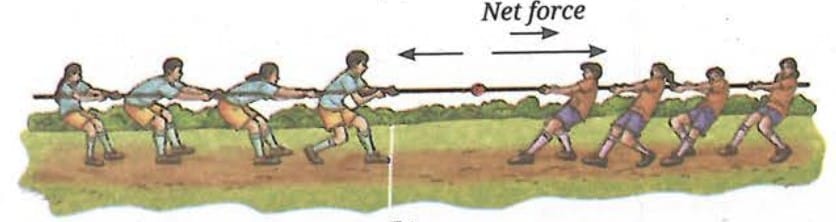
Net Force Rules:
- Two forces in opposite directions: Net force = difference of magnitudes; direction is along the larger force.
- Two forces in the same direction: Net force = sum of magnitudes; direction is the same as both forces.
Example: Two forces of 10 N and 6 N are acting on a block lying on the table as shown . What is the magnitude and the direction of the net force acting on the block in each case?
- (a) Both act towards the right: Net force = 10 + 6 = 16 N, towards the right.
- (b) 10 N right, 6 N left: Net force = 10 - 6 = 4 N, towards the right.
- (c) 6 N right, 10 N left: Net force = 10 - 6 = 4 N, towards the left.

Ready to Go Beyond:
Sometimes, forces do not act in the same line (parallel or opposite) but at angles to each other. In such cases, finding the net force is more complex and is studied in higher classes.
Also, when equal and opposite forces act on different ends of an object, they can make it rotate instead of move straight. For example, turning a tap or handlebar causes rotation
Try yourself: What happens when two forces are equal and opposite?
6.3 The Force of Friction: Often Overlooked but Always Present
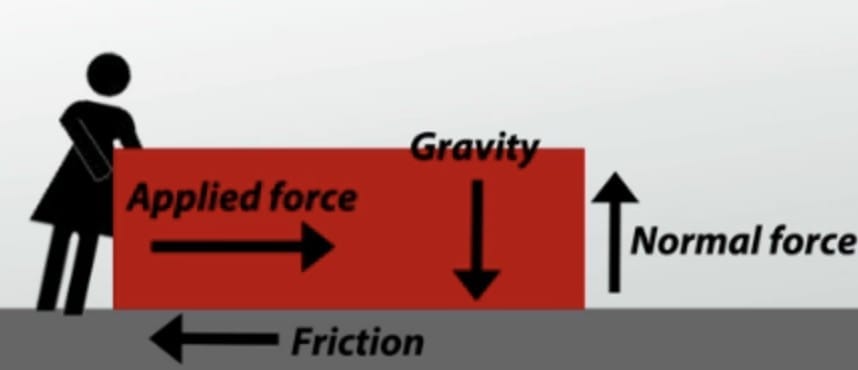
When a force is applied to an object on a surface, the force of friction acts between the bottom of the object and the surface, in the direction opposite to the motion.
The object starts moving only when the applied force is larger than the force of friction, creating a net force in the direction of motion.
Key Facts About Friction
- Friction depends on the nature of the surfaces in contact.
- Smoother surfaces have less friction; rougher surfaces have more friction.
- When friction is smaller, an object slows down more slowly and travels a larger distance before stopping.
- Multiple forces act on a moving object: applied force, friction, normal force, and gravitational force. Normal force and gravitational force balance each other on a horizontal surface.
- The spring balance measures the force required to just start moving the block, which equals the force of friction acting on it. When the block moves with constant velocity, the forces are balanced and the net force is zero. Different surfaces give different readings, showing that friction varies with surface type-smaller readings mean less friction and larger readings mean more friction.
Note: Multiple forces may act on an object, but its motion depends only on the net force.
Ready to Go Beyond: Apart from the applied force and friction, other forces also act on an object being pushed - gravitational force (weight, acting downward) and normal force (exerted by the surface, acting upward, perpendicular to the surface). These two forces are balanced. Air also exerts a friction force on the box as it moves through air, but its magnitude is usually so small it can be neglected.
Meet a Scientist - Galileo Galilei: He explained that a force is not needed to keep an object moving at constant velocity.
He showed through thought experiments that if no resistance (like friction) is present, an object will continue moving indefinitely.
This idea corrected the earlier belief that continuous force is required for motion.Meet a Scientist - Isaac Newton: Isaac Newton introduced the concept of inertia, the tendency of objects to resist changes in motion.
He formulated the three laws of motion in 1687, which explain how forces affect objects.
The SI unit of force, newton (N), is named after him.
6.4 Newton's First Law of Motion
Newton's first law of motion can be stated as:
An object at rest remains at rest and an object in motion continues to move with a constant velocity, unless a net force acts upon the object.
In other words: If the net force acting on an object is zero, the body cannot begin to move or change its velocity. In such a case, its acceleration is zero.
Note: An object at rest means that it has zero velocity. Remember that constant velocity means that there is no change in the magnitude or the direction of velocity. If this constant velocity is non-zero, the motion is in a straight line in the same direction and the magnitude of velocity remains the same.
Graphs for Newton's First Law
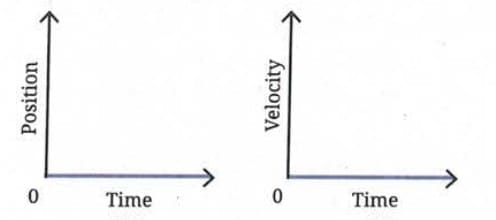
Object at rest (no net force):
- Position-time graph: A horizontal straight line (position does not change with time).
- Velocity-time graph: A horizontal straight line at v = 0 (velocity remains zero).
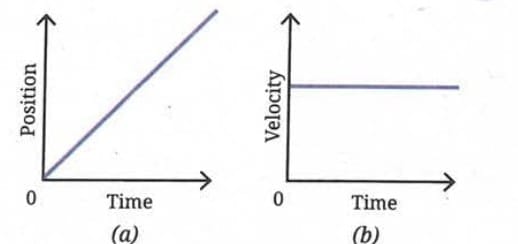
Object moving with constant velocity (no net force):
- Position-time graph: A straight line inclined to the time axis.
- Velocity-time graph: A horizontal straight line at some constant non-zero value.
Example: A person exerts a force on a moving box equal to the force of friction between the bottom surface of the box and the floor. Will the box continue moving or come to rest?
Answer: The force of friction acts in the backward direction on the box. The two forces acting on the box are equal and opposite, so they balance each other. The net force acting on the box is zero. As per Newton's first law of motion, the box will continue moving with constant velocity.
Note: If the force of friction is zero, a net force will have to be applied to an object at rest to set it moving. But once the object is moving, no further force is required to keep it moving with a constant velocity. However, to change the velocity (magnitude or direction), or to stop a moving object, a force will have to be applied.
Try yourself: What happens to an object at rest according to Newton's first law?
6.5 Newton's Second Law of Motion
It is important to understand the connection between the total or net force acting on an object and its acceleration.
Newton's second law of motion can be stated as:
When a net force acts on an object, the object accelerates in the direction of the net force. The magnitude of the acceleration is proportional to the magnitude of the net force and is inversely proportional to the mass of the object.
Mathematical Form
a = F/m or F = ma
where a = acceleration, F = net force, m = mass of the object. The direction of acceleration is the same as the direction of the net force.
Definition of One Newton
One newton of force is defined as the force that produces an acceleration of 1 m s⁻² on an object of mass 1 kg.
F = (1 kg) × (1 m s⁻²) = 1 kg m s⁻² = 1 N
Gravitational Force
When an object falls under gravity, the acceleration involved is called the acceleration due to gravitational force by the Earth, denoted by g. Its unit is the same as that of acceleration, m s⁻².
F = mg
The value of g = 9.8 m s⁻². It can be taken as nearly constant near the surface of the Earth. For quick estimations, one can also take g = 10 m s⁻².
Note: The acceleration due to gravitational force by the Earth (g) does not depend on the mass of the object.
Threads of Curiosity: If you hold a 100 g mass in your palm, the upward force your palm applies on the mass is around 1 N.
- For the same object (fixed mass): Larger force → larger acceleration. The acceleration of an object of fixed mass increases as the net force applied on it increases.
- For the same force: Smaller mass → larger acceleration. For a given magnitude of force, the acceleration produced is inversely related to the mass of the object.
Ready to Go Beyond: Momentum is the product of mass and velocity, and it has the same direction as velocity. Newton's second law can be stated as the rate of change of momentum being proportional to the net force and occurring in its direction. This form is useful even when the mass of an object is not constant.
Real-Life Applications of Newton's Second Law
- Pulling hands back while catching a cricket ball increases the time of stopping, reducing force and preventing injury.
- Airbags increase the time of impact during a collision, which reduces the force on passengers and lowers injury risk.
- In contrast, a coconut hitting the ground stops in very little time, producing a large force that breaks it.
Example:A weightlifter is holding a barbell with mass of 10 kg fixed on each side of the bar. The mass of the bar itself is 10 kg. How much force is she applying to keep the barbell steady?
Answer: Total mass of barbell = 10 + 10 + 10 = 30 kg. Gravitational force (downward): F = mg = 30 kg × 9.8 m s⁻² = 294 N
To keep the barbell steady, the weightlifter applies 294 N in the upward direction.
Example :A student is trying to push a stationary block of 25 kg on a horizontal floor. Maximum force of friction opposing this motion is 50 N. Determine the displacement of the block in 2 seconds if Rahul pushes it with a constant force of (i) 50 N and (ii) 55 N in the forward direction.
Answer: (i) The force applied equals the opposing force of friction. The two forces are balanced. Net force = 0. The block will remain stationary. Displacement = 0.
(ii) Net force = 55 N - 50 N = 5 N. Using Newton's second law: a = F/m = 5 N / 25 kg = 0.2 m s⁻²
Using the kinematic equation s = ut + ½at²: s = (0 m s⁻¹ × 2 s) + (½ × 0.2 m s⁻² × (2 s)²) = 0 + 0.4 = 0.4 m in the forward direction.
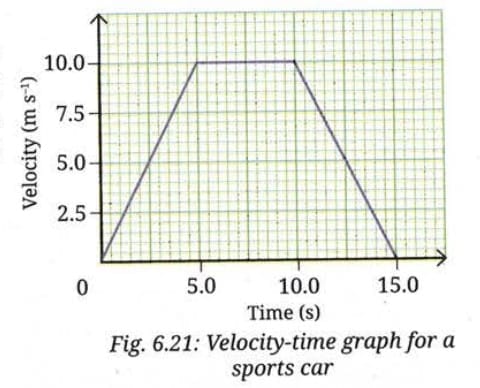
Example :A sports car of mass 1500 kg is moving towards the east and its velocity-time graph is shown . Calculate the force acting on the car during (i) 0 to 5 s, (ii) 5 to 10 s, and (iii) 10 to 15 s.
Answer:
(i) 0 to 5 s: Velocity-time graph is a straight line inclined to the time axis → constant acceleration. u = 0 m s⁻¹, v = 10 m s⁻¹, t = 5 s. Using v = u + at: 10 = 0 + (a × 5) → a = 2 m s⁻² F = ma = 1500 × 2 = 3000 N acting towards the east.
(ii) 5 to 10 s: Velocity-time graph is a straight line parallel to the time axis → constant velocity. Acceleration = 0. Hence, no force is acting on the sports car.
(iii) 10 to 15 s: Velocity-time graph is a straight line inclined to the time axis → constant acceleration. u = 10 m s⁻¹, v = 0 m s⁻¹, t = 5 s. Using v = u + at: 0 = 10 + (a × 5) → a = -2 m s⁻² F = ma = 1500 × (-2) = -3000 NThe negative sign shows the force is acting in a direction opposite to the direction of motion, that is towards the west.
6.6 Newton's Third Law of Motion
Force always arises due to interaction between two objects. When one object exerts a force on another, the second object also exerts a force back.This idea is explained by Newton's third law of motion.
Newton's third law of motion can be stated as:
Whenever one object is exerting a force on a second object, the second object is simultaneously exerting an equal and opposite force on the first object.
- Newton's third law applies to all types of forces - contact forces as well as non-contact forces (magnetic, electrostatic, gravitational).
- The magnitudes of the action and reaction forces are always equal.
- The directions are always opposite.
- They act on different objects, so they do not balance each other.
Real-Life Applications of Newton's Third Law
- Kicking a ball: Foot pushes the ball, and the ball pushes the foot back.
- Walking/Running: Foot pushes the ground backward, and the ground pushes you forward.
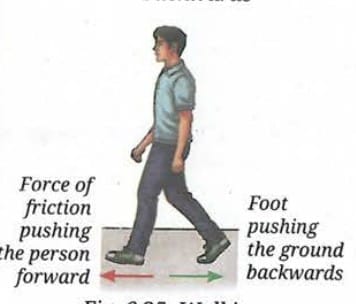
- Cycling: Feet push the ground backward, and the ground pushes the cycle forward.
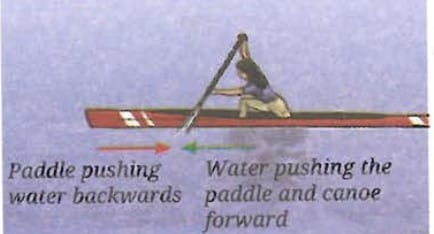
- Rowing: Paddle pushes water backward, and water pushes the boat forward.
 Rocket launch: Gas is pushed downward, and the rocket is pushed upward. During Chandrayaan-3, the rocket engine fired gases opposite to the direction of motion, creating a backward force.This reduced the speed of the Vikram Lander and helped it achieve a safe soft landing on the Moon.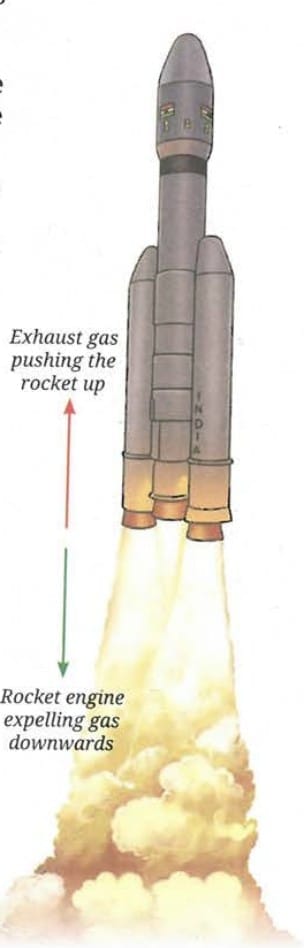
- Balloon: Air rushes out backward, and the balloon moves forward.
- Tree climbing: Legs push the tree downward, and friction pushes the person upward.
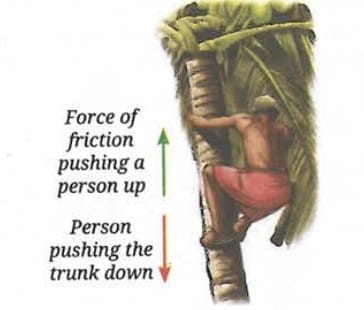
Note: The forces always occur in pairs but remember that these two forces act on two different objects.
The pair of equal and opposite forces (as per Newton's third law) acts on two different objects. Thus, they do not balance each other. On the other hand, if two equal and opposite forces act on the same object, they balance each other.
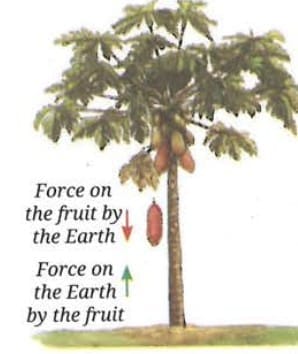
Example: The Earth and the fruit apply equal and opposite gravitational forces on each other. Then why does the fruit move towards the Earth while the Earth doesn't seem to move towards the fruit?
Answer: Though the forces acting on both the Earth and the fruit are equal in magnitude, the mass of the Earth is so large (as compared to the fruit) that the acceleration of the Earth caused by the force is extremely small (as per a = F/m). Thus, its effect on the Earth is too small to be noticed.
Example: When a 0.1 kg bullet is fired from a 5 kg gun with a force of 2 N, the gun recoils. What are the magnitudes of initial accelerations of the bullet and the gun?
Answer: From Newton's third law, the recoil force on the gun is also 2 N.
Acceleration of gun = force / mass of gun = 2 N / 5 kg = 0.4 m s⁻²
Acceleration of bullet = force / mass of bullet = 2 N / 0.1 kg = 20 m s⁻²
Even though the pair of forces are equal in magnitude, the magnitudes of accelerations are not equal because their masses are different.
6.7 Forces Acting on a System of Objects
When two objects are connected, we can treat them as a single system to simplify the problem.
System Approach
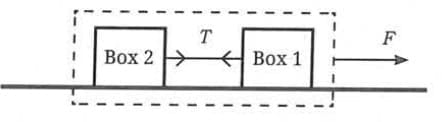
A simpler approach is to consider the two boxes and the string as a single system.
- Internal forces: The tension T acting on both boxes - these need not be considered.
- External forces: Only the applied force F matters.
Consider two boxes of masses m₁ and m₂ on a frictionless horizontal surface connected by a string. A force F pulls Box 1 to the right, and it pulls Box 2 through the string. By Newton's third law, equal and opposite tension acts between the boxes-on Box 1 to the left and on Box 2 to the right.
Using the system approach of treating both boxes as one system and Newton's second law, the acceleration of both boxes is given by
a = F / mass of system
a = F / (m₁ + m₂).
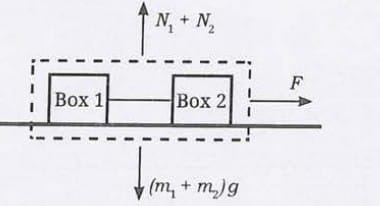
Ready to Go Beyond: In addition to F, the external forces will be gravitational force (m₁g + m₂g) acting on the system downwards, which is balanced by the normal force (N₁ + N₂) acting on the system from the ground.
Try yourself: What pulls Box 2 when a force F pulls Box 1?
At a Glance (Summary)
- The force of friction acts on an object in the direction opposite to its direction of motion.
- Newton's first law of motion: An object at rest remains at rest and an object in motion continues to move with a constant velocity, unless a net force acts upon the object.
- Newton's second law of motion: When a net force acts on an object, the object accelerates in the direction of the net force. The magnitude of the acceleration is proportional to the magnitude of the net force and is inversely proportional to the mass of the object.
- Newton's third law of motion: Whenever one object is exerting a force on a second object, the second object is simultaneously exerting an equal and opposite force on the first object.
FAQs on Chapter Notes: How Forces Affect Motion
| 1. What is the definition of force in physics? |  |
| 2. What is the difference between balanced and unbalanced forces? | |
| 3. How does friction act as a force in everyday life? | |
| 4. What does Newton's First Law of Motion state? | |
| 5. Can you explain Newton's Third Law of Motion with an example? | |




