Chapter Notes : Work, Energy, and Simple Machines


Introduction
In earlier chapters, you learnt how forces change the motion of objects and how kinematic equations and Newton's laws can be used to analyse motion. When forces change with time or act in complicated ways, applying these laws directly becomes difficult. Chapter 7 introduces a simpler and more powerful way to understand such situations - through the concepts of Work, Energy, and Power.
These ideas often allow us to analyse motion and interactions more easily. We also learn about Simple Machines, which help us perform tasks with less effort and more convenience. Energy, the capacity to do work, lies at the heart of all these ideas.
7.1 Work Done by a Constant Force
The concept of work in science has a precise meaning, different from everyday usage.
Consider lifting a wheat bag of mass 5 kg to a height of 1 m. You apply an upward force equal to mg on the bag over a displacement of 1 m in the direction of force - you do "work".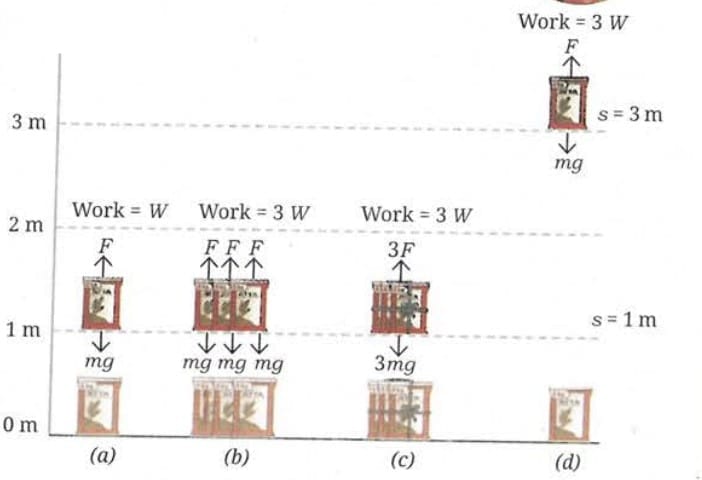
- Lifting 3 such bags one after the other to the same height requires 3 times more work (force applied 3 times).
- Lifting all 3 bags together requires 3 times the force over the same distance - again 3 times the work.
- Lifting one bag to a height of 3 m (3 times more displacement) requires 3 times more work.
These observations lead to the scientific definition:
Work done on an object = Force applied × Displacement in the direction of force
W = F × s
This applies whether the force and displacement are in vertical, horizontal, or any other direction. It is important to specify the force (or agency) doing the work and the object on which work is done.
SI Unit of Work: The SI unit of work done is the joule (J). 1 J = 1 N × 1 m. That is, 1 joule is the work done when a constant force of 1 newton is applied to an object and it is displaced by 1 metre in the direction of the force. Since 1 N = 1 kg m s⁻², note that 1 J = 1 kg m² s⁻².
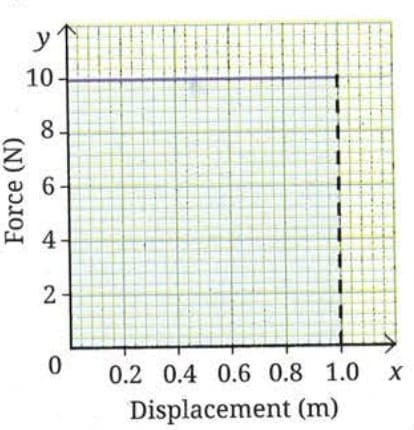
Graph: When force is constant, the work done equals the area under the force-displacement graph, which here is a rectangle: 10 N × 1 m = 10 J. When the force is not constant, the work done is still found by calculating the area under the force-displacement graph between the initial and final positions.
Note: Work has no direction , it is a scalar quantity. It can be positive or negative. Even when force is not constant, work done can be calculated by finding the area under the force-displacement graph between the initial and final positions.
7.1.1 When is Work Done Equal to Zero?
From W = F × s, work is zero when:
- The force acting on the object is zero (F = 0).
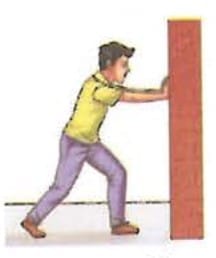
- There is no displacement (s = 0), even if a force is applied - e.g., pushing a rigid wall.
- The force acts perpendicular to the displacement - e.g., when a girl carries a box horizontally, the upward force she applies is perpendicular to horizontal displacement, so no work is done by that force on the box.
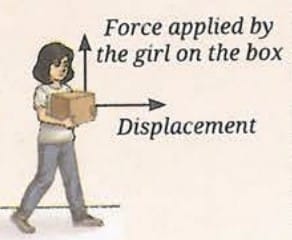
Note: When you push a wall and feel tired, your muscles use internal energy, but no work is done on the wall (in the scientific sense), because there is no displacement.
7.1.2 Positive and Negative Work Done
Work done can be positive or negative depending on the relative directions of force and displacement:
- Positive Work: Displacement is in the same direction as force. Example: Pushing a wheelchair - force and displacement are both forward.
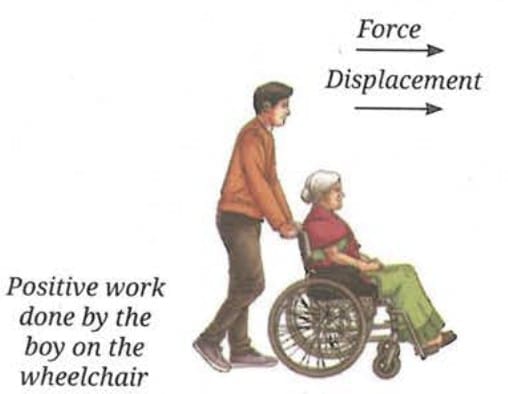
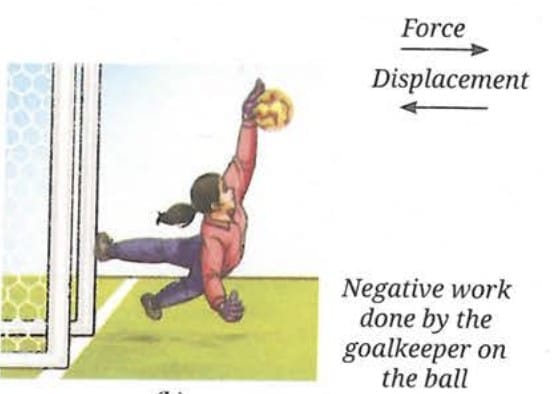
- Negative Work: Displacement is opposite to the direction of force. Example: A goalkeeper stopping a ball - force is opposite to the ball's displacement.
Example: A girl lifts a dumbbell up and slowly lowers it down. Identify when she does positive and negative work.
Answer: Lifting up: force (upward) and displacement (upward) are in the same direction - positive work. Lowering down: force she applies is upward (to hold the weight) but displacement is downward - negative work.Example : A goalkeeper's hand moved back 15 cm while stopping a ball with a force of 200 N. How much work did the goalkeeper do on the ball?
Answer: The force applied is opposite to ball's displacement. Displacement = -0.15 m. Work = 200 N × (-0.15 m) = -30 J.
7.2 The Work-Energy Theorem
When a force is applied on an object and it is displaced, work is done. Does this cause the object to gain the capacity to do further work?
Examples: A fielder throws a cricket ball - it hits the wicket (does work). A flowerpot raised to a height can damage an object if it falls. In each case, the ball or pot has acquired a capacity to do work - they are said to possess energy.
- The ball gained energy from the work done by the fielder in throwing it.
- The pot gained energy from the work done in raising it to a height.
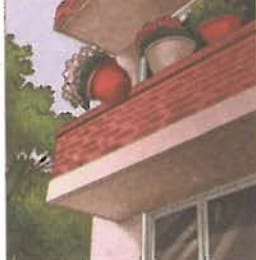
When positive work is done on an object, it gains energy. Work done on an object appears as a change in its energy.
Work-Energy Theorem :Work done on an object = Change in its energy
This theorem holds for a system of objects or even when forces are not constant. The SI unit of energy is the same as the SI unit of work - the joule (J).
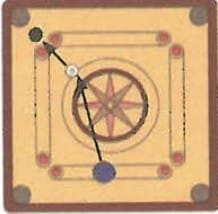
Example: In a game of carrom, a player struck the shot shown to pocket the black coin. Identify who does work, and the changes in energy that occur at each collision.
Answer: When the striker hits the white coin, it does positive work on it, transferring energy and making it move. The white coin applies an equal and opposite force on the striker, doing negative work and reducing its energy. Similarly, the white coin transfers energy to the black coin by doing positive work, while the black coin does negative work on the white coin, reducing its energy.
Meet a Scientist
The SI unit of work and energy is the joule, named after James Prescott Joule. He showed that mechanical energy and heat are related and can be converted into each other, helping develop a unified concept of energy.
Ready to Go Beyond
Mechanical work is one way of transferring energy from one object to another, but energy can also be transferred as heat. When objects at different temperatures come in contact, energy flows from the hotter object to the colder one. Energy can also be transferred without contact, such as through radiation from the Sun, as well as through electric currents, sound waves, and nuclear reactions.
7.3 Forms of Energy
Energy is the capacity to do work. Energy exists in many forms and can be converted from one form to another: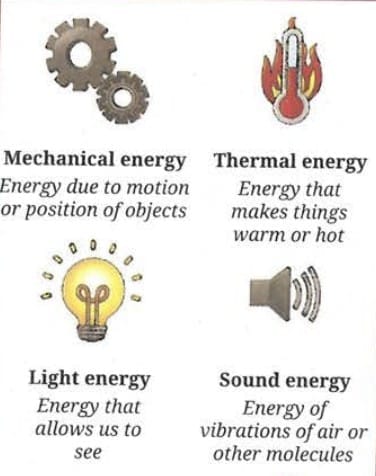
- Mechanical energy - energy due to motion or position of objects
- Thermal energy - makes things warm or hot
- Light energy - energy that allows us to see
- Sound energy - energy of vibrations of air or other molecules
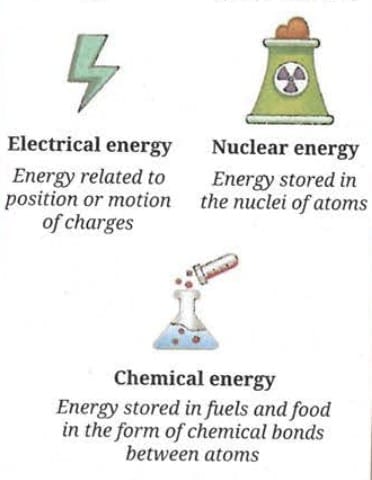
- Electrical energy - related to position or motion of charges
- Chemical energy - energy stored in fuels and food in the form of chemical bonds between atoms
- Nuclear energy - energy stored in the nuclei of atoms
Examples of conversions:
Electrical energy → light energy (bulb); chemical energy in food → mechanical energy (muscles); mechanical energy → sound energy (ringing bell).
7.4 Mechanical Energy
Mechanical energy is the energy that an object possesses due to its motion or position. It has two forms: Kinetic Energy and Potential Energy.
7.4.1 Kinetic Energy
The energy possessed by an object due to its motion is called kinetic energy (K). All moving objects possess kinetic energy (e.g., a moving bicycle, a rolling ball).
Derivation: Consider an object of mass m starting from rest (u = 0) and acquiring final velocity v under constant force F over displacement s.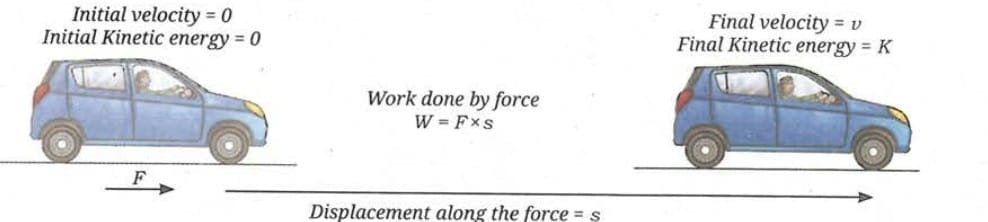
- From kinematics: v² = u² + 2as → s = (v² - u²) / (2a)
- Work done: W = F × s = ma × (v² - u²)/(2a) = ½m(v² - u²)
- By work-energy theorem, if u = 0: W = ½mv² = kinetic energy gained
Kinetic Energy :K = ½mv²Where m = mass (kg), v = velocity (m/s). Unit: joule (J).
- Positive work → velocity increases → KE increases.
- Negative work → velocity decreases → KE decreases.
- W = 0 → velocity unchanged → KE unchanged.
Example : If the velocity of a vehicle doubles, what will its kinetic energy be?Answer: Initial KE = ½mv². New KE at 2v = ½m(2v)² = 4 × ½mv². The kinetic energy becomes 4 times the original.
Example : In one of their fastest deliveries, an Indian cricketer bowled a cricket ball with an approximate mass of 0.2 kg at a velocity of about 154.8 km h⁻¹. Calculate the kinetic energy of the ball at the time of its delivery.
Answer: v = 154.8 km/h = 43 m/s. K = ½ × 0.2 × (43)² = 184.9 J.Example : A jet aircraft of mass 15000 kg lands on the deck of an aircraft carrier . To stop the aircraft within the short length of the deck, a hook on the aircraft's tail is caught in a wire stretched across the deck. The wire exerts an approximately constant backward force of 367500 N and stops the jet within 100 m. What was the velocity of the aircraft just before the wire caught the hook?
Answer: Work done by wire = 367500 × (-100) = -36750000 J. Using work-energy theorem: -½mv² = -36750000. v² = 4900 m² s⁻². v = 70 m s⁻¹ = 252 km h⁻¹.
7.4.2 Potential Energy
Objects or systems of objects can store energy due to:
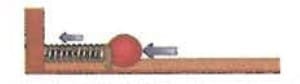
- Deformation - e.g., a compressed spring, stretched rubber band, bent bow. The work done to deform them gets stored as potential energy.
- Relative positions - systems interacting through gravitational, electric, or magnetic forces store energy based on their configuration. E.g., two unlike magnetic poles separated store energy; a ball lifted above the ground stores gravitational potential energy.
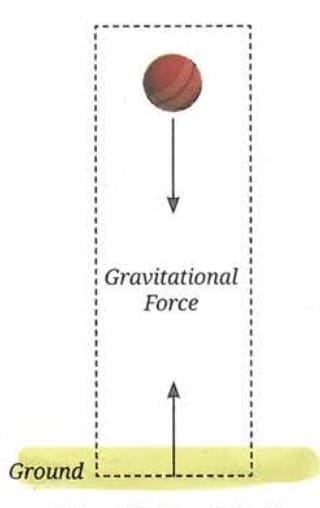
Potential energy is the energy stored by an object as a result of its deformation or in a system of objects due to their relative positions.
Gravitational Potential Energy
Gravitational potential energy is the energy an object has due to its position relative to the Earth. Since the Earth is very massive, only the object (like a ball) is considered to have this energy. Thus, the stored energy in the Earth-object system is referred to as the gravitational potential energy of the object.
Dropping a heavy ball from greater heights creates deeper depressions in sand - objects possess more energy at greater heights.
Derivation: To raise an object of mass m to height h slowly, apply force F = mg (equal to gravitational force). Work done: W = mg × h = mgh 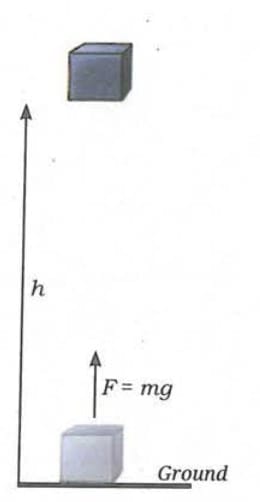
By work-energy theorem, this work appears as change in potential energy:
Gravitational Potential Energy:U = mgh
Where m = mass (kg), g ≈ 10 m s⁻², h = height above ground (m). Unit: joule (J).
Note: U = mgh is valid only near Earth's surface. Potential energy does not change with horizontal motion (h unchanged), but increases when the object is raised vertically.
Example : A fielder threw a cricket ball (200 g) 10 m high. Find its potential energy at maximum height. (g = 10 m s⁻²)
Answer: U = mgh = 0.2 × 10 × 10 = 20 J.
7.4.3 Conservation of Mechanical Energy
The sum of kinetic energy (K) and potential energy (U) is called mechanical energy (E):E = K + U
Analysis of a freely falling object (mass m dropped from height h):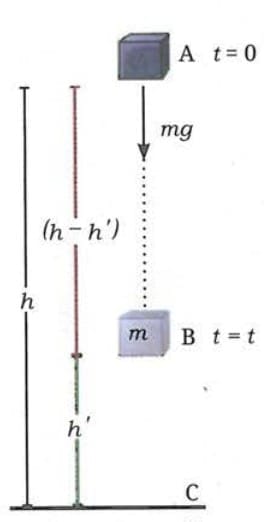
| Position | Potential Energy (U) | Kinetic Energy (K) | Total ME (E) |
|---|---|---|---|
| A (top, height h) | mgh | 0 | mgh |
| B (mid-air, height h') | mgh - ½mg²t² | ½mg²t² | mgh |
| C (ground, h = 0) | 0 | ½mv² = mgh | mgh |
As the object falls, potential energy decreases and kinetic energy increases by exactly the same amount - total mechanical energy remains constant (= mgh) at every point.
Law of Conservation of Mechanical Energy:The mechanical energy of an object is conserved if no other external forces (friction, air resistance, etc.) act on it.
Pendulum: 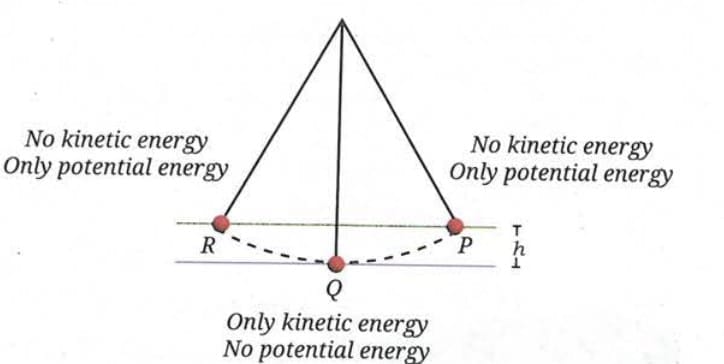
A simple pendulum consists of a small heavy bob attached to a light, inextensible string fixed at one end. When the bob is pulled to one side and released, it swings to and fro under the influence of gravity.
At the extreme positions (P and R), the bob is momentarily at rest. Here, its velocity is zero, so kinetic energy is zero and potential energy is maximum (due to height).
As the bob moves toward the center, potential energy converts into kinetic energy.
At the lowest point (Q), the bob has maximum speed, so kinetic energy is maximum and potential energy is minimum (≈ 0).
As it moves to the other side, kinetic energy again converts back into potential energy, and the bob reaches nearly the same height. This shows that mechanical energy (KE + PE) remains constant during motion (if friction and air resistance are ignored).
In real life, the pendulum gradually slows down and stops because some energy is lost due to air resistance and friction at the support.
Example: Find the velocity of a child at the bottom of a slide of height h.
Answer: PE at top = mgh; KE at bottom = ½mv². Setting equal: ½mv² = mgh → v = √(2gh). Velocity depends only on height, not mass or shape of slide.
Example :Escape ramps are inclined planes filled with sand or gravel that help stop trucks when their brakes fail on a highway. A truck of mass 10000 kg is moving at 72 km h⁻¹ when its brakes fail. The driver steers it onto an escape ramp inclined at 30°, where the truck comes to a rest. If the sand exerts a force of 50000 N opposite to truck's motion, what is the minimum length of the ramp to be able to stop such a truck? Take g = 10 m s⁻² (Hint: For a 30° incline, the truck rises 1 m vertically for every 2 m it travels along the ramp).
Answer: Initial KE = ½ × 10000 × (20)² = 2000000 J.
Height gained = d/2 (given).
Final PE = 50000d J.
Work by sand = -50000d J.
Using work-energy theorem: -50000d = (50000d - 0) - 2000000
→ 100000d = 2000000 → d = 20 m.
Note: The total energy of an object or system of objects which is not acted upon by any external forces, stays constant.
7.5 Power
Running up stairs in one minute feels very different from walking up slowly in five minutes, even though the same work is done. This difference is described by power.
Power is the rate at which work is done.P = W / t (Eq. 7.11)Where W = work done (J), t = time taken (s). SI unit: watt (W). 1 W = 1 J s⁻¹.
- To do more work in the same time → more power required.
- To do the same work in less time → more power required.
- The unit watt is named after James Watt, who invented an efficient steam engine.
- Another unit: horsepower (hp). 1 hp = 746 W. Used for car engines and pumps.
Example: A weightlifter lifts a 75 kg mass by 2 m in 5 s. How much power would she require for this task?
Answer: W = mgh = 75 × 10 × 2 = 1500 J. Power = 1500 / 5 = 300 W.Example: A car of mass 1000 kg starts from rest and reaches a speed of 72 km h⁻¹ in 10 seconds. Calculate the power of the engine required to achieve this start.
Threads of Curiosity
Horsepower (hp) is another unit used to measure power, especially for engines and pumps. One horsepower is equal to 746 watts. It was originally defined by comparing the power of machines to the work done by real horses used to pull carriages.
Meet a Scientist
The unit of power, watt, is named in the honour of James Watt. He invented an efficient steam engine that could generate rotational motion and move wheels.
7.6 Simple Machines
In everyday life, we need to do work against gravity or other forces. Although total work cannot be reduced, tasks can be made easier by changing the magnitude or direction of the applied force. Devices that help do this are called simple machines.
Key terms:
- Effort: The force we apply to a machine.
- Load: The force that needs to be overcome.
- Mechanical Advantage (MA) = Load / Effort
Simple machines do not reduce total work - they only make the task feel easier. Machines do not create energy.
7.6.1 Pulley
A pulley is a wheel with a groove that guides a rope. A flag is raised using a fixed pulley at the top.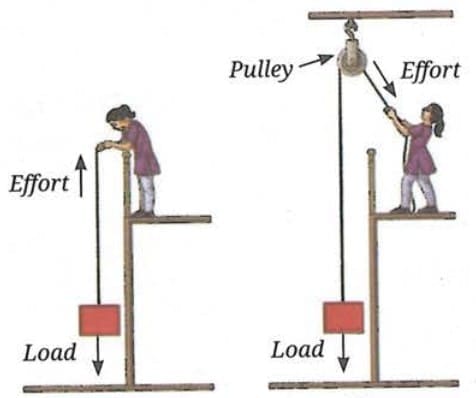
- A fixed pulley does not reduce the force required - it only changes the direction of the force.
- It is easier to pull downward than to lift a load upward directly.
- Since effort and load are equal in a fixed pulley → MA = 1.
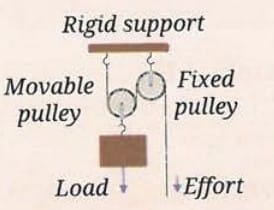
- Movable pulleys or systems of pulleys can provide a mechanical advantage greater than 1, allowing heavy loads to be lifted with less effort. In such systems, the load is attached to the movable pulley, one end of the rope is fixed, and effort is applied at the other end. These pulleys are commonly used in real life, such as in elevators and cranes, for easier lifting.
7.6.2 Inclined Plane
An inclined plane helps move a heavy load to a higher level using a smaller force over a larger distance, instead of lifting it vertically with a large force.
Derivation of MA: Let mass = m, weight (load) = mg, incline length = L, height = h, effort along incline = F'.
- Work done by effort: F' × L
- PE gained: mgh
- By work-energy theorem (no friction): F' × L = mgh → mg/F' = L/h
MA of Inclined Plane MA = load / effort = mg / F' = L / h
Since L > h → MA > 1.
A longer/shallower incline gives a greater MA.
MA= Mechanical Advantage
Example 7.12: A person uses an inclined ramp to raise an object over astep 30 cm high. The ramp has a width of 40 cm. What is the mechanical advantage of the ramp that helps the person achieve the task?
Answer: Length = √(30² + 40²) = √2500 = 50 cm. MA = L/h = 50/30 = 1.67.
Note: Work done (force × displacement) remains the same in all cases.If the force applied decreases, the displacement increases accordingly.Thus, the total work done stays constant.
7.6.3 Lever
A lever is a rigid bar that can rotate about a fixed point. A lighter eraser can lift a heavier stapler using a scale as lever.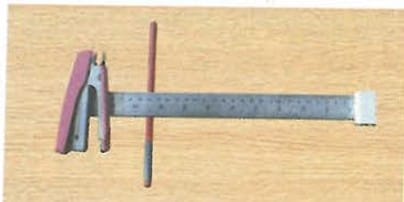
Parts of a lever:
- Fulcrum: Fixed point about which the lever rotates.
- Load (F₂): Force to be overcome; acts on the load arm (d₂).
- Effort (F₁): Force applied; acts on the effort arm (d₁).
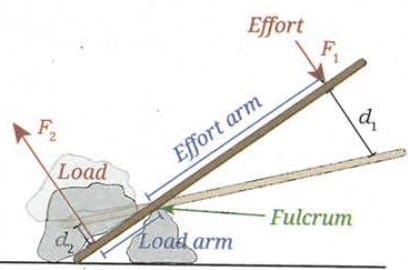
Principle of Lever :
F₁ × d₁ = F₂ × d₂
effort × effort arm = load × load arm
MA = load / effort = effort arm / load arm
By increasing the effort arm, a lever applies a larger force on the load. The effort required is smaller but must move a larger distance.
Note: A lever reduces the force required to perform a task but not the total work done.
Example: For a seesaw having four seats A, B, D, E and fulcrum at C , AC = EC = 2 m and BC = DC = 1 m. On which seats should children of masses 15 kg and 30 kg sit to make the seesaw balanced?
Answer: Using principle of lever: 15 kg × 2 m = 30 kg × L → L = 1 m. The 15 kg child sits at seat A (2 m from fulcrum) and the 30 kg child sits at seat D (1 m from fulcrum).
Ready to go beyond
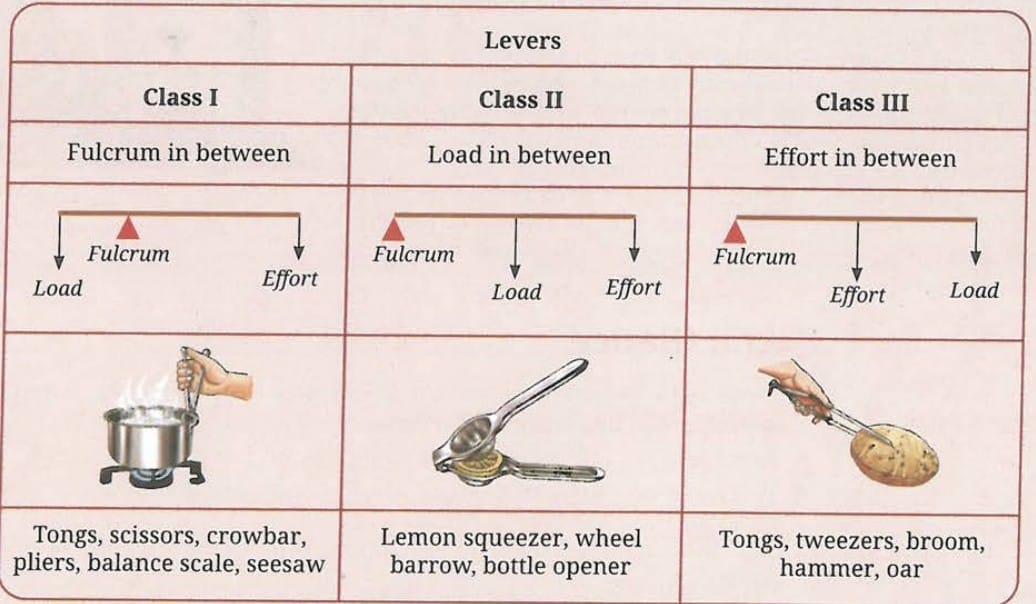
Levers can be of three classes
Summary: At a Glance
- Work is done by a force on an object when the force displaces the object in the direction of the force.
- An object having the capacity to do work is said to possess energy.
- Work-Energy Theorem: Work done on an object = change in its energy.
- Kinetic energy: K = ½mv²
- Gravitational Potential energy: U = mgh
- Mechanical energy = K + U, and is conserved when no external forces act.
- Power is the rate at which work is done: P = W/t. SI unit: watt (W).
- Simple machines make work easier by changing the magnitude or direction of force, but do not reduce total work.
- MA = Load / Effort = L/h (inclined plane) = d₁/d₂ (lever).
Key Formulas at a Glance
| Quantity | Formula | SI Unit |
|---|---|---|
| Work (W) | W = F × s | Joule (J) |
| Kinetic Energy (K) | K = ½mv² | Joule (J) |
| Potential Energy (U) | U = mgh | Joule (J) |
| Work-Energy Theorem | W = ΔE = ½m(v² - u²) | Joule (J) |
| Power (P) | P = W/t | Watt (W) |
| MA (inclined plane) | MA = L/h | - |
| MA (lever) | MA = d₁/d₂ | - |
| Conservation of ME | K + U = constant | Joule (J) |
FAQs on Chapter Notes : Work, Energy, and Simple Machines
| 1. What is the work done by a constant force? |  |
| 2. What is the Work-Energy Theorem? | |
| 3. What are the different forms of energy mentioned in the article? | |
| 4. How is mechanical energy defined, and what are its components? | |
| 5. What is the significance of power in relation to work and energy? | |




