Chapter Notes: Sound Waves: Characterstics and Applications


Introduction
Sound is an everyday sensory experience that helps us become aware of our surroundings. We hear sounds like human voices, birds chirping, waves crashing, leaves rustling, mobile phones ringing, vehicles honking, music, and thunder. Sound is a form of energy (studied in Chapter 7), and energy can neither be created nor destroyed - it only changes form. This chapter explores how sound is produced, how it travels, and its various applications.1. Production of Sound
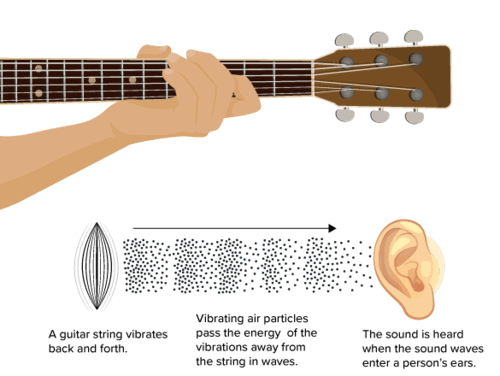
Sound is produced by vibrations. Vibration refers to the periodic to and fro motion (oscillations) of an object.
Key observations:
- Plucking a stretched rubber band across a cardboard box produces sound as long as the band vibrates. When vibration stops, sound stops.
- Pulling a stretched string or striking a metal object makes it vibrate, producing sound.
- Blowing through a bansuri (flute) causes vibration of the air inside the hollow pipe, producing sound.
- Sound can be produced by vibrating strings, membranes, air columns, and many other vibrating objects.
- The object that produces sound is called the source of sound.
- In most musical instruments, more than one vibrating part is involved.
How humans produce sound: Sound is produced by the vibration of vocal cords, which are tightly stretched muscular flaps located inside the voice box or larynx in the throat. The tongue, lips, mouth, and nasal cavity help convert sound into speech or music.
How some animals produce sound: Some animals produce sound by striking or rubbing certain body parts. For example, grasshoppers and crickets rub their wings or legs.
1.1 Tuning Fork
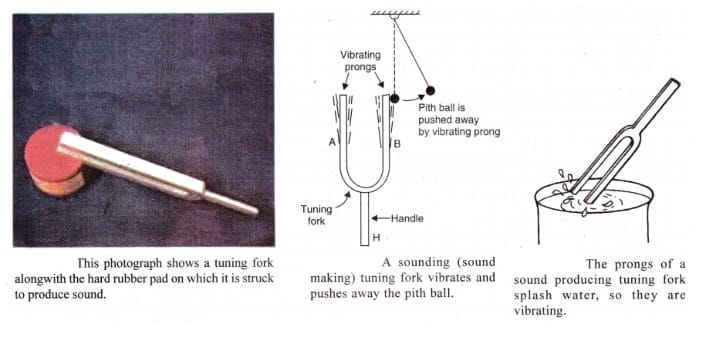
A tuning fork is a U-shaped metal bar with a stem, usually made of steel or aluminium. The sides of the 'U' are called prongs or tines, which are struck on a pad to make them vibrate.
Observations with a tuning fork:
- Striking the prong against a rubber pad and bringing it near the ear produces a sound.
- When a vibrating prong touches a water surface, waves form on the water - confirming that the prongs are vibrating.
- Sound is heard regardless of the orientation of the tuning fork near the ear, indicating that sound propagates in multiple directions from a source.
2. Propagation of Sound
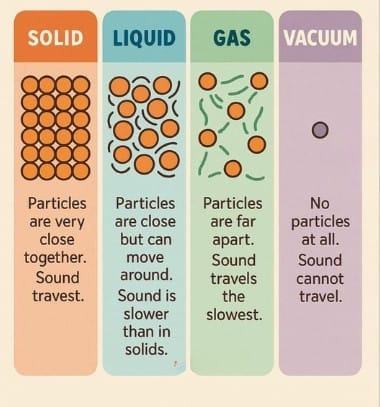
Sound travels through air but also through solids and liquids.
Sound through solids: Placing an ear against a desk and listening to knocking on the other end confirms that sound travels through solids.
Sound through liquids: Submerging two metal spoons in water and tapping them together - the sound can still be heard - shows sound travels through liquids.
Conclusion: Sound can travel or propagate through solids, liquids, and gases. The material through which sound propagates is called a medium.
Vacuum: A space where there is no medium (matter) is referred to as a vacuum. Sound cannot travel in vacuum.
2.1 Sound Needs a Medium to Propagate
The vacuum bell jar experiment demonstrates this:
- An electric bell is placed inside a bell jar. When switched on, the sound is heard.
- As air is sucked out using a vacuum pump, the sound becomes fainter.
- Once near-vacuum is reached, almost no sound is heard even though the bell can be seen ringing.
- When air is let back in, sound is heard again.

Conclusion: Sound cannot propagate in vacuum. Sound needs a medium - solid, liquid, or gas.
In outer space: There is near vacuum, so astronauts cannot directly hear each other speak or hear sounds like metal clanking. They communicate through special devices fitted in their spacesuits.
3. Sound Waves
Sound propagates in multiple directions from a source. For simplicity, we consider sound moving in one direction.
Analogy - the slinky: A slinky is used to understand how sound travels. When one end is pushed and pulled:
- Regions where turns are closer together (compressed) and regions where turns are more spread out (rarefied) are observed.
- These regions appear to travel along the slinky.
- The mark on the slinky only oscillates back and forth (parallel to the direction of disturbance) - it does not travel with the wave.
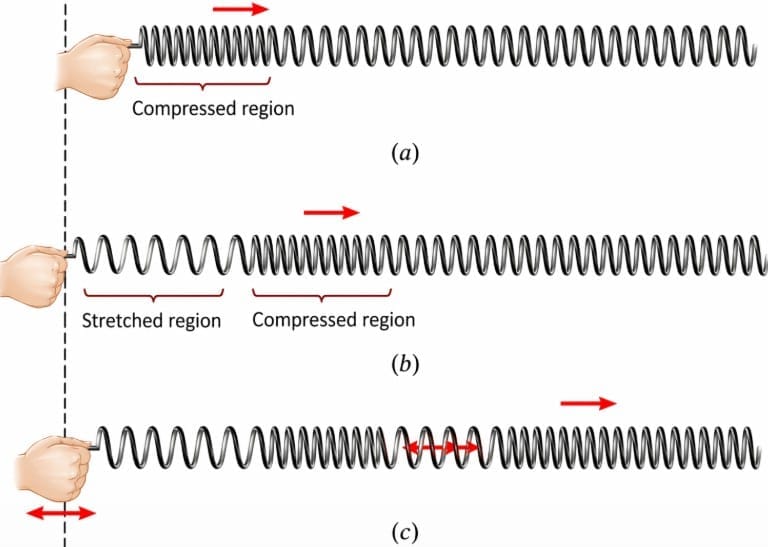 Disturbance travelling along a slinky
Sound in air - piston model: Consider a long tube filled with air with an oscillating piston at one end.
- When the piston is still, air has uniform (average) density.
- Forward motion of piston: Air particles near the piston are pushed forward → air density increases in that region → this high-density region is called compression (C).
- The compression moves forward through the air as compressed particles collide with neighboring particles, even though the air particles themselves don't travel with it.
- Backward motion of piston: Air near the piston becomes less dense → this low-density region is called rarefaction (R).
- As the piston oscillates, compressions and rarefactions are produced alternately and travel away from the source.
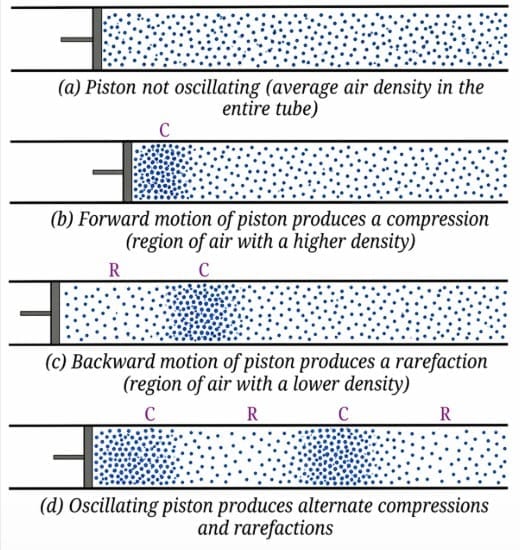 Density of air in a tube with a piston
Sound wave: The disturbance consisting of a series of alternating compressions and rarefactions propagating through a medium, without the actual flow of medium particles, is called a sound wave.
Direction of propagation: The direction in which the wave travels is the direction of propagation of the wave.
Important note: Particles of the medium do not travel with the wave. They just vibrate about their mean positions.
Longitudinal waves: In sound waves, particles of the medium vibrate back and forth parallel to the direction of propagation of the disturbance. Such waves are called longitudinal waves.
Mechanical waves: Waves that require a material medium for propagation are called mechanical waves. Sound is a type of mechanical wave.
Transverse waves (for reference - "Ready to Go Beyond"): Mechanical waves are of two types - longitudinal and transverse. In transverse waves, particles vibrate in a direction perpendicular to the direction of wave propagation (e.g., seismic transverse waves). Light is a transverse wave but is not a mechanical wave - it can travel through vacuum.
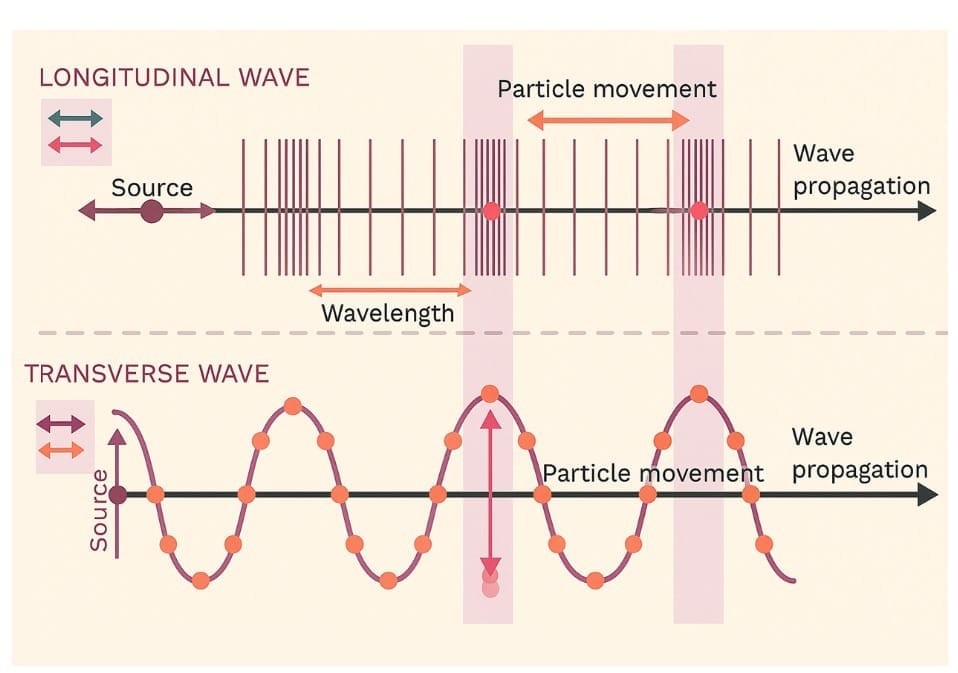
Spherical waves: When the medium is not confined to a tube, the vibrating particles collide in all directions, and the sound wave spreads out as spherical waves from a point source.

Note: Sudden loud sounds occur when air is heated quickly, causing it to expand rapidly and create a strong pressure disturbance (sound wave). When this disturbance reaches our ears, it is heard as a loud sound; in supersonic flight, this forms a powerful shock wave called a sonic boom.
4. Energy of Sound Waves
Activity demonstration: When a loud sound is produced near a bowl covered with a tightly stretched cellophane sheet (with grains on it), the grains move or jump. This happens because sound propagates through air, reaches the sheet, makes it vibrate, and this vibration causes the grains to move.
Conclusion: Sound is a form of energy. When a source vibrates, it transfers energy to the surrounding medium. As sound waves propagate, the vibration of medium particles and their collisions transfer this energy.
Important note: In sound wave propagation, it is the energy that is transferred, not the particles of the medium.
Microphone and Speaker:
- A microphone converts sound energy to electrical energy. Sound waves make a thin membrane (diaphragm) vibrate, and these vibrations are converted into an electrical signal.
- A speaker does the opposite - an electrical signal makes a cone or diaphragm inside it vibrate, producing sound that closely matches the originally captured sound.
5. Graphical Representation of a Sound Wave
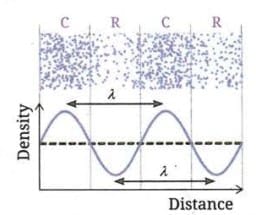
As a sound wave propagates, the density of the medium at any given instant varies periodically with distance from the source.
- Compressions (C): Regions of higher density - appear as crests (highest points) in the graph.
- Rarefactions (R): Regions of lower density - appear as troughs (lowest points) in the graph.
- The graph plots density on the y-axis and distance on the x-axis.
- A horizontal dashed line marks the average density.
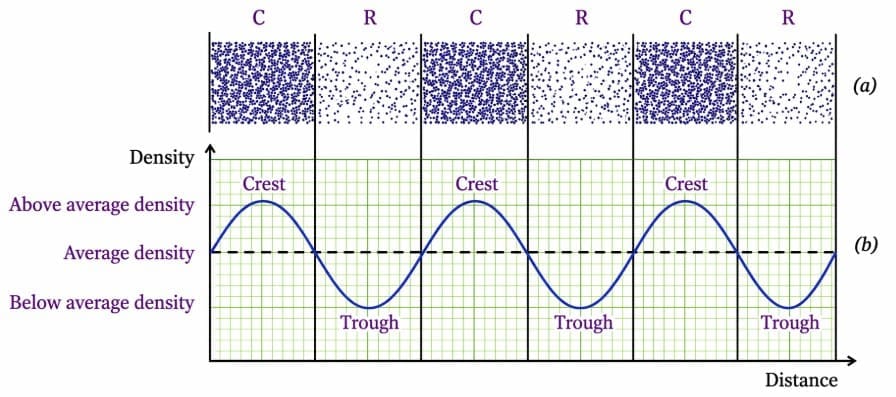 For a sound wave (a) variation of density of medium, (b) graphical representation ofvariation of density with distance
6. Characteristics of a Sound Wave
6.1 Wavelength, Frequency, and Time Period
Wavelength (λ):The distance between two consecutive crests or two consecutive troughs is called the wavelength of a wave.
- Symbol: λ (Greek letter lambda)
- SI unit: metre (m)
Frequency (ν):The number of density oscillations at a fixed point per unit time is the frequency of the sound wave.
- It represents how often the density at a given position changes from maximum to minimum and back.
- Symbol: ν (Greek letter nu)
- SI unit: per second (s⁻¹), also called hertz (Hz)
Time Period (T):The time taken for one complete density oscillation at a fixed point is the time period of the wave.
- Symbol: T
- SI unit: second (s)
Relationship between frequency and time period:
ν = 1/T ... (10.1)
Frequency and time period are inversely related - a shorter time period corresponds to a higher frequency.
Nearly single-frequency sounds can be made by striking a tuning fork or by oral whistling. Everyday sounds usually contain a mixture of many frequencies.
Example: If there are 10 density oscillations in 2 seconds at a given position, calculate (i) frequency and (ii) time period.
Answer:
- Frequency = number of oscillations / time taken = 10/2 s = 5 Hz
- Time period = 2s/10 = 0.2 s
6.2 Amplitude and Intensity of Sound Waves
Amplitude:The amplitude of a sound wave is the maximum change in the density of air in a compression (or a rarefaction) compared to the average density.
- A larger change in density corresponds to a larger amplitude.
- A wave with a larger amplitude carries more energy.
- When a plate is struck harder, more energy is transferred to the medium → larger displacement → sheet vibrates more → grains jump higher.
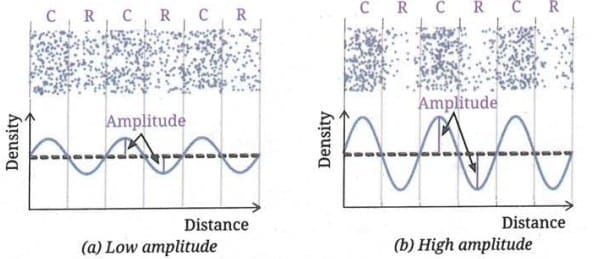
Intensity:The amount of sound energy passing through a unit area perpendicular to the direction of propagation of the sound wave in a unit time is called the intensity of sound.
How intensity changes with distance:As a sound wave travels away from its source, it spreads over a larger area. Since energy must be conserved, the same energy is now spread over a larger area, so the intensity decreases with distance from the source. Sounds with larger initial amplitude carry more energy and can travel farther before intensity reduces to zero.
6.3 Speed of Sound
The speed of sound is defined as the distance which a point on a wave (such as a crest or a trough) travels in unit time.
Derivation:For a sound wave of given frequency, the distance between two consecutive crests = one wavelength (λ). This distance is covered in one time period (T).
speed = distance/time → v = λ/T
Since ν = 1/T:
v = λ × ν ... (10.2)
speed = wavelength × frequency
Dependence on medium:Sound travels fastest in solids, slower in liquids, and slowest in gases.
- Sound travels about 4-5 times faster in water than in air.
- Sound travels 15-20 times faster in solids than in air.
Dependence on temperature and humidity:
- As temperature or humidity increases, speed of sound increases.
- Speed of sound in dry air: about 331 m s⁻¹ at 0°C and nearly 344 m s⁻¹ at 22°C.
Speed of sound in different media at 15°C (Table 10.1):
| State | Substance/Medium | Approximate Speed |
|---|---|---|
| Solid | Steel | 5000 m s⁻¹ |
| Liquid | Water | 1500 m s⁻¹ |
| Gas | Air | 340 m s⁻¹ |
Example: Human hearing spans 20 Hz to 20 kHz. Find corresponding wavelengths in air (speed = 344 m s⁻¹).
Answer:λ = speed / frequency
(i) For ν = 20 Hz: λ = 344/20 = 17.2 m
(ii) For ν = 20,000 Hz: λ = 344/20000 = 0.0172 m = 1.72 cm
Example: Lightning is seen before thunder is heard (sound travels much slower than light). If the time delay between seeing lightning and hearing thunder is 5 s, estimate the distance to the lightning strike. (Speed of sound = 340 m s⁻¹; light reaches instantaneously.)
Answer:Distance = v × t = 340 m s⁻¹ × 5 s = 1700 m ≈ 1.7 km
6.4 Human Perception of Sound
Physical properties (time period, wavelength, frequency, amplitude, speed) are well-defined and measurable. But human perception of sound is subjective, described by terms like loudness and pitch.
Pitch:
- How frequency is perceived by humans is called pitch.
- Shrill sounds (whistle, siren) → high pitch → higher frequency.
- Deep sounds (thunder, aircraft rumble) → low pitch → lower frequency.
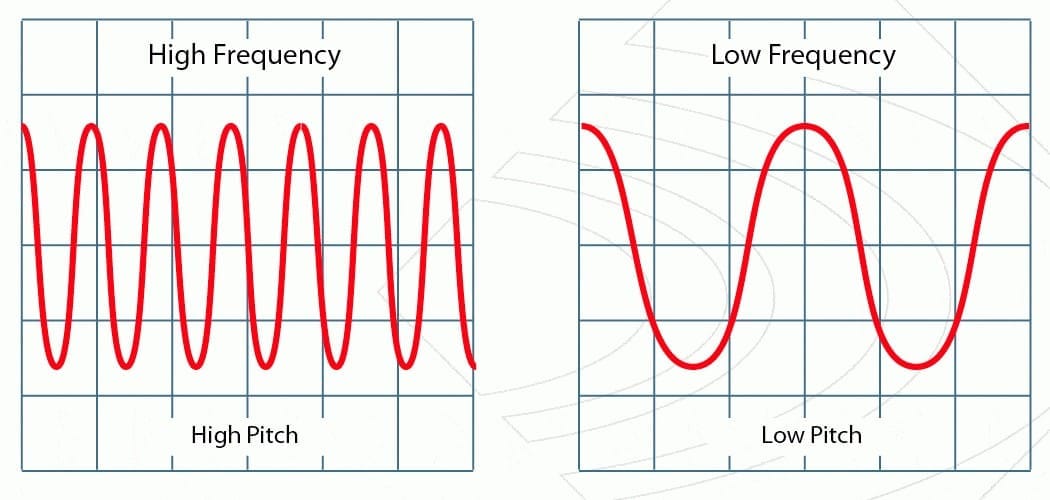
Human audible range: 20 Hz to 20,000 Hz (20 kHz). This range varies from person to person and decreases with age.
- Sound waves with frequency below 20 Hz → infrasonic waves (infrasound).
- Sound waves with frequency above 20 kHz → ultrasonic waves (ultrasound).
- Humans cannot hear infrasound or ultrasound.
- Dogs, cats, bats, dolphins can detect ultrasound; elephants can detect infrasound.
Loudness:
- Humans perceive the amplitude of a sound wave as loudness.
- Larger amplitude → heard louder; smaller amplitude → sounds softer.
- Loudness decreases as we move farther from the source.
- Loudness is measured in decibels (dB).
- Very soft sounds (rustling leaves): a few dB
- Normal conversation: about 60 dB
- Very loud sounds (firecrackers): can exceed 100 dB
- Loudness depends on the listener's hearing ability; intensity is a measurable physical quantity.
Noise pollution: Unwanted or harmful sound is called noise. Prolonged exposure to loud sound can cause hearing loss (tested via audiograms). Hearing aids consist of a microphone, amplifier, and speaker.
Have you ever wondered how we hear sound from our ears?
- We often overlook how incredible our sense of hearing is.
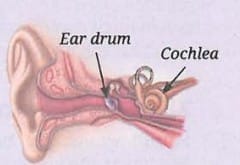
- When sound enters the ear, it makes a thin membrane called the eardrum vibrate.
- Small bones in the ear quickly make these vibrations stronger.
- The cochlea then changes these vibrations into electrical signals that travel to the brain.
- The brain interprets these signals as sound.
- Having two ears helps the brain determine the direction from which a sound comes.
- By comparing which ear hears the sound first, the brain can figure out where the sound originated.
- This is based on the tiny time difference between the two ears, which is often less than a thousandth of a second.
- Different animals have various ways of hearing.
- For example, snakes and fish can sense vibrations through their bodies.
- Some insects have ear-like organs on their body parts to detect sounds.
Timbre: Even when different instruments play the same note at the same loudness, each sounds unique. This quality is called timbre, determined by the shape, material, and construction of the instrument, and the pattern and intensity of overtones.
Tone vs Musical Note:
- A tone is a sound of a single frequency (e.g., from a tuning fork or whistling).
- A musical note is a combination of a lowest frequency (fundamental) and higher frequencies called overtones, creating a rich and pleasant sound.
Octave: The interval between two notes where one has double the frequency of the other (e.g., 200 Hz and 400 Hz).
Fun Fact: Indian drums like the tabla or mridangam have a black patch at the centre of the drum head membrane called the syaahi. This patch alters the vibration of the membrane, allowing these instruments to produce a rich variety of sounds. The syaahi also gives a level of tonal control rarely found in other drums.
7. Reflection of Sound
Sound waves can bounce off solid or liquid obstacles. This is known as the reflection of sound.
Sound follows the same laws of reflection as light:
- The incident and reflected sound make equal angles with the normal to the reflecting surface at the point of incidence.
- All three (incident direction, reflected direction, normal) lie in the same plane.
7.1 Echo
When we shout near a mountain, cliff, or long corridor and hear our voice again after some time, it is called an echo.
Condition for hearing an echo:
- The brain needs a time gap of at least 0.1 s between the original sound and the reflected sound to hear them as separate sounds.
- If the gap is less than 0.1 s, we cannot distinguish between them.
Minimum distance for an echo:Using speed of sound = 340 m s⁻¹:
- Distance travelled in 0.1 s = 340 × 0.1 = 34 m (total, to and back)
- Minimum distance of reflecting surface = 34/2 = 17 m
Echoes are stronger from: hard, smooth surfaces that reflect sound well.Soft surfaces (curtains) tend to absorb sound. Rough surfaces scatter it.
Example: You clap in an empty corridor and hear an echo after 0.5 s. Speed of sound = 340 m s⁻¹. Calculate your distance from the wall.
Answer:Distance from wall = (v × t)/2 = (340 × 0.5)/2 = 85 m
7.2 Reverberation
When sound undergoes multiple reflections from walls in a large hall or auditorium, the emitted sound persists after the source stops - this is called reverberation.
This occurs when sound reflections from surfaces arrive with a time difference less than 0.05 s.
Design of auditoriums: Modern auditoriums are architecturally designed for desirable reverberations. Sound absorbing panels, upholstered chairs, curtains, and other soft, porous surfaces reduce unwanted reverberations to prevent garbled sound.
Historical example: The Whispering Gallery of the Gol Gumbaz in Bijapur, Karnataka, is designed so that even a faint whisper can be heard multiple times across the large dome.
8. Ultrasonic and Infrasonic Waves, and Their Applications
Sound waves with frequencies outside the human audible range have important applications.
Applications of Infrasonic Waves (below 20 Hz):
- Used for detecting natural events like earthquakes and volcanic eruptions.
- Used for detecting severe storms, as such waves travel long distances through air and the Earth.
Applications of Ultrasonic Waves (above 20 kHz):
- Used for imaging internal organs without surgery (ultrasonography).
- Used for breaking kidney stones into smaller pieces that can pass out of the body.
- Used for ultrasonic welding and cleaning delicate machine parts in industries.
- Used for detecting defects inside metal blocks during construction and industrial testing.
- Used for locating objects when sound waves get reflected off them.
8.1 Echolocation
Bats are nocturnal creatures that fly and search for prey in the dark without colliding with objects. Most bats emit short bursts of ultrasonic waves. By sensing the echoes, the bat can determine the position of obstacles and prey.
The ability to locate objects using reflected sound waves is called echolocation. Besides bats, dolphins, whales, and some birds also use echolocation for navigation and hunting.
Sonar (Sound Navigation and Ranging):Humans have adapted this principle in underwater exploration. In sonar, ultrasonic waves are sent into water and the reflected waves are analysed to determine the distance, direction, and speed of underwater objects such as submarines or shipwrecks.
Example: A naval sonar signal returns after 0.90 s. Speed of sound in seawater = 1530 m s⁻¹. How far is the object?
Answer:
- Time to reach the object = 0.90/2 = 0.45 s
- Distance = speed × time = 1530 × 0.45 = 688.5 m
Audio Surveillance: Drones and aircraft produce characteristic low-frequency humming sounds from their motors. Even when hard to see, these sounds can be detected using sensitive sound sensors - this is called audio surveillance, used for monitoring airspace for safety and security.
Fun Fact:
- Sound allows us to explore areas and events that humans cannot hear.
- Space probes have captured the first sounds from Mars.
- Scientists are measuring the sound of faraway earthquakes to detect tiny shifts in ocean temperature, which helps us understand the changing climate of Earth.
- Biologists are using the buzz of mosquitoes to spot those that carry diseases.
- Researchers are listening to the small crackles made by microbes in the soil to investigate soil health and biodiversity.
- As technology gets better, sound is becoming an even stronger tool for exploring planets, living things, and the hidden activities of nature.
At a Glance (Summary)
- Sound is produced by vibrating objects.
- Sound is a longitudinal mechanical wave that needs a medium to travel.
- Sound can propagate through solids, liquids, and gases.
- In sound propagation, it is the density disturbance (energy) that travels, not the particles. Particles only vibrate about their mean positions.
- Wavelength: distance between two consecutive crests or troughs.
- One complete oscillation = change in density from maximum → minimum → maximum (or vice versa).
- Frequency: number of density oscillations per unit time at a fixed point.
- Time period: time for one complete density oscillation.
- Amplitude: maximum change in air density in a compression or rarefaction compared to average density.
- Intensity: sound energy passing through unit area perpendicular to propagation direction per unit time.
- Speed of sound = distance a crest (or trough) travels per unit time.
- Echoes and reverberations are due to reflection of sound.
- Infrasound: frequency below 20 Hz; Ultrasound: frequency above 20 kHz.
FAQs on Chapter Notes: Sound Waves: Characterstics and Applications
| 1. What are the main characteristics of sound waves? |  |
| 2. How does the medium affect the speed of sound? | |
| 3. What is the relationship between frequency and pitch? | |
| 4. What are some common applications of sound waves? | |
| 5. How does sound travel in a vacuum? | |




