NCERT Solutions: Sound Waves: Characteristics and Applications


Think It Over (Page 184)
Q1: Two astronauts are repairing the arm of a space station together during a spacewalk. Can they talk to each other and hear the sounds of metal clanking as they do on the Earth?
Ans: No, they cannot hear sounds directly because space is a vacuum and sound requires a medium to travel. They communicate using radio devices in their suits, which transmit signals through electromagnetic waves.
Q2: How do most bats use sound to locate their prey in the dark at night?
Ans: Bats use echolocation. They emit ultrasonic sounds which reflect off objects and return as echoes. By detecting these echoes, bats can locate the position, distance, and movement of their prey.
Pause and Ponder (Page 186)
Q1: Explore various ways of producing sound.
Ans: Sound is produced by vibrating objects. It can be produced by plucking (strings), striking (drums), blowing (flutes), rubbing (violin bow), or shaking (bells). In all cases, vibration of an object produces sound.
Q2: Make a list of different types of musical instruments and identify their vibrating parts which produce sound.
Ans:
- Guitar/Veena → Vibrating strings
- Drum/Tabla → Vibrating stretched membrane
- Flute → Vibrating air column
- Violin → Vibrating strings (with bow)
- Bell → Vibrating metal body
Pause and Ponder (Page 186)
Q3: Assertion (A): We cannot hear the sound of a bell ringing in a closed jar after most of the air is pumped out.Reason (R): Sound requires a medium to travel.
Choose the correct statement:
(i) Both A and R are true, but R is not the correct explanation of A.
(ii) Both A and R are true, and R is the correct explanation of A.
(iii) A is true, but R is false.
(iv) A is false, but R is true.
Answer: (ii) Both A and R are true, and R is the correct explanation of A.When air is pumped out, a near-vacuum is created. Since sound is a mechanical wave requiring a medium to propagate, the absence of a medium (air) means sound cannot reach our ears, even though the bell is ringing.
Pause and Ponder (Page 191)
Q4: Assertion (A): Compressions and rarefactions move through the medium.
Reason (R): Individual particles of the medium continuously move forward with the wave. Choose the correct statement:
(i) Both A and R are true, but R is not the correct explanation of A.
(ii) Both A and R are true, and R is the correct explanation of A.
(iii) A is true, but R is false.
(iv) A is false, but R is true.
Answer: (iii) A is true, but R is false.Compressions and rarefactions do move through the medium. However, individual particles of the medium do not move forward with the wave - they only oscillate (vibrate) about their mean positions. It is the disturbance (energy) that travels, not the particles.
Pause and Ponder (Page 192)
Q5:When sound travels from a tuning fork to your ear, which of the following actually reaches your ear?
(i) Air particles near the tuning fork (ii) Energy carried by sound waves
(iii) The tuning fork material
(iv) A continuous stream of compressed air
Answer: (ii) Energy carried by sound waves.In sound propagation, it is the energy that is transferred through the medium. The air particles only vibrate about their mean positions and do not travel to the ear.
Pause and Ponder (Page 193)
Q6 :The variation of density of the medium for two sound waves is shown in Fig. 10.17 (a) and (b). Label compression and rarefaction by C and R on it. In the graph given in Fig. 10.17 (c) and (d), label the axes and draw the curves corresponding to Fig. 10.17 (a) and (b).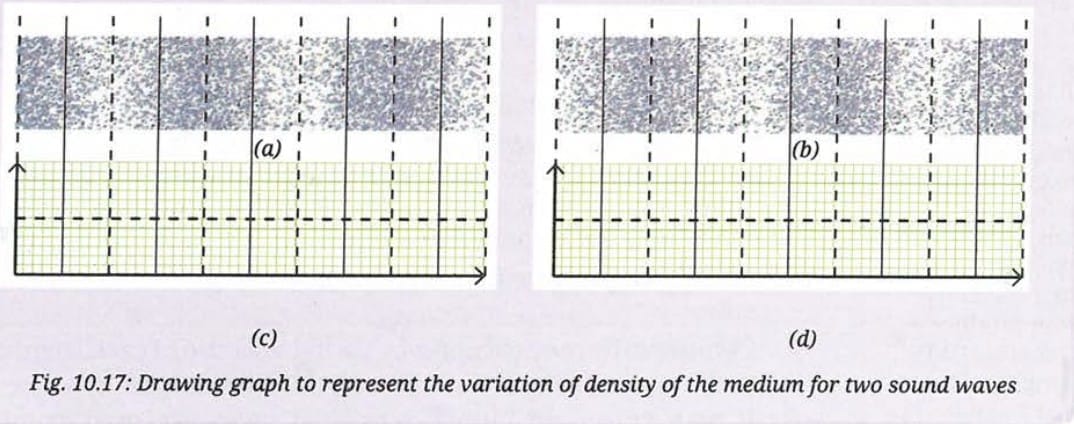
Answer: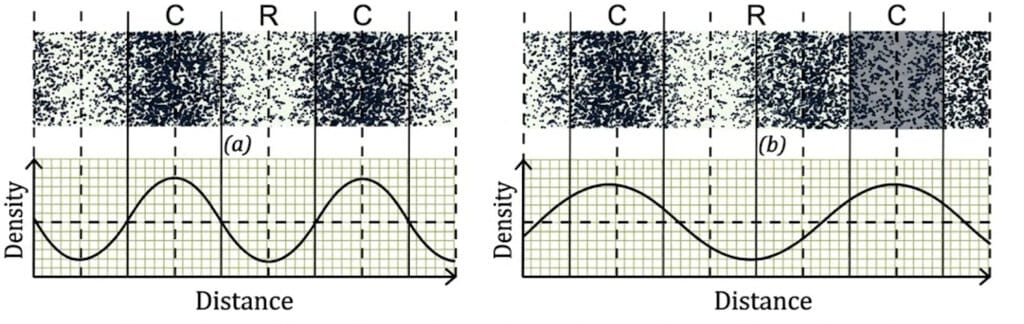
- In the density variation diagram, regions where particles are closer together (higher density) are labelled C (compression), and regions where particles are more spread out (lower density) are labelled R (rarefaction).
- For the graphs (c) and (d):
- X-axis: Position/ Distance; Y-axis: Density
- A horizontal dashed line marks the average density.
Pause and Ponder (Page 193)
Q7 :Conduct Activity 10.1 once again with a thick rubber band and then with a thin rubber band. Does the thin rubber band vibrate faster than the thick rubber band? If yes, how do the frequency and time period of the sound produced by the thin rubber band differ from that of the thick rubber band?
Answer:Yes, the thin rubber band vibrates faster than the thick rubber band. Since frequency is higher when vibrations are faster:
- The frequency of the sound produced by the thin rubber band is higher than that of the thick rubber band.
- The time period of the thin rubber band's sound is shorter (since T = 1/ν, and frequency is higher, time period is smaller).
Q8:If the frequency of a sound wave produced by an oscillating piston of a long tube filled with air is 20 Hz, then how many oscillations does the piston complete per minute?
Answer:Frequency = 20 Hz means 20 oscillations per second. Oscillations per minute = 20 × 60 = 1200 oscillations per minute
Q9:For the sound wave represented by the graph shown in Fig. 10.19, what is half of its wavelength?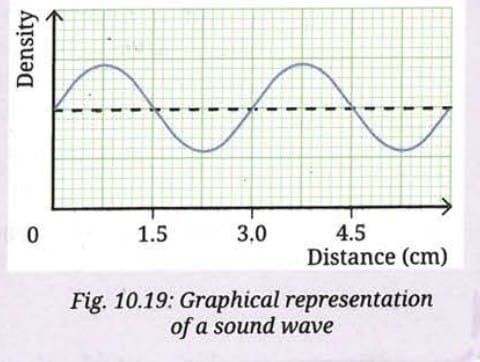
Answer:From Fig. 10.19, the x-axis shows distance up to 4.5 cm with markings at 1.5 and 3.0 cm. One complete wave (crest to crest or trough to trough) spans 3.0 cm, so the wavelength λ = 3.0 cm. Half of wavelength = 3.0/2 = 1.5 cm
What if (Page 196)
Q: What if the speed of sound in air depended on its frequency? Would music still sound pleasant when a singer performs with instruments? Why or why not?
Ans: No, music would not sound pleasant. If the speed of sound depended on frequency, different sound waves (notes) would travel at different speeds and reach the listener at different times. This would distort the combination of sounds from the singer and instruments, making the music unclear and unpleasant.
Pause and Ponder (Page 197)
Q10: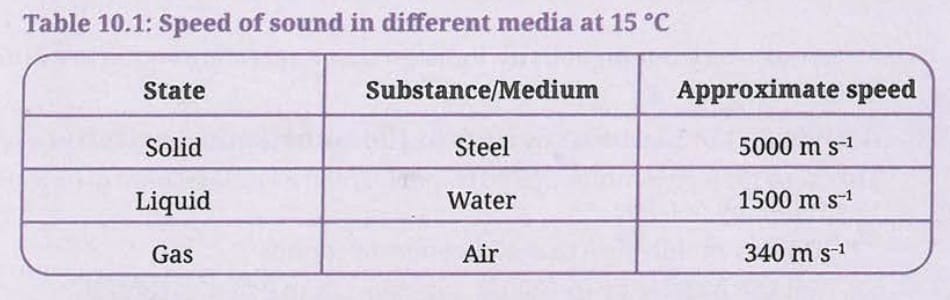 Compare the speeds by finding the ratio of: (i) the speed of sound in water with respect to the speed in the air. (ii) the speed of sound in steel with respect to the speed in the water.
Answer:(i) Speed in water / Speed in air = 1500 / 340 ≈ 4.41 (approximately 4.4 times)
(ii) Speed in steel / Speed in water = 5000 / 1500 ≈ 3.33 (approximately 3.3 times)
Pause and Ponder (Page 198)
Q11:Two friends are standing along a steel fence at a distance of 340 m from each other. Gunjan places her ear over the fence and her friend knocks the fence with a metal object. Using the values of the speed of sound in steel and air given in Table 10.1, calculate the time difference between the sound that reached Gunjan through the air and the steel. Would it have been possible for her to distinguish between the two sounds? (The time interval between two sounds must be at least 0.1 s to be heard separately.)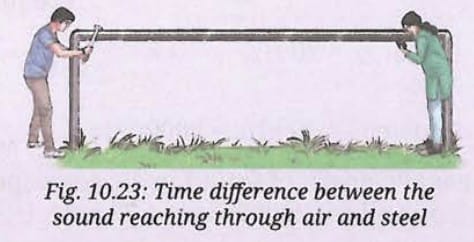
Answer:Distance = 340 m
Time taken through steel = distance / speed in steel = 340 / 5000 = 0.068 s
Time taken through air = distance / speed in air = 340 / 340 = 1.0 s
Time difference = 1.0 - 0.068 = 0.932 s
Since 0.932 s > 0.1 s, Gunjan would be able to distinguish between the two sounds.
Pause and Ponder (Page 201)
Question 12:An experiment is being set up that requires echoes to arrive at least 0.2 s after the emission of sound. What minimum distance should a reflecting surface be placed at? Assume the speed of sound to be 343 m s⁻¹.Answer:Sound must travel to the surface and back in 0.2 s. Total distance = speed × time = 343 × 0.2 = 68.6 m Minimum distance of reflecting surface = 68.6 / 2 = 34.3 m
What if (Page 202)
Q: What if humans could detect ultrasonic waves like dogs can? What would be the advantages and disadvantages?
Ans:
If humans could detect ultrasonic waves, we would be able to hear very high-frequency sounds beyond our current hearing range.
Advantages:
- Better detection of hazards like gas leaks or high-frequency alarms
- Improved medical and technological applications (e.g., ultrasound monitoring)
- Ability to sense movements or objects using reflected sound (like echolocation)
Disadvantages:
- Increased noise and disturbance from devices emitting ultrasonic sounds
- Difficulty in concentrating due to extra sounds
- Possible discomfort or stress due to continuous exposure to high-frequency sounds
Pause and Ponder (Page 203)
Q13:Sound travels much farther in water than light, and thus, is used for various underwater applications. A sonar signal sent to find the depth of ocean takes 4 s to return. What is the depth of the ocean at that location if the speed of sound in seawater is 1500 m s⁻¹?Answer:Total time = 4 s; time to reach the ocean floor = 4/2 = 2 s Depth = speed × time = 1500 × 2 = 3000 m
Revise, Reflect, Refine
Question 1: Which observation best supports the idea that sound is a mechanical wave? (i) Sound shows reflection (ii) Sound needs a medium to propagate (iii) Sound has frequency (iv) Sound carries energy
Answer: (ii) Sound needs a medium to propagate.Mechanical waves are defined as waves that require a material medium for propagation. The fact that sound cannot travel in vacuum (as shown by the bell jar experiment) directly supports this.
Question 2: For a sound wave propagating in a medium, increasing its frequency will increase its (i) wavelength (ii) speed (iii) number of compressions per second (iv) time period
Answer: (iii) number of compressions per second.Frequency is the number of oscillations (compressions) per second. Increasing frequency directly increases the number of compressions passing a point per second. Speed is a property of the medium (not frequency, in most media). Wavelength decreases with increasing frequency (since v = λν and v is constant). Time period decreases (T = 1/ν).
Question 3: If 20 compressions pass a point in 4 seconds, the frequency is (i) 80 Hz (ii) 5 Hz (iii) 10 Hz (iv) 0.2 Hz
Answer: (ii) 5 HzFrequency = number of compressions / time = 20 / 4 = 5 Hz
Question 4: In a room, the reflected sound reaches the ear 0.05 s after its production. Will it produce an echo or reverberation? Justify your answer.
Answer:It will produce reverberation, not an echo.
For an echo, the time gap between the original and reflected sound must be at least 0.1 s for the brain to perceive them as separate sounds. Since 0.05 s < 0.1 s, the brain cannot distinguish the reflected sound from the original. Instead, the reflected sound mixes with the original, prolonging and persisting the original sound - this is reverberation (which occurs when reflections arrive with a time difference less than 0.05 s is for multiple reflections; here 0.05 s is exactly the boundary - but since it is less than 0.1 s, the sounds are not heard separately, making it reverberation).
Question 5: Graphs representing two sound waves are given in Fig. 10.30. If the scales on the X and Y axes of the two graphs are the same, which of the two sound waves has (i) greater wavelength, and (ii) smaller amplitude?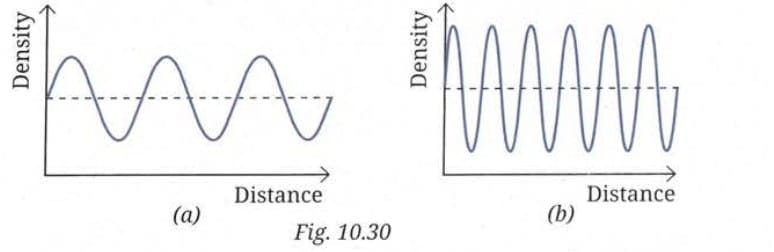
Answer:Looking at the two graphs (a) and (b) in Fig. 10.30 with the same scale:
(i) Greater wavelength: Graph (a) - The distance between consecutive crests (or troughs) is larger in graph (a), indicating a longer wavelength.
(ii) Smaller amplitude: Graph (b) - The maximum change in density (height of crests) is smaller in graph (b), indicating a smaller amplitude.
Question 6: The sound waves emitted by three sources A, B and C are represented in Fig. 10.31. If the frequency of A is maximum and C is minimum, identify the corresponding curves, and mark A, B and C on them.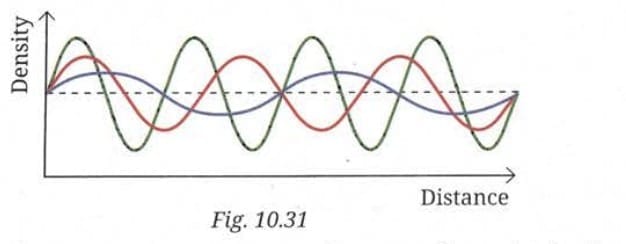
Answer:Frequency is inversely related to wavelength (v = λν, speed is constant).
- Higher frequency → shorter wavelength (more crests per unit distance).
- Lower frequency → longer wavelength (fewer crests per unit distance).
From Fig. 10.31 (three overlapping curves):
- A (maximum frequency) → the curve with the shortest wavelength (most closely spaced crests).
- C (minimum frequency) → the curve with the longest wavelength (most widely spaced crests).
- B → the curve with wavelength between A and C.
Question 7: Draw a graph to represent a sound wave for which the density amplitude is 3 units and wavelength is 4 cm.
Answer: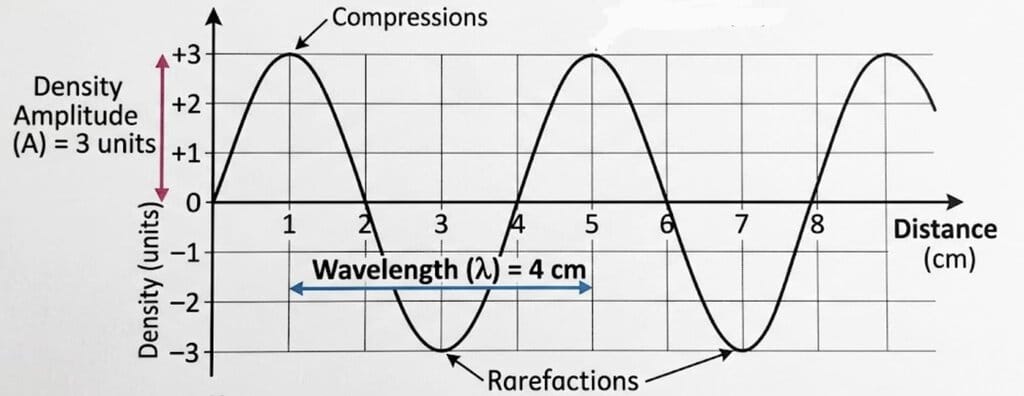
- X-axis: Distance (in cm)
- Y-axis: Density
- A horizontal dashed line at average density (e.g., at the middle).
- A sinusoidal curve where:
- The maximum density (crest) is 3 units above the average density line.
- The minimum density (trough) is 3 units below the average density line.
- The distance between two consecutive crests (or troughs) = 4 cm (the wavelength).
- Mark compressions (C) at crests and rarefactions (R) at troughs.
Question 8: In a movie, while showing the explosion of a spacecraft in space, a flash of light is shown along with sound at the same time. What are the errors in this depiction?
Answer:There are two errors:
- Sound cannot travel in space (vacuum): Outer space has near vacuum - there is no medium for sound to propagate. Sound is a mechanical wave and requires a material medium. So, no sound from the explosion should be heard.
- Light and sound travel at vastly different speeds: Even if sound could somehow travel in space, light travels much faster (300,000 km s⁻¹) than sound (approximately 340 m s⁻¹ in air). So they would not be perceived simultaneously from any significant distance. The flash of light would be seen far before any sound (if it could exist) would be heard.
Question 9: A source produces a sound wave of wavelength 3.44 m. If the wave travels with a speed of 344 m s⁻¹, find its time period.
Answer:Using v = λ × ν: ν = v/λ = 344 / 3.44 = 100 Hz
Time period T = 1/ν = 1/100 = 0.01 s
Question 10: A ship searching for a sunken ship sent a sonar signal and detected an echo after 5 s. If ultrasonic wave travels at 1525 m s⁻¹ in seawater, approximately how far down in the ocean is the wreckage of the sunken ship located?
Answer:Total time = 5 s; time to reach the sunken ship = 5/2 = 2.5 s
Distance = speed × time = 1525 × 2.5 = 3812.5 m ≈ 3812.5 m (approximately 3.8 km)
Question 11: A vehicle is fitted with an ultrasonic distance sensor as part of parking assistance system which provides echolocation, while the driver is reversing the vehicle. It emits ultrasonic wave (about 40 kHz) which is reflected by the obstacle. When the warning beep starts sounding at a distance of 1.2 m from the obstacle, how much time is taken by ultrasonic wave to travel to the obstacle and come back? Assume the speed of ultrasonic wave in air to be 345 m s⁻¹.
Answer:Total distance to travel (to obstacle and back) = 2 × 1.2 = 2.4 m
Time = distance / speed = 2.4 / 345 ≈ 0.00696 s ≈ 6.96 × 10⁻³ s
Question 12: The speed of sound in air is about 331 m s⁻¹ at 0°C and nearly 344 m s⁻¹ at 22°C. Roughly how much extra time will the sound of thunder take to travel a distance of 1720 m, if the air temperature changes from 22°C to 0°C? Assume that all other conditions remain unchanged.
Answer:Time at 22°C = distance / speed = 1720 / 344 = 5 s
Time at 0°C = distance / speed = 1720 / 331 ≈ 5.196 s
Extra time = 5.196 - 5 = ≈ 0.196 s ≈ 0.2 s
Question 13: The variation of density of medium for a sound wave propagating with a speed of 340 m s⁻¹ is shown in Fig. 10.32. The wavelength shown is 8 cm. Calculate the wavelength and frequency of the sound wave.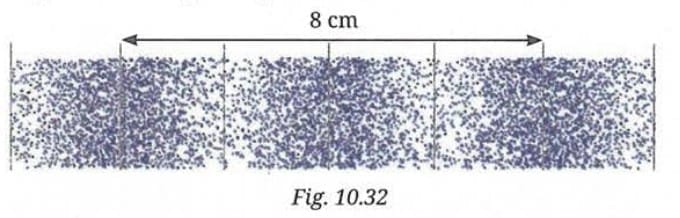
Answer:Wavelength λ = 8 cm = 0.08 m
Frequency ν = v/λ = 340 / 0.08 = 4250 Hz
Question 14: The graphical representation of two sound waves A and B propagating at the same speed of 345 m s⁻¹ is shown in Fig. 10.33. What is the wavelength of each of them? Also, calculate their frequencies.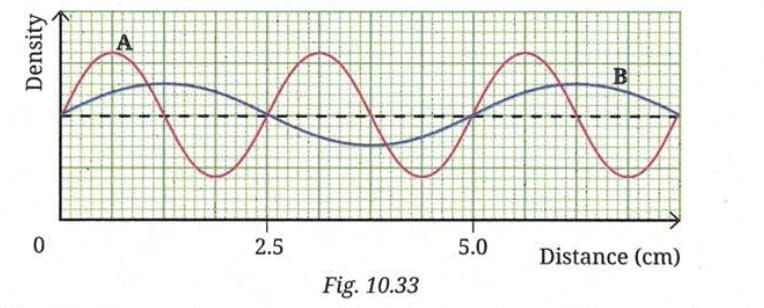
Answer:From Fig. 10.33 (x-axis up to 5.0 cm):
Wave A (blue curve): One complete wave spans approximately 5.0 cm.
- λ_A = 5.0 cm = 0.05 m
- ν_A = v/λ = 345 / 0.05 = 6900 Hz
Wave B (red curve): One complete wave spans approximately 2.5 cm.
- λ_B = 2.5 cm = 0.025 m
- ν_B = v/λ = 345 / 0.025 = 13800 Hz
Question 15: Two identical sound sources are placed at A and B - one in air and one submerged in water (Fig. 10.34). Both produce sounds at the same time, which travel horizontally to the vertical side of the cliff and come back. If the time taken by the sound to return to A is 4.5 times than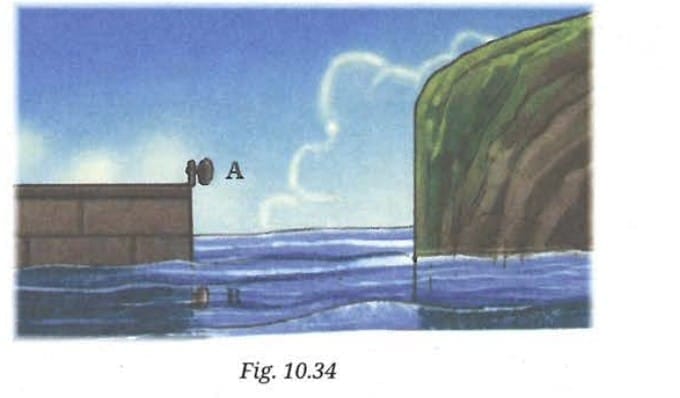 that of B, what is the ratio between the speeds of sound in air and water?
Answer:Let the distance from A (and B) to the cliff = d (same for both).
Time for A (in air) = 2d / v_air
Time for B (in water) = 2d / v_water
Given: Time for A = 4.5 × Time for B
2d/v_air = 4.5 × (2d/v_water)
1/v_air = 4.5/v_water
v_air/v_water = 1/4.5 = 2/9
The ratio of speed of sound in air to water = 1 : 4.5 (or equivalently 2 : 9)
FAQs on NCERT Solutions: Sound Waves: Characteristics and Applications
| 1. What are the characteristics of sound waves? |  |
| 2. How does frequency affect the pitch of sound? | |
| 3. What is the role of amplitude in sound waves? | |
| 4. Can sound waves travel in a vacuum? | |
| 5. What are some applications of sound waves in daily life? | |




