Chapter Notes: Reproduction: How Life Continues


Introduction
Reproduction is one of the defining features of all living organisms. Each organism follows a life cycle - it is born, grows, matures, reproduces, and eventually dies. Through reproduction, organisms produce new individuals of the same kind, ensuring life on Earth continues across generations. For instance, a mango tree may age and die, but its seeds give rise to new plants; similarly, cows produce calves, dogs produce puppies, and humans produce children.
Living beings reproduce in two main ways:
- Asexual reproduction - a single parent produces offspring that are almost exact copies of itself.
- Sexual reproduction - offspring inherit a mix of traits from two parents. This mixing may lead to small differences between generations. Accumulated over many generations, these differences help organisms adapt to changing environments and can even give rise to new species.
11.1 Asexual Reproduction
Asexual reproduction is found in many unicellular organisms like bacteria, amoeba, and yeast, as well as in simple multicellular organisms such as hydra and sponge. Many plant species also reproduce asexually.
Several plants can sprout new shoots and roots from existing parts of their bodies. Plants with fleshy underground stems - like potato and ginger - produce new plants without seeds. Stem cuttings of money plant and sugarcane grow into new plants independently. Leaves of Bryophyllum develop tiny plantlets that eventually grow into full plants.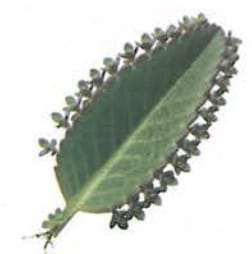
All these are examples of vegetative propagation - new plants arise from the vegetative (growing) parts of a parent plant. Since only one parent is involved, the offspring are genetically identical to the parent.
11.1.1 How is vegetative propagation in plants helpful in agriculture?
Asexual reproduction produces genetically identical individuals. Scientists and horticulturists have developed several techniques of vegetative propagation including cutting, grafting, layering, and tissue culture. These methods are widely used to efficiently propagate desirable plant varieties on a large scale.Cutting
Shoot cuttings are collected in the morning and leaves from the lower half are removed. The cuttings are inserted into compost-mixed soil at roughly 45-60° from the surface, up to about half their length. They are watered regularly and monitored for growth.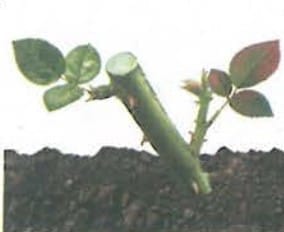
Grafting
A healthy rooted plant (Plant A) and a stem piece from a different variety (Plant B) are used. A slit is made on a twig of Plant A, into which the cutting of Plant B is fitted. The joint is wrapped in cotton or plastic film to protect it from pests while it heals. Other branches of Plant A are trimmed. With regular watering, Plant B grows alongside Plant A.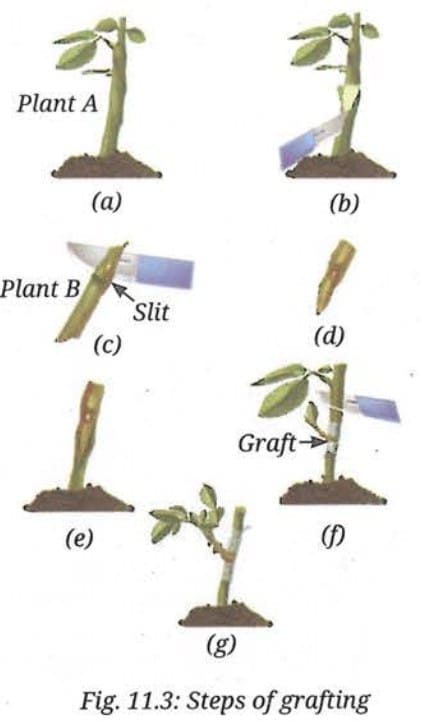
Bridging Science & Society: Various Krishi Vigyan Kendras (KVKs) under ICAR provide farmers training in modern grafting techniques, helping them grow high-yield fruit varieties and improve their incomes.
Layering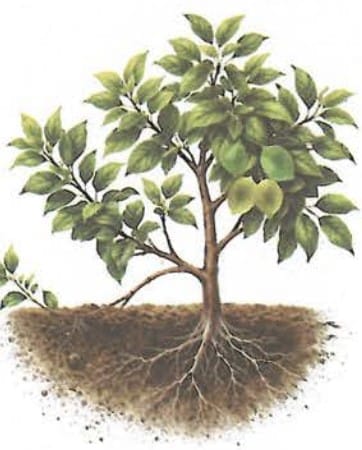
A flexible, thin twig of a shrub (such as lemon) is selected and its middle portion is buried under the soil surface. After 10-15 days of regular watering, roots develop from the buried section. Once rooted, the twig is cut from the parent plant and grows independently as a new plant.
Bridging Science and Society
Plant propagation via tissue culture has transformed farming, particularly in crops like banana. Farmers receive mass-produced, disease-free plantlets grown from the shoot tip (apical meristem) of selected plants. This technique eliminates virus-infected individuals and ensures high yields. It is also an example of asexual reproduction in plants.
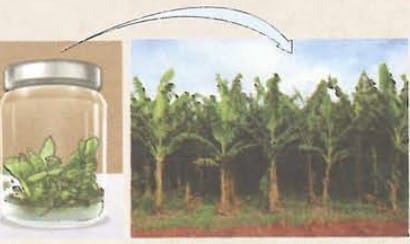
Asexual Reproduction in Other Organisms
Budding in Yeast
Small round outgrowths called buds emerge from parent yeast cells. These buds grow and eventually detach to become new independent yeast cells. This process is called budding.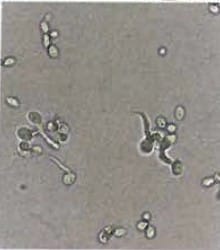
Budding in Hydra
In Hydra (a multicellular animal), repeated cell division at a specific location on the body wall produces a small outgrowth called a bud. This bud enlarges and separates from the parent to live on its own. Multiple buds can often be seen growing on a single hydra at the same time.
Spore Formation in Fungi
Fungi such as Rhizopus and Aspergillus reproduce through spore formation. Spores are produced in sac-like structures or on a swollen vesicle at the tip of long fungal hyphae. A single mould colony can release millions of spores - lightweight, usually single-celled, floating easily through air currents and germinating rapidly when they encounter moisture and nutrients.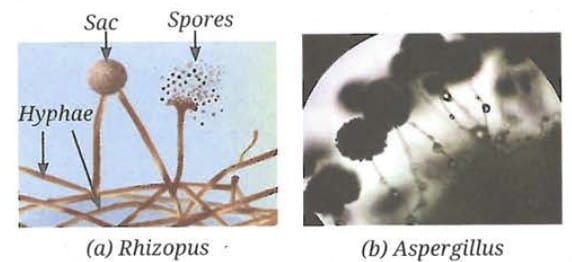
Bridging Science and Society
Although moulds on bread may look unpleasant, fungi are extremely useful to society. They grow rapidly by spore formation and help in decomposing organic wastes and pollutants, thus keeping the environment clean. Fungi also play an important role in removing heavy metals from industrial waste. In addition, many life-saving antibiotics, such as penicillin and amoxicillin, are obtained from fungi, which help in treating bacterial infections.
Threads of Curiosity
We kept the moist chamber warm (25-35°C) because spores of mould present in the air require warmth and moisture to grow on bread or roti. At lower temperatures, the growth and reproduction of mould slow down or stop. This is the reason perishable food is stored in refrigerators. Before refrigerators became common about 100 years ago, fresh food could be preserved only for 1-2 days. Refrigeration and deep freezing have revolutionised food storage by preventing spoilage caused by moulds and bacteria and allowing year-round availability of fruits, vegetables, and dairy products.
11.2 Sexual Reproduction
Sexual reproduction involves two parents, both contributing genetic material to the offspring. However, if each new generation received the full chromosome set from both parents, the chromosome number would double every generation. This biological problem is solved by a special type of cell division called meiosis.
11.2.1 How Does Meiosis Help Create Variations in sexual reproduction?
Every species has a fixed number of chromosomes - thread-like structures in the cell nucleus that carry genetic information. Humans have 46 chromosomes arranged in 23 pairs, one chromosome in each pair coming from each parent.
Meiosis is a specialised cell division that produces gametes - cells used exclusively for reproduction. During meiosis, the chromosome number is halved: a diploid (2n) parent cell gives rise to haploid (n) daughter cells. In animals, male gametes are called sperm and female gametes are called eggs. In plants, the pollen grain carries male gametes, delivered to an ovule containing the egg cell.
Because meiosis randomly distributes one chromosome from each pair into each gamete, every gamete gets a unique combination. With 23 chromosome pairs each carrying many characters, the possible combinations are enormous. This random mixing means children are genetically different from their parents and from each other - creating genetic variation, which is crucial for species survival and drives evolution. For example, some humans can tolerate low oxygen at high altitudes, or digest milk into adulthood.
11.2.2 Sexual Reproduction in Flowering Plants
Flowering plants (angiosperms) are the most diverse group of plants on Earth. The flower is the reproductive organ of angiosperms, though non-flowering plants like pines also reproduce sexually.
A complete flower has four main parts: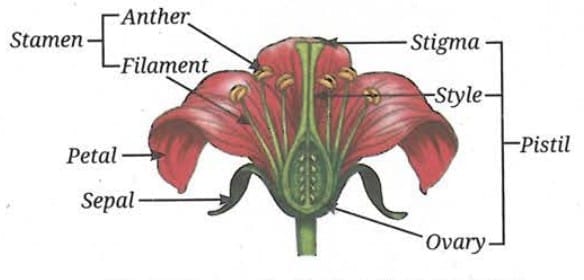
- Sepal: The outermost green whorl that protects the flower bud.
- Petal: Brightly coloured projections that attract pollinators.
- Stamen (male part): Composed of a filament and an anther, which produces pollen grains containing male gametes.
- Pistil (female part): Has three components - the stigma (sticky tip that receives pollen), the style (thin tube connecting stigma to ovary), and the ovary (contains ovules, each with an egg cell).
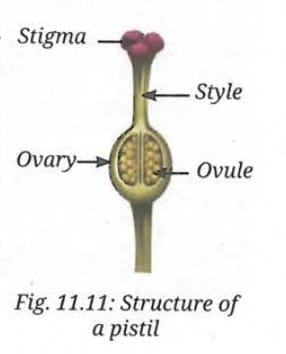
11.2.3 How does the process of pollination occur inflowers?
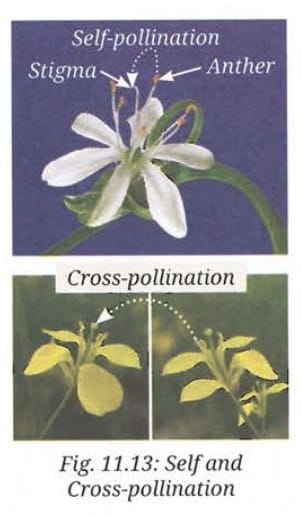
11.2.4 Pollination Strategies and Reproductive Success
Plants rely on external agents called pollinators - wind, water, insects, or birds:
- Wind pollination (e.g., wheat, maize, rice): Pollen is light and small, produced in large quantities; stigma is long and feathery to trap them.
- Water pollination (e.g., Vallisneria, Hydrilla): Water currents carry pollen between flowers in aquatic plants.
- Insect pollination (e.g., sunflower, hibiscus, marigold): Flowers are brightly coloured, fragrant, and nectar-producing; pollen is large, sticky, or spiny so it clings to insect bodies.
- Bird pollination (e.g., coral tree, hibiscus): Pollinated by birds like the Indian white-eye and sunbirds.
Pollen Production and Seed Formation
| Pollination Strategy | Approx. Pollen Grains / Flower | Estimated Seeds Formed |
|---|---|---|
| Wind-pollinated (maize, wheat) | 5,00,000 - 10,00,000 | 50 - 200 |
| Insect-pollinated (sunflower) | 20,000 - 40,000 | 800 - 1,000 |
11.2.5 Fertilisation and Seed Formation
When pollen lands on a compatible stigma, it germinates and produces a pollen tube that grows through the style into the ovary. The male gamete travels through this tube and fuses with the egg cell inside the ovule.
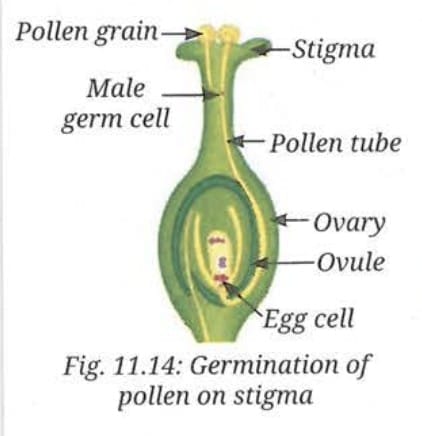
After fertilisation, the ovary enlarges into a fruit, while the ovules develop into seeds. Seeds are dispersed by wind, water, or animals. Given suitable conditions, a seed germinates and grows into a new plant.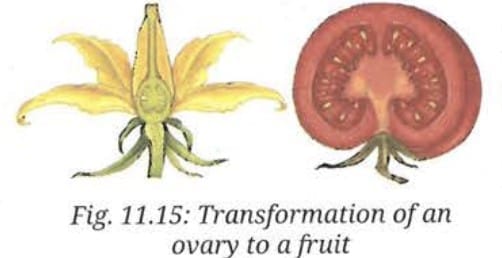
Meet a Scientist
P. Maheshwari, known as the Father of Indian Embryology, was a leading scientist in the field of plant embryology, which deals with the study of plant reproductive organs. He developed the technique of in-vitro fertilisation in flowering plants by successfully fusing the egg and male gamete in a test tube to produce new hybrid plants. He was also among the first scientists to grow plant embryos on artificial nutrient media. His famous book, An Introduction to the Embryology of Angiosperms (1950), became a classic and is still widely used by scientists around the world.
Bridging Science and Society Sexual reproduction is important in plant breeding. Methods like selective breeding, artificial hybridisation, and genetic engineering are used to develop plants with desirable traits. These techniques help produce high-yielding, disease-resistant varieties, improving agricultural production.
11.3 Sexual Reproduction in Animals
11.4 Variations in Reproduction in Animals
| Animal | Habitat | Fertilisation | Eggs Produced | Survival of Young |
|---|---|---|---|---|
| Fish | Water | External | 100s - 1000s | Low |
| Frog | Water/land | External | 5,000 - 50,000 | Low |
| Lizard | Land | Internal | 2 - 20 | Moderate |
| Bird | Water/land | Internal | 1 - 15 | Moderate to High |
Despite wide variation, all animals face the same fundamental challenge: ensuring gametes meet and that offspring survive long enough to reproduce.
Fish, amphibians, and insects produce eggs with just enough yolk to produce a larva. The larva hatches and feeds on organic matter (rotten food, manure), accumulating nutrition for metamorphosis - transformation into the adult form (seen in butterflies and frogs).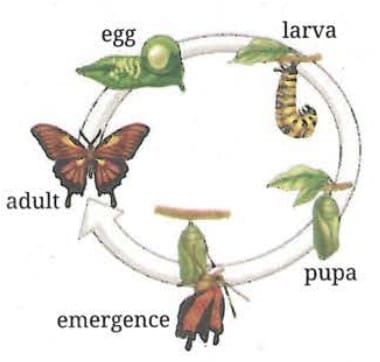
Reptiles and birds lay eggs with enough yolk to nourish the embryo until hatching. In mammals, the zygote develops entirely inside the female's body.
After birth or hatching, some young ones can immediately find their own food; others need extended parental care. Mammals typically feed their young on breast milk for a period after birth.
11.5 Reproduction in Human Beings
11.5.1 Reproductive Maturity
As a child grows into an adult, physical and emotional changes mark the onset of reproductive maturity - when the reproductive organs begin producing gametes (sperm in males, eggs in females). When sperm and egg unite inside the female body, a zygote forms, eventually developing into an embryo and then a foetus in the uterus.
11.5.2 What are the parts of the male reproductive system?
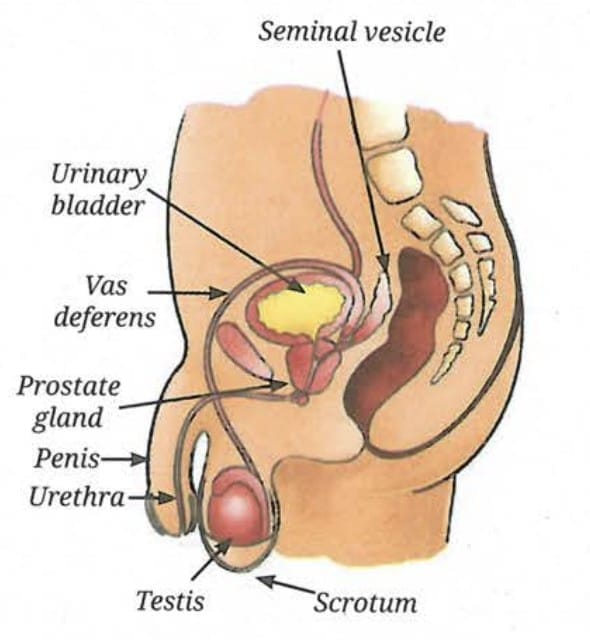
- Testes: Two oval-shaped organs in the scrotum - a skin pouch that keeps them slightly cooler than body temperature, which is necessary for sperm production. The testes also produce hormones controlling sperm production and driving puberty changes.
- Vas deferens: A long tube through which sperm travel from testes to the urethra - the common passage for urine and sperm.
- Seminal vesicles and Prostate gland: Secrete fluids that nourish sperm and keep them active.
- Sperm structure: Head containing genetic material; a long tail enabling it to swim toward the egg.
11.5.3 The Female Reproductive System
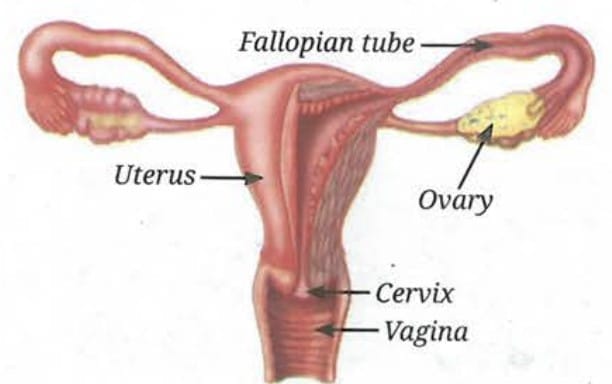
- Ovaries: Produce eggs and release hormones responsible for puberty changes.
- Oviducts (Fallopian tubes): Connect each ovary to the uterus.
- Uterus: A bag-like structure where the foetus develops. Opens into the vagina through the cervix.
- Cervix: The narrow passage connecting the uterus to the vagina.
Meet a Scientist
In-vitro fertilisation (IVF) is a medical technique in which an egg and sperm are combined outside the female body in a laboratory dish. The fertilised egg is then implanted into the uterus to initiate pregnancy. A baby born through this method is called a test tube baby, although the process actually takes place in a culture dish. In India, Subhash Mukhopadhyay achieved a major milestone in 1978 by developing the first test tube baby, Kanupriya Agarwal (Durga).
11.5.4 How Are Reproductive Cells Made? (Gametogenesis)
Human body cells have 46 chromosomes; gametes each carry only 23. When they combine at fertilisation, the zygote is restored to the full 46 chromosomes - the same as both parents.
- In males: Gametogenesis produces millions of tiny, actively motile sperm.
- In females: Gametogenesis produces a single large, non-motile egg at a time.
Structure, Size, and Number of Gametes
| Feature | Sperm | Egg |
|---|---|---|
| Size | Very small | Large |
| Number produced | Millions | Few |
| Stored nutrients | Absent | Present |
| Motility | Actively motile | Non-motile |
11.5.5 What Happens When a Sperm Meets an Egg?
At birth, a girl's ovaries already contain millions of immature eggs. From puberty onwards, usually one mature egg is released each month. Before ovulation, the uterine lining thickens in preparation. The egg travels from the ovary into the oviduct.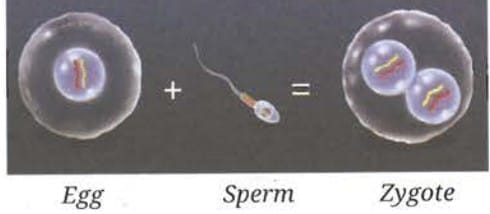
During sexual intercourse, millions of sperm enter through the vagina and swim toward the egg. If a sperm fuses with the egg in the oviduct, a zygote forms. The zygote undergoes a series of mitotic divisions as it travels to the uterus, then implants into the thickened uterine lining - marking the beginning of pregnancy.
11.5.6 What Happens When an Egg Is Not Fertilised?
If the egg is not fertilised, it degenerates within about a day. The thickened uterine lining is no longer needed and sheds along with some blood through the vagina.
This cycle of ovulation, uterine preparation, and menstruation repeats approximately every 21-35 days (often around 28 days), beginning at puberty (ages 10-14) and continuing until menopause (around age 50).
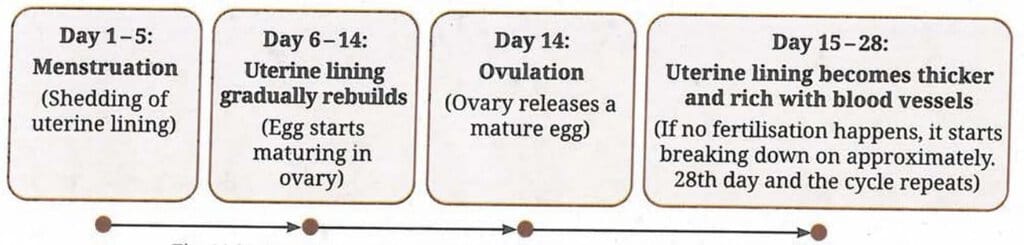
Stages of the Menstrual Cycle (typical 28-day period):
- Day 1-5: Menstruation - uterine lining is shed.
- Day 6-14: Uterine lining gradually rebuilds; egg starts maturing in ovary.
- Day 14: Ovulation - ovary releases a mature egg.
- Day 15-28: Uterine lining thickens and becomes rich in blood vessels. If no fertilisation occurs, it starts breaking down around day 28 and the cycle repeats.
What determines a baby's biological sex? Females carry XX sex chromosomes; males carry XY. The mother always contributes an X chromosome. The father contributes either an X (girl: XX) or a Y (boy: XY). So the father's contribution determines the baby's biological sex.
Menstrual Hygiene: Use biodegradable sanitary products (pads, tampons, cups); wash the genital area with water only - soap disrupts natural bacterial balance; wash hands before and after changing pads; change pads every 4-6 hours; dispose of used products by wrapping and binning (never flush). Menstruation is a sign of a healthy reproductive system, not a cause for shame.
11.5.7 Pregnancy and Childbirth
Pregnancy in humans lasts about nine months and is divided into three trimesters:
- First Trimester: The fertilised egg develops into an embryo; major organs begin forming. From around the ninth week, it is called a foetus.
- Second Trimester: The foetus grows bigger and stronger; the mother typically begins to feel its movements.
- Third Trimester: Rapid growth as the baby prepares for life outside the womb.
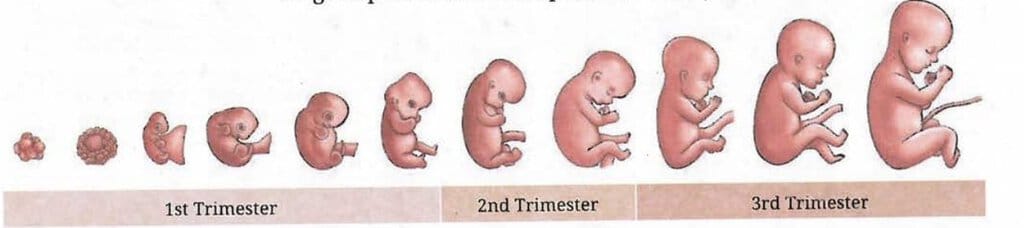 The uterus protects and nourishes the baby throughout. During childbirth, strong uterine contractions push the foetus out through the birth canal. In some cases, medical or surgical procedures are used to deliver the baby safely.
Menstruation is asign of a healthy reproductive system,not something to beashamed of. Usingclean menstrual products, changing them as often as required, anddisposing themresponsibly helpsin staying healthy and keeping your surroundings clean.
After birth, breastfeeding is essential - a mother's milk provides complete nutrition and protects the infant from many infections. Newborns should be kept warm, vaccinated on schedule, and handled gently.
Post-partum Depression: Some mothers experience anxiety and fatigue after delivery. This is a recognised and treatable condition. Mothers should be encouraged to speak to a healthcare professional (doctor, nurse, or ASHA worker) if they feel low or overwhelmed.ASHA Workers: More than 10 lakh Accredited Social Health Activist (ASHA) workers serve across India, particularly in rural areas under the National Health Mission. They promote hygiene, immunisation, and family planning, and provide guidance on maternal care, safe deliveries, and contraception.
11.5.8 Mother's Health During Pregnancy
A pregnant woman's health directly affects the baby's development. She should eat a balanced diet rich in proteins, vitamins, and minerals; attend regular medical check-ups; follow her doctor's advice on rest and light exercise; and avoid smoking, alcohol, and unprescribed medicines. Emotional well-being is equally important - family support helps keep her healthy and stress-free.
11.5.9 What Does It Mean to Be Sexually Mature?
During adolescence, the body gradually becomes capable of reproduction - sperm production begins in boys and the menstrual cycle begins in girls. However, physical maturity does not equal readiness for adult responsibilities. Emotional maturity - the ability to handle feelings, communicate clearly, and make thoughtful decisions - develops over a longer period and is equally important.
11.5.10 How Can Unwanted Pregnancies and Infections Be Prevented?
Being ready for sexual activity involves not just physical changes but also the ability to make thoughtful, responsible decisions. Such choices help prevent unplanned pregnancies, sexually transmitted infections, and support healthy relationships.
Contraceptive methods to prevent unwanted pregnancy:
- Barrier methods (condoms, vaginal covers): Physically prevent sperm from reaching the egg.
- Oral contraceptive pills (hormonal): Suppress ovulation by altering hormones; may have side effects.
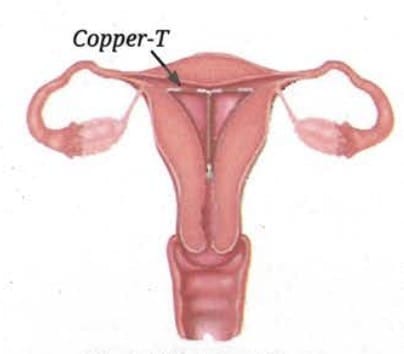
- IUDs (e.g., Copper-T): Placed in the uterus to prevent pregnancy; may occasionally cause uterine irritation.
- Surgical methods: Blocking the vas deferens (vasectomy) in males or fallopian tubes (tubectomy) in females - permanently prevents sperm and egg from meeting.
- Abortion: Surgical removal of an unwanted pregnancy, generally only within the first trimester when the embryo is very small.
Important - Legal Notice: The practice of sex-selective abortion can cause a dangerous imbalance in the sex ratio. Prenatal sex determination is strictly prohibited by law in India. Maintaining a balanced sex ratio is vital for a healthy society.Indian Innovation: Scientists at the Central Drug Research Institute, Lucknow, developed the world's first non-steroidal, non-hormonal oral contraceptive pill. Taken once weekly, it avoids common side effects like weight gain, nausea, and headaches, and is distributed free through the National Family Planning Programme.
At a Glance - Summary
- Reproduction is the biological process by which living organisms produce new individuals of the same species, ensuring continuity of life and transfer of genetic information.
- The two main types are asexual reproduction (single parent, genetically identical offspring via mitosis) and sexual reproduction (two parents, genetically varied offspring via meiosis).
- Asexual reproduction includes budding (yeast, hydra), spore formation (fungi), and vegetative propagation (plants).
- A flower is the reproductive organ of a plant, bearing the male stamen and female pistil.
- Pollination transfers pollen from anther to stigma via wind, water, insects, or birds - through self- or cross-pollination.
- After fertilisation, the pollen tube carries sperm to the ovule; the ovule becomes the seed and the ovary becomes the fruit.
- In humans, sperm are produced in the testes and eggs in the ovaries. Both gametes are formed by meiosis and carry 23 chromosomes each.
- Ovulation occurs around day 14 of the menstrual cycle. If fertilised, pregnancy begins; if not, menstruation occurs.
- Pregnancy lasts about nine months across three trimesters. Maternal nutrition, rest, and medical check-ups are essential.
- Birth control methods include condoms, oral pills, IUDs (Copper-T), and surgical procedures.
- Prenatal sex determination is illegal in India to protect the sex ratio in society.
FAQs on Chapter Notes: Reproduction: How Life Continues
| 1. How is vegetative propagation in plants helpful in agriculture? |  |
| 2. How does meiosis help create variations in sexual reproduction? | |
| 3. What are the processes involved in pollination in flowering plants? | |
| 4. What are the strategies for pollination and how do they affect reproductive success? | |
| 5. What are the main parts of the male and female reproductive systems in humans? | |




