NCERT Solutions: Reproduction: How Life Continues


Think It Over (Page 208)
Question 1: When does a farmer prefer asexual or sexual methods of reproduction for crops production?
Answer:
A farmer prefers asexual methods of reproduction when:
- They want to produce genetically identical plants that reliably carry desirable traits (e.g., high yield, disease resistance, specific taste or fruit quality).
- They want to propagate plants quickly without waiting for seeds to germinate.
- They want to grow plants that do not produce seeds easily or whose seeds take a long time to germinate (e.g., banana, sugarcane, potato).
A farmer prefers sexual methods of reproduction when:
- They want to develop new varieties with improved traits by crossing two varieties (hybridisation).
- They want to produce seeds for large-scale cultivation of crops like wheat and rice.
- They want to introduce variation and adaptability into crops to help them survive changing environmental conditions or diseases.
Question 2: Why do you think most complex animals and flowering plants use sexual reproduction, while many simple organisms, like yeast and hydra, mainly reproduce asexually?
Answer:
Most complex animals and flowering plants use sexual reproduction because it creates genetic variation in offspring. Variation is important for survival in complex, changing environments. It allows populations to adapt to new diseases, climate changes, and other environmental pressures over time, ultimately contributing to evolution.
Simple organisms like yeast and hydra mainly reproduce asexually because:
- Asexual reproduction is faster and more energy-efficient.
- These organisms live in relatively stable environments where variation is not as critical.
- Asexual reproduction allows for rapid population increase when food and conditions are favourable.
- Being simple organisms, they do not need the complexity of finding a mate or forming specialised reproductive organs.
Bridging Science and Society (Page 212)
Q: Bridging Science and Society - Moulds on bread may look unpleasant but fungi benefit society greatly. Fungi grow very fast by spore formation and degrade organic wastes and pollutants. Fungi also play an important role in removal of heavy metals from industrial wastes. Many antibiotics are derived from fungi (penicillin and amoxicillin), saving countless lives from bacterial infections. Do you know any fungus that can degrade plastic?
Ans: Yes, some fungi such as Aspergillus and Penicillium are known to degrade certain types of plastics. These fungi produce enzymes that can break down plastic materials, making them useful in reducing plastic pollution and managing waste.
Pause and Ponder Questions (Page 217)
Q1: In a china-rose (hibiscus or gudhal) plant, a pollen tube grows and continues through the style after pollen lands on the stigma. Which process is about to happen next?Ans: The process about to happen next is fertilisation, where the male gamete from the pollen fuses with the female gamete in the ovule.
Q2: Look at the pictures of calotropis (madar) seeds and dandelion seeds. Can you guess what kind of seed dispersal these seeds are adapted for?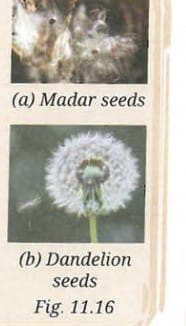
Ans: These seeds are adapted for wind dispersal, as they have light, hairy structures that help them float in air.
Q3: A farmer plants two varieties of maize side by side, but notices that seeds form only when pollen from one variety reaches the stigma of the other. What type of pollination is this?
Ans: This is cross-pollination, where pollen from one plant reaches the stigma of another plant of the same species.
Pause and Ponder Questions (Page 218)
Q4. Why do animals with external fertilisation generally produce more eggs than animals with internal fertilisation?Ans: Animals with external fertilisation (like fish and frogs) produce a very large number of eggs because eggs fertilised externally are highly vulnerable - many are destroyed by water currents or eaten by other animals. Producing a huge number of eggs compensates for this high rate of loss, ensuring that at least a few survive and develop into new individuals. In contrast, animals with internal fertilisation (like reptiles, birds and mammals) provide protection to the fertilised egg inside the body, resulting in a much higher chance of survival for each egg. Therefore, they need to produce fewer eggs.
Q5. In animals, which fertilisation method keeps the gametes more protected?
Ans: Internal fertilisation keeps the gametes more protected. In internal fertilisation, fertilisation takes place inside the body of the female, where the environment is controlled and safe. The fertilised egg or embryo is protected from external dangers like water currents, predators and harsh environmental conditions. This leads to a higher survival rate for the young ones.
Threads of Curiosity (Page 221)
Q: What determines a baby's biological sex?
So far, you have learnt that every person has two sex chromosomes. Females have XX and males have XY chromosomes. The mother always contributes an X chromosome to a baby and the father contributes either an X (Female: XX) or a Y (Male: XY) chromosome. Now, from the above information, can you predict who determines the sex of a baby?
Ans: The biological sex of a baby is determined by the father. This is because the mother always contributes an X chromosome, while the father can contribute either an X or a Y chromosome. If the father contributes an X chromosome, the baby will be female (XX), and if he contributes a Y chromosome, the baby will be male (XY). Thus, the type of chromosome contributed by the father determines the sex of the baby.
Pause and Ponder Questions (Page 222)
Q6. Ravi suddenly notices that he is growing taller rapidly, his shoulders are broadening, and his voice cracks. What stage of life is he entering?
Ans: Ravi is entering the stage of adolescence (puberty). The changes he is experiencing - rapid increase in height, broadening of shoulders and voice cracking - are secondary sexual characteristics that appear due to the production of male sex hormones (testosterone) by the testes. These are signs of sexual maturation, which marks the transition from childhood to adulthood.
Q7. Rina's period occurs every 28 days. Her last period was on the 5th of March. On which day is she most likely to get her next period?
Ans: Rina's last period was on the 5th of March. Since her cycle is 28 days, her next period will most likely begin on 5th March + 28 days = 2nd April.
Q8. A human zygote has just formed. How many chromosomes does it have?
Ans: A human zygote has 46 chromosomes (23 from the sperm and 23 from the egg). When the sperm (with 23 chromosomes) fuses with the egg (with 23 chromosomes) during fertilisation, the resulting zygote has the complete set of 46 chromosomes, restoring the diploid number characteristic of the human species.
Pause and Ponder Questions (Page 223)
Q9. What protective devices can be used during sexual activity to reduce the spread of STIs?
Ans: Condoms (male or female) can be used during sexual activity to reduce the spread of Sexually Transmitted Infections (STIs). Condoms act as a physical barrier that prevents direct contact between the mucous membranes of partners, thereby preventing the transfer of disease-causing organisms. They are effective against infections like HIV, gonorrhoea, herpes, syphilis and genital warts. Condoms also help prevent unwanted pregnancies.
Q10. If a couple uses oral contraceptive pills but not condoms, which risks remain and why?
Ans: If a couple uses oral contraceptive pills but not condoms, the risk of Sexually Transmitted Infections (STIs) remains. Oral contraceptive pills only prevent unwanted pregnancy by altering hormonal levels to stop the release of eggs. They do not provide any protection against disease-causing organisms such as bacteria or viruses. Infections like HIV, gonorrhoea, herpes, syphilis and genital warts can still be transmitted because there is no physical barrier between the partners. Using condoms, in addition to oral pills, would reduce both risks - unwanted pregnancy and STI transmission.
Pause and Ponder Questions (Page 224)
Q11. In many animals, the young ones can walk or find food soon after birth but human babies are completely dependent for a long time. What might be some advantages and disadvantages of this for humans as a species?
Ans:
Advantages of prolonged dependency of human babies:
- Extended brain development - the human brain continues to develop rapidly after birth. This long period of dependency allows the brain to develop fully, enabling complex thinking, language, problem-solving and social behaviour.
- Cultural and social learning - the long dependency period allows children to learn complex skills, language, values and knowledge from parents and society.
- Strong family and social bonds - the need to care for dependent young ones strengthens family and social structures, promoting cooperation and community living.
Disadvantages of prolonged dependency:
- High parental investment - parents must invest a great deal of time, energy and resources in raising each child.
- Vulnerability - a dependent child is highly vulnerable to danger if parental care is absent or inadequate.
- Reduced number of offspring - since each child requires such intensive care, humans cannot produce and raise as many children as animals whose young are independent soon after birth.
Revise, Reflect, Refine
Q1. A flower's anthers are removed before it matures. Later, pollen from another plant of the same species is dusted onto its stigma and seeds are produced. Which process has been ensured here?
(i) Self-pollination (ii) Cross-pollination (iii) Fertilisation (iv) Tissue culture
Answer: (ii) Cross-pollination
Explanation: Removing the anthers ensures that the flower cannot pollinate itself (self-pollination is prevented). When pollen from another plant of the same species is then placed on its stigma, pollen is transferred from one plant to another of the same species - this is exactly the definition of cross-pollination.
Q2. Arrange the following stages of sexual reproduction in plants in the correct order:
(i) Pollen germination on stigma (ii) Fertilisation (iii) Pollination (iv) Formation of zygote
Answer: (iii) Pollination → (i) Pollen germination on stigma → (ii) Fertilisation → (iv) Formation of zygote
Explanation: First, pollen is transferred to the stigma (pollination). Then the pollen grain germinates on the stigma and produces a pollen tube. The pollen tube grows down through the style into the ovary (germination). The male gamete travels through the tube to the ovule and fuses with the egg cell (fertilisation). This fusion produces the zygote (formation of zygote).
Q3. Assertion (A): The zygote formed after fertilisation immediately attaches to the uterus wall. Reason (R): The uterus wall is always prepared to receive the zygote.
(i) Both A and R are true, and R is the correct explanation of A. (ii) Both A and R are true, but R is not the correct explanation of A. (iii) A is true, but R is false. (iv) A is false, but R is true.
Answer: (iv) A is false, but R is true.
Explanation: The assertion is false because the zygote does NOT immediately attach to the uterus wall. After fertilisation in the oviduct, the zygote undergoes a series of mitotic divisions while travelling to the uterus, and it is only after reaching the uterus that it implants into the inner lining. The reason is true that the uterine lining thickens and prepares to receive the zygote after ovulation. Since the assertion is false and the reason is true, option (iv) is correct.
Q4. Why does asexual reproduction produce offspring that are genetically identical to the parent?
Answer: Asexual reproduction produces genetically identical offspring because it involves only one parent and no fusion of gametes. The central process of asexual reproduction is mitosis - a type of cell division in which the parent cell divides to produce two daughter cells, each having the exact same number and type of chromosomes as the parent cell. Since there is no mixing of genetic material from two different individuals, all the genetic information in the offspring is identical to that of the parent. Such offspring are called clones. This is why asexual reproduction always produces genetically identical individuals.
Q5. Explain why the menstrual cycle stops during pregnancy.
Answer: The menstrual cycle stops during pregnancy because once a fertilised egg implants itself into the inner lining of the uterus (endometrium), the body produces hormones to maintain the thick uterine lining and support the developing embryo. Since the uterine lining is required for nourishment and protection of the growing foetus, it is not shed. The hormonal changes also prevent the release of further eggs (ovulation). Because ovulation and the preparation and shedding of the uterine lining do not occur during pregnancy, the menstrual cycle is suppressed throughout the entire period of pregnancy.
Q6. Why are flowers that bloom at night white or light in colour as compared to flowers that bloom during the day?
Answer: Flowers that bloom at night are typically white or light in colour because they are pollinated by night-active (nocturnal) insects like moths. During the night, there is very little or no light, so bright colours would not be visible. However, white or light-coloured flowers reflect whatever little moonlight or starlight is available, making them more visible to nocturnal pollinators. Additionally, night-blooming flowers often produce strong fragrances to help attract pollinators in the dark when colour is less effective. During the day, flowers can use bright colours (red, yellow, orange, blue) to attract pollinators like bees, butterflies and birds, which have good colour vision.
Q7. Why do vegetatively propagated plants tend to be more vulnerable to diseases than sexually reproduced plants?
Answer: Vegetatively propagated plants are genetically identical to the parent plant (clones). Since all individuals in the population have the same genetic makeup, if one plant is susceptible to a particular disease, pest or pathogen, all plants in the population will be equally susceptible. There is no genetic variation that might allow some individuals to be resistant. As a result, a single disease can wipe out an entire crop of vegetatively propagated plants. In contrast, sexually reproduced plants have genetic variation due to the mixing of chromosomes from two parents during meiosis and fertilisation. This variation means that some individuals in the population may have genes that provide resistance to a particular disease, allowing the population to survive even if some individuals are affected. This makes sexually reproduced populations more resilient.
Q8. If all flowers in a type of plant were only capable of self-pollination, how would it affect the genetic diversity over several generations? Explain.
Answer: If all flowers in a type of plant were only capable of self-pollination, genetic diversity would decrease significantly over several generations. In self-pollination, pollen from a flower is transferred to the stigma of the same flower or another flower on the same plant. Since only one individual's genetic material is involved, there is no introduction of new genetic combinations from a different individual. Over many generations of self-pollination, offspring would become increasingly similar to each other and to the parent - essentially forming highly inbred populations. Any harmful or unfavourable genes present in the plant would also be passed on to all offspring without any chance of being diluted or eliminated by genes from another individual. This would reduce the ability of the plant population to adapt to changing environments, diseases or other stresses, making the population more vulnerable to extinction. Genetic diversity, which is the raw material for evolution and adaptation, would be greatly reduced.
Q9. A farmer wants to produce a large number of genetically identical plants quickly. Suggest suitable reproduction methods and explain why they are effective.
Answer: The farmer should use asexual (vegetative) reproduction methods. Suitable methods include:
- Cutting: Stem cuttings from a desirable plant are placed in soil. Each cutting develops roots and grows into a new plant genetically identical to the parent.
- Tissue Culture: Cells from the shoot tip (apical meristem) of the desired plant are grown in artificial nutrient media in a laboratory. A large number of plantlets are produced rapidly, all genetically identical to the parent plant.
- Grafting: A stem piece from the desired plant (Plant B) is attached to a rooted plant (Plant A). The graft grows and produces a plant with the desired characteristics of Plant B.
These methods are effective because:
- They involve only one parent, so all offspring are genetically identical (clones) to the desired parent plant.
- They are much faster than growing plants from seeds, as they bypass the germination stage.
- They allow large-scale production of uniform, high-quality plants that farmers can rely on for consistent yield, flavour and disease resistance.
- Tissue culture, in particular, can produce thousands of plantlets from a single parent plant in a short time and ensures virus-free plantlets.
Q10. Suresh prepares slides with pollen grains in different sugar concentrations (0%, 2.5%, 5%, 7.5%, 10%) to study the germination of pollen.
(i) What are the different hypotheses which can be tested using this set-up?
Answer: The following hypotheses can be tested:
- Pollen germination rate increases as sugar concentration increases up to an optimal level.
- There is an optimal sugar concentration at which pollen germination is highest; both lower and higher concentrations result in reduced germination.
- Pollen grains do not germinate in the absence of sugar (0% concentration).
- Too high a sugar concentration (osmotic stress) inhibits pollen germination compared to moderate concentrations.
(ii) What parameters should be kept the same in this set-up?
Answer: The following parameters (variables) should be kept constant:
- Type of pollen grains used (same species and same batch).
- Amount of pollen grains placed on each slide.
- Temperature and humidity of the environment.
- Duration for which pollen is allowed to germinate before observation.
- Volume of sugar solution used on each slide.
- pH of the solution.
- Microscope magnification and light conditions for observation.
Q11. Look at the picture given below and think in line with the given prompts and find out which type(s) of pollination might have been followed in these flowers ):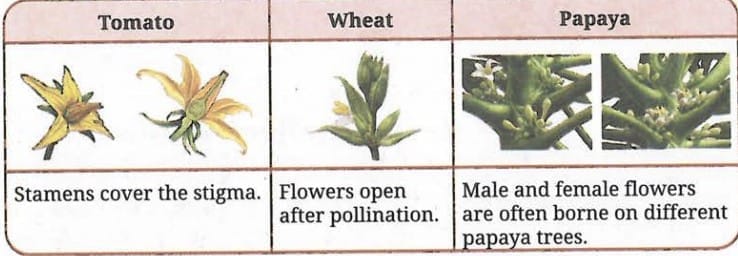
Answer:
- Tomato (Stamens cover the stigma): Self-pollination. Since the stamens surround and cover the stigma, pollen from the anthers easily falls directly onto the stigma of the same flower, leading to self-pollination.
- Wheat (Flowers open after pollination): Wind pollination / Self-pollination. The flowers open only after pollination has already taken place within the closed flower (cleistogamy), indicating self-pollination. Wind may also carry pollen between plants. Wheat is a well-known wind-pollinated crop.
- Papaya (Male and female flowers are often borne on different papaya trees): Cross-pollination. Since male and female flowers are on different trees, pollen must be transferred from the male flower on one tree to the female flower on another tree. This is cross-pollination, facilitated by insects or wind.
Q12: In the lower Himalayan region of northern India, apples are an important cash crop that contribute significantly to farmer's livelihoods. The fruit yield in apple cultivation is declining continuously, associated with climate change and a significant decline in the population of natural pollinators. A researcher-farmer group set up two experimental apple orchards at two distinct locations: Places A and B. In apple orchards at Place A, they allowed natural pollinators to pollinate the flowers of the apple. In apple orchards at Place B, they applied mixed farming techniques of beekeeping. Along with honey, the farmer yielded apples. The yield of apples is depicted in Fig. 11.24, in terms of fruit setting (number of fruits/the total number of corresponding fruit-bearing branches) and fruit drop (premature falling of developing fruits) in the two types of experimental places of apple orchards.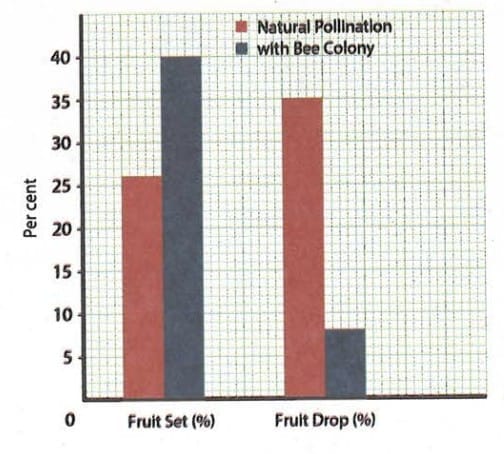
(i) What are the hypotheses the researcher-farmers group has thought of for this investigation?
Answer:
- Using bee colonies for pollination (mixed farming with beekeeping) increases the fruit setting percentage in apple orchards compared to natural pollination alone.
- Using bee colonies for pollination reduces fruit drop percentage compared to natural pollination alone.
- Managed pollination by bee colonies leads to higher apple yields than relying only on natural pollinators.
(ii) What are the different parameters in the experiment?
Answer:
- Independent variable: Pollination method (natural pollination at Place A vs. mixed farming with bee colony at Place B).
- Dependent variables: Fruit setting percentage (number of fruits formed per total number of fruit-bearing branches) and fruit drop percentage (premature falling of developing fruits).
- Controlled variables: Apple variety, geographical conditions of the two locations (must be similar), farming practices other than pollination, irrigation, pesticide use, etc.
(iii) Compare and analyse the data of two experimental orchards Places A and B, in terms of high yields of apple fruits.
Answer:
- The graph shows that the fruit setting percentage at Place B (with bee colony) is significantly higher (approximately 35%) compared to Place A (natural pollination, approximately 25%).
- The fruit drop percentage at Place B (with bee colony) is significantly lower (approximately 8%) compared to Place A (natural pollination, approximately 30%).
- This indicates that managed bee pollination results in both more fruits being set and fewer fruits dropping prematurely.
(iv) Based on your analysis, what do you infer from the data?
Answer: The data strongly suggests that managed bee pollination (mixed farming with beekeeping) is significantly more effective than relying solely on natural pollinators for high-yield apple cultivation. The higher fruit setting and lower fruit drop in Place B indicate that bee colonies ensure better and more efficient pollination of apple flowers. As natural pollinator populations decline due to climate change, introducing bee colonies can help compensate and maintain or improve fruit yields. This supports the practice of integrating beekeeping with apple farming in the lower Himalayan region.
Q13. A student claims, "In humans, ovulation always happens on day 14 of the menstrual cycle". Critically examine this claim and state whether the claim is correct or not. Give at least two reasons for your answer.
Answer: The claim that "ovulation always happens on day 14 of the menstrual cycle" is NOT entirely correct. While ovulation typically occurs around day 14 in a standard 28-day cycle, it is not always exactly on day 14 for every woman or in every cycle.
Reasons why this claim is not always correct:
- Menstrual cycle length varies: Cycle repeats every 21-35 days (often around 28 days). In women with shorter cycles (e.g., 21 days), ovulation may occur around day 7-10. In women with longer cycles (e.g., 35 days), ovulation may occur around day 21. Day 14 applies specifically to a standard 28-day cycle.
- Individual variation: Different women may have different hormonal patterns, meaning the exact day of ovulation can vary from person to person, even in those with a regular cycle. Stress, illness, nutritional changes and other factors can cause the timing of ovulation to shift.
- Cycle irregularity: Many women do not have perfectly regular 28-day cycles. Irregular cycles make it impossible to predict that ovulation will consistently occur on day 14.
Therefore, while day 14 is a general guideline for a 28-day cycle, it is an approximation and cannot be taken as an absolute rule for all women in all cycles.
FAQs on NCERT Solutions: Reproduction: How Life Continues
| 1. What is reproduction and why is it essential for life? |  |
| 2. What are the two main types of reproduction? | |
| 3. Can you explain the process of asexual reproduction with examples? | |
| 4. What is the role of gametes in sexual reproduction? | |
| 5. How does fertilisation occur in flowering plants? | |




