NCERT Solutions: Patterns in Life: Diversity and Classification


Q1: What do you understand by biodiversity?
Ans: Biodiversity refers to the variety of living organisms present on Earth, including different plants, animals, and microorganisms, along with the ecosystems they form.
Q2: How does the grouping of organisms help us understand diversity?
Ans: Grouping organisms based on similarities and differences helps us organise the vast diversity of life, making it easier to study, compare, and understand relationships among organisms.
Q3: On what basis are plants and animals classified?
Ans: Plants and animals are classified based on characteristics such as cell structure, level of organisation, mode of nutrition, body structure, and evolutionary relationships.
Q4: How does classification help address problems in farming?
Ans: Classification helps identify useful traits in plants, such as drought resistance or pest resistance, which allows farmers to select better crop varieties and improve agricultural productivity.
Pause and Ponder (Page 231)
Question 1: If many organisms share common features, could they also share a common ancestry?
Answer: Yes, if many organisms share common features, they could also share a common ancestry. Similar features in organisms suggest that they may have evolved from common ancestors. The more features two organisms share, the more closely related they are likely to be. This is one of the key ideas behind biological classification - organisms are grouped based on shared characteristics, which often reflect their shared evolutionary history. For example, all vertebrates share a backbone, suggesting they evolved from a common ancestor with this feature.
Pause and Ponder (Page 236)
Question 2: How can a single-celled organism carry out all its life processes when billions of cells are required to perform similar functions in multicellular organisms like us?
Answer: A single-celled organism carries out all its life processes within that single cell itself. The one cell performs all functions such as nutrition, respiration, excretion, reproduction, and movement. In multicellular organisms like humans, the body is so large and complex that billions of specialised cells are needed, with each group of cells performing specific functions (for example, muscle cells for movement, nerve cells for coordination, etc.). In contrast, a single cell in unicellular organisms is self-sufficient - it does not need to depend on other cells. All the necessary organelles and structures within that one cell work together to keep the organism alive. For example, Amoeba uses pseudopodia for movement and engulfing food, a cell membrane for gas exchange, and the nucleus for reproduction, all within a single cell.
Pause and Ponder (Page 238)
Question 3: Which plant features reduce their dependence on water but still require moist conditions?
Answer: Pteridophytes like ferns have features that reduce dependence on water compared to thallophytes and bryophytes:
They possess true roots, stems, and leaves, which are well-developed structures adapted for life on land.
They have vascular tissues (xylem and phloem) that transport water and food throughout the plant, reducing the need for all parts to be in direct contact with water.
However, pteridophytes still require moist conditions because they depend on water for reproduction - the male reproductive cells must swim through water to reach the female cells for fertilisation. Thus, they are better adapted to land than bryophytes but are not completely independent of water.
Question 4: Why do taller plants need specialised transport tissues?
Answer: Taller plants need specialised transport tissues because water, minerals, and food need to travel over large distances within the plant. In simple, small plants like thallophytes and bryophytes, the plant body is in close contact with the environment, and water and nutrients can be absorbed and distributed directly through diffusion. However, in taller plants, the distance between roots (which absorb water and minerals from soil) and leaves (where photosynthesis occurs) is very large. Diffusion alone cannot efficiently transport substances over such distances. Therefore, specialised vascular tissues - xylem (for transporting water and minerals upward from roots to leaves) and phloem (for transporting food prepared in leaves to other parts of the plant) - are necessary to ensure efficient transport throughout the plant.
Question 5: How do seeds and fruits affect, where and how plants can survive?
Answer: Seeds and fruits greatly expand where and how plants can survive:
Seeds protect the developing embryo and contain stored food, which helps the young plant survive until it can photosynthesize on its own. Seeds allow plants to survive unfavourable conditions (drought, cold) in a dormant state and germinate when conditions improve.
Fruits help in dispersal of seeds to new locations - far from the parent plant. This is done by different agents such as insects, birds, animals, wind, and water. Fruits make seed dispersal efficient and allow plants to colonise new and varied environments.
Pause and Ponder (Page 242)
Question 6: An earthworm (annelida) and a beetle (arthropoda), both have segmented bodies but the beetle has a hard external skeleton. How does the beetle's external skeleton help it survive?
Answer: The beetle's hard external skeleton (exoskeleton) helps it survive in the following ways:
It provides protection against predators and physical injury.
It reduces water loss from the body, which allows arthropods to survive in dry and exposed environments where softer-bodied animals like earthworms would dry out and die.
It supports powerful muscles, enabling effective movement and locomotion.
It protects internal organs from damage.
In contrast, the earthworm (annelida) has a soft, segmented body without a hard external skeleton, which is why it is restricted to moist soil and water environments and cannot survive in dry conditions.
Pause and Ponder (Page 247)
Question 7: Does the term 'biodiversity' relate only to the variety of organisms, or does it encompass other elements?
Answer: The term 'biodiversity' does not relate only to the variety of organisms. It encompasses much more - it includes the variety of all living organisms on Earth in all forms and habitats, the interactions between organisms and their environments, the variety of ecosystems (such as forests, grasslands, coral reefs, deserts), the variety of genes within species, and the ecological roles that different organisms play. Biodiversity includes the interconnections between organisms, such as pollination, decomposition, and food chains, which help sustain ecosystems. It also encompasses the role that organisms play in keeping nature stable and functioning, and the benefits that humans derive from biodiversity for food, shelter, medicines, and livelihoods.
Question 8: If you find a new organism in a pond, what features will you observe to classify it and why?
Answer: To classify a new organism found in a pond, the following features would be observed:
First, cell type - whether the organism has a membrane-bound nucleus (eukaryote) or not (prokaryote). This is fundamental because it determines the kingdom at the broadest level (Monera vs others).
Second, cell structure - whether the organism is unicellular or multicellular, and whether it has a cell wall (and what the cell wall is made of - chitin, cellulose, etc.).
Third, mode of nutrition - whether it is autotrophic (makes its own food) or heterotrophic (depends on other organisms).
Fourth, level of organisation - if multicellular, whether the cells are organised into tissues, organs, or organ systems.
Fifth, ecological role - whether it is a producer, consumer, or decomposer.
These features are used because they reflect fundamental biological differences between organisms, are linked to evolutionary history, and form the basis of the five kingdom classification system.
Question 9: Why do genetic studies provide deep information about living beings?
Answer: Genetic studies provide deep information about living beings because every living cell contains genetic material (DNA), which carries the instructions for the organism's growth and function. Organisms with similar DNA are considered to have a common ancestry. By comparing DNA, scientists can determine how closely related different organisms are, trace evolutionary history, and discover relationships that are not apparent from external features alone. Genetic studies have also revealed that microscopic life forms are far more diverse than previously believed - as shown by Carl Woese's three domain system (Bacteria, Archaea, Eukarya). Genetic information is more reliable and detailed than just comparing physical characteristics, because two organisms may look similar but have very different genetic make-up, or may look different but be closely related genetically.
Question 10: How can changes in climate affect the biodiversity?
Answer: Changes in climate can affect biodiversity in several ways:
When climate changes, temperatures and rainfall patterns shift, altering the habitats that species depend on. Species that are adapted to specific temperature ranges or moisture levels may not be able to survive in the changed conditions. This can lead to decline in population or even extinction.
Climate change can affect the availability of food - for example, if the flowering time of plants shifts but the animals that pollinate them or depend on them for food do not adjust accordingly, both the plant and the animal can be affected.
Rising sea levels and changes in ocean temperature can affect marine biodiversity, including coral reefs, which are important biodiversity hotspots.
When one species disappears due to climate change, others that depend on it may also decline, creating a chain reaction that reduces overall biodiversity.
Revise, Reflect, Refine
Question 1: Meena and Hari observed an animal in their garden. Hari called it an insect while Meena said it was an earthworm. Choose the correct option which confirms that it is an insect.
(i) Bilateral symmetrical body
(ii) Body with jointed legs
(iii) Cylindrical body
(iv) Body with little segmentation
Answer: (ii) Body with jointed legs. Insects belong to Arthropoda, a defining feature of which is the presence of jointed appendages (legs). Earthworms (Annelida) have a cylindrical, segmented body without jointed legs. Both insects and earthworms have bilateral symmetry and segmented bodies, but jointed legs are a characteristic feature of arthropods like insects that distinguishes them from earthworms.
Question 2: Sponges represent one of the simplest animal body plans. Their bodies lack true tissues and organs. Which feature of sponge cells supports its classification under the animal kingdom?
(i) Absence of mitochondria
(ii) Ability to photosynthesise
(iii) Presence of a cell membrane
(iv) Presence of a cell wall
Answer: (iii) Presence of a cell membrane. Sponges are classified under the animal kingdom (Animalia). Animal cells have a cell membrane but do NOT have a cell wall. Plants and fungi have cell walls. The presence of a cell membrane (without a cell wall) is consistent with animal cell structure. Sponges are also multicellular and heterotrophic (they depend on other organisms for food), which are characteristic features of animals.
Question 3: Observe two different animals in your immediate environment. What features help you distinguish between them? How do these features help place them into different groups?
Answer: Two common animals that can be observed are a butterfly (insect) and an earthworm.
Features that help distinguish between them:
The butterfly has jointed legs and a hard external skeleton (exoskeleton), while the earthworm has a soft, cylindrical, segmented body without jointed legs.
The butterfly has three pairs of legs, wings, and a distinct head with antennae. The earthworm has no legs, wings, or antennae.
The butterfly has a well-defined body divided into head, thorax, and abdomen. The earthworm has a cylindrical body divided into similar-looking segments.
How these features help place them into different groups:
The butterfly belongs to Arthropoda because of jointed appendages (legs), segmented body, and hard exoskeleton.
The earthworm belongs to Annelida because of a cylindrical, segmented body, presence of muscles and nerve cord, body cavity, and no exoskeleton.
These features reflect differences in internal organisation, body plan, and adaptations to different environments, which are the fundamental criteria for biological classification.
Question 4: How would a scientist justify choosing cellular organisation as a more fundamental characteristic for the basis of classification rather than the presence of xylem and phloem?
Answer: A scientist would justify choosing cellular organisation as a more fundamental characteristic because cellular organisation applies to ALL living organisms - from bacteria and fungi to plants and animals. It is the most basic level of biological organisation. Whether an organism is prokaryotic or eukaryotic, unicellular or multicellular, fundamentally determines the nature of the organism - its metabolism, reproduction, and evolutionary history.
In contrast, xylem and phloem are characteristics only of certain plants (pteridophytes and higher plants). They are much more specific and apply to a very narrow group of organisms. Using xylem and phloem as a primary criterion would be useless for classifying bacteria, fungi, animals, and algae.
Cellular organisation reflects the deepest evolutionary differences among life forms. For example, the separation between prokaryotes (Monera) and eukaryotes (all other kingdoms) is a fundamental division in the history of life, far more significant than the presence or absence of xylem and phloem. Therefore, cellular organisation is a more universal, fundamental, and meaningful criterion for the basis of classification.
Question 5: You find an unlabelled slide of a single-celled organism that has a well-defined nucleus and multiple cilia. Which group would it most likely belong to? Give reasons.
Answer: The organism would most likely belong to Kingdom Protista.
Reasons:
It is single-celled (unicellular) - this rules out Plantae, Animalia, and most of Fungi (which are multicellular).
It has a well-defined nucleus (membrane-bound nucleus) - this means it is a eukaryote, which rules out Kingdom Monera (prokaryotes).
It has multiple cilia - cilia are structures used for movement, and many protists like Paramecium use cilia for locomotion.
Kingdom Protista includes all single-celled eukaryotic organisms. The presence of cilia strongly suggests it could be an organism like Paramecium, which is a well-known protist. Therefore, the organism most likely belongs to Kingdom Protista.
Question 6: How does the diversity of organisms contribute to the balance and stability of an ecosystem?
Answer: The diversity of organisms contributes to the balance and stability of an ecosystem in the following ways:
Each organism plays a specific role in the ecosystem. Plants (producers) capture sunlight and produce food that supports nearly all other life. Animals pollinate flowers and disperse seeds, enabling plants to reproduce and spread. Fungi and bacteria (decomposers) break down dead organic matter, recycling nutrients back into the soil.
When there is high biodiversity, if one species is lost or reduced, other species can often perform similar functions, preventing the collapse of the ecosystem. This redundancy makes ecosystems more resilient.
Diverse ecosystems have complex food webs - energy and nutrients can flow through multiple pathways. If one pathway is disrupted, others can compensate.
Biodiversity also contributes to ecosystem stability by creating physical, biological, and chemical barriers against threats. For example, forests with rich biodiversity helped reduce the impact of the super cyclone that hit Orissa in 1999.
When one species disappears, others that depend on it may also decline, creating a chain reaction that destabilises the ecosystem. This shows that biodiversity is essential for maintaining balance and stability.
Question 7: If all unicellular organisms were grouped into a single kingdom, what problems would arise?
Answer: If all unicellular organisms were grouped into a single kingdom, serious problems would arise:
Unicellular organisms are extremely diverse - they include both prokaryotes (bacteria, without a membrane-bound nucleus) and eukaryotes (Amoeba, Paramecium, with a membrane-bound nucleus). These two groups are fundamentally different at the most basic level of cell structure. Grouping them together would ignore this critical difference.
Unicellular organisms also differ greatly in mode of nutrition - some are autotrophic (like cyanobacteria and some algae) while others are heterotrophic (like bacteria and Amoeba). They differ in their ecological roles - some are producers, others are decomposers, and others are parasites.
Grouping all unicellular organisms together would create a very large, confusing, and scientifically misleading group that would not reflect their true biological relationships or evolutionary history. It would make it difficult to study, identify, and understand these organisms systematically.
This is precisely why scientists separated bacteria (Kingdom Monera - prokaryotes) from Amoeba, Paramecium, etc. (Kingdom Protista - unicellular eukaryotes).
Question 8: Viruses were studied in earlier classes. Why are they not placed in any of the five kingdoms? Give reasons.
Answer: Viruses are not placed in any of the five kingdoms for the following reasons:
The five kingdom classification is based on characteristics of living organisms - cell type (prokaryote or eukaryote), cell structure, level of organisation (unicellular or multicellular), and mode of nutrition.
Viruses do not fit any of these criteria because they are acellular - they have no cell structure at all. They do not have a cell membrane, cytoplasm, or organelles. They are essentially genetic material (DNA or RNA) enclosed in a protein coat.
Viruses are also not truly living outside a host cell - they remain inactive outside a host cell and can only replicate inside a living host cell. They do not carry out any metabolic activities on their own.
Since viruses do not have a cellular organisation - the most fundamental criterion for classification - they cannot be placed in any of the five kingdoms, which are all based on cellular life forms.
Question 9: If you were asked to revise the five kingdom classification, would you create a separate category for viruses or keep them outside the system? Justify your answer and explain what this indicates about the evolving nature of scientific classification.
Answer: Creating a separate category for viruses would be scientifically challenging because viruses lack the fundamental characteristic that forms the basis of the five kingdom system - cellular organisation. They are acellular and remain inactive outside a host cell. They do not independently carry out metabolic processes.
If one were asked to revise the classification, it might be justified to create a separate category for viruses because they are an important part of nature, contain genetic material like living organisms, and play significant roles in ecosystems and in causing diseases. A separate category would acknowledge their existence and importance without forcing them into a system built for cellular organisms.
This indicates that scientific classification is an evolving process. Classification systems are not final or perfect - they are tools built from the knowledge available at a particular time. As new tools (like microscopes and genetic studies) and new knowledge become available, classification systems are revised. The progression from Aristotle's two-category system to Whittaker's five kingdom system, and then Carl Woese's three domain system, shows this evolution. The inability to place viruses in the five kingdoms reveals the limitations of any classification system and shows that science is an ongoing process of reasoning and change.
Question 10: Viruses contain genetic material like living organisms but lack cellular organisation. Which features prevent them from fitting into the five kingdom system? What does this tell us about the limitations of classification systems?
Answer: Features that prevent viruses from fitting into the five kingdom system:
Viruses are acellular - they have no cell structure. The entire five kingdom system is based on the characteristics of cells (prokaryotic or eukaryotic, unicellular or multicellular, presence or absence of cell wall).
They do not carry out independent metabolism - they cannot grow, reproduce, or perform any life processes outside a host cell.
They do not fit the criteria of mode of nutrition (autotrophic or heterotrophic) as applied to cellular organisms.
They cannot be classified as prokaryote or eukaryote because they have no cell at all.
What this tells us about the limitations of classification systems: This shows that any classification system is built on assumptions and criteria that work well for most known organisms at the time of its creation, but may not be universal or perfect. As science progresses and new organisms or entities are discovered, existing systems may be inadequate. Classification systems are human-made frameworks to understand diversity - they are useful tools but not absolute truths. The challenge of classifying viruses reveals that the boundary between living and non-living is not always clear, and that classification systems must evolve as our understanding of life deepens.
Question 11: Both pteridophytes and bryophytes lack flowers and seeds, yet they are placed in different groups. Explain this classification using their key features.
Answer: Both pteridophytes and bryophytes lack flowers and seeds, yet they are placed in different groups because they differ significantly in other key features:
Bryophytes:
They have a simple, partially differentiated body - they have rhizoids (root-like structures) and may have stem-like and leaf-like structures, but do not have true roots, stems, or leaves.
They lack vascular tissues (xylem and phloem).
They require water for reproduction because male reproductive cells must swim to reach female cells.
They are called the 'amphibians' of the plant kingdom - they represent a partial adaptation to land but remain strongly dependent on moisture.
Pteridophytes:
They have well-developed true roots, stems, and leaves.
They possess specialised vascular tissues - xylem and phloem - for transporting water and food throughout the plant.
They can grow taller and live further from water than bryophytes (for vegetative growth).
However, they still require water for reproduction.
The key difference that justifies placing them in different groups is the presence of vascular tissues and true roots, stems, and leaves in pteridophytes, which represents a major structural advancement over bryophytes. This structural difference reflects an important step in the evolution of plants from aquatic to fully terrestrial environments.
Question 12: In the classification hierarchy, which group - class or genus - has fewer members but more features in common? Explain your answer.
Answer: Genus has fewer members but more features in common compared to class.
In the classification hierarchy: Kingdom → Phylum → Class → Order → Family → Genus → Species
As we move from kingdom towards species, each successive group contains fewer organisms but those organisms share more features in common with one another. Genus is a lower and more specific level than class. It contains a smaller, more closely related group of organisms.
For example, the genus Panthera includes only the large roaring cats (tiger, lion, leopard, jaguar) - a small, closely related group sharing many common features like skull structure, roaring ability, etc. In contrast, the class Mammalia includes all mammals - a much larger group from whales to bats to tigers - which share only broader features like presence of mammary glands, body hair, and giving birth to live young.
Therefore, genus has fewer members but those members share far more features in common, because they are more closely related evolutionarily.
Question 13: A scientist discovers a new organism with the characteristic features of locomotion and autotrophic nutrition. Which character(s) would help the scientist identify the organism belonging to Protista according to the five kingdom classification?
Answer: If the organism has both locomotion and autotrophic nutrition, the following characters would help identify it as belonging to Kingdom Protista:
It should be unicellular - Protista includes single-celled eukaryotic organisms. If it is multicellular, it would be placed in Plantae (if autotrophic) or Animalia (if it moves).
It should be eukaryotic - it should have a well-defined membrane-bound nucleus. This would distinguish it from Kingdom Monera (prokaryotes), which also contains unicellular organisms but without a membrane-bound nucleus.
It may or may not have a cell wall, and if present, the cell wall would be made of cellulose (not chitin).
An example of such an organism is Euglena, which is a unicellular eukaryote that is autotrophic in the presence of light (through photosynthesis) but can also be heterotrophic in the absence of light, and uses flagella for locomotion. This combination of locomotion and autotrophic nutrition in a unicellular eukaryote is characteristic of Protista.
Question 14: A researcher identified a unicellular eukaryotic organism as fungi. What identification key would you suggest according to the five kingdom classification to keep a unicellular organism in the Kingdom Fungi?
Answer: According to the five kingdom classification, to keep a unicellular organism in Kingdom Fungi, the following identification key (criteria) must be met:
The organism must be eukaryotic - it must have a membrane-bound (true) nucleus. This distinguishes it from Monera.
The cell wall must be made of chitin - this is the most important distinguishing feature of fungi. Unlike plants (whose cell walls are made of cellulose) and protists (which may not have a cell wall or have cellulose walls), fungi have chitin cell walls.
The mode of nutrition must be heterotrophic by absorption - fungi obtain nutrients by absorbing them from dead or decaying matter (saprophytic) or from a host (parasitic or symbiotic). They do not photosynthesise.
Yeast is an example of a unicellular organism that fits all these criteria and is therefore placed in Kingdom Fungi - it is eukaryotic, has a chitin cell wall, and is heterotrophic by absorption.
Question 15: During a long-term ecological study, students examined organisms collected from three different environments - a freshwater pond, damp soil near decaying logs, and the digestive tract of animals. Instead of naming organisms directly, scientists recorded only structural,cellular and nutritional features as given in the table below.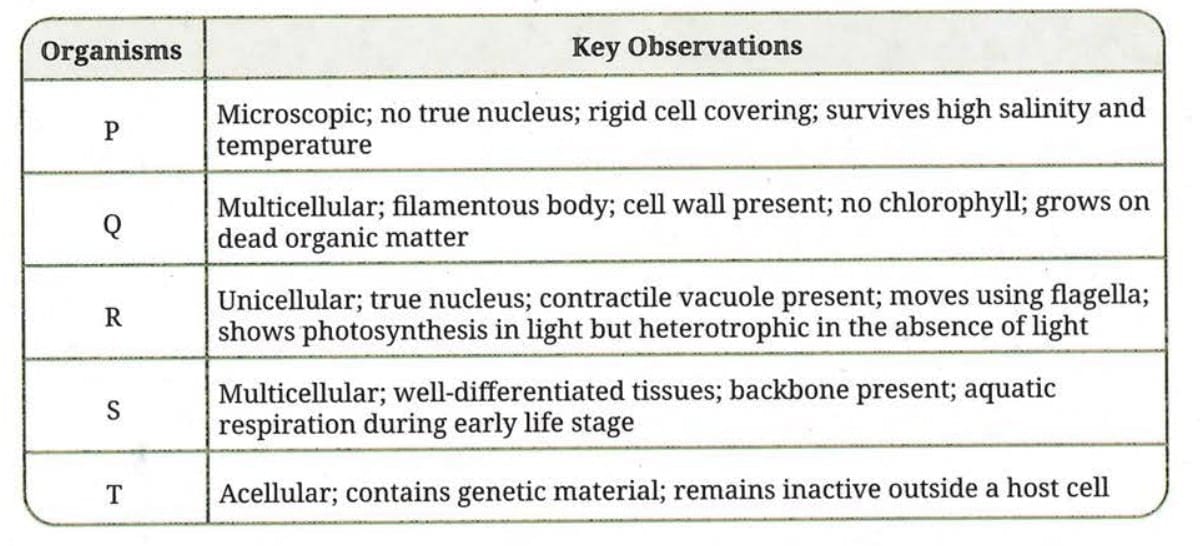
The students realised that some organisms fit neatly into Whittaker's five kingdom classification, while others challenged the very basis oft his classification.
Based on the case study, answer the following questions:
(i) Identify one organism that clearly belongs to the Kingdom Fungi. State one observation that supports your answer.
Answer: Organism Q belongs to Kingdom Fungi. Supporting observation: It is multicellular with a filamentous body (mycelium), has a cell wall (made of chitin in fungi), has no chlorophyll (so it cannot photosynthesise - it is heterotrophic), and grows on dead organic matter (saprophytic - characteristic of fungi as decomposers).
(ii) Which organism would be placed in the Kingdom Monera? Mention one characteristic that justifies this placement.
Answer: Organism P would be placed in Kingdom Monera. Justifying characteristic: It has no true nucleus (no membrane-bound nucleus) - it is a prokaryote. Kingdom Monera is the only kingdom consisting of prokaryotic organisms. Additionally, it has a rigid cell covering and can survive high salinity and temperature, which is characteristic of extremophile bacteria.
(iii) Organisms R and Q are both eukaryotic, yet they are placed in different kingdoms. Analyse the criteria that separate them.
Answer: Both R and Q are eukaryotic (they have a true, membrane-bound nucleus), yet they are placed in different kingdoms because of the following differences:
R (Kingdom Protista):
It is unicellular.
It can be autotrophic (photosynthesis in light) or heterotrophic (in absence of light).
It moves using flagella.
It has a contractile vacuole.
Q (Kingdom Fungi):
It is multicellular with a filamentous body.
It is heterotrophic - obtains nutrients by absorption from dead organic matter.
It has a cell wall (chitin in fungi).
It has no chlorophyll and cannot photosynthesise.
The key criteria that separate them are: level of organisation (unicellular vs multicellular), mode of nutrition (can be autotrophic vs strictly heterotrophic by absorption), and cell wall composition.
(iv) Explain why organism S cannot be classified using the mode of nutrition alone.
Answer: Organism S is multicellular, has well-differentiated tissues, a backbone, and shows aquatic respiration during early life stage (indicating it could be an amphibian or fish - vertebrates).
Organism S cannot be classified using the mode of nutrition alone because all animals (Kingdom Animalia) are heterotrophic - they all depend on other organisms for food. Mode of nutrition alone would only tell us that it belongs to an organism that is heterotrophic, which could be Fungi, Animalia, or some Protista. It would not be able to distinguish between the different groups within heterotrophic organisms.
To classify organism S correctly, structural features like the presence of a backbone (vertebral column), well-differentiated tissues, multicellularity, and pattern of reproduction and respiration are needed. The backbone specifically places it in the sub-phylum Vertebrata, and aquatic respiration in early life suggests it belongs to a vertebrate group like fish or amphibians. Mode of nutrition alone is insufficient for this level of identification.
(v) Organism T does not fit into any of the five kingdoms. Which fundamental characteristic used in classification does it lack and what does this reveal about the limitations of classification systems?
Answer: Organism T (acellular; contains genetic material; remains inactive outside a host cell) is a virus. It does not fit into any of the five kingdoms.
Fundamental characteristic it lacks: Cellular organisation. The entire five kingdom classification system is based on organisms having cells - either prokaryotic or eukaryotic, unicellular or multicellular. Viruses are acellular - they have no cell structure whatsoever. They have no cell membrane, cytoplasm, or organelles.
What this reveals about the limitations of classification systems: This shows that the five kingdom classification system, while very useful, is not universal or complete. It was built to organise cellular life forms and cannot accommodate entities like viruses that occupy the boundary between living and non-living. Classification systems are human-made tools based on the knowledge and criteria available at a particular time. As new discoveries are made, the limitations of existing systems become apparent, showing that scientific classification is an ongoing, evolving process. No single classification system can perfectly represent the full complexity and diversity of life and life-like entities on Earth.
(vi) If classification were based only on habitat, which organisms might be incorrectly grouped together? Explain the scientific consequences of such a classification.
Answer: If classification were based only on habitat, very different organisms sharing the same environment could be incorrectly grouped together.
For example, in aquatic habitats - fish (Kingdom Animalia, vertebrate), Spirogyra (Kingdom Plantae, Thallophyta), Amoeba (Kingdom Protista), bacteria (Kingdom Monera), and fungi living in water could all be grouped together simply because they live in water. However, these organisms are fundamentally different in their cell type, body organisation, mode of nutrition, and evolutionary history.
Similarly, organisms living in soil like earthworms (Annelida), bacteria (Monera), fungi, and plant roots could be incorrectly grouped together.
Scientific consequences of such a classification:
It would be scientifically meaningless - it would not reflect the true biological relationships between organisms or their evolutionary history.
It would create enormous confusion - organisms with completely different biological structures, functions, and relationships would be treated as though they are similar.
It would not help in understanding how organisms function or how they are related to each other.
It would make it very difficult to study, name, or identify newly discovered organisms.
This is why Aristotle's early classification based on habitat was considered an "Artificial System" with serious limitations, and was eventually replaced by more scientifically meaningful classification systems based on internal and cellular characteristics.
(vii) Imagine scientists discover a new organism that is multicellular, eukaryotic, lacks chlorophyll and absorbs nutrients from a host externally. Should it be placed under fungi or animalia? Justify your reasoning using classification criteria.
Answer: The new organism should most likely be placed under Kingdom Fungi.
Justification based on classification criteria:
The organism is multicellular - this rules out Kingdom Protista (unicellular eukaryotes) and Kingdom Monera (prokaryotes).
It is eukaryotic - it has a membrane-bound nucleus.
It lacks chlorophyll - it cannot photosynthesise, so it is not autotrophic. This rules out Kingdom Plantae.
It absorbs nutrients from a host externally - this is the key distinguishing criterion. Fungi obtain nutrition by absorption (absorbing nutrients from the host or from dead/decaying matter through fine filaments called mycelium). In contrast, animals in Kingdom Animalia obtain food by ingestion - they physically take in food and digest it internally.
Since this organism absorbs nutrients externally (rather than ingesting them), its mode of nutrition is characteristic of fungi, not animals.
Therefore, despite being multicellular and eukaryotic like animals, the external absorption mode of nutrition places it in Kingdom Fungi.
FAQs on NCERT Solutions: Patterns in Life: Diversity and Classification
| 1. What is the importance of biodiversity in life? |  |
| 2. How are organisms classified in biology? | |
| 3. What are the main criteria for classifying living organisms? | |
| 4. What role do ecosystems play in biodiversity? | |
| 5. Why is classification important in the study of biology? | |




