NCERT Solutions: Earth as a System: Energy, Matter, and Life


Think It Over (Page 252)
Q1: How does the warming of Arabian Sea water affect the southwest monsoon in India?
Ans: Warmer Arabian Sea water increases evaporation, leading to more moisture in the air. This strengthens the southwest monsoon winds and can result in heavier rainfall over India.
Q2: If a large forest is cleared, how can that affect the flow of a river in that area?
Ans: Clearing forests reduces water absorption and increases surface runoff. This can cause irregular river flow, more flooding during rains, and reduced water levels during dry seasons.
Q3: What might happen to coastal cities in India if glaciers and polar ice keep melting faster?
Ans: Faster melting of glaciers and polar ice will raise sea levels, which can lead to flooding of coastal cities, loss of land, and damage to ecosystems and infrastructure.
Q4: How would increasing carbon dioxide levels in the atmosphere affect ocean plankton?
Ans: Increased carbon dioxide dissolves in oceans, causing ocean acidification. This can harm plankton, especially those with calcium shells, affecting marine food chains and ecosystems.
Pause and Ponder (Page 258)
Question 1 : Visit the website given below and study the effect of the concentration of greenhouse gas on surface temperature. https://phet.colorado.edu/en/simulations/greenhouse-effectAnswer:The simulation shows that as the concentration of greenhouse gases increases, the Earth's surface temperature also increases. This happens because greenhouse gases absorb and trap outgoing heat (infrared radiation), preventing it from escaping into space. When greenhouse gas levels are low, more heat escapes and the temperature remains lower. Thus, there is a direct relationship: more greenhouse gases → more heat trapped → higher surface temperature.
Pause and Ponder (Page 258)
Question 2: How does the cool mountain breeze benefit agriculture activity, particularly the crops and soil?
Answer: The cool mountain breeze, which flows down from the mountain slopes into the valley after sunset, benefits agriculture in the following ways:
- It lowers the temperature in the valley region during the night, which helps prevent crops from overheating and reduces water loss through evaporation from the soil.
- The cool breeze helps maintain moisture in the soil, which is beneficial for crop growth.
- It helps regulate temperature, moisture conditions and supports soil and crop health.
- The cool breeze also reduces the risk of certain pests and diseases that thrive in warm and humid conditions, thus protecting crops.
Question 3: What happens to the warm surface of water from the equator as it travels toward the poles? What impact does this movement have on the area?
Answer: As warm surface water from the equator travels toward the poles:
- The warm water gradually loses heat to the surrounding environment as it moves to cooler regions.
- It becomes cooler and denser as it nears the polar regions.
- Eventually, the cooler and denser water sinks to deeper ocean levels and slowly flows back towards the equator through deeper ocean levels.
Impact of this movement:
- This movement helps transport heat from the equatorial regions to the polar regions, reducing temperature differences across the planet.
- It keeps certain coastal regions warmer than they would otherwise be. For example, the North Atlantic Drift keeps many European ports ice-free during winter.
- This movement supports a massive ecosystem by transporting nutrients across the ocean.
- It influences weather and climate patterns of the surrounding areas.
Pause and Ponder (Page 263)
Question 4: The CO₂ dissolved in the ocean is disturbed when the global temperature increases. What will happen to marine life?Answer: When global temperature increases:
- Warmer ocean water reduces the ocean's capacity to dissolve CO₂. This means less CO₂ is absorbed by the oceans.
- Excess CO₂ remaining in the atmosphere further intensifies the greenhouse effect.
- The CO₂ already dissolved in the ocean reacts with water to form carbonic acid, making the sea water more acidic (ocean acidification).
- This increased acidity can harm marine organisms that have calcium carbonate shells or skeletons, such as corals, molluscs, and some plankton - their shells and skeletons can dissolve or become weaker.
- Coral reefs, which are biodiversity hotspots supporting thousands of marine species, could be severely damaged or destroyed.
- The disruption of tiny plankton (phytoplankton) at the base of the marine food chain would have cascading effects on all marine life.
- Fish and other marine animals that depend on these organisms for food would also be affected, threatening entire marine ecosystems and the fisheries that humans depend on.
Pause and Ponder (Page 265)
Question 5: What would happen to plants and animals on Earth if the biogeochemical cycles were disrupted and stopped? Explain by giving a few examples.Answer: If biogeochemical cycles were disrupted and stopped, life on Earth would be severely affected or would cease to exist. Here are some examples:
If the Water Cycle stopped:
- There would be no precipitation (rain, snow), so rivers and lakes would eventually dry up.
- Plants would not get water for photosynthesis and would die.
- Animals would have no water to drink and would perish.
- The entire food web would collapse.
If the Carbon Cycle stopped:
- CO₂ would not be available for plants to carry out photosynthesis.
- Without photosynthesis, plants would die, and all animals depending on plants for food would also die.
- Oxygen production would stop, making life impossible for most organisms.
If the Nitrogen Cycle stopped:
- Nitrogen compounds would not be recycled back into the soil.
- Plants would not get the nitrogen needed to synthesise proteins and nucleic acids.
- Without proteins, neither plants nor animals could survive.
- The fertility of soil would decline drastically, leading to crop failure and eventual extinction of most life forms.
If the Oxygen Cycle stopped:
- Oxygen would not be replenished in the atmosphere.
- Animals and plants would not be able to respire.
- Combustion would not be possible.
- Life as we know it would cease to exist.
What if (Page 265)
Q: What if photosynthesis stopped, what would happen on the Earth?Ans: If photosynthesis stopped, plants would not be able to produce food and oxygen. Oxygen levels in the atmosphere would gradually decrease, while carbon dioxide levels would increase. Since plants form the base of food chains, herbivores would starve first, followed by carnivores. Over time, most life on Earth would be unable to survive, leading to the collapse of ecosystems.
Pause and Ponder (Page 266)
Question 6: Discuss how human activities increase the concentration of greenhouse gases in the atmosphere. What would you do as an individual to reduce the emission of greenhouse gas?Answer:
How human activities increase greenhouse gases:
- Burning of fossil fuels (coal, oil, natural gas) for electricity, heating, cooking and transportation releases large amounts of CO₂ into the atmosphere.
- Deforestation reduces the number of trees that absorb CO₂ through photosynthesis, and burning trees releases stored carbon back as CO₂.
- Industrial processes such as cement production, steel manufacturing and chemical industries release CO₂ and other greenhouse gases.
- Agriculture - livestock farming releases methane (CH₄) from the digestive processes of animals; rice paddies also release methane.
- Use of fertilisers releases nitrous oxide (N₂O), a potent greenhouse gas.
- Waste decomposition in landfills releases methane.
- Vehicular emissions release CO₂ and other pollutants.
What I would do as an individual:
- Use public transport, cycle, or walk instead of using private vehicles.
- Switch to energy-efficient appliances and reduce electricity consumption.
- Use renewable energy sources like solar panels at home.
- Plant trees and participate in afforestation drives.
- Reduce, reuse and recycle materials to reduce waste going to landfills.
- Avoid burning waste.
- Eat less meat and adopt more plant-based food habits.
- Spread awareness among family and friends about the importance of reducing greenhouse gas emissions.
Revise, Reflect, Refine
Q1: Choose the most appropriate option to describe the role of biogeochemical cycles in an ecosystem.
(i) To provide food directly to all organisms.
(ii) To recycle essential nutrients between biotic and abiotic components.
(iii) To create new elements for use by living things.
(iv) To remove pollutants and toxins from the organism.
Answer: (ii) To recycle essential nutrients between biotic and abiotic components.
Biogeochemical cycles ensure that essential nutrients such as carbon, nitrogen and oxygen are recycled and remain available to support life on the Earth. They represent the cyclic movement of matter and energy between the abiotic and biotic components of the Earth.
Q2: Which of the following is primarily responsible for warming of the Earth?
(i) Solar radiation is immediately absorbed by carbon dioxide, which then releases it as heat.
(ii) The atmosphere's tiny particles absorb incoming solar radiation, which directly heats the Earth.
(iii) The Earth's surface absorbs solar radiation, which is then re-radiated and trapped by greenhouse gases.
(iv) The Earth's environment is heated only by the solar radiation reflected by the clouds.
Answer: (iii) The Earth's surface absorbs solar radiation, which is then re-radiated and trapped by greenhouse gases.
The Earth's surface absorbs visible light and warms up. It then re-radiates this heat back into the atmosphere in the infrared region. Greenhouse gases like CO₂, CH₄ and water vapour absorb this re-radiated heat, preventing it from escaping into space, and thus warming the Earth.
Q3: Explain how climate change affects the water cycle. Illustrate with examples.
Answer: Climate change significantly affects the water cycle in the following ways:
1. Increased Evaporation: A warmer atmosphere holds more moisture. Higher temperatures lead to greater evaporation from oceans, rivers and lakes, intensifying the water cycle.
2. Heavier and More Uneven Rainfall: The increased moisture in the atmosphere causes heavier rains in some areas - for example, intensified monsoons in India - while other regions experience droughts due to changes in wind and pressure patterns.
3. Melting of Glaciers: Rising global temperatures cause glaciers (cryosphere) and polar ice to melt, adding more water to rivers. This raises sea levels in the long run and threatens coastal cities such as Mumbai and Chennai.
4. Flooding and Soil Erosion: Sudden bursts of intense rainfall result in more runoff that erodes soil, reducing the fertility of agricultural land.
5. Reduced Groundwater Recharge: Less infiltration of water into the ground reduces the recharge of groundwater, making it difficult to sustain agriculture especially during dry months.
6. Interconnected Effects: The water cycle links the cryosphere (glaciers), hydrosphere (rivers and oceans), atmosphere (moisture), geosphere (soil erosion and decreased infiltration), and biosphere (crops and fisheries) - all of which are affected by global warming.
Q4: Describe how albedo affects the Earth's surface temperature and its climate.
Answer: Albedo is the fraction of solar radiation reflected by a surface.
Effect on Surface Temperature:
- Surfaces with high albedo (like snow with 0.80-0.90 and ice with 0.50-0.70) reflect a large proportion of the incoming solar radiation. Therefore, they absorb very little heat and remain cool. This is why polar regions covered with snow and ice are very cold.
- Surfaces with low albedo (like black soil and ocean water) reflect very little solar radiation and absorb more of it. Therefore, they heat up more quickly and are relatively warmer.
- Dark coloured roads heat up more quickly, while light coloured surfaces remain comparatively cooler - this is due to differences in their albedo.
Effect on Climate:
- The difference in albedo between various surfaces (land, water, ice, forests) creates uneven heating of the Earth's surface, which drives winds and ocean currents, and influences weather patterns and climate.
- The Urban Heat Island Effect is a result of low albedo materials (concrete, asphalt) in cities - cities are warmer than surrounding rural areas because these materials absorb and retain more heat.
- If ice caps melt due to global warming, the high-albedo ice is replaced by low-albedo ocean water, which absorbs more heat, further accelerating warming - this is known as a positive feedback loop.
- Forests have different albedos compared to bare land; deforestation alters surface albedo, affecting local and regional climate.
Q5: How are mountain and valley breezes formed? Suppose there are two mountains, one covered with grass and another covered with barren rocks; would the temperature of the two mountain breezes be different? If so, how?
Answer:
Formation of Valley Breeze:During the day, the mountain slopes facing the Sun are heated more rapidly than the valley floor. The air over the slopes becomes warm and rises, creating a low pressure region. Cooler air from the valley moves up the slopes to replace the rising warm air. This flow of air is called a valley breeze.
Formation of Mountain Breeze:After sunset, the mountain slopes lose heat faster and become cooler, while the valley floor remains relatively warmer. The air over the slopes becomes cooler and denser and flows down into the valley. This is known as a mountain breeze.
Would the temperatures be different for the two mountains?Yes, the temperature of the mountain breezes would be different for the two mountains:
- The mountain covered with barren rocks would heat up more during the day (as rocky surfaces have lower albedo and absorb more solar radiation) and would also cool down more rapidly after sunset. Therefore, the mountain breeze from the barren rocky mountain would be cooler in temperature.
- The mountain covered with grass would heat up less during the day (vegetation has higher albedo and reduces solar absorption through shade and transpiration) and would retain some warmth due to the insulating effect of vegetation. Therefore, the mountain breeze from the grassy mountain would be relatively warmer compared to the one from the barren rocky mountain.
Thus, the type of surface covering significantly affects the temperature of the mountain breeze.
Q6: You have witnessed weather phenomena, such as winds, storms, rainfall, etc. Which atmospheric layer is mainly responsible for such phenomena and what is the primary reason for its occurrence?
Answer: Nearly all weather phenomena such as winds, storms, rainfall, etc. take place in the troposphere - the lowest layer of the atmosphere extending from 0 to approximately 12 km above the Earth's surface.
Primary Reason:The troposphere is heated from the Earth's surface below. The Earth's surface absorbs solar radiation and re-radiates it as heat, warming the air immediately above it. As this warm air rises, temperature decreases with height at a rate of approximately 6.5 °C per km. This creates instability in the air - the warm air rises, cools, and may form clouds and precipitation.
The uneven heating of the Earth's surface (due to differences in land and water, latitude, albedo, etc.) creates regions of different temperatures and pressures. Air moves from high pressure regions to low pressure regions, generating winds. This movement of air, combined with the moisture evaporated from water bodies, leads to the formation of clouds, storms and rainfall.
The increase in temperature with height in the stratosphere (above the troposphere) acts as a "lid," confining all weather activity to the troposphere by preventing the vertical mixing of air between layers.
Q7: Explain the processes involved in the nitrogen cycle. How would life on Earth be affected if nitrogen were not cycled?
Answer:
Processes in the Nitrogen Cycle:
1. Nitrogen Fixation: Nitrogen-fixing bacteria such as Rhizobium (in root nodules of legumes) and Azotobacter (in the soil) convert atmospheric N₂ into ammonia (NH₃). Lightning also contributes to the fixation of nitrogen oxides.
2. Nitrification: Nitrifying bacteria like Nitrosomonas convert ammonia into nitrite (NO₂⁻), and Nitrobacter convert nitrite into nitrate (NO₃⁻).
3. Assimilation: Plants absorb nitrates and nitrites from the soil and use them to synthesise proteins and nucleic acids. Animals obtain nitrogen by eating plants or other animals.
4. Ammonification: When plants and animals die or produce waste, decomposers like bacteria and fungi break down the organic matter, converting it back into ammonia. This is ammonification.
5. Denitrification: Denitrifying bacteria such as Pseudomonas convert nitrates back into nitrogen gas (N₂), which is released into the atmosphere, completing the cycle.
Effect if Nitrogen Were Not Cycled:
- Nitrogen compounds in the soil would not be replenished, leading to a gradual depletion of soil nutrients.
- Plants would not be able to synthesise proteins and nucleic acids, and would eventually die.
- All animals that depend on plants for food (either directly or indirectly) would also perish.
- Decomposers would not return nitrogen to the soil, breaking the cycle of nutrient return.
- The entire food web and ecosystem would collapse.
- Life on Earth as we know it would be impossible, as nitrogen is essential for the building blocks of all living organisms - proteins and DNA.
Q8: What are the impacts of deforestation on the Earth's oxygen and carbon cycles? What are the other consequences of deforestation?
Answer:
Impact on Oxygen Cycle:
- Trees are the primary producers of oxygen through photosynthesis. Deforestation decreases photosynthesis, reducing the production of oxygen.
- With fewer trees, less CO₂ is absorbed and less O₂ is released into the atmosphere.
- This could gradually reduce the concentration of oxygen in the atmosphere, affecting the respiration of all organisms.
Impact on Carbon Cycle:
- Trees store large amounts of carbon in their biomass. When forests are cleared by burning, the stored carbon is released back as CO₂ into the atmosphere, increasing greenhouse gas concentration.
- Deforestation reduces the number of trees available to absorb atmospheric CO₂ through photosynthesis, saturating the natural carbon sink.
- This excess CO₂ intensifies the greenhouse effect, leading to global warming and disrupting the carbon cycle.
Other Consequences of Deforestation:
- Reduced Transpiration: Less water is released into the atmosphere, which can lead to a decline in local rainfall.
- Altered Albedo: Removing forests changes the albedo of the land surface, affecting local and regional temperature patterns.
- Soil Erosion: Without tree roots to hold the soil together, soil erosion could increase, degrading the quality of the land.
- Loss of Biodiversity: Habitats could be destroyed, leading to a decline in biodiversity as many species lose their natural homes.
- Disruption of Water Cycle: Reduced infiltration reduces groundwater recharge, affecting river flow and availability of fresh water.
- Eutrophication: Soil erosion can lead to excess nutrients (from fertilisers) entering water bodies, causing algal blooms and eutrophication.
Q9: Explain with suitable diagram the path that carbon takes to go back to the atmosphere. You may start from plants using CO₂ from the atmosphere.
Answer:
Path of Carbon from Plants Back to the Atmosphere:
Step 1 - Photosynthesis: Plants absorb CO₂ from the atmosphere and, using sunlight, water and CO₂, produce glucose and oxygen (O₂). Carbon is now stored in the plant's body (leaves, stems, roots, fruits).
Step 2 - Respiration: Plants themselves release some CO₂ back into the atmosphere through their own respiration process.
Step 3 - Consumption: Animals eat the plants and obtain the carbon stored in them. The carbon is incorporated into the animals' bodies (proteins, fats, carbohydrates).
Step 4 - Respiration by Animals: Animals release CO₂ back into the atmosphere through respiration.
Step 5 - Death and Decomposition: When plants and animals die, decomposers (bacteria and fungi) break down the organic matter and release CO₂ back into the atmosphere through the process of decomposition.
Step 6 - Fossilisation (Slow Cycle): If dead organisms are buried without decomposing, over millions of years they become fossil fuels (coal, oil, gas). When these fossil fuels are burnt by humans, the stored carbon is released back as CO₂ into the atmosphere very rapidly.
Step 7 - Ocean Exchange: The ocean also absorbs CO₂ from the atmosphere. Marine organisms use it for photosynthesis or to form shells. When they die, the carbon sinks to the ocean floor and may be stored for a long time.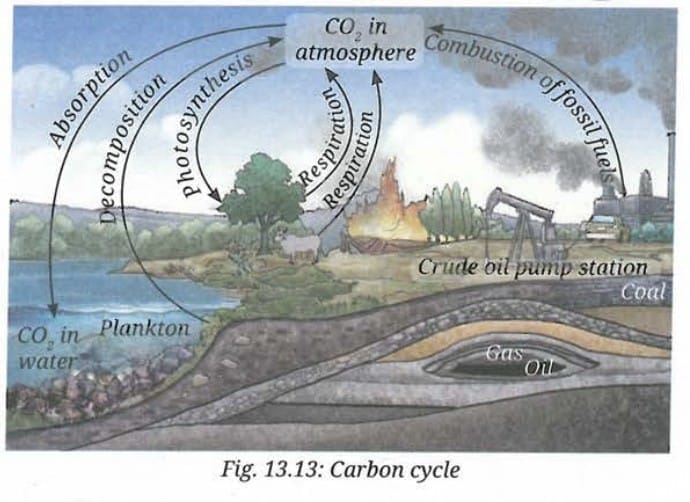
Q10: Why is an excess of CO₂ in the atmosphere considered undesirable even though it is required by plants?
Answer: Although CO₂ is essential for plants to carry out photosynthesis and produce food and oxygen, an excess of CO₂ in the atmosphere is considered undesirable for the following reasons:
1. Greenhouse Effect and Global Warming: CO₂ is a greenhouse gas. While some CO₂ is necessary to keep the Earth warm enough to support life, excessive CO₂ traps more outgoing infrared radiation, intensifying the greenhouse effect and causing global warming.
2. Melting of Glaciers and Ice Caps: Global warming due to excess CO₂ causes glaciers and polar ice to melt, raising sea levels and threatening coastal cities and low-lying areas.
3. Extreme Weather: Excess CO₂ leads to more extreme weather conditions - intense monsoons, droughts, storms and floods - disrupting agriculture and ecosystems.
4. Ocean Acidification: The oceans absorb excess CO₂, making sea water more acidic. This threatens marine organisms, particularly plankton and coral reefs, disrupting marine ecosystems.
5. Biodiversity Loss: Changes in climate and ocean acidity lead to habitat loss and the extinction of many species.
6. Reduced Absorption by Oceans: Warmer ocean water (caused by global warming) reduces the ocean's capacity to absorb CO₂ as an effective carbon sink, creating a further imbalance.
Thus, while some CO₂ is necessary for life, an excess creates an imbalance in the Earth's system, causing irreversible damage to the climate, ecosystems and life on Earth.
Q11: How is heat lost from the surface of the Earth? What is its significance?
Answer:
How heat is lost from the Earth's surface:
The Earth's surface absorbs solar radiation (mainly visible and infrared light) and warms up. This stored heat is then lost from the surface in the following ways:
1. Re-radiation (Infrared Radiation): The warmed Earth's surface re-radiates heat back into the atmosphere in the form of infrared (IR) radiation. This is the primary way heat is lost from the surface.
2. Trapping by Greenhouse Gases: A portion of this outgoing infrared radiation is trapped by greenhouse gases (CO₂, CH₄, water vapour) in the atmosphere, which prevents all the heat from escaping into space.
3. Reflection: Some solar radiation is reflected back by clouds, ice, snow and light-coloured surfaces (high albedo surfaces) without being absorbed.
4. Conduction and Convection: Heat is also transferred from the surface to the atmosphere through conduction (direct contact) and convection (movement of warm air upward).
Significance:
- The re-radiation of heat and its partial trapping by greenhouse gases maintains the Earth's average surface temperature at approximately 15 °C, which is warm enough to support life. Without this process, the Earth would be too cold.
- The uneven loss of heat from different parts of the Earth's surface (due to differences in albedo, latitude, land vs. water) drives the atmospheric and oceanic circulation, generating winds, ocean currents and weather patterns.
- However, excess heat retention due to increased greenhouse gases leads to global warming, which has serious consequences for climate, sea levels and biodiversity.
Q12: If the Earth were a flat disc instead of a sphere, how would the patterns of solar radiation and temperature be different?
Answer: If the Earth were a flat disc instead of a sphere, the following differences would be observed in solar radiation and temperature patterns:
1. Uniform Distribution of Solar Radiation: On a flat disc, if the surface faced directly toward the Sun, solar radiation would strike the surface at the same angle everywhere (perpendicular). This means all parts of the flat disc would receive the same intensity of solar radiation. There would be no variation in insolation due to latitude as there is on a spherical Earth.
2. No Polar-Equatorial Temperature Difference: On a spherical Earth, the equatorial regions receive more concentrated solar radiation (direct rays) while the polar regions receive slanted rays spread over a larger area, causing temperature differences. On a flat disc, this difference would not exist if the entire surface received radiation at the same angle.
3. No Seasons: Seasons occur on Earth due to the tilt of the Earth's spherical axis during its orbit around the Sun. On a flat disc, the concept of seasons as we experience them would not exist in the same way.
4. No Planetary Winds and Ocean Currents as We Know Them: Planetary winds and ocean currents are driven by the temperature differences between the equator and the poles on a sphere. Without this temperature gradient, the pattern of global winds and ocean currents would be entirely different and would not follow the belt-like system seen on a spherical Earth.
5. Different Weather Patterns: The formation of pressure belts, trade winds, westerlies and polar winds - all of which depend on the spherical shape and resulting temperature gradients - would not form in the same way. Weather patterns would be fundamentally different.
6. Uniform Temperature (Theoretically): In an idealised scenario where the flat disc faced the Sun directly, temperatures could be more uniform across the surface. However, the edges of the disc would receive radiation at much more oblique angles, becoming cooler - similar to polar regions.
Q13: Suppose there is a rise in atmospheric temperature on Earth. How would this affect the cryosphere, hydrosphere and biosphere?
Answer:
Effect on Cryosphere:
- A rise in atmospheric temperature would cause glaciers and polar ice caps (cryosphere) to melt at a faster rate.
- The snow cover in mountain regions like the Himalayas and Ladakh would reduce.
- This would lead to a loss of the Earth's natural frozen water reserves.
Effect on Hydrosphere:
- The melting of glaciers and polar ice would add more water to rivers, initially increasing their flow and potentially causing flooding in the short term.
- In the long run, as glaciers disappear, the rivers fed by them would receive less water, particularly during the dry season.
- Sea levels would rise significantly, threatening coastal areas and low-lying regions.
- The increased temperature would cause more evaporation, altering the water cycle - causing more intense rainfall in some areas and droughts in others.
- The oceans would become warmer and less able to absorb CO₂, leading to ocean acidification, harming marine life.
Effect on Biosphere:
- Habitat loss would occur as glaciers melt and sea levels rise, flooding coastal ecosystems and destroying the habitats of many species.
- Warmer temperatures would affect the distribution of species - many species may be forced to migrate to cooler regions or face extinction.
- Coral reefs would be threatened by both the warmer ocean temperatures (causing coral bleaching) and ocean acidification.
- Changes in rainfall patterns would affect agriculture, threatening food security.
- Ecosystems such as mangroves, forests, wetlands and polar habitats would be severely disrupted, causing a loss of biodiversity.
- The biosphere as a whole would face widespread disruption as the delicate balance of the Earth system is disturbed.
Q14: Explain how the Earth's atmosphere helps in maintaining a suitable temperature for life to survive on the Earth.
Answer: The Earth's atmosphere helps maintain a suitable temperature for life in the following ways:
1. Filtering Harmful Radiation:
- The ozone layer in the stratosphere absorbs most of the harmful short wavelength UV radiation from the Sun, protecting life from its damaging effects (skin cancer, eye damage, harm to ecosystems).
- Gamma rays and X-rays are also mostly filtered by the Earth's upper atmosphere, preventing these high-energy, harmful radiations from reaching the surface.
2. Greenhouse Effect (Trapping Outgoing Heat):
- The Earth's surface absorbs solar radiation and re-radiates it as infrared (heat) radiation into the atmosphere.
- Greenhouse gases in the atmosphere - CO₂, CH₄, and water vapour - absorb this outgoing infrared radiation and prevent it from escaping into space.
- This natural greenhouse effect keeps the Earth's average surface temperature at approximately 15 °C, which is warm enough to support life.
- Without the atmosphere, the Earth would be too cold (approximately -18 °C) for life to survive.
3. Redistribution of Heat:
- The atmosphere helps redistribute heat across the globe through winds and atmospheric circulation. This prevents extreme temperature differences and maintains a climate range suitable for life in many regions.
4. Water Cycle:
- The atmosphere is an essential part of the water cycle, holding water vapour and enabling precipitation. This ensures fresh water is available for life on land.
5. Protection from Meteoroids:
- The atmosphere burns up most meteoroids before they can reach the surface, protecting life from impacts.
Thus, the atmosphere acts as both a protective shield and a heat regulator, maintaining conditions that are essential for life on Earth.
Q15: Describe the interrelationship between different spheres of the Earth. Illustrate with example how these spheres function in a delicate balance.
Answer:
Interrelationship Between the Earth's Spheres:
The Earth system is made up of five interacting spheres - the geosphere, hydrosphere, cryosphere, atmosphere and biosphere. These spheres are not isolated; they are continuously interacting and exchanging energy and matter. A change in one sphere inevitably affects the others.
How the Spheres are Interrelated:
- The atmosphere receives water vapour from the hydrosphere (evaporation) and the biosphere (transpiration). This moisture returns to the surface as precipitation.
- The cryosphere (glaciers and ice) stores fresh water and releases it slowly into the hydrosphere (rivers and oceans).
- The geosphere (soil and rocks) provides minerals to the hydrosphere (rivers dissolve minerals) and the biosphere (plants absorb nutrients from soil).
- The biosphere depends on the atmosphere for oxygen and CO₂, on the hydrosphere for water, on the geosphere for nutrients, and interacts with all other spheres.
- Biogeochemical cycles (water cycle, carbon cycle, nitrogen cycle, oxygen cycle) are the mechanisms through which matter and energy are exchanged between all spheres.
Example Illustrating Delicate Balance:
Consider the interconnection involving warmer Arabian Sea water:
- Warmer Arabian Sea (hydrosphere) leads to more evaporation.
- This increases moisture in the atmosphere, causing fluctuations in the southwest monsoon.
- This results in variability in rainfall - floods in some regions and drought in others - disrupting the hydrosphere.
- The rise in atmospheric temperature accelerates the melting of glaciers and polar ice (cryosphere), raising sea levels.
- Flooding of low-lying regions and habitat loss disturbs the biosphere (ecosystems and species).
- Changes in rainfall affect the geosphere through increased soil erosion and altered groundwater levels.
This example shows that a change in the temperature of a part of the hydrosphere (Arabian Sea) can set off a chain of events affecting the atmosphere, cryosphere, geosphere and biosphere - demonstrating how all spheres function in a delicate balance. If one sphere is disturbed significantly, the balance of the entire Earth system is disrupted, with consequences for all life on Earth.
Human activities that disturb this balance - through burning fossil fuels, deforestation and overuse of resources - can trigger irreversible changes across all spheres, highlighting the importance of sustainable living and conservation.
FAQs on NCERT Solutions: Earth as a System: Energy, Matter, and Life
| 1. What are the main components of the Earth as a system? |  |
| 2. How does energy flow through the Earth's systems? | |
| 3. What role does matter play in the Earth's systems? | |
| 4. How does life interact with energy and matter on Earth? | |
| 5. What is the significance of understanding Earth as a system? | |

