CBSE Class 9 > Class 9 Notes > Science New NCERT 2026-27 (New Syllabus) > Mind Map: Cell: The Building Block of Life
Mind Map: Cell: The Building Block of Life

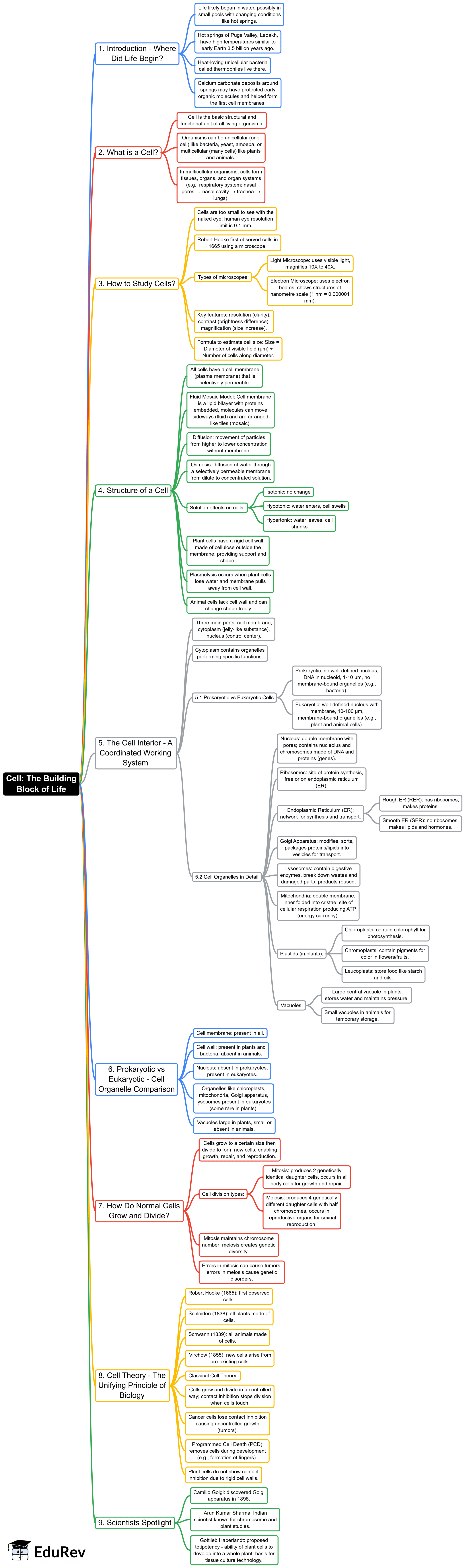
The document Mind Map: Cell: The Building Block of Life is a part of the Class 9 Course Science Class 9 New NCERT 2026-27 (New Syllabus).
All you need of Class 9 at this link: Class 9
FAQs on Mind Map: Cell: The Building Block of Life
| 1. What are the main components of a cell? |  |
Ans. The main components of a cell include the cell membrane, cytoplasm, and nucleus. The cell membrane acts as a protective barrier, the cytoplasm is the jelly-like substance where cellular processes occur, and the nucleus contains the genetic material, DNA, which controls cell activities.
| 2. What is the difference between prokaryotic and eukaryotic cells? | |
Ans. Prokaryotic cells are simpler and smaller, lacking a true nucleus and membrane-bound organelles. They are generally unicellular organisms, such as bacteria. Eukaryotic cells, on the other hand, are larger and more complex, containing a true nucleus and various membrane-bound organelles, and can be unicellular or multicellular, such as plants and animals.
| 3. How do cells obtain energy? | |
Ans. Cells obtain energy primarily through the process of cellular respiration, where glucose and oxygen are converted into carbon dioxide, water, and energy (ATP). In plants, energy is also obtained through photosynthesis, where sunlight is converted into chemical energy stored in glucose.
| 4. What role do organelles play in a cell? | |
Ans. Organelles are specialised structures within a cell that perform specific functions necessary for the cell's survival and operation. For example, mitochondria are responsible for energy production, ribosomes are involved in protein synthesis, and the endoplasmic reticulum assists in the production and transport of proteins and lipids.
| 5. Why is the cell membrane important? | |
Ans. The cell membrane is crucial because it regulates what enters and exits the cell, thus maintaining homeostasis. It provides structural support and protection, and it facilitates communication between cells through receptors that respond to external signals.
About this Document

4.90/5 Rating

Apr 25, 2026 Last updated
Related Exams
Document Description: Mind Map: Cell: The Building Block of Life for Class 9 2026 is part of Science Class 9 New NCERT 2026-27 (New Syllabus) preparation. The notes and questions for Mind Map: Cell: The Building Block of Life have been prepared according to the Class 9 exam syllabus. Information about Mind Map: Cell: The Building Block of Life covers topics like and Mind Map: Cell: The Building Block of Life Example, for Class 9 2026 Exam. Find important definitions, questions, notes, meanings, examples, exercises and tests below for Mind Map: Cell: The Building Block of Life.
Introduction of Mind Map: Cell: The Building Block of Life in English is available as part of our Science Class 9 New NCERT 2026-27 (New Syllabus) for Class 9 & Mind Map: Cell: The Building Block of Life in Hindi for Science Class 9 New NCERT 2026-27 (New Syllabus) course. Download more important topics related with notes, lectures and mock test series for Class 9 Exam by signing up for free. Class 9: Mind Map: Cell: The Building Block of Life
Description
Mind Map: Cell: The Building Block of Life of Science Class 9 New NCERT 2026 provides you one-page visual summary of the chapter covering all the important topics. Download the PDF from EduRev.
Information about Mind Map: Cell: The Building Block of Life
In this doc you can find the meaning of Mind Map: Cell: The Building Block of Life defined & explained in the simplest way possible. Besides explaining types of Mind Map: Cell: The Building Block of Life theory, EduRev gives you an ample number of questions to practice Mind Map: Cell: The Building Block of Life tests, examples and also practice Class 9 tests



Related Searches
Summary, Mind Map: Cell: The Building Block of Life, Mind Map: Cell: The Building Block of Life, Mind Map: Cell: The Building Block of Life, Viva Questions, Previous Year Questions with Solutions, Exam, Extra Questions, ppt, mock tests for examination, practice quizzes, Semester Notes, video lectures, Important questions, Free, Objective type Questions, shortcuts and tricks, past year papers, pdf , Sample Paper, study material, MCQs;