Case Based Questions: Patterns in Mathematics

Q1: Read the source and answer the question that follows
In a newly constructed hotel, a painter was assigned to decorate its 96 walls using a specific stripe pattern for aesthetic appeal. Each wall was to be painted in a repeating sequence of 2 blue stripes followed by 4 red stripes. The hotel owner wanted the pattern consistent throughout the building, making accurate pattern calculation essential for error-free decoration.

Q1.How many blue stripes will be needed?
Ans. 32 blue stripes
Explanation: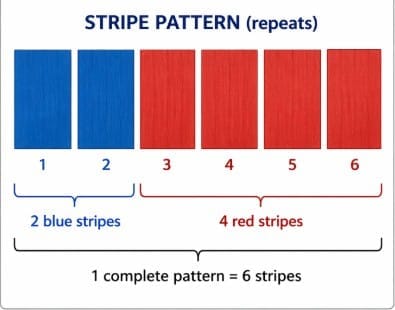
Pattern unit: 2 blue + 4 red = 6 stripes
96 ÷ 6 = 16 sets
16 sets × 2 = 32 blue stripes
Q2.How many red stripes will be needed?
Ans.64 red stripes
Explanation:16 sets × 4 = 64 red stripes
Q3.Which stripe color will be at 95th position?
Ans.Red
Explanation: 95 ÷ 6 = 15 sets, remainder 5
In a set: First 2 are blue, next 4 are red.
Remainder 5 → 2 blue + 3 red.
So, 95th stripe is red
Q4.Why is pattern understanding important in such work?
Ans.Pattern understanding avoids error in design.
Q2: Read the source and answer the question that follows
Patterns can become more intricate as we explore them further. In mathematics, patterns can follow multiple rules, combining arithmetic, geometric, and even shape-based changes. Recognizing patterns requires careful observation and analysis of the relationship between the numbers, objects, or shapes.
For example, consider the number pattern:
2, 5, 10, 17, 26, ...
Here, the difference between consecutive numbers is increasing. To get from 2 to 5, we add 3. To get from 5 to 10, we add 5. To get from 10 to 17, we add 7, and so on. This is an example of a pattern where the differences between numbers increase by a constant amount.
Now, let's look at a shape pattern:
○, △, □, ○○, △△, □□, ...
In this sequence, not only are the shapes repeating, but each shape is doubling in number as the pattern progresses. Such patterns combine both geometric growth and alternating shapes.
Q1. In the pattern 2, 5, 10, 17, 26, __, __, find the next two numbers in the sequence. Explain the rule.
Ans. 37, 50
Explanation:To understand the pattern, look at the differences between consecutive terms:
5 - 2 = 3
10 - 5 = 5
17 - 10 = 7
26 - 17 = 9
The differences are increasing by 2 each time: 3, 5, 7, 9, ...
So the next differences will be:
11 and 13
Now continue the pattern:
26 + 11 = 37
37 + 13 = 50
Next two numbers: 37, 50
Rule: Add consecutive odd numbers (3, 5, 7, 9, 11, 13, ...) to get the next terms in the sequence.
Q2. A pattern starts with 1 and follows this rule: multiply the number by 2, then subtract 1 to get the next number. Write the first five numbers of the sequence.
Ans. 1, 1, 1, 1, 1
Explanation:
A pattern starts with 1 and follows this rule:
Multiply the number by 2, then subtract 1 to get the next number.
Let's apply the rule step by step:
First Number: 1
Second Number: (1 × 2) - 1 = 2 - 1 = 1
Third Number: (1 × 2) - 1 = 1
Fourth Number: (1 × 2) - 1 = 1
Fifth Number: (1 × 2) - 1 = 1
First five numbers:
1, 1, 1, 1, 1
Q3. Identify the next two shapes in the following pattern:
○, △, □, ○○, △△, □□, ○○○, __, __.
Ans. △△△, □□□
Explanation: This pattern alternates between circles (○), triangles (△), and squares (□). The number of shapes increases by 1 in each set.
First: ○ (1 circle)
Second: △ (1 triangle)
Third: □ (1 square)
Fourth: ○○ (2 circles)
Fifth: △△ (2 triangles)
Sixth: □□ (2 squares)
Seventh: ○○○ (3 circles)
Following this alternating pattern:
Eighth: △△△ (3 triangles)
Ninth: □□□ (3 squares)
The next two shapes in the pattern are △△△ (3 triangles) and □□□ (3 squares).
Q4. Find the missing numbers in the pattern: The differences are increasing by 3: 6, 9, ... So the next differences will be: Now continue the pattern: Missing number: 30 Rule: Add increasing multiples of 3 (6, 9, 12, 15, 18, ...) to get the next terms in the sequence. Q5. The first number in a pattern is 4, and the rule is to add 4 to the number, then multiply the result by 2 to get the next number. Write the first four numbers of the pattern. First number = 4 Second number: Third number: Fourth number: First four numbers: Arjun and Meera were doing their maths homework together. Arjun noticed something interesting while adding odd numbers. "Meera, look at this!" he said excitedly and wrote on his notebook: 1 = 1 1 + 3 = 4 1 + 3 + 5 = 9 1 + 3 + 5 + 7 = 16 1 + 3 + 5 + 7 + 9 = 25 "Do you see the pattern?" asked Arjun. Meera looked carefully and said, "Oh! The answers are 1, 4, 9, 16, 25 - these are all square numbers!" Arjun smiled and said, "Exactly! When we add odd numbers starting from 1, we always get a square number. And the answer is the square of how many odd numbers we added. So if we add the first 6 odd numbers, the answer should be 6 × 6 = 36!" Meera was amazed. "So the sum of the first 10 odd numbers will be 10 × 10 = 100?" "Yes!" said Arjun. They were both delighted to discover this beautiful pattern in mathematics. Q1. What do you get when you add the first 4 odd numbers: 1 + 3 + 5 + 7? Ans. Option (c) is correct. Q2. According to the pattern discovered by Arjun, what is the sum of the first 6 odd numbers? Ans. Option (c) is correct. Q3. Which sequence do the answers 1, 4, 9, 16, 25, 36, ... belong to? (a) Triangular numbers Ans. Option (d) is correct. Q4. Meera guessed that the sum of the first 10 odd numbers is 100. Is she correct? How does the pattern help us find this answer without adding all numbers? Ans. Yes, Meera is correct. The sum of the first 10 odd numbers is 10 × 10 = 100. The pattern tells us that when we add the first n odd numbers starting from 1, the answer is always n × n (a square number). So instead of adding 1 + 3 + 5 + 7 + 9 + 11 + 13 + 15 + 17 + 19, we can directly say the answer is 10 × 10 = 100. This is how patterns in mathematics help us solve problems quickly.
3, 9, 18, __, 45, 63. Identify the rule.
Ans. 30
Explanation: Look at the differences between consecutive terms:
9 - 3 = 6
18 - 9 = 9
12, 15, 18
18 + 12 = 30
30 + 15 = 45
45 + 18 = 63
Ans. 4, 16, 40, 88
Explanation: Start with the first number and apply the rule step by step:
4 + 4 = 8
8 × 2 = 16
16 + 4 = 20
20 × 2 = 40
40 + 4 = 44
44 × 2 = 88
4, 16, 40, 88Q3: Read the source and answer the question that follows
(a) 12
(b) 14
(c) 16
(d) 18
Explanation: 1 + 3 + 5 + 7 = 16, which is 4 × 4. Adding the first 4 odd numbers gives the square of 4.
(a) 25
(b) 30
(c) 36
(d) 42
Explanation: The sum of the first n odd numbers = n × n. So the sum of the first 6 odd numbers = 6 × 6 = 36.
(b) Cube numbers
(c) Even numbers
(d) Square numbers
Explanation: 1, 4, 9, 16, 25, 36 are square numbers - they are formed by multiplying a number by itself (1×1, 2×2, 3×3, ...).
FAQs on Case Based Questions: Patterns in Mathematics
| 1. What are patterns in mathematics? |  |
| 2. How can we identify number patterns? | |
| 3. What is the significance of patterns in problem-solving? | |
| 4. Can you give an example of a simple shape pattern? | |
| 5. How do patterns relate to real-life situations? | |