Case Based Questions: Lines and Angles

Q1: Read the source and answer the question that follows
Kabir organized a fun classroom challenge during the mathematics exhibition where students had to guess the angles formed between the hour and minute hands of a clock at different times. He asked everyone to calculate the exact angle at specific hours without using a protractor. For example, at 2:00 PM, the angle formed is x°, and at 4:00 PM, the angle formed is y°.
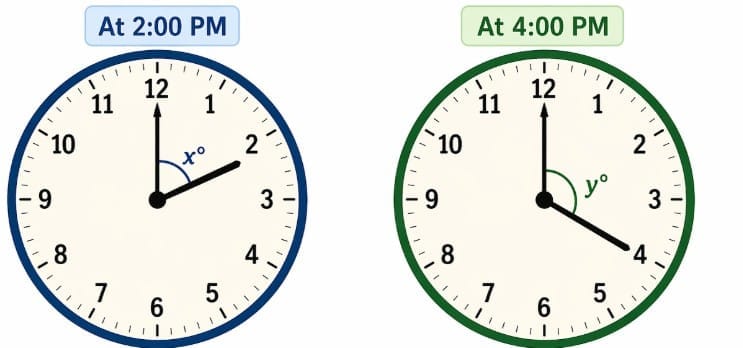
Q1. Find the values of x and y.
Ans. 60° , 120°
Explanation:
At 2:00 PM:
Angle = 2 × 30° = 60°
At 4:00 PM:
Angle = 4 × 30° = 120°
Q2.Which angle is greater?
Ans. 120° > 60°, so angle at 4:00 PM is greater
Q3.Are both angles acute, right, or obtuse?
Ans. 60° = acute ,120° = obtuse
Q4.Draw and label both clock faces showing the angles.
Ans.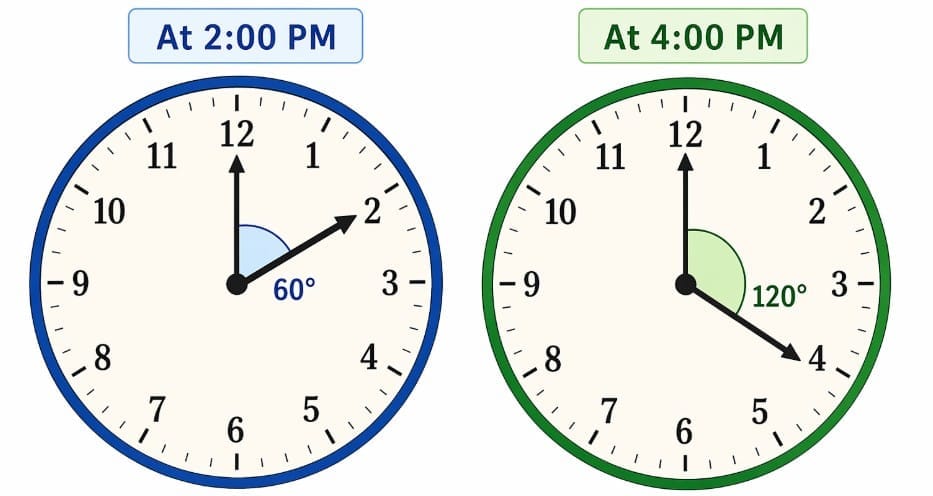
Q2: Read the source and answer the question that follows
Joy learns the art of knitting from his grandmother.
Q1. Which of the following pictures can be an example of a line segment?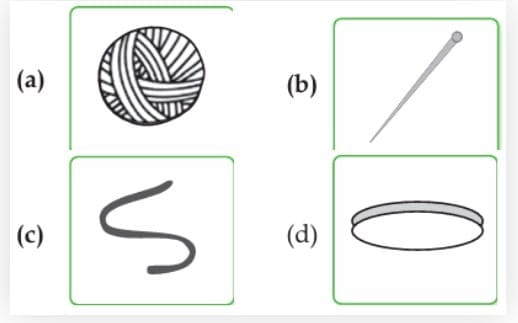
Ans. Option (b) is correct
Q2. How many lines can pass through a point?
Ans. Infinite lines
Q3. Which of the following is an open curve?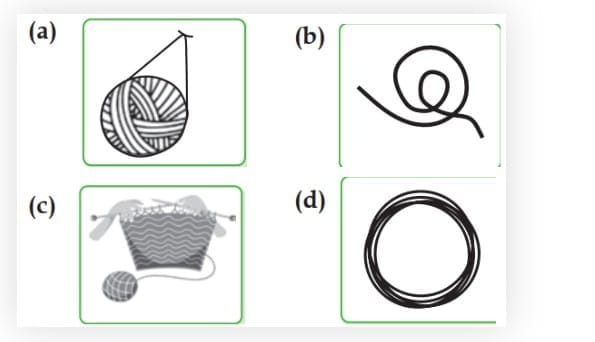
Ans. Option(b) is correct
Q3: Read the source and answer the question that follows
In a school science lab, students were conducting an experiment related to angles and light. To observe the effect of sunlight, a window shade was initially pulled open, forming an angle of 95° with the wall. As the intensity of light needed to be increased, the shade was pulled further, creating a larger obtuse angle of 185°. This setup helped students understand how angles can influence light entry.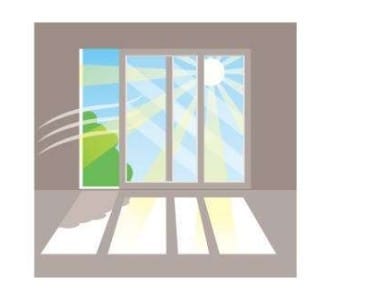
Q1. What types of angles are these?
Ans. 95° = obtuse, 185° = reflex
Q2. How many degrees was the increase?
Ans. Change in angle = 185° - 95° = 90°
Q3. Draw both positions of the shade.
Ans. Draw two diagrams with same vertex and two different rays showing each position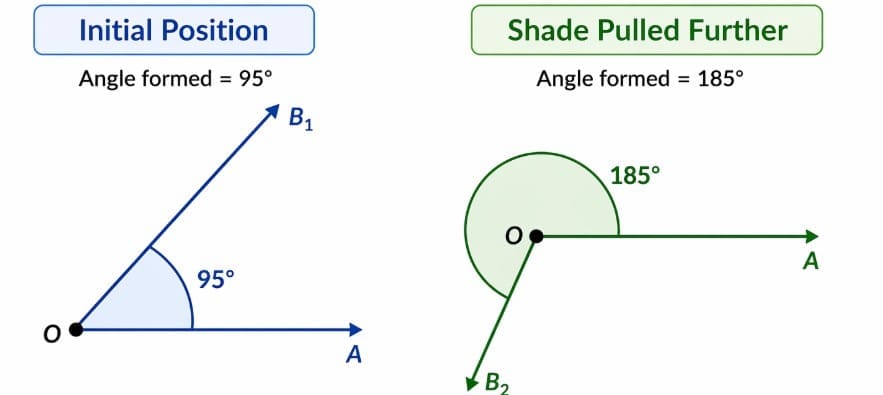
Q4. What type of angle will it be if the shade turns 270°?
Ans. If the shade turns 270°, the angle = reflex angle
FAQs on Case Based Questions: Lines and Angles
| 1. What are complementary angles? |  |
| 2. How do we define supplementary angles? | |
| 3. What is the significance of a transversal in geometry? | |
| 4. Can you explain what vertically opposite angles are? | |
| 5. What is the sum of angles in a triangle? | |