NCERT Based Activity: Tissues in Action


Activity 3.1: Let us design experiments
- Take two glass jars or couplin jars and fill them with water.
- Now, take two onion bulbs and place one in each jar, as shown in Fig.
- Observe the growth of roots in both bulbs for a few days.
- Measure the length of roots on days 1, 2 and 3.
- On day 3, cut the root tips of the onion bulb in Jar B by about 1 cm. After this, observe the growth of roots in both jars, measure their lengths for four more days (day 4 onwards), and record your observations in Table .
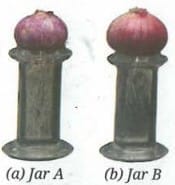 Experimental set-up to observe the growth of roots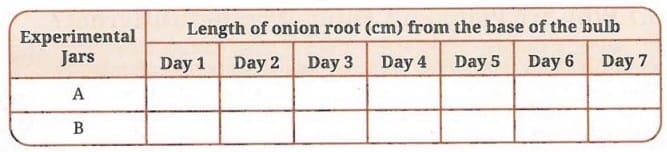
Table : Experimental data
| Experimental Jars | Day 1 | Day 2 | Day 3 | Day 4 | Day 5 | Day 6 | Day 7 |
|---|---|---|---|---|---|---|---|
| A | 0.5 cm | 1.2 cm | 2.0 cm | 2.8 cm | 3.6 cm | 4.4 cm | 5.2 cm |
| B | 0.5 cm | 1.1 cm | 1.9 cm | 1.9 cm | 1.9 cm | 1.9 cm | 1.9 cm |
(Note: Root tips of Jar B are cut on Day 3. Values are representative/approximate.)
Observation:
- Roots in Jar A continue to grow steadily in length throughout all 7 days.
- Roots in Jar B grow at a similar rate to Jar A on Days 1, 2 and 3, but stop growing completely after the root tips are cut on Day 3.
- The graph of Jar A shows a continuously rising straight line, while Jar B shows a flat plateau from Day 3 onwards.
Explanation:
Roots grow only from their tips. The root tips consist of cells which divide continuously. These actively dividing cells at the tip form the apical meristem. When the tips of the roots in Jar B are cut, the apical meristematic tissue is removed and the roots can no longer grow in length. The roots in Jar A, with tips intact, continue to grow. This confirms that plants have growth zones at the tips of their roots and shoots, called the apical meristems, which help the plants grow in length.
This activity demonstrates the role of apical meristematic tissue in the lengthwise growth of plant roots.
Activity 3.2: Let us understand further
- Recall everyday experiences given in the first column of Table .
- Write your observations and questions in your notebook.
- Compare your observations with the observations given in Table .
Table : Your experiences, observations and questions from daily life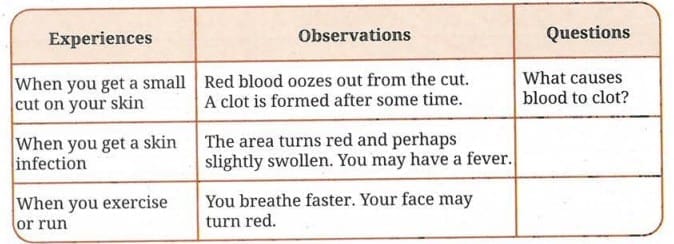
Observation:
| Experiences | Observations | Questions |
|---|---|---|
| When you get a small cut on your skin | Red blood oozes out from the cut. A clot is formed after some time. | What causes blood to clot? |
| When you get a skin infection | The area turns red and perhaps slightly swollen. You may have a fever. | What causes redness and swelling at the site of infection? |
| When you exercise or run | You breathe faster. Your face may turn red. | Why does breathing rate increase and face turn red during exercise? |
- A small cut on the skin results in red blood oozing out, followed by clot formation after some time. This indicates the presence of clotting agents in blood.
- A skin infection causes redness and swelling at the affected area, sometimes accompanied by fever. This indicates the body's immune response.
- During exercise or running, the breathing rate increases and the face turns red due to increased blood flow.
Explanation:
The everyday experiences mentioned above are related to blood and its components:
- The red colour of blood is due to haemoglobin, an iron-rich protein in the Red Blood Cells (RBCs). RBCs live for about 4 months and are replaced regularly.
- Platelets help in blood clotting at the site of injury, preventing excessive blood loss.
- During exercise or running, muscles need more oxygen, so breathing becomes faster and blood flow increases (face appears red).
- White Blood Cells (WBCs) collect at infected areas, causing inflammation (redness and swelling) and possible pus formation and fever at the infected area.
This activity demonstrates how blood functions as a connective tissue, with its various components - RBCs, WBCs and platelets - performing specific and coordinated functions in the body.
Activity 3.3: Let us perform
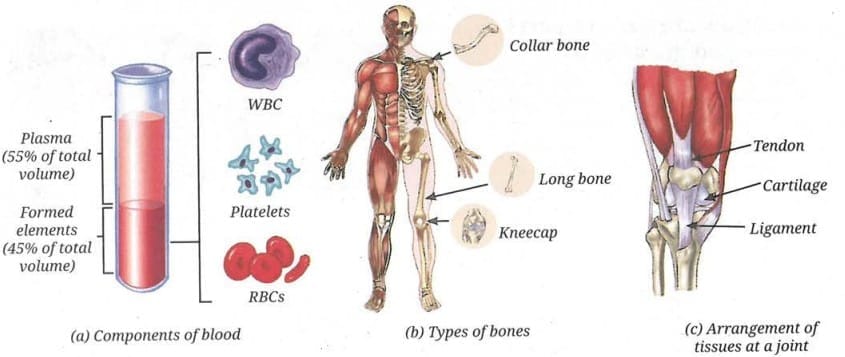
- Perform the actions given in Table .
- Record your experiences and compare them with the experiences given in Table .
- Study their functions and identify the connective tissues (Fig. ).
Table : Connective tissues
| Action | Experience | Function | Identified connective tissue |
|---|---|---|---|
| Touch your elbow gently | A hard and rigid structure | Gives strength, support and protection | Bone (Fig. b) |
| Press and fold your ear or gently press your nose and stop | A soft and flexible structure that retains shape again | Provides flexibility and cushions the ends of bones for shock absorption | Cartilage (Fig. c) |
| Touch your forearm muscles and wiggle your fingers | Feel movement in the forearm even though fingers are far away | Connects muscle to bone, and thus, brings about movement | Tendon (Fig. c) |
| Sit on a chair and move your leg upwards till your knee allows | The joint does not go beyond a limit | Connects bone to bone and provides stability, limits movement, and helps prevent dislocation | Ligament (Fig. c) |
Observation:
- Touching the elbow feels hard and rigid, indicating the presence of bone, which provides structural strength and protection to the body.
- The ear and nose feel soft and flexible, and return to their original shape when released, indicating the presence of cartilage, which provides cushioning and flexibility.
- Touching the forearm muscles while wiggling fingers shows that movement is transmitted from the muscles even to distant parts, indicating the role of tendons in connecting muscles to bones.
- The knee joint stops movement at a fixed limit, indicating the role of ligaments in connecting bones and preventing excessive or dislocating movement.
Explanation:
Bones have a rigid matrix containing calcium and phosphorus compounds, giving them strength and rigidity. In contrast, cartilage has a soft, jelly-like matrix and provides flexibility and cushioning. Tendons connect muscles to bones, while ligaments connect bones to bones and prevent excessive movement (Fig. c).
This activity demonstrates the functions of the four major connective tissues of the human body - bone, cartilage, tendon and ligament - through simple everyday physical actions.
Activity 3.4: Let us investigate
What percentage of total body weight comes from bones and muscles?
- Step on a weighing scale and record your total body weight.
- Use online references or health resources to find average bone and muscle mass percentage for your age, gender, and an Indian body type (these may vary by ethnicity). For example, on average, adult males have about 40-50 per cent muscle, and adult females have approximately 30-40 per cent muscle, although bone mass is about 12-15 per cent for all adults.
- Multiply your total body weight by the bone percentage and muscle percentage to estimate the weight of your bones and muscles.
- Record the estimated bone weight and muscle weight, and compare them with your total body weight.
- Compare your findings with those of your classmates and calculate the class average.
Discuss why bone and muscle mass differ between individuals, and how they contribute to the overall body weight.
Observation:
- Each student's estimated bone mass is approximately 12-15% of their total body weight.
- Estimated muscle mass is approximately 40-50% in males and 30-40% in females.
- Total bone + muscle mass accounts for roughly 50-65% of the total body weight in most students.
- Comparison with classmates shows variation in bone and muscle mass percentages based on age, gender, physical activity levels and body composition.
- The class average helps identify the typical range for the group and highlights individual differences.
Explanation:
Bones and muscles together form a major part of total body weight. Bones are composed of a rigid matrix containing calcium and phosphorus, while muscles are made up of bundles of long, cylindrical cells called muscle fibres. The musculoskeletal system - consisting of bones, muscles, joints, cartilage, tendons and ligaments - helps the body stand upright, move, maintain posture and protect delicate organs. The adult human skeleton makes up about 12-15 per cent of body weight, though this can vary with age, gender and body composition.
This activity helps students understand the significant contribution of bones and muscles to total body weight, and highlights the importance of maintaining a healthy musculoskeletal system through proper nutrition and exercise.
Activity 3.5: Let us observe
Move different parts of your body and observe what movement(s) each part can make.
Table : Different types of movements our body can make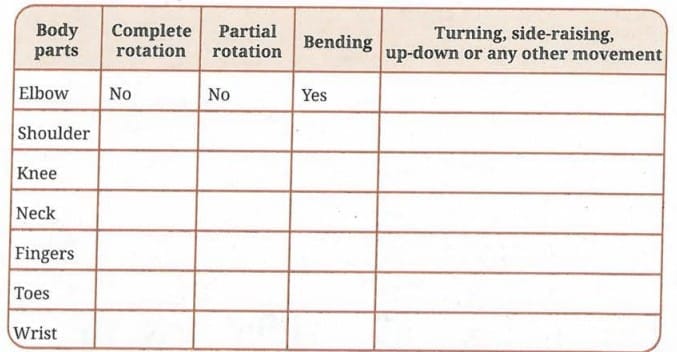
Observation:
| Body parts | Complete rotation | Partial rotation | Bending | Turning, side-raising, up-down or any other movement |
|---|---|---|---|---|
| Elbow | No | No | Yes | No |
| Shoulder | Yes | Yes | Yes | Yes - forward, backward, sideways, circular |
| Knee | No | No | Yes | No |
| Neck | No | Yes | Yes | Yes - side to side turning |
| Fingers | No | No | Yes | Partial sideways spreading |
| Toes | No | No | Yes | Slight sideways spreading |
| Wrist | No | Yes | Yes | Yes - side to side, up-down rotation |
- The elbow can only bend in one direction - it cannot rotate. This is because it has a hinge joint.
- The shoulder allows the widest range of movements - complete rotation, bending, forward, backward and sideways movements. This is due to the ball and socket joint.
- The knee can only bend and straighten in one direction, similar to the elbow - also a hinge joint.
- The neck can turn side to side and bend, but cannot make a full rotation. This is due to the pivot joint, which connects the skull to the backbone.
- Fingers and toes can only bend and straighten, with slight sideways spreading - they have hinge-type joints.
- The wrist allows partial rotation and bending in multiple directions - it has a condyloid joint.
Explanation:
Some parts of the body can move easily in many directions, while others move only in a single direction. This difference is due to the type of joint present. A joint is a junction between two or more bones. Joints allow movement, but the muscles attached to the bones produce the actual movement.
- Ball and socket joint (e.g., shoulder): The rounded top of the bone fits into a hollow of another bone. Allows widest movement - forward, backward, sideways and circular.
- Hinge joint (e.g., elbow, knee): Allows movement in one direction only, like a door hinge.
- Pivot joint (e.g., neck): Allows the head to move side to side, like a doorknob turning in its socket.
- Fixed joint (e.g., skull): Bones are fused together and cannot move, protecting the brain.
This activity demonstrates how the type of joint determines the range and direction of movement of each body part, and how the musculoskeletal system coordinates muscles, bones and joints to produce precise and controlled movement.
Think as a Scientist
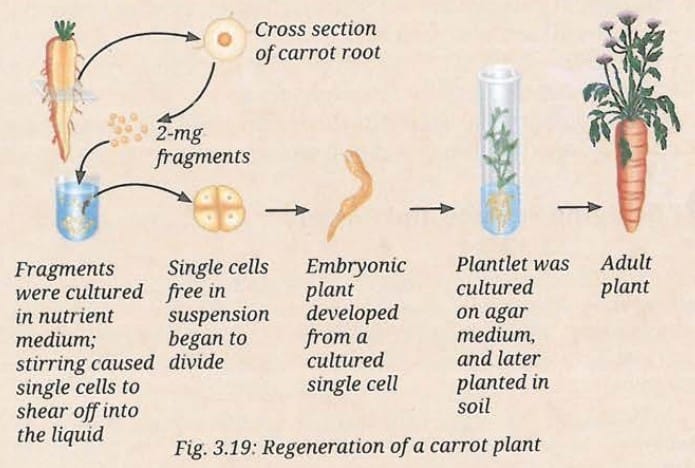
In F. C. Steward experiment on phloem cells of carrot, he used different combinations of nutrients and other factors, and obtained the following results.
Table 3.6: Effect of light, air and nutrient medium on growth of cultured plant cells
| Light | Air | Composition of Nutrient Medium | Increase in fresh weight (mg) from initial weight |
|---|---|---|---|
| ✓ | ✗ | Solid medium + nutrients | Reduced |
| ✓ | ✓ | Liquid medium + nutrients | 20% increased |
| ✗ | ✓ | Liquid medium + nutrients | Reduced |
(a) What do you conclude about the characteristics of phloem cells of carrot?
Ans. Phloem cells of carrot are totipotent - they retain the genetic information and capability to dedifferentiate into an undifferentiated callus mass and then redifferentiate into a complete, functional plant. This shows that even mature, specialised cells can reverse their differentiation under appropriate conditions.
(b) Which combination gives highest and lowest biomass? Possible reasons?
Ans. Highest biomass: Light ✓ + Air ✓ + Liquid medium + nutrients → 20% increase
- Reason: Light enables photosynthesis, air provides CO₂ and O₂, and the liquid medium ensures better nutrient absorption and gas exchange around cells.
- Lowest biomass: Both Light ✓ + Air ✗ (solid medium) AND Light ✗ + Air ✓ (liquid medium) → Reduced
- Reason: Absence of air prevents aerobic respiration and CO₂ supply; absence of light stops photosynthesis. Either deprivation alone is sufficient to hinder cell growth.
(c) Will you get the same results if you culture animal cells instead of carrot cells?
Ans. No. Animal cells are not totipotent (except the zygote and early embryonic cells). Differentiated animal cells generally cannot dedifferentiate and regenerate a whole organism under nutrient medium conditions. Animal cells also lack cell walls and require very different culture conditions (e.g., serum, CO₂ incubators). The concept of totipotency as demonstrated here is largely characteristic of plant cells.
(d) Two commercial applications of this study:
Ans.
Micropropagation / Clonal propagation: Millions of genetically identical, disease-free plants (e.g., orchids, bananas, potatoes) can be rapidly produced from a small tissue sample for agriculture and horticulture.
Production of disease-free and transgenic plants: Totipotency is exploited in genetic engineering to introduce desired genes into plant cells and then regenerate whole transgenic plants with improved traits (pest resistance, higher yield, etc.).
FAQs on NCERT Based Activity: Tissues in Action
| 1. What are the main types of tissues in plants? |  |
| 2. What is the function of xylem in plants? | |
| 3. How do meristematic tissues differ from permanent tissues? | |
| 4. What roles do phloem play in a plant's life? | |
| 5. Why is the study of plant tissues important? | |