NCERT Based Activity: How Forces Affect Motion


Activity 6.1: Let us investigate
1. Collect four coins of ₹ 10, one large strong rubber band and an adhesive tape. Locate horizontal surfaces of different materials, such as wooden table top, cemented floor, laminated table top, and polished marble or tiled floor (you may also choose other surfaces). Check that the surfaces are levelled.
2. Stack the four coins on top of each other and secure them together with an adhesive tape around the sides.
3. Hold the rubber band slightly stretched between your forefinger and thumb on the wooden table top (Fig. 6.12a). Mark points A and B at its ends as shown in Fig. 6.12b. Make another mark C up to which you will stretch the rubber band.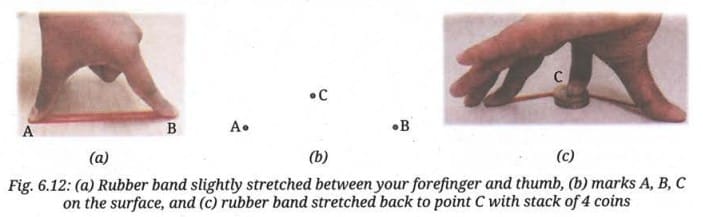
4. Holding the ends of the rubber band at A and B, place the stack of coins near the middle of A and B. Now, using a finger of your other hand, push back the stack of coins till the rubber band is pulled back to the mark C (Fig. 6.12c). Then, release the stack of coins and observe its motion. Do you find that after losing contact with the rubber band, the velocity of the stack of coins decreases gradually and it comes to rest after travelling some distance? Measure the distance travelled from C and record it. Repeat this step twice.
5. Repeat steps 3 and 4 for laminated table top while ensuring that the points A, B and C are marked at the same distances as earlier. Does the stack of coins travel a larger distance than it did on the wooden table top before coming to rest? Does its velocity decrease more slowly now?
6. Next, repeat step 5 on a horizontal polished marble or tile floor. Does the stack of coins travel an even larger distance and its velocity decrease even more slowly? What conclusion do you draw from your observations?
Ans: Observations:
Wooden Table Top: The stack of coins travels a certain distance (e.g., approximately 20-30 cm) before coming to rest. The velocity decreases relatively quickly due to a moderate force of friction.
Laminated Table Top: The stack of coins travels a larger distance (e.g., approximately 35-50 cm) before coming to rest. The velocity decreases more slowly, indicating a smaller force of friction.
Polished Marble or Tile Floor: The stack of coins travels the largest distance (e.g., approximately 55-70 cm) and its velocity decreases most slowly. This indicates the smallest force of friction among the surfaces tested.
Explanation:
Before release, the stack of coins is stationary - the forces acting on it are balanced. Upon release, the force applied by the stretched rubber band in the forward direction on the stack of coins sets it moving. The coins start moving because the force applied by the rubber band is larger than the force of friction and a net force acts on the stack of coins in the forward direction. Due to the net force, the velocity of the stack of the coins changes from zero to a certain value, i.e., the net force provides an acceleration in the forward direction.
However, the moment the stack of coins loses contact with the rubber band, the force due to the rubber band is no longer acting upon it. But the force of friction continues to act upon the stack of coins in the direction opposite to their motion. It gradually decreases its velocity and finally brings it to rest.
Even though the rubber band is stretched by the same amount in each case, the distance travelled by the stack of coins on different surfaces changes. This indicates that the force of friction on these surfaces is different.
Conclusion:
The force of friction depends on the nature of the surfaces in contact. Smoother surfaces (polished marble) have a smaller force of friction, allowing the object to travel farther and slow down more gradually. Rougher surfaces (wooden table top) have a larger force of friction, bringing the object to rest in a shorter distance. When the force of friction is smaller, the velocity of the object decreases more slowly and it travels a larger distance before coming to rest.
Activity 6.2: Let us measure
1. Take a spring balance and a wooden block.
2. Place the spring balance in a horizontal position on one of the surfaces used in Activity 6.1 and check that its scale reading is zero. Attach the wooden block to the hook of the spring balance as shown in Fig. 6.14.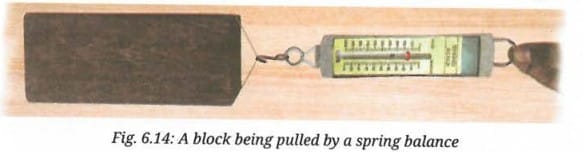
3. Pull the spring balance by gradually increasing force and note down the reading on it when the block just starts moving. What does this reading indicate? The forces acting on the block are the force applied by the spring on it and the force of friction. If the velocity of the block is neither increasing nor decreasing, what can you say about the net force acting on the block? Does the reading of the spring balance indicate the magnitude of the force of friction acting on the wooden block?
4. Now repeat step 3 on the remaining three surfaces from Activity 6.1.
5. Compare the readings of the spring balance for all surfaces. Are the readings different? Is the reading smallest for the surface on which the stack of coins travelled the largest distance? Is the reading largest for which the distance travelled was the smallest?
Ans: Setup:
A spring balance is attached to a wooden block placed on each of the four surfaces. The spring balance is pulled horizontally until the block just starts to move, and the reading at that instant is noted.
Observations:
At the instant the block just starts moving, its velocity is neither increasing nor decreasing (it is on the verge of motion). This means the net force on the block is zero, and the force applied by the spring balance equals the force of friction. Therefore, the spring balance reading directly gives the magnitude of the force of friction on that surface.
Wooden Table Top: Largest spring balance reading (e.g., approximately 2.0 N) - indicating the greatest friction.
Cemented Floor: High spring balance reading (e.g., approximately 1.8 N).
Laminated Table Top: Smaller reading (e.g., approximately 1.2 N).
Polished Marble or Tile Floor: Smallest reading (e.g., approximately 0.8 N) - indicating the least friction.
Comparison:
Yes, the readings are different for different surfaces. The surface on which the stack of coins (in Activity 6.1) travelled the largest distance (polished marble/tile) gives the smallest spring balance reading, confirming the smallest force of friction. The surface on which the coins travelled the shortest distance (wooden table top) gives the largest spring balance reading, confirming the largest force of friction.
Conclusion:
The reading of the spring balance gives an approximate measure of the force of friction acting between the surface of the block and the surface on which it moves. A smaller reading indicates a smaller force of friction, while a larger reading indicates a larger force of friction. From Activities 6.1 and 6.2, we conclude that when the force of friction is smaller, the velocity of the object decreases more slowly and it travels a larger distance before coming to rest.
Think as a Scientist
Now, conduct a thought experiment. We do a thought experiment when the conditions required for the experiment are difficult to recreate in the real world. Suppose, you find an object and a horizontal floor having such smooth surfaces that the force of friction between them is zero. Imagine, what will happen if you repeat steps 3 and 4 of Activity 6.1 with such an object and horizontal floor? Will the velocity of the object decrease? Will the object ever come to rest or continue moving forever?
Ans:
Setting up the Thought Experiment:
In steps 3 and 4 of Activity 6.1, the rubber band is stretched to mark C and then released, launching the stack of coins forward. In the real world, once the coins lose contact with the rubber band, the force of friction acts on them in the direction opposite to their motion, gradually reducing their velocity until they come to rest.
Now, imagine repeating the same steps but with a perfectly smooth object on a perfectly smooth horizontal floor - where the force of friction between them is zero.
What will happen to the velocity?
Once the object loses contact with the rubber band, there is no longer any force acting on it in the horizontal direction - the rubber band force has vanished and the force of friction is zero. The only forces acting on the object are gravity (downward) and the normal force from the floor (upward), and these two balance each other. Therefore, the net force acting on the object is zero.
Since the net force on the object is zero, by Newton's first law of motion, the object cannot change its velocity. The velocity it had at the moment of losing contact with the rubber band will remain unchanged - neither increasing nor decreasing.
Will the velocity of the object decrease?
No. The velocity of the object will not decrease at all. In the real world, it is the force of friction that decreases the velocity of the object after it loses contact with the rubber band. Since friction is zero here, there is no force to oppose the motion and reduce the velocity.
Will the object ever come to rest or continue moving forever?
The object will never come to rest. It will continue moving forever with the same constant velocity in the same direction, as long as no net force acts upon it. There is nothing to slow it down or stop it.
Conclusion:
This thought experiment leads us to a fundamental idea in physics - an object does not need a continuous force to keep moving. It only needs a force to change its motion. If there is no net force acting on a moving object, it will continue to move with the same velocity indefinitely. This is exactly what Newton's first law of motion states:
An object at rest remains at rest and an object in motion continues to move with a constant velocity, unless a net force acts upon the object.
Think as a Scientist
From our everyday experiences, you know that if a ball is pushed gently, it moves slowly starting from rest, i.e., the acceleration due to the force applied by you is small. On the other hand, a strong push results in the ball starting to move fast, i.e., a larger acceleration due to the force applied by you. So based on your experiences, you can make a hypothesis - for the same object, a larger force results in larger acceleration (or a smaller force results in smaller acceleration). Now, how can you test your hypothesis? You will have to think of an activity where you can apply forces of different magnitudes on the same object and the same surface to find the resultant acceleration. How can you apply forces of different magnitudes? You have learnt in earlier grade about gravitational force with which the Earth pulls an object towards itself. It is called the weight of an object and is different for different objects. Hence, you can use weights of different magnitudes to apply forces of different magnitudes.
Ans:
Hypothesis:
For the same object (fixed mass), a larger force results in a larger acceleration and a smaller force results in a smaller acceleration. In other words, for a fixed mass, acceleration is directly proportional to the net force applied on the object.
How to Test the Hypothesis:
To test this hypothesis, we need to apply forces of different magnitudes on the same object placed on the same surface and observe the resulting acceleration each time. Since it is difficult to apply a precisely measured force directly by hand, we use the weight of objects as a convenient source of constant and measurable force.
The weight of an object is the gravitational force with which the Earth pulls it towards itself. Since weight is different for objects of different masses, placing objects of different masses in the hanging cup of the cart-pulley system (as in Activity 6.3) applies different magnitudes of force on the same cart each time. The heavier the objects placed in the cup, the greater the force pulling the cart. By keeping the mass of the cart constant and only changing the mass of objects in the cup, we can apply different forces on the same object and measure the resulting acceleration.
Observation:
When a larger mass is placed in the cup, a greater force is applied on the cart. The cart covers the same distance in less time, indicating a larger acceleration. When a smaller mass is placed in the cup, a smaller force is applied and the cart takes more time to cover the same distance, indicating a smaller acceleration.
Using the kinematic equation (since initial velocity u = 0 and distance s is the same):
s = ½ a₁T₁² and s = ½ a₂T₂²
This gives: a₁/a₂ = T₂²/T₁²
When the force is doubled (mass in cup is doubled), T₂ < T₁, giving a₂ > a₁. The acceleration approximately doubles when the force is doubled, confirming the hypothesis.
Conclusion:
The thought and experiment both confirm our hypothesis. For the same object (same mass), a larger force produces a larger acceleration and a smaller force produces a smaller acceleration. Acceleration is directly proportional to the net force applied on the object when mass is kept constant:
a ∝ F (when mass is constant)
This forms the first and foundational part of Newton's second law of motion.
Activity 6.3: Let us experiment (Demonstration activity)
1. Take four ball bearing wheels, two pencils, an empty cardboard box (to make a cart), a paper cup, a piece of pipe (to use as a pulley), a length of thread, some coins or other objects (to place in cup) and a weighing scale to measure mass.
2. Insert two pencils through the sides of the box near the bottom, to function as axles and attach a wheel to each of their free ends as shown in Fig. 6.17a (if the wheels are loose, wrap some adhesive tape at the pencil ends to fit the wheels tightly). Attach a thread to the front end of the box with which you can pull the cart.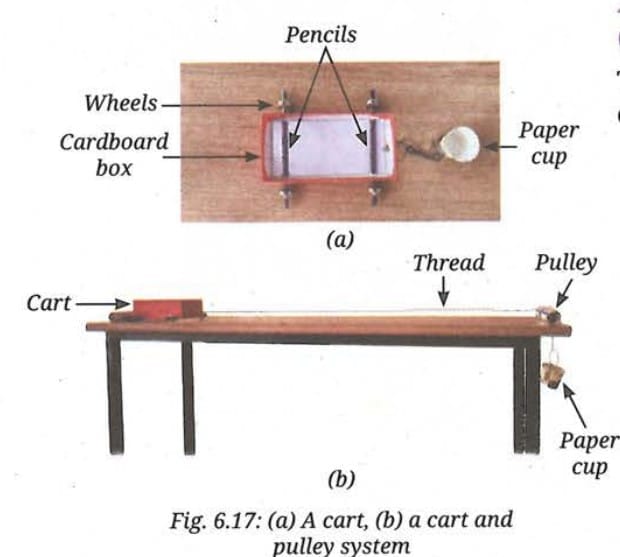
3. Draw a line at one end of the table, which will mark the starting point for the cart. Put the thread over a small pipe attached at the other end of the table (Fig. 6.17b). To this thread attach a cup in which you can put some objects. As you let the system go, the cup will move down due to the gravitational force by the Earth on it, and the thread will pull the cart with a constant force.
4. Measure the mass of the cup along with any other objects put inside it with the weighing scale.
5. Start recording a video of the cart in slow motion. Release the cart from the start line, and record the video until it reaches the pipe at the other end of the table.
6. Read the time when you released the cart and when it reached the end of the table by seeing the slow-motion video and record the difference as time T₁.
7. Now double the mass of the cup with the objects inside it, and repeat steps 5 and 6 to record the time difference T₂.
Ans: Analysis:
Using the values of the time measured, let us do some analysis. For both cases, the cart starts with zero velocity u = 0 and travels the same distance s. If a₁ and a₂ are the accelerations in the two cases respectively, using kinematic equation, we obtain
s = ½ a₁T₁² and s = ½ a₂T₂²
Equating the two equations, we obtain
a₁/a₂ = T₂²/T₁²
Observation:
Substituting the values of T₁ and T₂, you find that when you increased the force for the same mass of the cart the acceleration increased. When the mass of the cup (and therefore the force) is doubled, T₂ < T₁, which means a₂ > a₁. The acceleration approximately doubles when the force is doubled for the same mass of the cart.
Conclusion:
You may conclude that the acceleration of an object of fixed mass increases as the net force applied on it increases. This confirms our hypothesis: for the same object (same mass), a larger force produces a larger acceleration.
Think as a Scientist
Apart from force, does acceleration depends on any other factor? From everyday experiences, you know that with the same magnitude of force, it is easier to set lighter objects in motion than heavier ones. This leads to a second hypothesis, that for the same force, a smaller mass has a larger acceleration (or a larger mass has a smaller acceleration). Now how can you test your second hypothesis?
Ans:
Second Hypothesis:
For the same magnitude of force, a smaller mass has a larger acceleration and a larger mass has a smaller acceleration. In other words, for a fixed force, acceleration is inversely proportional to the mass of the object.
How to Test the Hypothesis:
To test this hypothesis, we need to keep the force constant and only vary the mass of the object on which the force acts, then observe and measure the resulting acceleration each time.
Using the same cart-pulley system from Activity 6.3, we keep the mass of the cup and the objects inside it exactly the same throughout - this ensures that the pulling force on the cart remains constant and unchanged. We then change only the mass of the cart itself by adding more objects inside it. By doubling the mass of the cart while keeping the force the same, we can compare the accelerations in the two cases.
The acceleration cannot be measured directly, but since the cart starts from rest (u = 0) and travels the same distance s in both cases, we can use the kinematic equation:
s = ½ a₁T₁² and s = ½ a₂T₂²
Equating the two:
a₁/a₂ = T₂²/T₁²
By recording the time T₁ taken by the original cart and T₂ taken by the heavier cart (double mass) to travel the same distance, we can find the ratio of their accelerations and check whether doubling the mass halves the acceleration, as our hypothesis predicts.
Observation:
When the mass of the cart is doubled while the force remains the same, the cart takes a longer time (T₂ > T₁) to cover the same distance. This means the acceleration of the heavier cart is smaller (a₂ < a₁). Substituting the values of T₁ and T₂ into the equation shows that the acceleration approximately halves when the mass is doubled, confirming our hypothesis.
When the mass is smaller, the same force produces a larger acceleration and the cart covers the distance in less time. When the mass is larger, the same force produces a smaller acceleration and the cart takes more time to cover the same distance.
Conclusion:
The results confirm our second hypothesis. For the same magnitude of force, a larger mass produces a smaller acceleration and a smaller mass produces a larger acceleration. Acceleration is inversely proportional to the mass of the object when force is kept constant:
a ∝ 1/m (when force is constant)
Combining this with the conclusion from the first Think as a Scientist (a ∝ F when mass is constant), we get:
a ∝ F/m or F = ma
This is Newton's second law of motion: when a net force acts on an object, the object accelerates in the direction of the net force. The magnitude of the acceleration is proportional to the magnitude of the net force and is inversely proportional to the mass of the object.
Activity 6.4: Let us experiment (Demonstration activity)
This activity is recommended to be performed as a classroom group activity facilitated by the teacher.
1. Repeat Activity 6.3 with a variation. Keep the mass of the cup and objects inside it constant. Double the mass of the cart by adding more objects in it.
2. Measure the mass of the cart along with the objects inside it with a weighing scale.
3. Carry out steps 5 and 6 of Activity 6.3.
Ans: Analysis:
Using the values of time measured, find the ratio of acceleration for these two cases. Do you find that for the same force, when you increased the mass of the cart, the acceleration decreased?
a₁/a₂ = T₂²/T₁²
Observation:
This means that for a given magnitude of a force, the acceleration produced is inversely related to the mass of the object. When the mass of the cart is doubled while keeping the force (cup mass) constant, T₂ > T₁, which means a₂ < a₁. The acceleration approximately halves when the mass doubles.
Conclusion:
The relation between force, mass and acceleration is expressed in Newton's second law, one of the most fundamental ideas in all of science. When a net force acts on an object, the object accelerates in the direction of the net force. The magnitude of the acceleration is proportional to the magnitude of the net force and is inversely proportional to the mass of the object.
Mathematically it can be expressed as:
a = F/m or F = ma
where a denotes acceleration, F denotes force and m denotes mass of the object. The direction of acceleration is the same as the direction of net force.
Activity 6.5: Let us explore
1. Locate a chair with wheels and a large heavy table.
2. Sit on the chair with your legs raised above the floor. Now, using both your hands, push the table away from you, i.e., apply a force on the table in the forward direction as shown in Fig. 6.23a. What happens to you? Does the chair you are sitting upon move in the opposite direction?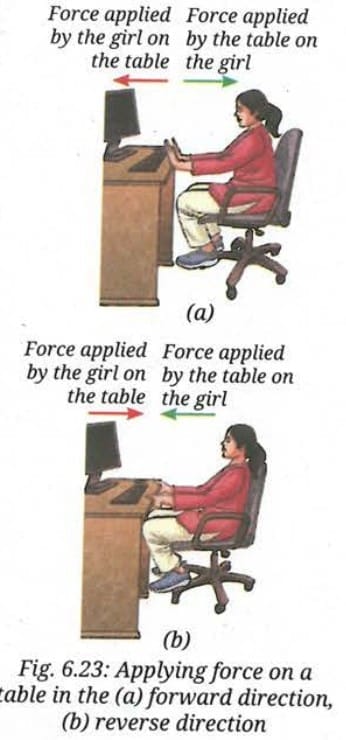
3. Now, try to pull the table towards you, i.e., apply a force on the table in the direction opposite to that in step 2 (Fig. 6.23b). In which direction does your chair move now?
What conclusion can you draw from this activity? Each time, when you applied a force on the table, the table applied a force upon you in the opposite direction.
Ans: Observations:
Step 2 (Pushing the table away): When you push the table forward, the table applies an equal and opposite force on your hands (and thus on you and the chair). As a result, the chair you are sitting upon moves in the opposite direction - backwards. The table moves (or tends to move) forward due to the force you applied on it.
Step 3 (Pulling the table towards you): When you pull the table towards yourself, the table exerts an equal and opposite force on you in the direction away from you. The chair moves forward (towards the table). The table moves (or tends to move) towards you.
Conclusion:
Each time, when you applied a force on the table, the table applied a force upon you in the opposite direction. You may have experienced this in various other situations. This demonstrates Newton's third law of motion: whenever one object exerts a force on a second object, the second object is simultaneously exerting an equal and opposite force on the first object. The forces always occur in pairs but remember that these two forces act on two different objects.
Activity 6.6: Let us verify
1. Take two identical spring balances.
2. Place them in horizontal position on a table and connect them by their hooks as shown in Fig. 6.26. Fix the free end of one of the spring balances to an immovable object or hold it fixed by your hand.
3. Imagine that you are pulling the free end of the other spring balance with your other hand. Predict what will be the readings of their scales if the spring balances are stationary.
4. Now, carry out step 3. Repeat it multiple times by varying the magnitude of the force applied by you. Is your observation same as your prediction?
Ans: Prediction:
If the two spring balances are stationary, both should show the same reading, because the force pulling one balance must be equal to the reaction force pulling back through the connection.
Observations:
The readings of the scales of two spring balances are the same every time. It indicates that the forces applied by them on each other in the opposite direction are equal in magnitude.
Explanation:
Spring Balance 1 (fixed end): It records the force with which the connection pulls on the fixed end. Spring Balance 2 (free end being pulled): It records the force you apply on it. Since the system is stationary, the force applied by you equals the force transmitted through the connection, so both balances read the same value.
Conclusion:
The readings of the scales of two spring balances are the same every time. It indicates that the forces applied by them on each other in the opposite direction are equal in magnitude. This experimentally verifies Newton's third law of motion: whenever one object is exerting a force on a second object, the second object is simultaneously exerting an equal and opposite force on the first object.
Activity 6.7: Let us understand
1. Collect a large balloon, a piece of drinking straw, adhesive tape, a long thread and two nails or hooks on two walls.
2. Inflate the balloon and tie its neck with a small piece of thread.
3. Stick the piece of straw with an adhesive tape on the surface of the balloon such that, one end of the straw points towards the neck of the balloon, as shown in Fig. 6.29.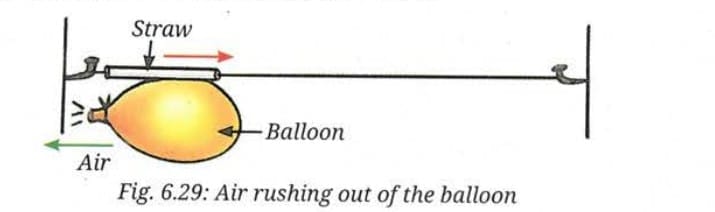
4. Pass the thread through the straw and tie its two ends to the nails, keeping the thread taut (Fig. 6.29).
5. Remove the thread tied to the neck of the balloon and observe in which direction the straw and the balloon move.
Ans: Observation:
When the thread tied to the neck of the balloon is removed, the air inside rushes out from the neck end in the backward direction. The balloon moves in the direction opposite to the flow of escaping air - forward along the thread - with the straw and balloon sliding along the thread away from the neck end.
Explanation:
The stretched material of the balloon applies a force on the air molecules inside to expel them as it shrinks in size. The air rushing out exerts an equal and opposite force on the balloon material in the opposite direction. This force causes the balloon to start moving in a direction opposite to the direction in which the air is rushing out.
A rocket moves in a similar manner. Its engine produces gas and expels it in the downward direction, which in turn exerts an equal and opposite force on the rocket in the upward direction. This force on the rocket in the upward direction is larger than the weight of the rocket, so the net force is in the upward direction and the rocket lifts off.
Conclusion:
This activity demonstrates Newton's third law of motion applied to propulsion. The action force is the balloon (its stretched material) pushing air molecules outward; the reaction force is the air pushing the balloon forward. The pair of equal and opposite forces as per Newton's third law acts on two different objects - the air molecules and the balloon - thus, they do not balance each other. On the other hand, if two equal and opposite forces act on the same object, they balance each other.
FAQs on NCERT Based Activity: How Forces Affect Motion
| 1. What are the key concepts related to forces and motion in Class 9? |  |
| 2. How do balanced and unbalanced forces influence motion? | |
| 3. What is Newton's first law of motion? | |
| 4. How can experiments help us understand the effects of forces on motion? | |
| 5. What is the significance of measuring forces in scientific investigations? | |




