NCERT Based Activity: Work, Energy, and Simple Machines

Activity 7.1: Let us investigate
1. Take a heavy ball and a large container filled with loose sand.
2. Raise the ball over the sand bed to a height of about 1 m and drop it (Fig. 7.17). Is a depression created in the sand? Why does the ball create a depression?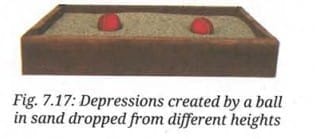
3. Now, raise the ball to the height of 2 m and release it at a slightly different position over the sand bed such that the depressions do not overlap. Repeat this step one more time. Compare the depths of the depressions. Is there any difference? In which case is the depression deepest and in which case the shallowest?
Ans: Observations:
Step 2 - Ball dropped from 1 m:
Yes, a depression is created in the sand when the ball is dropped from a height of 1 m. The ball creates a depression because it possesses energy by virtue of its height above the ground - this is its gravitational potential energy. When the ball is released, this potential energy gets converted into kinetic energy as it falls. When the ball hits the sand, it applies a force on the sand and does work on it, creating a depression. The depth of the depression is a measure of the energy the ball had just before hitting the sand.
Step 3 - Comparing depressions from different heights:
Yes, there is a clear difference in the depths of the depressions. The depression created by the ball dropped from 2 m is deeper than the one created from 1 m, and the depression from 1 m is deeper than that from a lower height (if repeated). The depression is deepest when the ball is dropped from the greatest height and shallowest when dropped from the smallest height.
Explanation:
Raising a ball to a greater height from the surface of the Earth requires more work. Thus, the ball possesses more energy at greater height. The potential energy of the ball at a height h is given by U = mgh, where m is the mass of the ball and g is the acceleration due to gravity. When the ball is released from a greater height, this larger energy gets converted into a larger kinetic energy just before impact. A greater kinetic energy means the ball does more work on the sand, creating a deeper depression.
Thus, the greater the height of the ball above the Earth's surface, the greater is its potential energy, and the deeper is the depression it creates upon impact.
Conclusion:
The depth of the depression in the sand increases with the height from which the ball is dropped. This activity demonstrates that objects raised to a greater height possess more gravitational potential energy. The gravitational potential energy of an object of mass m at a height h is:
U = mgh
This energy is converted into kinetic energy as the ball falls, and the kinetic energy does work on the sand upon impact. The greater the height, the greater the potential energy, and the deeper the depression created.
Activity 7.2: Let us experiment
1. Set up a simple pendulum as you have learnt in Grade 7.
2. Paste a white sheet of paper on a wall behind the pendulum. Draw a horizontal line above the position of the bob when it is not oscillating (Fig. 7.20).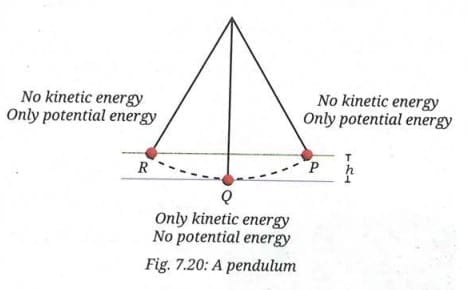
3. Take the bob to one side to a point P, which is at the level of the horizontal line and let it go. Observe it at the extreme points of the first couple of oscillations. Does the bob almost reach the level of the horizontal line?
Ans: Observation:
Yes, the bob almost reaches the level of the horizontal line at both extreme points of its swing. When the bob is taken to point P (at the level of the horizontal line) and released, it swings to the other side and reaches a point R which is almost at the same height as point P. The bob nearly reaches the same height it started with on both sides.
Explanation:
At point P, the pendulum bob is at rest - it has zero velocity and zero kinetic energy. All its mechanical energy is in the form of potential energy equal to mgh, where h is the height of point P above the lowest point Q.
As the bob swings down from P to Q (the bottom-most point), its height decreases and its potential energy decreases. At the same time, its velocity increases and its kinetic energy increases. At point Q, the bob is at its lowest position - its potential energy is zero (taking Q as the reference) and all its mechanical energy has been converted into kinetic energy. The bob has maximum velocity and maximum kinetic energy at Q.
As the bob swings upward from Q to R (on the other side), its kinetic energy decreases and its potential energy increases. At point R, the bob momentarily comes to rest - its kinetic energy is zero and all its mechanical energy is again in the form of potential energy. Since the mechanical energy remains constant (conserved), the bob reaches almost the same height h on the other side.
Thus:
- At P and R: Only potential energy, no kinetic energy
- At Q: Only kinetic energy, no potential energy
- At all intermediate points: Both kinetic and potential energy, but their sum (mechanical energy) remains constant = mgh
Conclusion:
This activity demonstrates the conservation of mechanical energy. The sum of the kinetic energy and potential energy of the pendulum bob remains constant throughout its motion:
Mechanical energy = Kinetic energy + Potential energy = constant = mgh
The lost potential energy of the object is converted into kinetic energy during motion, while its mechanical energy remains constant. This is called the conservation of mechanical energy - as an object moves due to the gravitational force, its mechanical energy remains the same, provided no other external forces act on it.
In real life, the pendulum slows down and eventually stops because of energy loss due to friction at the support and air resistance. The mechanical energy is not truly conserved - it gets converted into heat energy due to these resistive forces.
Activity 7.3: Let us experiment
1. Take a smooth plank (say a cardboard piece) about 1.5 m long, a toy car (or the cart that you used in Activity 6.3) and a spring balance. Attach the spring balance to the cart. Arrange an elevated surface, such as the top of a low stool or a pile of books, at about 0.5 m height from the floor.
2. First, lift the cart vertically, slowly and steadily, from the floor to the top of the pile of books or stool, and note the reading of the spring balance scale. This reading indicates that the force required to lift the cart vertically is equal to the weight of the cart.
3. Next, place the plank against the top of the pile of books or stool as shown in Fig. 7.27a. Pull the cart along the plank slowly and steadily. Is the reading of the spring balance (the force required) smaller than that of step 2?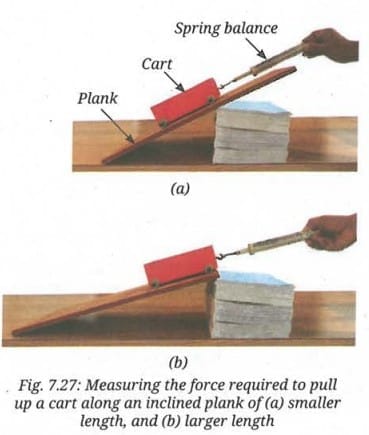
4. Now, reduce the angle between the plank and the base as shown in Fig. 7.27b, and repeat the step 3. Observe how the force required changes as the plank becomes less steep.
Ans: Observations:
Step 2 - Lifting vertically:
The spring balance reading while lifting the cart vertically gives the weight of the cart (force = mg). This is the maximum force required to raise the cart to the height of the stool or pile of books. For example, if the cart weighs 5 N, the spring balance reads 5 N.
Step 3 - Pulling along the plank (steeper angle):
The spring balance reading while pulling the cart along the inclined plank is smaller than the reading in step 2. The force required to pull the cart up the slope is less than its weight. For example, the spring balance might read about 2.5 N for the same cart that weighed 5 N, depending on the angle of inclination. This confirms that the inclined plane reduces the effort needed to raise the object.
Step 4 - Pulling along the plank (less steep angle, longer plank):
When the angle between the plank and the base is reduced (making the plank less steep and effectively longer), the spring balance reading decreases further. A less steep, longer plank requires an even smaller force to pull the cart to the same height.
Explanation:
The force required to pull the cart up the inclined plane upto the height of the pile of books or stool decreases as the plank becomes less steep. However, you have to apply the force over a larger distance to bring it to the same height.
The inclined plane is a simple machine. Its mechanical advantage is:
mechanical advantage = load / effort = mg / F' = L / h
where L is the length of the inclined plane and h is the height. Since L is always larger than h, the mechanical advantage of an inclined plane is always greater than 1 - meaning the effort F' is always less than the load mg.
By making the inclined plane longer with a shallower angle (increasing L), we can further reduce the effort F' required to move the object. However, the total work done remains the same in all cases - the reduction in force is compensated by the increase in the distance over which the force is applied.
Conclusion:
The force required to pull up the cart to the height of the pile of books or stool decreases as the plank becomes less steep. However, you have to apply the force over a larger distance to bring it to the same height. This demonstrates the principle of the inclined plane as a simple machine - it reduces the effort required to raise a load but does not reduce the total work done. The mechanical advantage of the inclined plane is:
mechanical advantage = L / h
where L is the length of the inclined plane and h is the vertical height. A longer, shallower inclined plane provides a greater mechanical advantage.
Activity 7.4: Let us investigate
1. Take a 30 cm long scale, a pencil, 2-3 erasers and a stapler (or a similar object).
2. Place the scale over the pencil such that the pencil is closer to one end of the scale as shown in Fig. 7.31. On the end of the scale closer to the pencil, place the stapler.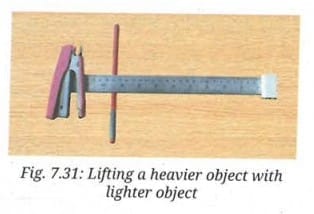
3. On the other end of the scale, place one eraser. Does the stapler lift up? If not, add one more eraser.
Ans: Observation:
When the scale is placed over the pencil (acting as a fulcrum) closer to the heavier end (where the stapler is placed), placing one or two lighter erasers on the other end causes the stapler to lift up. A much lighter object (eraser) is able to lift a much heavier object (stapler). If one eraser is not sufficient, adding a second eraser lifts the stapler.
Explanation:
This arrangement works as a lever. The scale acts as the rigid bar, the pencil acts as the fulcrum (the fixed point about which the lever rotates), the stapler acts as the load (the force to be overcome), and the erasers act as the effort (the force applied).
The lever works because of the principle of moments. The end of the lever on which the smaller force (effort - erasers) is applied moves a larger distance, while the other end which applies a larger force (to lift the stapler - load) moves a smaller distance. The work done on one end of the lever is transferred to the other end.
Using the lever equation: F₁ × d₁ = F₂ × d₂
where F₁ is the effort (weight of erasers), d₁ is the effort arm (distance of erasers from pencil/fulcrum), F₂ is the load (weight of stapler), and d₂ is the load arm (distance of stapler from pencil/fulcrum).
Since the pencil (fulcrum) is placed closer to the stapler end, d₂ is small and d₁ is large. Therefore, even a small effort force F₁ (lighter erasers) can balance or lift a large load F₂ (heavier stapler), because a small F₁ multiplied by a large d₁ equals a large F₂ multiplied by a small d₂.
The mechanical advantage of this lever is:
mechanical advantage = load / effort = effort arm / load arm = d₁ / d₂
Since d₁ > d₂, the mechanical advantage is greater than 1, meaning the lever amplifies the applied force.
Conclusion:
A much heavier object (stapler) could be lifted by a much lighter eraser. This was made possible by using a scale as a simple machine called a lever. By placing the fulcrum (pencil) closer to the load (stapler), the effort arm becomes larger than the load arm, giving a mechanical advantage greater than 1. This allows a smaller effort to overcome a larger load. The lever reduces the force required to perform a task but does not reduce the total work done.
Activity 7.5: Let us experiment
1. Take a long scale (50 cm or larger), a piece of string, two paper cups (to act as pans), adhesive tape or a piece of thread and identical coins (to act as weights).
2. Tie the string tightly around the scale at its midpoint. This string will act as the fulcrum. Hang the scale from this string using a stand or hook, so that it can swing freely. This scale will now act as a beam (Fig. 7.33).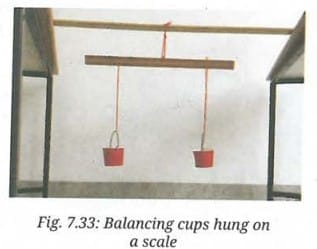
3. Fix paper cups to both ends of the beam using thread. These cups act as the pans of a balance. Check whether the beam is levelled. If it is tilted, adjust the hanging points of the pans until both sides balance equally.
4. Place 1 coin in the left pan (call it effort) and 1 identical coin in the right pan (call it load). Observe that the beam stays horizontal.
5. Add one more coin to the right pan, so that it contains 2 coins. The beam tilts. Move the heavier pan closer to the centre of the beam to balance the beam. Measure its distance from the centre.
6. Repeat step 5 with 4 coins and then 8 coins in the right pan. Each time, note its distance from the centre that balances the beam.
7. Record all observations and measurements, and complete the Table 7.1 by adding more rows.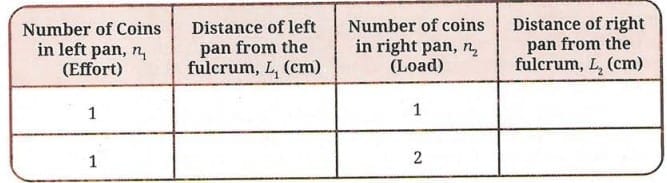
Observation:
Table 7.1: Observations of beam balance experiment
| Number of Coins in left pan, n₁ (Effort) | Distance of left pan from the fulcrum, l₁ (cm) | Number of coins in right pan, n₂ (Load) | Distance of right pan from the fulcrum, l₂ (cm) |
|---|---|---|---|
| 1 | 25 cm | 1 | 25 cm |
| 1 | 25 cm | 2 | 12.5 cm |
| 1 | 25 cm | 4 | 6.25 cm |
| 1 | 25 cm | 8 | 3.1 cm |
(Note: The left pan is kept fixed at 25 cm from the fulcrum throughout. The right pan is moved closer to the fulcrum as more coins are added, until the beam balances. Values are representative/approximate.)
- When equal numbers of coins (1 coin each) are placed in both pans at equal distances from the fulcrum, the beam remains perfectly horizontal.
- When the number of coins in the right pan is increased to 2 (while the left pan still has 1 coin), the beam tilts to the right - the heavier side goes down.
- Moving the right pan (heavier side) closer to the centre/fulcrum restores the balance. The right pan now needs to be at half the distance from the fulcrum compared to the left pan.
- As the number of coins in the right pan is further increased to 4 and then 8, the right pan must be moved even closer to the fulcrum to achieve balance.
- A clear pattern is observed: as the load (n₂) doubles, the distance of the load pan from the fulcrum (l₂) halves.
- The product n₁ × l₁ = n₂ × l₂ holds true in all cases, confirming the principle of moments.
Explanation:
This activity demonstrates the principle of moments (also known as the law of the lever). A lever is a simple machine that consists of a rigid beam (the scale) balanced on a fixed point called the fulcrum. The turning effect of a force about the fulcrum is called the moment of force or torque, and is equal to the force multiplied by its perpendicular distance from the fulcrum.
For the beam to be balanced (in equilibrium):
Moment of effort = Moment of load
n₁ × l₁ = n₂ × l₂
This means that a smaller force (fewer coins) applied at a greater distance from the fulcrum can balance a larger force (more coins) applied at a shorter distance. This is the working principle of levers - they allow us to lift heavy loads with smaller effort by increasing the distance of the effort from the fulcrum. Common examples of levers in daily life include a seesaw, a crowbar, scissors and a weighing balance.
FAQs on NCERT Based Activity: Work, Energy, and Simple Machines
| 1. What is the concept of work in physics? |  |
| 2. How is energy defined in the context of work and machines? | |
| 3. What are simple machines, and how do they facilitate work? | |
| 4. Can you explain the principle of mechanical advantage in simple machines? | |
| 5. What role does energy conservation play in the functioning of machines? | |