CBSE Class 9  >  Class 9 Notes  >  Science New NCERT 2026-27 (New Syllabus)  >  NCERT Based Activity: Journey Inside the Atom

NCERT Based Activity: Journey Inside the Atom

Think as a Scientist 

Observe Fig. 8.4 of the gold foil experiment. Predict the observations you would expect if the gold foil in the experiment were made thicker. Also, draw a simple diagram to show the observations you expect.Think as a Scientist 
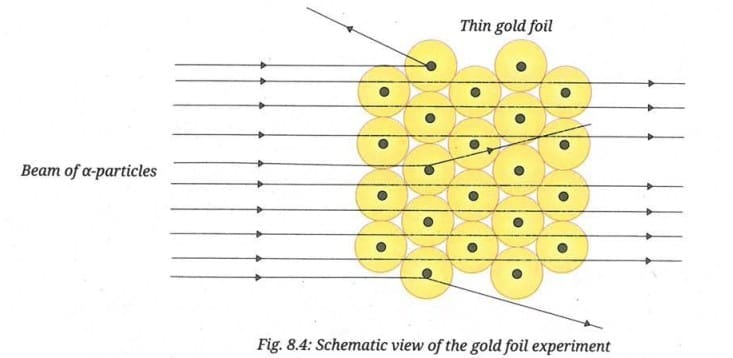
Hint: Compare thin foil vs thick foil. How does the thickness affect the chances of hitting a nucleus?

Observations:

  • If the gold foil is made thicker, the beam of alpha particles encounters a greater number of gold atoms and nuclei along its path.
  • More alpha particles would be deflected at large angles because the probability of a direct or near-direct collision with a nucleus increases with thickness.
  • A greater number of alpha particles would also bounce back (backscattering) compared to the thin foil experiment.
  • Fewer alpha particles would pass through completely undeflected, since increased thickness reduces the chance of passing through empty space without any interaction.
  • The pattern of deflections would be significantly more pronounced compared to the original thin foil experiment.

Explanation:

In Rutherford's model, an atom is mostly empty space with a tiny, dense, positively charged nucleus at the centre. When the foil is thin, most alpha particles pass through the vast empty space without hitting any nucleus, and are therefore undeflected. Only a very few particles travel close enough to a nucleus to get deflected.

When the foil is made thicker, there are many more layers of gold atoms in the path of the alpha particles. This means:

  • The probability of an alpha particle encountering a nucleus increases with each additional atomic layer.
  • Even if one layer is mostly empty space, multiple layers together significantly raise the chance of a nucleus collision.
  • Therefore, more large-angle deflections and backscattering are observed.

This reinforces Rutherford's conclusion that the nucleus is a real, concentrated region of positive charge and mass - its presence becomes statistically more detectable as foil thickness increases.

The document NCERT Based Activity: Journey Inside the Atom is a part of the Class 9 Course Science Class 9 New NCERT 2026-27 (New Syllabus).
All you need of Class 9 at this link: Class 9

FAQs on NCERT Based Activity: Journey Inside the Atom

1. What is an atom and what are its main components?
Ans. An atom is the smallest unit of matter that retains the properties of an element. Its main components include protons, neutrons, and electrons. Protons and neutrons are located in the nucleus at the centre of the atom, while electrons orbit around the nucleus in various energy levels.
2. How do protons and neutrons differ in terms of charge and mass?
Ans. Protons carry a positive charge of +1, while neutrons are electrically neutral and have no charge. In terms of mass, protons and neutrons have approximately the same mass, which is about 1 atomic mass unit (amu), whereas electrons have a much smaller mass, roughly 1/1836 of that of a proton.
3. What is the significance of electrons in an atom?
Ans. Electrons are significant because they determine the chemical behaviour of an atom. The arrangement of electrons in different energy levels influences how an atom interacts with others, forming bonds and creating compounds. The outermost electrons, known as valence electrons, are particularly important for bonding.
4. What is meant by atomic number and mass number?
Ans. The atomic number of an atom is the number of protons in its nucleus and determines the identity of the element. The mass number is the total number of protons and neutrons in the nucleus. For example, if an atom has 6 protons and 6 neutrons, its atomic number is 6 and its mass number is 12.
5. How do isotopes of an element differ from each other?
Ans. Isotopes of an element differ in the number of neutrons present in the nucleus, which results in different mass numbers. While they have the same number of protons and thus the same atomic number, their varying neutron counts lead to different physical properties, such as stability and half-life. For example, carbon has two stable isotopes, ¹²C and ¹³C, with 6 and 7 neutrons, respectively.
Explore Courses for Class 9 exam
Get EduRev Notes directly in your Google search
Related Searches
Summary, Important questions, study material, ppt, shortcuts and tricks, video lectures, Exam, Objective type Questions, Viva Questions, MCQs, Semester Notes, NCERT Based Activity: Journey Inside the Atom, NCERT Based Activity: Journey Inside the Atom, past year papers, Free, Sample Paper, Previous Year Questions with Solutions, pdf , practice quizzes, Extra Questions, NCERT Based Activity: Journey Inside the Atom, mock tests for examination;