NCERT Based Activity: Patterns in Life: Diversity and Classification


Activity 12.1: Let us compare and classify
Fig. 12.2 shows the diversity of animals in an ecosystem. Observe the image carefully. Can you guess how the organisms are grouped in the image?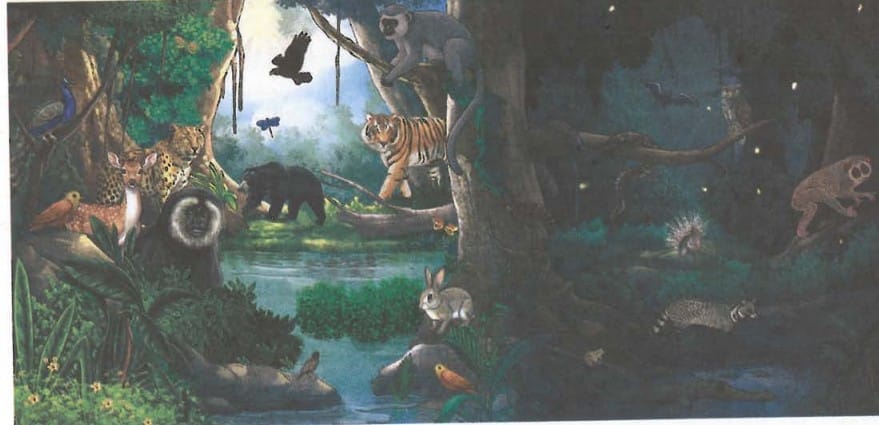
Ponder on the questions given below:
- Which animals can you identify in the given picture?
- Ans: You may identify animals such as tiger, leopard, bear, eagle, owl, bat, rabbit, monkey, peacock, deer, snake, and fish-like organisms in and around the water body.
- Where are they seen?
- Ans. Some animals are seen on the forest floor (tiger, deer, rabbit, snake), some on trees (monkey, owl), some flying in the air (eagle, bat, peacock), and some near or in the water.
- Which animals in the picture seem active:
- (i) during the day?
- Ans. Eagle, tiger, peacock, deer, rabbit, and monkey appear active during the day.
- (ii) during the night?
- Ans. Owl and bat appear active during the night.
- (iii) both during the day and the night?
- Ans. Snake and some insects may be active both during the day and the night.
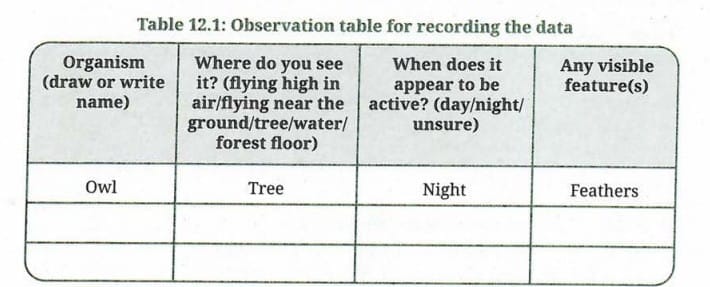
Record your observations in Table 12.1.
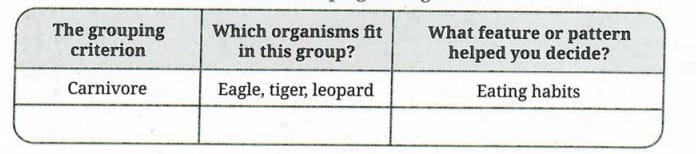
- Now, try grouping the same organisms in more than one way. Each time change the criterion you are using for grouping (Table 12.2).
Observation:
Table 12.1: Observation table for recording the data
| Organism (draw or write name) | Where do you see it? (flying high in air/flying near the ground/tree/water/forest floor) | When does it appear to be active? (day/night/unsure) | Any visible feature(s) |
|---|---|---|---|
| Owl | Tree | Night | Feathers, large eyes |
| Tiger | Forest floor | Night | Stripes, four legs |
| Eagle | Flying high in air | Day | Wings, sharp beak, talons |
| Rabbit | Ground | Day | Long ears, fur |
| Monkey | Tree | Day | Long tail, hands for gripping |
| Bat | Flying near ground | Night | Wings, no feathers |
| Deer | Forest floor | Day | Antlers, hooves |
| Snake | Ground/forest floor | Day | Scales, no legs |
| Peacock | Ground/flying near ground | Day | Colourful feathers, crest |
| Fish/fish-like organism | Water | Unsure | Fins, scales |
Table 12.2: Grouping the organisms
| The grouping criterion | Which organisms fit in this group? | What feature or pattern helped you decide? |
|---|---|---|
| Carnivore | Eagle, tiger, leopard | Eating habits - feed on other animals |
| Herbivore | Deer, rabbit | Eating habits - feed on plants |
| Has feathers | Eagle, peacock, owl | Body covering |
| Nocturnal (active at night) | Owl, bat, tiger | Activity pattern |
| Diurnal (active during day) | Eagle, rabbit, deer, peacock | Activity pattern |
| Lives on trees | Monkey, owl | Habitat |
| Has four legs | Tiger, deer, rabbit, monkey | Body structure/external features |
| Can fly | Eagle, owl, bat, peacock | Mode of locomotion |
You may notice that the same organism can fit into different groups depending on the criterion you choose. This leads to an important question: how do scientists decide which features to use while grouping the living organisms? This question leads us to the idea of classification, a systematic way of organising the Earth's living diversity.
Activity 12.2: Let us read a case study
Carefully read the given case study of Pakke Tiger Reserve.
The Pakke Tiger Reserve in Arunachal Pradesh is a forest where scientists have recorded nearly 300 bird species, which is striking given that India as a whole has about 1,300 bird species. Pakke is also known for supporting four species of hornbills - the Rufous-necked Hornbill, the Oriental Pied Hornbill, the Great Hornbill, and the Wreathed Hornbill. These large birds nest only in large, old trees with suitable cavities and feed on specific fruits. As a result, different hornbill species are found in different parts of the forest depending on tree size and fruit availability. Studying such patterns allows scientists to ask precise questions about biodiversity, such as -
- How are species distributed within a forest? Which plants and animals are closely linked?
- How does classifying the four hornbill species help us understand biodiversity?
Think and discuss the case based on the following questions -
- (i) How can scientists keep track of so many species?
- Ans. Scientists keep track of species by using biological classification - grouping organisms based on shared characteristics. Each species is given a unique scientific name. Detailed field surveys, photographs, audio recordings of calls, GPS tagging, and databases help scientists record and organise information about hundreds of species systematically.
- (ii) The four hornbills look similar in some ways. What features can help scientists distinguish them from one another?
- Ans. Scientists can distinguish the four hornbill species by comparing features such as body size, colour and pattern of feathers, the shape and size of the casque (the structure on top of the beak), the colour of the beak, and the call or vocalisation of each species. The nesting and feeding preferences also differ among them.
- (iii) What would happen if the large, old trees disappeared from the forest?
- Ans. Hornbills nest only in large, old trees with suitable cavities. If these trees disappeared, hornbills would lose their nesting sites and would be unable to reproduce successfully. This would lead to a sharp decline in hornbill populations. Since hornbills also disperse the seeds of the fruits they eat, their decline would affect the regeneration of those fruit trees as well, disrupting the entire forest ecosystem.
Activity 12.3: Let us study
- Study the concept map (Fig. 12.5).
- List the criteria which form the basis of five kingdom classification.
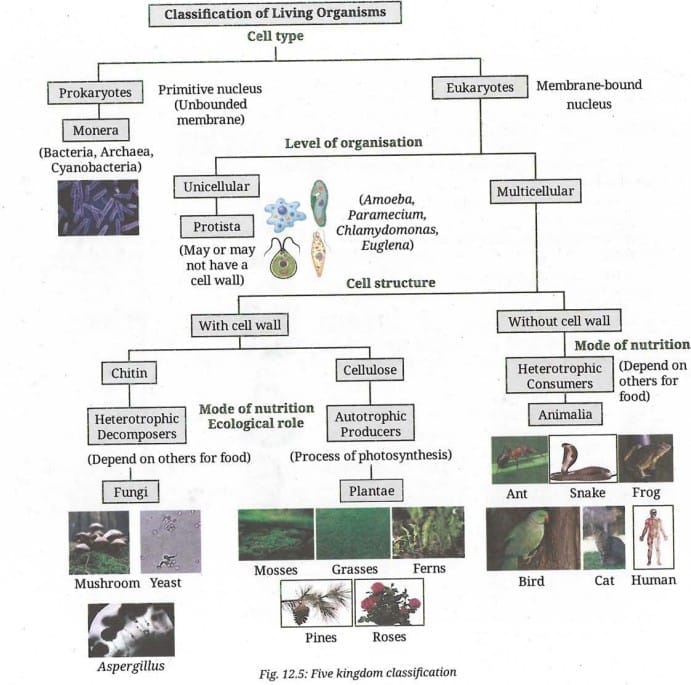
- Comparethe criteria you have listed after studying the concept map and the criteria given below:
- Cell type - prokaryote or eukaryote
- Cell structure - presence or absence of a cell wall
- Level of organisation - unicellular or multicellular
- Mode of nutrition - autotrophic or heterotrophic
Ans. The criteria listed from the concept map are:
- Cell type - prokaryote (no membrane-bound nucleus) or eukaryote (membrane-bound nucleus)
- Cell structure - presence or absence of a cell wall; if present, whether it is made of chitin or cellulose
- Level of organisation - unicellular or multicellular
- Mode of nutrition - autotrophic (producers) or heterotrophic (consumers or decomposers)
- Ecological role - producer, consumer, or decomposer
All four criteria listed match those visible in the concept map. The concept map additionally shows the material of the cell wall (chitin in Fungi, cellulose in Plantae) and the ecological role (decomposer, producer, consumer) as further distinguishing criteria within the eukaryotic kingdoms. Together, these criteria allow organisms to be placed in one of five kingdoms - Monera, Protista, Fungi, Plantae, or Animalia.
Activity 12.4: Let us explore
In the school laboratory, observe the available permanent slides of bacteria and cyanobacteria under the microscope.
Compare them with Fig. 12.6.
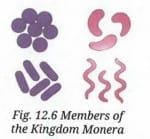
What do you observe? What do you observe? Bacteria and cyanobacteria are single-celled prokaryotes that are grouped under Monera. Bacteria are found everywhere, including soil, water, air, hot springs and other extreme environments where most organisms cannot survive and even inside the human bodies. Cyanobacteria are autotrophs and decomposers.
Comparing bacteria and cyanobacteria
| Feature | Bacteria | Cyanobacteria |
|---|---|---|
| Shape | Rod, spherical, or spiral | Filamentous, spherical, or rod shaped |
| Colour | Colourless/pale - no photosynthetic pigment visible | Blue-green due to phycocyanin and chlorophyll pigments |
| Presence of nucleus | Absent - prokaryote, no membrane-bound nucleus | Absent - prokaryote, no membrane-bound nucleus |
| Mode of nutrition | Heterotrophic (most); some autotrophic | Autotrophic - perform photosynthesis |
| Where commonly found | Soil, water, air, inside living organisms, extreme environments | Aquatic environments, moist soil, on rocks, hot springs |
Activity 12.5: Let us make
To make a hay infusion, follow the steps given below -
- Collect a small sample of grass after the lawn has been mowed, or collect straw or fodder.
- Take a small glass bottle and fill one fourth of it with the grass, straw or fodder.
- Fill the bottle with stagnant water or pond water and mix it with the collected plant material.
- Cover the bottle with a muslin cloth and tie it using a thread.
- Keep the bottle aside undisturbed for a week.
- Slightly open the mouth of the bottle by removing the muslin cloth, just enough to insert a dropper inside it and carefully take a drop of water.
- Put the drop of water on a clean slide and observe it under a microscope.
Caution: The hay infusion may smell bad. Therefore, take precaution during lab exercises.
- Wear a lab coat, mask and hand gloves.
- Discard the hay infusion after autoclaving.
Do you notice moving organisms in the drop of water under the microscope? Can you identify them by comparing them with Fig. 12.7?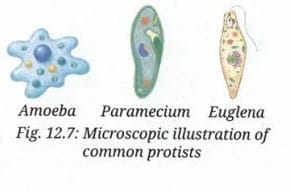
Ans. Yes, you will likely observe small moving organisms in the drop of water. These are protists - single-celled eukaryotic organisms that live in water or moist places. By comparing with Fig. 12.7, you may identify organisms such as Amoeba (that moves using pseudopodia and changes shape), Paramecium (oval-shaped, moves rapidly using cilia), and Euglena (moves using a flagellum and appears greenish due to chlorophyll). These organisms belong to the Kingdom Protista. Some are autotrophic (like Euglena) and others are heterotrophic (like Amoeba).
Activity 12.6: Let us explore
Observe some bryophytes with the help of a hand lens. Collect them in a watch glass.
Put a drop of water on it and observe it under a dissecting microscope. A dissecting microscope enables us to view magnified images of live specimens.
How do they differ from the leaves that you usually observe in your surroundings?
Record your observations in Table 12.4.
Ans. Bryophytes differ from common leaves in the following ways: they are very small and delicate, lack true veins or vascular tissue, feel soft and moist, grow only in damp and shaded places, and do not have a connection to true roots or a stem. Common leaves from flowering plants are larger, have a clear network of veins for transporting water and food, have a waxy or firm surface, and are part of a plant with true roots, stem and vascular tissue.
Activity 12.7: Let us compare
Recall the cross section of the sunflower stem you have studied in Chapter 3 (Fig. 3.7).
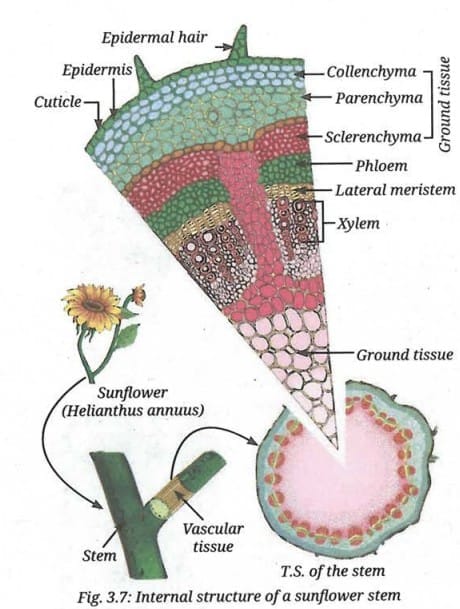
Compare the cross section of the stem of a fern, a pteridophytic plant (Fig. 12.11) with a cross section of sunflower stem you studied in Chapter 3 (Fig. 3.7).
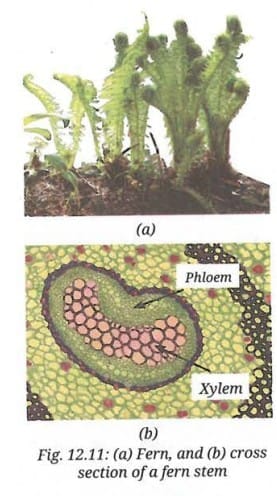
What difference do you observe in the vascular tissue of the fern stem and of the stem of higher plants? Write your observations. Share and discuss them in class.
Observations: In the fern stem, the vascular tissue (xylem and phloem) is present but arranged in a simpler pattern with fewer and less organised vascular bundles. The fern stem cross section shows vascular bundles scattered without a well-defined arrangement and the distinction between cortex and pith is less clear. In the sunflower stem, the vascular bundles are arranged in a clear ring, with a distinct cortex on the outside and a pith in the centre. Each vascular bundle has a clear arrangement of xylem on the inside and phloem on the outside with a bundle sheath. This shows that as plants evolved from pteridophytes to higher plants (angiosperms), the vascular system became more organised and efficient.
Activity 12.8: Let us discuss
Collect different leaves from your surroundings, and observe their shape and venation. Group them as monocots or dicots. Discuss how their structures help them adapt in different conditions to survive.
Ans. On collecting and observing leaves, you will find two broad patterns of venation. Leaves with parallel venation - such as grass, bamboo, maize, sugarcane - belong to monocots. Leaves with reticulate (net-like) venation - such as mango, rose, tulsi, neem - belong to dicots. Parallel venation provides even mechanical support along narrow leaves and is efficient for plants that grow in dense, competitive environments. Reticulate venation distributes water and nutrients to every part of a broad leaf surface, making it efficient for maximising photosynthesis. These structural differences reflect how each group has adapted to survive and thrive in its particular environment.
Activity 12.9: Let us study
- Carefully study the salient features of each plant group.
- Analyse the salient features, and write the advantages for survival of the group and the exceptions or challenges faced in the given columns.
Table 12.7: Classes of Kingdom Plantae with their advantages and challenges
| Plant groups and salient features | Advantages of the group for survival | Exceptions/Challenges |
|---|---|---|
| Thallophyta - Their body is like a thallus which facilitates easy absorption of water and nutrients, and exchange of gases from the surroundings. | Simple plant body facilitates survival and its dispersal in water. | They cannot live on land. _______________ |
| Bryophyta - Unlike algae, this group of plants began to colonise land but with strong dependence on moisture. Plant body shows slight differentiation in body parts but not in root, stem, or leaves. They lack vascular tissues for transporting water and food. They require water for reproduction, as male reproductive cells must swim to reach female cells. | They are plant amphibians. Their body is adapted to live on moist land. _______________ | They always need moisture. _______________ |
| Pteridophyta - Pteridophytes possess true roots, stems and leaves. They have vascular tissues (xylem and phloem) that transport water and food throughout the plant. They still depend on water for reproduction. They do not produce seeds. | They live on land. They transport food and water to all parts of the plant. _______________ | Reproduction does not take place without water. _______________ |
| Gymnosperm - They live on land. They have needle-like leaves which reduce water loss. Water is not essential for fertilisation. Their seeds are not enclosed in fruits and are exposed on cones. | Leaves are adapted for dry conditions. They do not require water for reproduction. They form seeds for continuity of life. _______________ | Seeds are not covered in the form of fruits. _______________ |
| Angiosperm - They possess well-developed roots, stems and leaves. They undergo sexual reproduction through flowers. Their seeds are enclosed within fruits. Their seeds disperse through insects or birds, animals, wind, or water. | They produce flowers, fruits and seeds. They have a well-developed system for reproduction. They produce seeds for continuity of life. Their seeds are covered. _______________ | Reproduction is dependent on pollination by different agents. They have complex processes through a well-developed tissue system. _______________ |
Observation:
Table 12.7: Classes of Kingdom Plantae with their advantages and challenges
| Plant groups and salient features | Advantages of the group for survival | Exceptions/Challenges |
|---|---|---|
| Thallophyta - Their body is like a thallus which facilitates easy absorption of water and nutrients, and exchange of gases from the surroundings. | Simple plant body facilitates survival and its dispersal in water. Direct absorption of nutrients from surroundings makes a complex transport system unnecessary. Simple structure allows rapid reproduction and colonisation of aquatic habitats. | They cannot live on land. They dry out quickly without water. They cannot grow tall as they lack structural support and vascular tissue. |
| Bryophyta - Unlike algae, this group of plants began to colonise land but with strong dependence on moisture. Plant body shows slight differentiation in body parts but not in root, stem, or leaves. They lack vascular tissues for transporting water and food. They require water for reproduction, as male reproductive cells must swim to reach female cells. | They are plant amphibians. Their body is adapted to live on moist land. They can colonise bare rocks and soil, preparing the ground for other plants. Rhizoids provide anchorage on land surfaces. | They always need moisture. They cannot grow in dry habitats. Reproduction requires water for male gametes to swim to female cells. They cannot grow tall due to the lack of vascular tissue. |
| Pteridophyta - Pteridophytes possess true roots, stems and leaves. They have vascular tissues (xylem and phloem) that transport water and food throughout the plant. They still depend on water for reproduction. They do not produce seeds. | They live on land. They transport food and water to all parts of the plant. True roots anchor the plant firmly and absorb water efficiently. Vascular tissue allows them to grow taller than bryophytes and compete for sunlight. | Reproduction does not take place without water. They cannot colonise truly dry habitats. They do not produce seeds, so their young ones are more vulnerable and less protected than seeds. |
| Gymnosperm - They live on land. They have needle-like leaves which reduce water loss. Water is not essential for fertilisation. Their seeds are not enclosed in fruits and are exposed on cones. | Leaves are adapted for dry conditions. They do not require water for reproduction. They form seeds for continuity of life. Seeds contain stored food for the embryo, increasing chances of survival. They can survive in cold and dry environments where other plants cannot. | Seeds are not covered in the form of fruits. Without fruits, seeds lack additional protection and efficient dispersal mechanisms. Seed dispersal is more limited compared to angiosperms. |
| Angiosperm - They possess well-developed roots, stems and leaves. They undergo sexual reproduction through flowers. Their seeds are enclosed within fruits. Their seeds disperse through insects or birds, animals, wind, or water. | They produce flowers, fruits and seeds. They have a well-developed system for reproduction. Flowers attract pollinators, making reproduction highly efficient. Fruits protect seeds and enable wide dispersal to new habitats. They are the most diverse and widespread plant group on Earth, occupying a wide range of environments. | Reproduction is dependent on pollination by different agents. In the absence of pollinators, reproduction fails. They have complex processes through a well-developed tissue system, requiring more energy and resources to maintain compared to simpler plant groups. |
FAQs on NCERT Based Activity: Patterns in Life: Diversity and Classification
| 1. What is the significance of classification in biology? |  |
| 2. How do scientists classify living organisms? | |
| 3. What are the main categories of living organisms in the NCERT classification system? | |
| 4. Why is the study of diversity important in understanding ecosystems? | |
| 5. What role do case studies play in the exploration of biological diversity? | |




