NCERT Based Activity: Earth as a System: Energy,Matter , and Life

Activity 13.1 : Let us explore
1. Observe the features of the Earth as shown in Fig. 13.1. Identify and circle one example representing each of the geosphere, hydrosphere, cryosphere, atmosphere, and biosphere.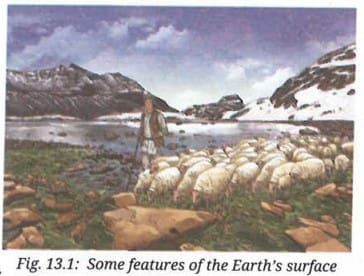
2. How does snow (cryosphere) eventually become part of the lake (hydrosphere)?
3. If there is less snowfall during winters for a few years, how would this affect the lake's level and the grass available for the sheep?
4. Discuss with your classmates and write down how all the spheres are interconnected, and how a disturbance in one can lead to changes in others.
Observation:
- The image shows several features of the Earth's surface simultaneously - snow-covered peaks (cryosphere), a lake (hydrosphere), the surrounding air (atmosphere), green pasture with sheep (biosphere), and rocky landforms (geosphere).
- Snow from the mountains (cryosphere) melts due to solar heating and flows downhill as meltwater, eventually entering the lake (hydrosphere).
- If snowfall decreases for several years, less meltwater reaches the lake, causing the lake level to fall. This results in less water available to support grass growth, which directly affects the sheep (biosphere).
- All spheres are interconnected - a change in one sphere triggers a chain of responses in the others, demonstrating that the Earth functions as one integrated system.
Explanation:
The Earth is made up of five interacting spheres - the geosphere (solid rocks and landforms), hydrosphere (liquid water in oceans, rivers, lakes), cryosphere (water in solid form as ice and snow), atmosphere (the air surrounding Earth) and biosphere (all living organisms and their habitats). These spheres are not isolated; they continuously exchange energy and matter.
Snow accumulates in the cryosphere during winter. As temperatures rise, the snow melts and the meltwater flows via streams and rivers (hydrosphere) into lakes. This water supports vegetation (biosphere) growing around the lake, which in turn is grazed upon by animals like sheep.
A reduction in snowfall (cryosphere disturbance) cascades through the system: less meltwater → lower lake levels (hydrosphere impact) → reduced grass growth (biosphere impact). On a larger scale, warmer Arabian Sea water leads to more evaporation, causing fluctuations in the southwest monsoon, bringing floods to some regions while leaving others in drought. Rising temperatures accelerate glacier melting, threatening coastal cities and disrupting ecosystems in the biosphere. This shows that a disturbance in one sphere leads to changes in all others - making Earth a dynamic, interconnected system.
Key Inference: Natural processes such as solar heating, movement of air and water, and nutrient cycling connect all spheres in a delicate balance. Understanding these connections is essential for predicting and responding to environmental changes
Think as a Scientist
An interesting estimation problem that helps us to appreciate the enormous amount of energy that we get from the Sun is to estimate how much of the Earth's surface would be needed to be covered with solar panels to supply all the electric power that our country uses today (Fig. 13.4). To make this estimate, you can find these numbers on the internet, assume some insolation on the Earth's surface and consider that some fraction of this energy is converted into electricity. You will probably find that even a fraction of the area of the Thar desert, if covered with solar panels, could supply India's electricity needs.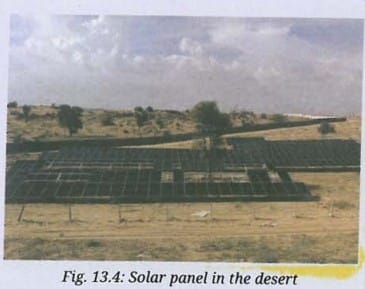
Ans. How to approach this problem:
Step 1 - Find India's total electricity consumption:Search for India's annual electricity consumption in kilowatt-hours (kWh) or total installed power capacity in gigawatts (GW). As of recent years, India consumes approximately 1,500-1,600 billion kWh of electricity per year, which equals a power demand of roughly 170-180 GW on average.
Step 2 - Assume insolation on Earth's surface:The maximum insolation reaching the Earth's surface under clear sky conditions is about 1 kWm⁻². However, solar panels do not receive peak sunlight for all 24 hours. A reasonable assumption is about 5-6 peak sun hours per day for most parts of India, giving an effective average insolation of roughly 200-250 Wm⁻².
Step 3 - Assume efficiency of solar panels:Modern solar panels convert about 15-20% of incoming solar energy into electricity. Using 18% as a reasonable figure:
- Effective power output per square metre = 250 × 0.18 ≈ 45 Wm⁻²
Step 4 - Calculate the area needed:
- Power needed = ~175 GW = 175 × 10⁹ W
- Area required = Power needed ÷ Power output per m²
- Area = (175 × 10⁹) ÷ 45 ≈ 3.9 × 10⁹ m² ≈ 3,900 km²
Observation:
- An area of roughly 3,900 km² covered with solar panels could potentially supply all of India's current electricity needs.
- The Thar Desert in Rajasthan alone covers over 200,000 km² - meaning even a small fraction (about 2%) of the Thar Desert, if covered with solar panels, could supply India's entire electricity demand.
- This shows that India has enormous untapped solar energy potential, especially in its arid and semi-arid regions that receive abundant sunlight throughout the year.
Explanation:
India lies in the tropical and sub-tropical regions and receives abundant solar insolation throughout the year. The solar constant - the average solar energy available at the top of the Earth's atmosphere - is approximately 1.4 kWm⁻². After absorption and scattering by the atmosphere, about 1 kWm⁻² reaches the Earth's surface under clear sky conditions.
This estimation exercise reveals two important ideas. First, the Sun provides an almost unimaginably large amount of energy - covering just a tiny fraction of our desert land with solar panels is sufficient to meet the entire electricity demand of a country of 1.4 billion people. Second, solar energy is clean, renewable and inexhaustible on human timescales, making it one of the most promising solutions to India's growing energy needs while also helping reduce carbon emissions.
India's pioneering atmospheric scientist Anna Mani mapped solar insolation across India in the 1950s and published Solar Radiation Over India in 1981, creating the country's first insolation atlas. Her work laid the scientific foundation for what is now being realised through the large-scale deployment of solar power across India.
Key Takeaway: You will probably find that even a fraction of the area of the Thar Desert, if covered with solar panels, could supply India's electricity needs - demonstrating the immense potential of solar energy as a renewable and sustainable source of power for our country.
Activity 13.2 : Let us find out
Complete Table 13.1 using information from authentic sources like websites and books.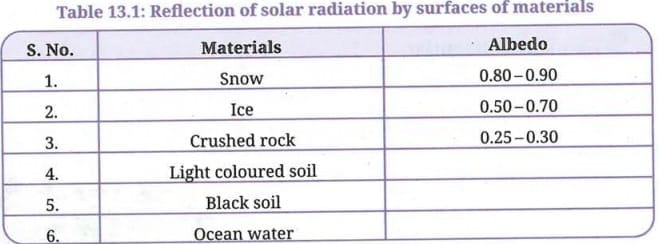
Observation:
Table 13.1: Reflection of solar radiation by surfaces of materials
| S. No. | Materials | Albedo |
|---|---|---|
| 1. | Snow | 0.80 - 0.90 |
| 2. | Ice | 0.50 - 0.70 |
| 3. | Crushed rock | 0.25 - 0.30 |
| 4. | Light coloured soil | 0.25 - 0.45 |
| 5. | Black soil | 0.05 - 0.15 |
| 6. | Ocean water | 0.06 - 0.10 |
- Snow and ice have the highest albedo values (0.50-0.90), meaning they reflect the greatest proportion of incoming solar radiation.
- Black soil and ocean water have the lowest albedo values (0.05-0.15 and 0.06-0.10 respectively), meaning they absorb the most solar radiation.
- Light coloured soil has a moderate albedo (0.25-0.45) - it reflects more radiation than dark soil but less than ice or snow.
- Crushed rock shows an intermediate albedo (0.25-0.30), absorbing a moderate amount of solar radiation.
- Surfaces with high albedo tend to stay cooler, while those with low albedo heat up more rapidly under sunlight.
Explanation:
Albedo is the fraction of incoming solar radiation that a surface reflects back into space. It is expressed as a value between 0 (no reflection - complete absorption) and 1 (complete reflection - no absorption). The word 'albedo' comes from Latin, meaning whiteness.
Light-coloured and shiny surfaces such as snow and ice have high albedo because they reflect most of the incoming solar radiation without absorbing much energy. This is why polar regions covered in snow and ice remain very cold - the energy from the Sun is mostly reflected away rather than being absorbed to warm the surface.
Dark-coloured surfaces such as black soil and ocean water have low albedo. They absorb a large proportion of the incoming solar radiation, converting it into heat. This makes such surfaces significantly warmer. For example, dark asphalt roads heat up much faster than concrete or gravel roads on a sunny day.
This principle has major implications for Earth's climate. As global warming causes ice sheets and glaciers to melt, the highly reflective white ice is replaced by dark ocean water or dark soil, both of which have low albedo. This causes more solar energy to be absorbed, further warming the Earth - a process known as the ice-albedo feedback loop.
Key Relationship: Albedo = (Solar radiation reflected) ÷ (Solar radiation received) | High albedo → More reflection → Surface stays cooler | Low albedo → More absorption → Surface heats up faster
FAQs on NCERT Based Activity: Earth as a System: Energy,Matter , and Life
| 1. What is the Earth System and how does it function? |  |
| 2. How do energy and matter flow through the Earth System? | |
| 3. What role does the biosphere play in the Earth System? | |
| 4. Why is understanding Earth as a system important for environmental science? | |
| 5. What are some examples of Earth system interactions? | |




