UPSC Exam > UPSC Notes > History CSE > Mind Map: Era of Mass Nationalism Begins (1919-1939)
Mind Map: Era of Mass Nationalism Begins (1919-1939)

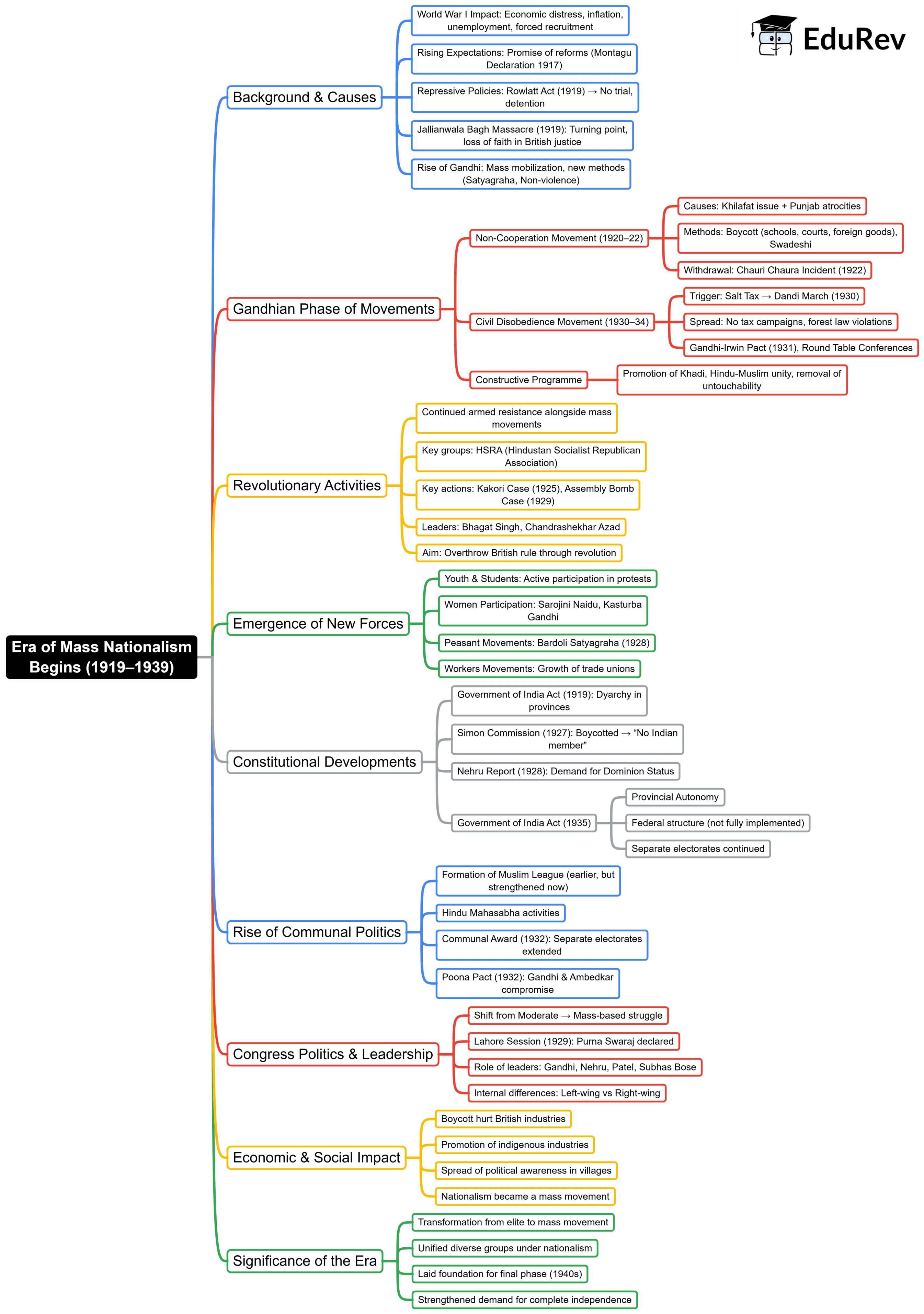
The document Mind Map: Era of Mass Nationalism Begins (1919-1939) is a part of the UPSC Course History for UPSC CSE.
All you need of UPSC at this link: UPSC
FAQs on Mind Map: Era of Mass Nationalism Begins (1919-1939)
| 1. What were the key factors that contributed to the rise of mass nationalism between the two World Wars? |  |
Ans. The rise of mass nationalism during the interwar period was influenced by several factors, including the disillusionment following World War I, the impact of the Treaty of Versailles, economic turmoil, and the desire for self-determination among various ethnic groups. The spread of nationalist ideologies was further propelled by the global economic crisis, which led to widespread social and political unrest, fostering a sense of unity and identity among people in various nations.
| 2. How did the Treaty of Versailles impact nationalist movements in different countries? | |
Ans. The Treaty of Versailles, signed in 1919, imposed heavy reparations and territorial losses on Germany, which sparked nationalist sentiments and resentment. Additionally, it led to the redrawing of borders and the creation of new nations in Eastern Europe and the Middle East, often without regard for ethnic or cultural groups. This resulted in nationalist movements seeking self-rule and autonomy in various regions, as populations felt aggrieved by the arbitrary nature of the treaty's terms.
| 3. What role did economic factors play in the rise of nationalism during this era? | |
Ans. Economic factors played a significant role in the rise of nationalism, particularly the Great Depression, which began in the late 1920s. The economic instability and high unemployment rates caused widespread discontent and a longing for national unity and strength. Nationalist leaders often exploited these economic hardships to rally support for their causes, promising recovery and prosperity through the assertion of national identity and sovereignty.
| 4. How did mass communication contribute to the spread of nationalist ideas in this period? | |
Ans. Mass communication, through the advent of radio, newspapers, and later cinema, significantly contributed to the spread of nationalist ideas. These platforms allowed nationalist leaders to reach wider audiences, disseminating their messages and uniting people around common goals. The ability to share propaganda and national narratives fostered a collective identity, galvanising support for nationalist movements across different regions and countries.
| 5. What were some of the consequences of mass nationalism during the interwar period? | |
Ans. The consequences of mass nationalism during the interwar period were profound, leading to both positive and negative outcomes. On one hand, it inspired movements for independence and self-determination in various regions, promoting national pride. On the other hand, it also contributed to the rise of totalitarian regimes, militarism, and ultimately, the outbreak of World War II as aggressive nationalist movements sought territorial expansion and dominance.
About this Document

4.95/5 Rating

Apr 30, 2026 Last updated
Related Exams
Document Description: Mind Map: Era of Mass Nationalism Begins (1919-1939) for UPSC 2026 is part of History for UPSC CSE preparation. The notes and questions for Mind Map: Era of Mass Nationalism Begins (1919-1939) have been prepared according to the UPSC exam syllabus. Information about Mind Map: Era of Mass Nationalism Begins (1919-1939) covers topics like and Mind Map: Era of Mass Nationalism Begins (1919-1939) Example, for UPSC 2026 Exam. Find important definitions, questions, notes, meanings, examples, exercises and tests below for Mind Map: Era of Mass Nationalism Begins (1919-1939).
Introduction of Mind Map: Era of Mass Nationalism Begins (1919-1939) in English is available as part of our History for UPSC CSE for UPSC & Mind Map: Era of Mass Nationalism Begins (1919-1939) in Hindi for History for UPSC CSE course. Download more important topics related with notes, lectures and mock test series for UPSC Exam by signing up for free. UPSC: Mind Map: Era of Mass Nationalism Begins (1919-1939)
Description
Mind Map: Era of Mass Nationalism Begins (1919 of History provides you one-page visual summary of the chapter covering all the important topics. Download the PDF from EduRev.
Information about Mind Map: Era of Mass Nationalism Begins (1919-1939)
In this doc you can find the meaning of Mind Map: Era of Mass Nationalism Begins (1919-1939) defined & explained in the simplest way possible. Besides explaining types of Mind Map: Era of Mass Nationalism Begins (1919-1939) theory, EduRev gives you an ample number of questions to practice Mind Map: Era of Mass Nationalism Begins (1919-1939) tests, examples and also practice UPSC tests



Related Searches
Important questions, Free, mock tests for examination, Mind Map: Era of Mass Nationalism Begins (1919-1939), video lectures, study material, MCQs, Exam, Summary, Viva Questions, Mind Map: Era of Mass Nationalism Begins (1919-1939), pdf , past year papers, Objective type Questions, Mind Map: Era of Mass Nationalism Begins (1919-1939), ppt, shortcuts and tricks, Previous Year Questions with Solutions, Sample Paper, Extra Questions, practice quizzes, Semester Notes;