CBSE Class 9 > Class 9 Notes > Science > NCERT Solutions: The Fundamental Unit of Life
NCERT Solutions: The Fundamental Unit of Life

Page No. 51
Q1. Who discovered cells and how?
Ans: The cell was first discovered by Robert Hooke in 1665. He examined thin slices of cork under a self-made microscope and saw a multitude of tiny hollow spaces that he remarked looked like the walled compartments of a honeycomb. He termed these spaces as 'cell' meaning 'small room' in Latin. Microscope and Cork cells
Q2. Why is the cell called the structural and functional unit of life?
Ans:
- All living organisms are made up of cells. This shows that the cell is the structural unit of life.
- Each living cell can perform certain basic functions that are characteristic of all living forms.
Example:
(i) Phagocytic cells eat or kill unwanted or foreign particles inside the body (e.g., WBCs).
(ii) Some cells secrete enzymes and hormones, e.g., pancreatic cells, small intestinal cells, and liver cells.
Page No. 53
Q1. How do substances like CO2 and water move in and out of the cell? Discuss.
Ans: CO2 moves by diffusion - This cellular waste accumulates in high concentrations in the cell, whereas the concentration of CO2 in the external surroundings is comparatively lower. This difference in the concentration level inside and outside of the cell causes the CO2 to diffuse from a higher (within the cell) region to a lower concentration.
H2O diffuses by osmosis through the cell membrane. It moves from a region of higher concentration to a lower concentration region through a selectively permeable membrane until equilibrium is reached.
Q2. Why is the plasma membrane called a selectively permeable membrane?
Ans: The plasma membrane allows or permits the entry and exit of some materials in and out of the cell and prevents the movement of some other materials through it. Hence, it is called a selectively permeable membrane.
Page No. 55
Q1. Fill in the gaps in the following table illustrating the differences between prokaryotic and eukaryotic cells.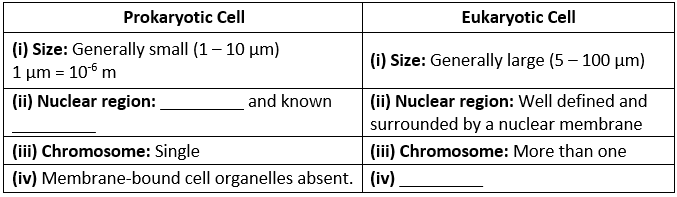
Ans: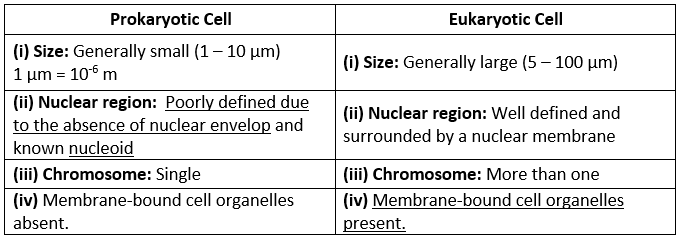
Page No. 57
Q1. Can you name the two organelles we have studied that contain their genetic material?
Ans: Two organelles that contain their genetic material are Mitochondria and Plastids. Mitochondria help in respiration in the cell, while plastids are responsible for the process of photosynthesis in leaves.
Q2. If the organization of a cell is destroyed due to some physical or chemical influence, what will happen?
Ans:
- Cell organelles are responsible for the organization and proper functioning of a cell, as each of them performs some specific functions.
- Naturally, if any of these organelles are destroyed, the cell will not be able to perform many basic functions like photosynthesis, respiration, nutrition, etc., and may also result in the stopping of all life activities in the cell. Due to the cell damage, the lysosome bursts, and their enzymes digest such cells.
Q3. Why are lysosomes known as suicide bags?
Ans: Lysosomes are the cell organelles involved in the digestion of any foreign material that enters the cell, as they contain digestive enzymes. In case any cell is dead or damaged, the lysosome bursts to release the digestive enzymes to digest its cell. Thus, these are known as 'suicide bags'.
Q4. Where are proteins synthesized inside the cell?
Ans: Proteins (chains of amino acids) are synthesized on ribosomes. These ribosomes may be free in the cytoplasm (making proteins for use inside the cell) or bound to the Rough Endoplasmic Reticulum (making proteins for secretion or membranes). The Rough Endoplasmic Reticulum looks "rough" because ribosomes stud its surface.
Page No. 59
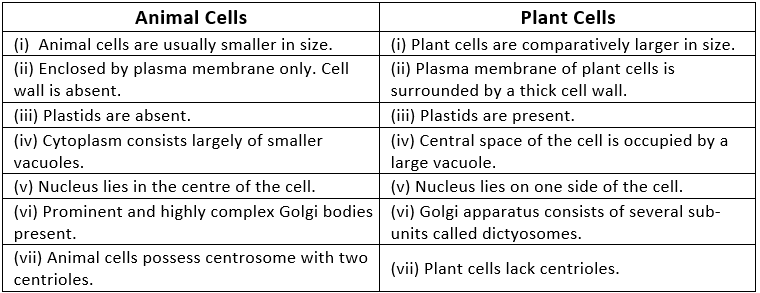
Q1. Make a comparison and write down ways in which plant cells are different from animal cells.
Ans:
Q2. How is a prokaryotic cell different from a eukaryotic cell?
Ans: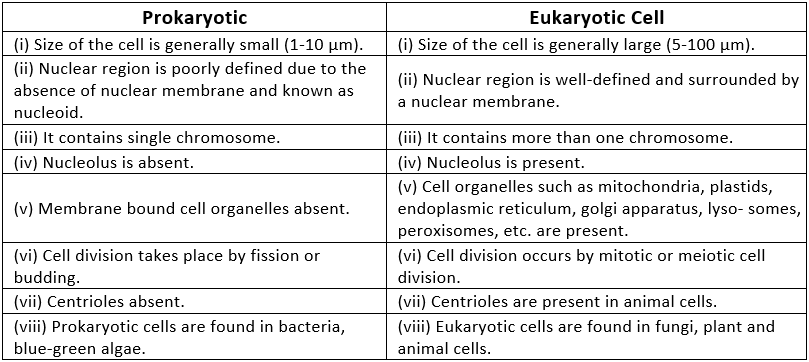
Q3. What would happen if the plasma membrane ruptures or breaks down?
Ans: Plasma membrane is a selectively permeable membrane of the cell that maintains its homeostasis, i.e., constant internal composition of the cell. If it ruptures or breaks down the constant internal chemical composition of the cell will be lost and it will not be able to perform its basic functions. Such a cell with ruptured plasma membrane is killed.
Q4. What would happen to the life of a cell if there was no Golgi apparatus?
Ans:
- If there were no Golgi apparatus, the material synthesized by the endoplasmic reticulum would not be carried to the various parts inside and outside of the cell.
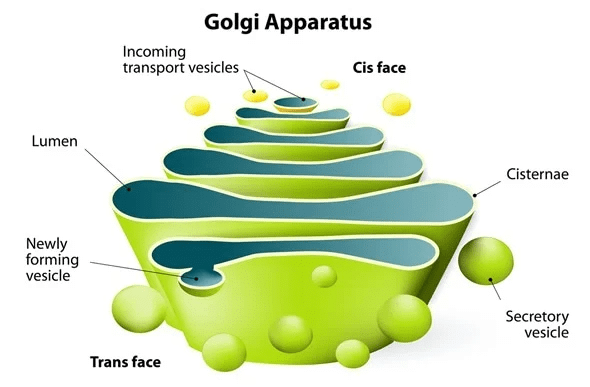
- Also, as the Golgi apparatus performs the function of storage and modification of the material synthesized in the cell, these materials would not be stored and modified further.
- Moreover, there will be no production of lysosomes, which will cause the accumulation of waste material, viz., worn out and dead cell organelles within the cell, which will ultimately lead to cell death.
Q5. Which organelle is known as the powerhouse of the cell? Why
Ans: Mitochondria are known as the powerhouse of the cell because these are the sites of cellular respiration.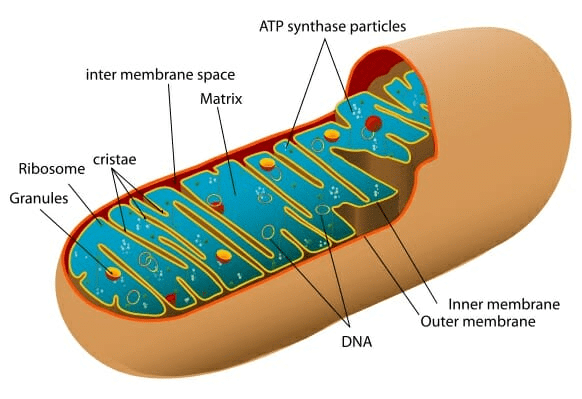 Mitochondria
The energy that is released by the mitochondria is in the form of ATP molecules and is required for various chemical activities needed for. The energy stored in ATP is used by the body to make new chemical compounds and to perform mechanical work.
Thus, mitochondria are known as the powerhouse of cells.
Q6. Where do the lipids and proteins constituting the cell membrane get synthesized?
Ans: The smooth endoplasmic reticulum is responsible for the synthesis of lipids, while the rough endoplasmic reticulum is responsible for the synthesis of proteins.
Q7. How does an Amoeba obtain its food?
Ans: Amoeba takes in food using temporary finger-like extensions of the cell surface, which fuse over the food particle, forming a food vacuole as shown in the figure.
Inside the food vacuole, complex substances are broken down into simpler ones, which then diffuse into the cytoplasm. The remaining undigested material is moved to the surface of the cell and thrown out.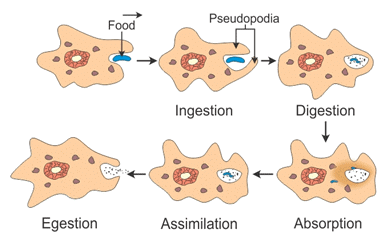 Nutrition in Amoeba
Q8. What is osmosis?
Ans: It is the passage of solvent from a region of high concentration to a region of low concentration through a semipermeable membrane.
Q9. Carry out the following osmosis experiment
Take four peeled potato halves and scoop each one out to make potato cups. One of these potato cups should be made from a boiled potato. Put each potato cup in a trough containing water. Now,
(a) Keep cup A empty.
(b) Put one teaspoon of sugar in cup B
(c) Put one teaspoon salt in cup C
(d) Put one teaspoon of sugar in the boiled potato cup D.
Keep these for two hours. Then observe the four potato cups and answer the following
(i) Explain why water gathers in the hollowed portion of B and C.
(ii) Why is potato A necessary for this experiment?
(iii) Explain why water does not gather in the hollowed-out portions of A and D.
Ans: 
(i) Water gathers in B and C because in both the situations there is difference in the concentration of water in the trough and water in the cup of Potato. Hence, osmosis takes place as the potato cells act as a semi-permeable membrane.
(ii) Potato A is necessary for this experiment for comparison, it acts as a control.
(iii) Water does not gather in the hollowed out portions of A and D. As cup of A does not have change in the concentration for water to flow. For osmosis to occur one of the concentration should be higher than the other.
In cup D, the cells are dead and hence the semi-permeable membrane does not exists for the flow of water and no osmosis takes place.
Q10. Which type of cell division is required for the growth and repair of the body and which type is involved in the formation of gametes?
Ans: For growth and repair, mitotic division (mitosis) is involved as this type of division keeps the chromosome number constant. For gamete formation, meiosis is involved as a reduction of chromosome number is necessary for this case.
The document NCERT Solutions: The Fundamental Unit of Life is a part of the Class 9 Course Science Class 9.
All you need of Class 9 at this link: Class 9
FAQs on NCERT Solutions: The Fundamental Unit of Life
| 1. What is the difference between prokaryotic and eukaryotic cells in CBSE Class 9 Science? |  |
Ans. Prokaryotic cells lack a membrane-bound nucleus and organelles, found in bacteria and archaea. Eukaryotic cells contain a true nucleus and membrane-enclosed organelles like mitochondria and chloroplasts, present in animals and plants. The fundamental unit of life exists in both forms, but eukaryotic cells are significantly larger and more complex in structure and function.
| 2. Why is the cell membrane selectively permeable and what does it control? | |
Ans. The cell membrane selectively permits certain substances to pass while blocking others, maintaining internal cell stability. This semi-permeable boundary controls nutrient entry, waste removal, and communication with neighbouring cells. The phospholipid bilayer structure with embedded proteins enables selective transport, making it essential for cell survival and regulation of cellular activities.
| 3. What are the main differences between plant and animal cell organelles? | |
Ans. Plant cells contain chloroplasts for photosynthesis and a rigid cell wall for structural support, absent in animal cells. Animal cells have centrioles aiding cell division, which plants lack. Both share mitochondria, nuclei, and endoplasmic reticulum, but organelle arrangement and function differ significantly, reflecting each cell type's specific biological role and adaptation.
| 4. How do mitochondria and chloroplasts function as the powerhouses in different cell types? | |
Ans. Mitochondria produce ATP through aerobic respiration in all cells, supplying energy for cellular processes. Chloroplasts in plant cells convert light energy into chemical energy during photosynthesis. Both organelles contain their own DNA and ribosomes, suggesting an evolutionary origin. Their double membrane structure enables efficient energy transformation, making them vital for cell survival and metabolism.
| 5. What happens during binary fission and how is it different from mitosis in cell division? | |
Ans. Binary fission is asexual reproduction in prokaryotes producing two identical daughter cells without spindle formation. Mitosis, occurring in eukaryotes, involves chromosomal separation through spindle fibres, producing genetically identical cells. Binary fission is simpler and faster, while mitosis includes prophase, metaphase, anaphase, and telophase stages, enabling growth and repair in complex organisms studied in Class 9 Biology.
About this Document

59.1K Views

4.76/5 Rating

Apr 21, 2026 Last updated
Related Exams
Document Description: NCERT Solutions: The Fundamental Unit of Life for Class 9 2026 is part of Science Class 9 preparation. The notes and questions for NCERT Solutions: The Fundamental Unit of Life have been prepared according to the Class 9 exam syllabus. Information about NCERT Solutions: The Fundamental Unit of Life covers topics like and NCERT Solutions: The Fundamental Unit of Life Example, for Class 9 2026 Exam. Find important definitions, questions, notes, meanings, examples, exercises and tests below for NCERT Solutions: The Fundamental Unit of Life.
Introduction of NCERT Solutions: The Fundamental Unit of Life in English is available as part of our Science Class 9 for Class 9 & NCERT Solutions: The Fundamental Unit of Life in Hindi for Science Class 9 course. Download more important topics related with notes, lectures and mock test series for Class 9 Exam by signing up for free. Class 9: NCERT Solutions: The Fundamental Unit of Life
Description
NCERT Solutions: The Fundamental Unit of Life of Science Class 9 provides all the questions of NCERT textbook with detailed solutions. Download free PDF from EduRev.
Information about NCERT Solutions: The Fundamental Unit of Life
In this doc you can find the meaning of NCERT Solutions: The Fundamental Unit of Life defined & explained in the simplest way possible. Besides explaining types of NCERT Solutions: The Fundamental Unit of Life theory, EduRev gives you an ample number of questions to practice NCERT Solutions: The Fundamental Unit of Life tests, examples and also practice Class 9 tests



Related Searches
pdf , ppt, Free, NCERT Solutions: The Fundamental Unit of Life, Exam, shortcuts and tricks, Objective type Questions, practice quizzes, past year papers, Summary, Important questions, study material, NCERT Solutions: The Fundamental Unit of Life, video lectures, Sample Paper, Semester Notes, MCQs, Viva Questions, mock tests for examination, Extra Questions, NCERT Solutions: The Fundamental Unit of Life, Previous Year Questions with Solutions;