Numerical Problems (Solved): Force and Newton's Law of Motion

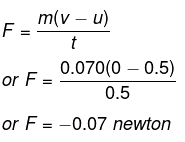
Q1: A cricket ball of mass 70 g moving with a velocity of 0.5 m s-1 is stopped by player in 0.5 s. What is the force applied by player to stop the ball?
Sol. Here m = 70 g = 0.070 kg; u = 0.5 m s-1; v = 0; t = 0.5 s
Q2: What will be the acceleration of a body of mass 5 kg if a force of 200 N is applied to it?
Sol. Here m = 5 kg; F = 200 N
F = ma or a = F/m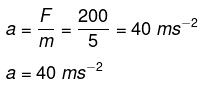
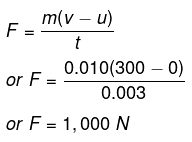
Q3: A bullet of mass 10 g is fired from a rifle. The bullet takes 0.003 s to move through its barrel and leaves with a velocity of 300 ms-1. What is the force exerted on the bullet by the rifle?
Sol. Here m = 10 g = 0.010 kg ; u = 0 ; v = 300 m s-1
t = 0.003 s, F = ?
Q4: A truck of mass 1500 kg is moving along a straight road with a uniform velocity of 72 km/h. Its velocity is reduced to 36 km/h in 6 seconds due to an external braking force. Calculate the acceleration and the change in momentum. Also, calculate the magnitude of the force required.
Sol. Mass of the truck: m = 1500 kg
Initial velocity of the truck: u = 72 km/hTo convert km/h to m/s: multiply the number by 5/18
u = 72 × 5/18 m/s = 20 m/s
Final velocity of the truck: v = 36 km/h
v = 36 × 5/18 m/s = 10 m/s
Time: t = 6 s
Acceleration:
a = v - ut
a = 10 - 20 x 6 = -10/6 m/s² = -1.67 m/s²
Momentum change:
Δp = mv - mu or m(v - u)
= 1500 × (10 - 20)
= 1500 × (-10)
= -15000 kg m/s
Magnitude of force: F = ma
= 1500 × (-1.67) = -2505 N
The acceleration, momentum change, and force are opposing the motion of the truck, as indicated by the negative sign.
Q5: A cricket ball of mass 200 g is moving with a speed of 40 m/s and is caught by a fielder, bringing it to rest in 0.02 s. What is the force exerted by the fielder's hand on the ball?
Sol. Mass of the ball: M = 200 g = 0.2 kg
Initial velocity of the ball: u = 40 m/s
Final velocity of the ball: v = 0
Time: t = 0.02 s
Acceleration of the ball:
a = v - ut = 0 - 40 x 0.02 = -2000 m/s²
Force exerted by the fielder's hand: F = ma
= (0.2) × (-2000 m/s²) = -400 N (opposite to the motion of the ball).
Q6: How much momentum will a basketball of mass 5 kg transfer to the ground if it falls from a height of 50 cm and does not rebound? Take its downward acceleration to be 10 m/s2.
Sol. Height: h = 50 cm = 0.5 m
Mass: m = 5 kg
Initial velocity: u = 0
Acceleration: a = 10 m/s²
Final velocity:
v = √(u² + 2ah) = √(0 + 2 × 10 × 0.5) = √10 m/s = 3.16 m/s
Momentum transferred:
mv = 5 kg × 3.16 m/s = 15.8 kg m/s
Q7: Which would require greater force: accelerating a 10 g mass at 5 m s_2 or 20 g mass at 2 m s-2?
Sol. In first case m1 = 10 g = kg = 0.010 kg;
Now a1 = 5 ms-2 ; F1 = ?
F1 = m1a1 = 0.010 × 5
F1 = 0.050 N
In second case, m2 = 20 g =0.020 kg
or m2 = 0.020 kg
a2 = 2 m s-2 ; F2 = ?
Now F2 = m2a2 = 0.020 × 2
or F2 = 0.04 N
We find that F1 > F2, hence more force is required to accelerate 10 g at 5 m s-2 than accelerating 20 g at 2 ms-2.
Q8: A force of 5 N gives a mass m1, an acceleration of 8 ms-2 and a mass m2, an acceleration of 24 m s-2. What acceleration would it give if both the masses were tied together?
Sol. Let us first find mass m1 and m2.
F = m1 a1
5 =m1 (8) or m1 = 5/8 kg
F = m2 a2
5 = m2 (24) or m2 = 5/24 kg
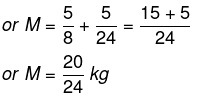
Total mass M = m1 + m2
Let A be the acceleration produced in mass M.
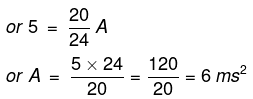
F = MA
Hence, the acceleration of the combination is 6 ms-2.
Q9: A cart of mass 150 kg is accelerated uniformly from a velocity of 4 m/s to 10 m/s in 5 s. Calculate the initial and final momentum of the cart. Also, find the magnitude of the force exerted on the cart.
Sol. Mass of the cart: m = 150 kg
Initial velocity: u = 4 m/s
Final velocity: v = 10 m/s
Time: t = 5 s
Initial momentum:
Pinitial = mu = 150 × 4 = 600 Ns
Final momentum:
Pfinal = mv = 150 × 10 = 1500 Ns
Force exerted on the cart:
F = m (v - u) / t = 150(10 - 4)/ 5 = 180 N
Q10: A car of mass 2 kg travelling in a straight line with a velocity of 15 m/s collides with and sticks to a stationary cart of mass 8 kg. They then move off together in the same straight line. Calculate the total momentum just before the impact and just after the impact. Also, calculate the velocity of the combined object.
Sol. Mass of the car: m₁ = 2 kg
Velocity of the car before collision: v₁ = 15 m/s
Mass of the stationary cart: m₂ = 8 kg
Velocity of the cart before collision: v₂ = 0
Total momentum before collision:
Pbefore = m₁v₁ + m₂v₂ = (2 × 15) + (8 × 0) = 30 kg m/s
It is given that after the collision, the car and the cart stick together.
Total mass of the combined system: (m₁ + m₂)
Velocity of the combined object: v
According to the law of conservation of momentum:
Total momentum before collision = Total momentum after collision
(m₁v₁ + m₂v₂) = (m₁ + m₂) v
(2 × 15) + (8 × 0) = (2 + 8) v
30 = 10 v
v = 30 / 10 = 3 m/s
Total momentum just before the impact: 30 kg m/s
Total momentum just after the impact: (m₁ + m₂) v = 10 × 3 = 30 kg m/s
Hence, the velocity of the combined object after the collision = 3 m/s.
Q11: The Velocity versus time graph of a ball of mass 100 g rolling on a concrete floor is shown below. Calculate the acceleration and the frictional force of the floor on the ball?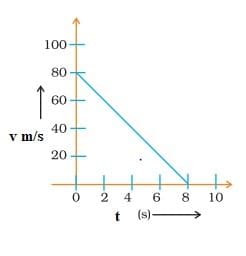
Sol. From the graph, we can see that
Δv=-80m/s, t=8 sec
Now
a=Δvt=-10m/s2
Frictional force will be given as
F=ma=0.1×-10=-1N
Q12: A man weighing 60 kg runs along the rails with a velocity of 18 km/h and jumps into a car of mass 1 quintal (100 kg) standing on the rails. Calculate the velocity with which the car will start travelling along the rails.
Sol. Here m= 60 kg ,u1= 18 km/hr = 5 m/s , M=100 kg ,u2=0
Let v be the velocity with car start travelling
Now
mu1+Mu2=(M+m)v
60×5=160v
v= 1.875 m/s
Q13: Two objects, A and B, having masses of 100 kg and 75 kg, are moving with velocity 40 km/hr and 6 km/hr respectively. Answer the following:
a.Which will have greater inertia?
b.Which will have greater momentum?
c.Which will stop first if equal negative acceleration is applied to both?
d.Which will travel a greater distance?
e.Which will impart greater impulse if it collides with a wall?
Sol. Ma=100 kg, Mb=75 kg, va=40km/hr, vb=6km/hr
a. Now Ma>Mb, so Object A has more inertia
b. pa=Mava=4000 kg km/hr, pb=Mbvb=450 kg km/hr
Clearly pa>pb
c. Since velocity of object B is less then velocity of object A, Object B will stops first if equal negative acceleration is applied on both
d. Object A
e. Object A
Q14: Two objects of masses of 100 g and 200 g are moving along the same line and direction with velocities of 2 m/s and 1 m/s , respectively. They collide, and after the collision, the first object moves at a velocity of 1.67 ms-1. Determine the velocity of the second object?
Sol. Given m1=100g=0.1kg, m2=200gm=0.2kg
u1=2 ms-1, u2=1 ms-1, v1=1.67 ms-1, v2=?
By the law of conservation of momentum,
m1u1 + m2u2 = m1v2 + m2v2
0.1×2 + 0.2×1 = 0.1×1.67 + 0.2v2
v2 = 1.165 ms-1
It will move in the same direction after the collision.
Q15: A hockey ball of mass .2 Kg travelling at 10 ms-1 is struck by a hockey stick so as to return it along its original path with a velocity of 2 m/s. Calculate the change of momentum that occurred in the motion of the hockey ball due to the force applied by the hockey stick.
Sol. ΔP=m×(v-u)=0.2×(-2-10)=-2.4 kg ms-1
(The negative sign indicates a change in direction of hockey ball after it is struck by hockey stick. )
FAQs on Numerical Problems (Solved): Force and Newton's Law of Motion
| 1. How do I solve numerical problems on Newton's second law of motion for Class 9 CBSE? |  |
| 2. What's the difference between mass and weight when solving force problems? | |
| 3. Why do I get different answers when calculating net force in problems with multiple forces? | |
| 4. How do I approach problems involving friction force and applied force together? | |
| 5. What's the best way to understand and apply Newton's third law in numerical problems? | |