NCERT Solutions: Units & Measurement

Q1.1: Fill in the blanks
(a) The volume of a cube of side 1 cm is equal to ______ m3
(b) The surface area of a solid cylinder of radius 2.0 cm and height 10.0 cm is equal to ______ (mm)2
(c) A vehicle moving with a speed of 18 km h-1covers ______ m in 1 s
(d) The relative density of lead is 11.3. Its density is ______ g cm-3or ______ kg m-3.
Ans: (a) 1 cm = (1/100)m
Volume of the cube = 1 cm3
But, 1 cm3 = 1 cm × 1 cm × 1 cm
= (1/100) m × (1/100) m × (1/100)m
∴ 1 cm3 = 10-6 m3
Hence, the volume of a cube of side 1 cm is equal to 10-6 m3.
(b) The total surface area of a cylinder of radius r and height h is
S = 2πr (r + h).
Given that,
r = 2 cm = 2 × 1 cm
= 2 × 10 mm = 20 mm
h = 10 cm = 10 × 10 mm
= 100 mm
∴ S = 2 × 3.14 × 20 × (20 + 100)
= 2 × 3.14 × 20 × 120 = 15072 mm2 ≈ 1.50 × 104 mm2
(c) Using the conversion,
1 km/h = (5/18) m/s
18 km/h = 18 × (5/18) = 5 m/s
Distance = Speed × Time = 5 × 1 = 5 m
Hence, the vehicle covers 5 m in 1 s.
(d) Relative density = (Density of substance)/(Density of water)
Density of water = 1 g cm-3
Density of lead = Relative density × Density of water = 11.3 × 1 = 11.3 g cm-3
1 g cm-3 = 103 kg m-3
∴ 11.3 g cm-3 = 11.3 × 10³ kg m-3 = 1.13 × 10⁴ kg m-3.
Therefore, the density of lead is 11.3 g cm-3 or 1.13 × 10⁴ kg m-3.
Q1.2: Fill in the blanks by suitable conversion of units:
(a) 1 kg m2s-2= ______ g cm2 s-2
(b) 1 m =______ ly
(c) 3.0 m s-2=______ km h-2
(d) G= 6.67 × 10⁻¹¹ N m2 (kg)-2=______ (cm)3s-2 g-1.
Ans: (a) 1 kg = 103 g
1 m2 = 104 cm2
1 kg m2 s-2 = 1 kg × 1 m2 × 1 s-2
=103 g × 104 cm2 × 1 s-2 = 107 g cm2 s-2
(b) Light year is the distance travelled by light in one year.
1 ly = Speed of light × One year
= (3 × 10⁸ m/s) × (365 × 24 × 60 × 60 s)
= 9.46 × 10¹⁵ m
∴ 1 m = 1/(9.46 × 1015) ly ≈ 1.057 × 10⁻¹⁶ ly
(c) 1 m = 10-3 km
1 s-2 = (3600)2 h-2
∴ 3.0 m s-2 = 3.0 × 10-3 km × (3600)2 h-2
= 3.0 × 10-3 × 1.296 × 107 km h-2 = 3.888 × 10⁴ km h-2 ≈ 3.89 × 10⁴ km h-2
(d) 1 N = 1 kg m s-2
G = 6.67 × 10⁻¹¹ N m2 kg-2 = 6.67 × 10⁻¹¹ m3 s-2 kg-1
1 m3 = 106 cm3, 1 kg = 103 g
∴ G = 6.67 × 10-11 × 106 × 10-3 cm3 s-2 g-1 = 6.67 × 10⁻⁸ cm3 s-2 g-1.
Q1.3: A calorie is a unit of heat or energy and it equals about 4.2 J where 1 J = 1 kg m2s-2. Suppose we employ a system of units in which the unit of mass equals α kg, the unit of length equals β m, the unit of time is γ s. Show that a calorie has a magnitude 4.2 α-1 β-2 γ2 in terms of the new units.
Ans. Given that 1 calorie = 4.2 J = 4.2 × (1 kg) (1 m2) (1 s-2)
In the new system: 1 unit of mass = α kg ⇒ 1 kg = α-1 (new mass units).
1 unit of length = β m ⇒ 1 m = β-1 (new length units) so 1 m2 = β-2.
1 unit of time = γ s ⇒ 1 s = γ-1 (new time units) so 1 s-2 = γ2.
Therefore, 1 calorie = 4.2 × (α-1) × (β-2) × (γ2) = 4.2 α-1 β-2 γ2 (in the new units).
Q1.4: Explain this statement clearly:
"To call a dimensional quantity 'large' or 'small' is meaningless without specifying a standard for comparison". In view of this, reframe the following statements wherever necessary:
(a) Atoms are very small objects
(b) A jet plane moves with great speed
(c) The mass of Jupiter is very large
(d) The air inside this room contains a large number of molecules
(e) A proton is much more massive than an electron
(f) The speed of sound is much smaller than the speed of light.
Ans: The statement means that words like "large" or "small" need a reference for comparison. What is large compared with one standard may be small compared with another.
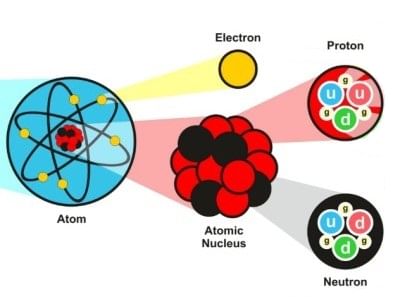 Size Comparision
Examples of reframed comparisons:
(a) An atom is very small compared with a soccer ball.
(b) A jet plane moves much faster than a bicycle.
(c) The mass of Jupiter is very large compared with the mass of a cricket ball.
(d) The air inside this room contains a large number of molecules compared with the number of molecules inside a small box.
(e) A proton is more massive than an electron (by a factor of about 1836).
(f) The speed of sound is much smaller than the speed of light.
Q1.5: A new unit of length is chosen such that the speed of light in vacuum is unity. What is the distance between the Sun and the Earth in terms of the new unit if light takes 8 min and 20 s to cover this distance?
Ans: Distance = speed × time. In the new unit speed of light = 1 unit.
Time = 8 min 20 s = 8 × 60 + 20 = 500 s.
Therefore, distance = 1 × 500 = 500 (new length units).
Q1.6: Which of the following is the most precise device for measuring length:
(a) a vernier callipers with 20 divisions on the sliding scale
(b) a screw gauge of pitch 1 mm and 100 divisions on the circular scale
(c) an optical instrument that can measure length to within a wavelength of light ?
Ans: A device with the smallest least count (minimum measurable increment) is the most precise.
(a) For a vernier with 20 divisions on the sliding scale, typically 20 vernier divisions correspond to 19 main-scale divisions. If the main-scale division is 1 mm, one vernier division = 19/20 mm = 0.95 mm. Least count = 1 mm - 0.95 mm = 0.05 mm = 0.005 cm.
(b) Least count of screw gauge = (Pitch)/(Number of divisions) = (1 mm)/(100) = 0.01 mm = 0.001 cm.
(c) Least count of an optical instrument ≈ wavelength of light ∼ 10-7 m = 10-5 cm.
Since 10-5 cm ≪ 0.001 cm ≪ 0.005 cm, the optical instrument (resolution ∼ wavelength) is the most precise among the three.
Q1.7: A student measures the thickness of a human hair by looking at it through a microscope of magnification 100. He makes 20 observations and finds that the average width of the hair in the field of view of the microscope is 3.5 mm. What is the estimate on the thickness of hair?
Ans: Magnification = 100.
Average observed width = 3.5 mm.
Actual thickness = observed width / magnification = 3.5 mm / 100 = 0.035 mm = 3.5 × 10⁻⁵ m.
Therefore, the estimated thickness of the hair is 0.035 mm.
Q1.8: Answer the following:
(a) You are given a thread and a metre scale. How will you estimate the diameter of the thread?
(b) A screw gauge has a pitch of 1.0 mm and 200 divisions on the circular scale. Do you think it is possible to increase the accuracy of the screw gauge arbitrarily by increasing the number of divisions on the circular scale?
(c) The mean diameter of a thin brass rod is to be measured by vernier callipers. Why is a set of 100 measurements of the diameter expected to yield a more reliable estimate than a set of 5 measurements only?
Ans: (a) Wrap the thread uniformly and closely around a smooth rod to make several turns. Measure the total length L of the wrapped portion with the metre scale and count the number of turns n. Then diameter ≈ (L)/(n).
(b) Increasing the number of divisions on the circular scale reduces the least count but only to a practical limit. Mechanical imperfections, backlash, wear, and reading errors put a lower bound on achievable accuracy. Thus accuracy cannot be increased arbitrarily by merely increasing divisions.
(c) A larger number of measurements reduces the effect of random errors and statistical scatter. The mean of 100 measurements is therefore more reliable and has a smaller uncertainty than the mean of 5 measurements.
Q1.9: The photograph of a house occupies an area of 1.75 cm2 on a 35 mm slide. The slide is projected on to a screen, and the area of the house on the screen is 1.55 m2. What is the linear magnification of the projector-screen arrangement?
Ans: Area of object = 1.75 cm2.
Area of image = 1.55 m2 = 1.55 × 104 cm2.
Area magnification ma = (Area of image)/(Area of object) = (1.55 × 10⁴)/(1.75) = 8857.142857...
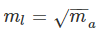
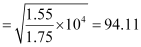
Linear magnification m = √(ma) = √(8857.142857...) ≈ 94.17 ≈ 94.2.
Therefore, the linear magnification is approximately 94.2.
Q1.10: State the number of significant figures in the following:
(a) 0.007 m2
(b) 2.64 × 1024 kg
(c) 0.2370 g cm-3
(d) 6.320 J
(e) 6.032 N m-2
(f) 0.0006032 m2
Ans: (a) 1
0.007 has one significant figure (the 7). Leading zeros are not significant.
(b) 3
2.64 × 1024 has three significant figures (2, 6, 4). Powers of ten do not affect significant-figure count.
(c) 4
0.2370 has four significant figures; trailing zero after the decimal is significant.
(d) 4
6.320 has four significant figures; trailing zero after decimal is significant.
(e) 4
6.032 has four significant figures; zeros between non-zero digits are significant.
(f) 4
0.0006032 has four significant figures (6, 0, 3, 2); leading zeros are not significant but the zero between 6 and 3 is.
Q1.11: The length, breadth and thickness of a rectangular sheet of metal are 4.234 m, 1.005 m, and 2.01 cm respectively. Give the area and volume of the sheet to correct significant figures.
Ans: Length l = 4.234 m (4 sig. figs.)
Breadth b = 1.005 m (4 sig. figs.)
Thickness h = 2.01 cm = 0.0201 m (3 sig. figs.)
The least number of significant figures among measurements affecting compound results is 3, so final results must be given to 3 significant figures.
Surface area S = 2[(l b) + (b h) + (h l)]
= 2[(4.234 × 1.005) + (1.005 × 0.0201) + (0.0201 × 4.234)]
= 2[4.25517 + 0.02020 + 0.08510] ≈ 2 × 4.36047 ≈ 8.72094 m2
Rounded to 3 significant figures: S = 8.72 m2.
Volume V = l × b × h = 4.234 × 1.005 × 0.0201 ≈ 0.085503 m3
Rounded to 3 significant figures: V = 0.0855 m3.
Q1.12: The mass of a box measured by a grocer's balance is 2.300 kg. Two gold pieces of masses 20.15 g and 20.17 g are added to the box. What is (a) the total mass of the box, (b) the difference in the masses of the pieces to correct significant figures?
Ans: Mass of box = 2.300 kg (measurement to 3 decimal places)
Mass of gold piece I = 20.15 g = 0.02015 kg (5 decimal places in kg)
Mass of gold piece II = 20.17 g = 0.02017 kg
(a) Total mass = 2.300 + 0.02015 + 0.02017 = 2.34032 kg.
Round the result to the least number of decimal places present in the given data (here 3 decimal places from 2.300 kg) ⇒ Total mass = 2.340 kg.
(b) Difference = 20.17 g - 20.15 g = 0.02 g. Both given masses have two decimal places, so the difference is correctly reported as 0.02 g.
Q1.13: A famous relation in physics relates 'moving mass' m to the 'rest mass' m0 of a particle in terms of its speed v and the speed of light, c. (This relation first arose as a consequence of special relativity due to Albert Einstein). A boy recalls the relation almost correctly but forgets where to put the constant c. He writes:
m = (m0/1-v2)1/2
Ans: The given form is dimensionally inconsistent because the quantity inside the square root must be dimensionless. The combination v2 must therefore be divided by c2 (where c has the same dimensions as v). The correct relation is:
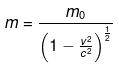
m = m0 / √(1 - v2/c2).
This form ensures the argument of the square root is dimensionless and yields the correct relativistic limit.
Q1.14: The unit of length convenient on the atomic scale is known as an angstrom and is denoted by Å : 1 Å = 10-10m. The size of a hydrogen atom is about 0.5Å . what is the total atomic volume in m3 of a mole of hydrogen atoms?
Ans: Radius r = 0.5 Å = 0.5 × 10⁻¹⁰ m = 5.0 × 10⁻¹¹ m.
Volume of one hydrogen atom ≈ (4/3)πr3 ≈ (4/3)π(5.0 × 10-11)3 ≈ 5.24 × 10⁻³¹ m3.
Number of atoms in 1 mole = 6.023 × 10²³.
Volume of 1 mole of hydrogen atoms ≈ 6.023 × 1023 × 5.24 × 10-31 m3 ≈ 3.16 × 10⁻⁷ m3.
Q1.15: One mole of an ideal gas at standard temperature and pressure occupies 22.4 L (molar volume). What is the ratio of molar volume to the atomic volume of a mole of hydrogen? (Take the size of hydrogen molecule to be about 1  ). Why is this ratio so large?
Ans: Atomic volume of one mole of hydrogen Va ≈ 3.16 × 10⁻⁷ m3 (from Q1.14).
Molar volume at STP Vm = 22.4 L = 22.4 × 10⁻³ m3.
Ratio Vm/Va = (22.4 × 10⁻³)/(3.16 × 10-7) ≈ 7.08 × 10⁴.
This large ratio indicates that in the gaseous state the average separation between molecules is much larger than the size of the molecules themselves; most of the volume of a gas is empty space between particles.
Q1.16: Explain this common observation clearly : If you look out of the window of a fast moving train, the nearby trees, houses etc. seem to move rapidly in a direction opposite to the train's motion, but the distant objects (hill tops, the Moon, the stars etc.) seem to be stationary. (In fact, since you are aware that you are moving, these distant objects seem to move with you).
Ans: The apparent motion is due to the rate of change of the line of sight. For nearby objects the angle of the line of sight changes rapidly as the train moves, so they appear to pass quickly in the opposite direction. Distant objects subtend much smaller angles and the line of sight to them changes very slowly, so they appear nearly stationary.
Q1.17:The Sun is a hot plasma (ionized matter) with its inner core at a temperature exceeding 107 K, and its outer surface at a temperature of about 6000 K. At these high temperatures, no substance remains in a solid or liquid phase. In what range do you expect the mass density of the Sun to be, in the range of densities of solids and liquids or gases? Check if your guess is correct from the following data: mass of the Sun = 2.0 × 1030 kg, radius of the Sun = 7.0 × 10⁸ m.
Ans. Mass M = 2.0 × 1030 kg.
Radius R = 7.0 × 10⁸ m.
Volume V = (4/3)πR3 ≈ (4/3)π(7.0 × 108)3 ≈ 1.437 × 1027 m3.
Density ρ = M/V ≈ (2.0 × 1030)/(1.437 × 1027) ≈ 1.39 × 10³ kg m-3.
This density (≈ 1.4 × 10³ kg m-3) is similar to the densities of liquids and solids (order 103 kg m-3), rather than typical gas densities at ordinary conditions. The high average density results from the Sun's large mass and strong gravitational compression of its interior.
Old NCERT Solutions
Q1: A physical quantity P is related to four observables a, b, c and d as follows:

The percentage errors of measurement in a, b, c and d are 1%, 3%, 4% and 2%, respectively. What is the percentage error in the quantity P? If the value of P calculated using the above relation turns out to be 3.763, to what value should you round off the result?
Ans:

Using standard error propagation for powers and products, the percentage error in P is obtained by summing the percentage errors multiplied by the absolute value of the power of each variable. Carrying out that sum gives 13% (as shown).
Hence percentage error in P = 13%.
Given P = 3.763, with 13% uncertainty the value should be quoted to the first significant figure consistent with the uncertainty. Rounding 3.763 to one decimal place gives P ≈ 3.8.
Q2: A book with many printing errors contains four different formulas for the displacement y of a particle undergoing a certain periodic motion:
(a) y = a sin(2πt/T)
(b) y = a sin vt
(c) y = (a/T) sin(t/a)
(d) y = (a√2) (sin(2πt/T) + cos(2πt/T))
(a = maximum displacement of the particle, v = speed of the particle. T = time-period of motion). Rule out the wrong formulas on dimensional grounds.
Ans: (a) Correct.
y = a sin(2πt/T). The argument 2πt/T is dimensionless and a has dimension of length, so dimensions match.
(b) Incorrect.
y = a sin(vt). Here vt has dimensions of length (v has L T-1, t has T), so the argument of the sine is not dimensionless. Hence invalid.
(c) Incorrect.
y = (a/T) sin(t/a). The prefactor a/T has dimensions L T-1 so the right-hand side has dimensions of velocity, not length. Also t/a is not dimensionless. Hence invalid.
(d) Correct.
y = (a√2)(sin(2πt/T) + cos(2πt/T)). The trigonometric arguments are dimensionless and prefactor a√2 has dimension of length; dimensions match.
Q3: The principle of 'parallax' in section 2.3.1 is used in the determination of distances of very distant stars. The baseline AB is the line joining the Earth's two locations six months apart in its orbit around the Sun. That is, the baseline is about the diameter of the Earth's orbit ≈ 3 × 10¹¹m. However, even the nearest stars are so distant that with such a long baseline, they show parallax only of the order of 1" (second) of arc or so. A parsec is a convenient unit of length on the astronomical scale. It is the distance of an object that will show a parallax of 1" (second) of arc from opposite ends of a baseline equal to the distance from the Earth to the Sun. How much is a parsec in terms of meters?
Ans: Radius of Earth's orbit r ≈ 1.5 × 10¹¹ m.
1 arcsecond ≈ 4.847 × 10⁻⁶ rad.
By small-angle approximation, θ = r/D ⇒ D = r/θ = (1.5 × 10¹¹)/(4.847 × 10-6) ≈ 3.09 × 10¹⁶ m.
Therefore, 1 parsec ≈ 3.09 × 10¹⁶ m.
Q4: The nearest star to our solar system is 4.29 light years away. How much is this distance in terms of parsecs? How much parallax would this star (named Alpha Centauri) show when viewed from two locations of the Earth six months apart in its orbit around the Sun?
Ans: 1 parsec ≈ 3.09 × 10¹⁶ m and 1 light year ≈ 9.46 × 10¹⁵ m.
so 1 parsec ≈ 3.26 ly.
Distance = 4.29 ly ≈ 4.29/3.26 ≈ 1.32 parsec.
Parallax p (in arcseconds) ≈ 1/(distance in parsecs) ⇒ p ≈ 1/1.32 ≈ 0.76″. (Using the baseline as the Earth-Sun distance, the parallax is of order 1″ for distances of 1 pc; for 1.32 pc it is ≈ 0.76″.
Q5: Precise measurements of physical quantities are a need of science. For example, to ascertain the speed of an aircraft, one must have an accurate method to find its positions at closely separated instants of time. This was the actual motivation behind the discovery of radar in World War II. Think of different examples in modern science where precise measurements of length, time, mass etc. are needed. Also, wherever you can, give a quantitative idea of the precision needed.
Ans: Precise measurements are essential in many areas. Examples:
- Atomic clocks: time precision ∼ 10-15 s or better for GPS and fundamental tests of physics.
- Interferometric gravitational-wave detectors: length changes of order 10-19 m are measured.
- Mass spectrometry: mass/charge measurements accurate to parts in 106-109 for isotope identification.
- X-ray and electron diffraction: distances at atomic scale (10-10 m) determined to high precision.
Q6: Just as precise measurements are necessary in science, it is equally important to be able to make rough estimates of quantities using rudimentary ideas and common observations. Think of ways by which you can estimate the following (where an estimate is difficult to obtain, try to get an upper bound on the quantity):
(a) The total mass of rain-bearing clouds over India during the Monsoon
(b) The mass of an elephant
(c) The wind speed during a storm
(d) The number of strands of hair on your head
(e) The number of air molecules in your classroom.
Ans: (a) Average monsoon rainfall height h ≈ 2.15 m over area A ≈ 3.3 × 10¹² m2 ⇒ volume V = A h ≈ 7.09 × 10¹² m3. With water density 103 kg m-3, mass ≈ 7.09 × 10¹⁵ kg.
(b) Use buoyancy: put elephant on a ship and measure additional displacement, or estimate from dimensions (volume ≈ body area × length) and typical animal density ≈ 103 kg m-3 to get mass ~ several tonnes.
(c) Use an anemometer to measure rotation; convert rotations per second to wind speed. Storm speeds typical tens to hundreds of km/h.
(d) Estimate head area A and hair cross-sectional area πr2; number ≈ A/(πr2). With A ≈ 0.06 m2 and r ≈ 5 × 10⁻⁵ m, number ≈ 0.06/(π(5 × 10-5)2) ∼ 7.6 × 10⁴ (order 104 to 105).
(e) Room volume V (m3); number density at NTP ≈ (6.023 × 10²³)/(22.4 × 10-3) ≈ 2.69 × 1025 molecules m-3. So number ≈ 2.69 × 1025 × V.
Q7: When the planet Jupiter is at a distance of 824.7 million kilometers from the Earth, its angular diameter is measured to be 35.72\" of arc. Calculate the diameter of Jupiter.
Ans: Distance D = 824.7 × 10⁶ km = 8.247 × 10⁸ km = 8.247 × 10¹¹ m (careful with units; original uses km directly).
Angular diameter θ = 35.72″ = 35.72 × (4.848 × 10-6) rad ≈ 1.732 × 10⁻⁴ rad.
Diameter d = θ D ≈ (1.732 × 10-4) × (8.247 × 1011 m) ≈ 1.43 × 10⁸ m = 1.43 × 10⁵ km.
Thus diameter of Jupiter ≈ 1.435 × 10⁵ km.
Q8: A man walking briskly in rain with speed v must slant his umbrella forward making an angle θ with the vertical. A student derives the following relation between θ and v: tan θ = v and checks that the relation has a correct limit: as v →0, θ → 0, as expected. (We are assuming there is no strong wind and that the rain falls vertically for a stationary man). Do you think this relation can be correct? If not, guess the correct relation.
Ans: The relation tan θ = v is dimensionally incorrect because tan θ is dimensionless while v has dimensions of speed. The correct form compares the horizontal speed v of the man to the vertical speed v′ of the rain, giving a dimensionless ratio:
tan θ = v/v′.
This reduces to θ → 0 as v → 0 and is dimensionally consistent.
Q9: It is claimed that two cesium clocks, if allowed to run for 100 years, free from any disturbance, may differ by only about 0.02 s. What does this imply for the accuracy of the standard cesium clock in measuring a time-interval of 1 s?
Ans: Difference over 100 years = 0.02 s.
100 years ≈ 100 × 365 × 24 × 60 × 60 ≈ 3.15 × 10⁹ s.
Fractional uncertainty per second ≈ 0.02 / (3.15 × 10⁹) ≈ 6.35 × 10⁻¹².
Therefore, the accuracy in measuring 1 s is about 6.35 × 10⁻¹² s (fractional accuracy ≈ 6.35 × 10⁻¹²).
Q10: Estimate the average mass density of a sodium atom assuming its size to be about 2.5. (Use the known values of Avogadro's number and the atomic mass of sodium). Compare it with the density of sodium in its crystalline phase: 970 kg m-3. Are the two densities of the same order of magnitude? If so, why
Ans: Diameter ≈ 2.5 Å ⇒ radius r = 1.25 Å = 1.25 × 10⁻¹⁰ m.
Volume per atom ≈ (4/3)πr3 ≈ (4/3)π(1.25 × 10-10)3 ≈ 8.19 × 10⁻³⁰ m3.
Mass of one Na atom = (23 × 10-3 kg) / (6.023 × 10²³) ≈ 3.82 × 10⁻²⁶ kg.
Density ≈ mass/volume ≈ (3.82 × 10⁻²⁶)/(8.19 × 10-30) ≈ 4.67 × 10³ kg m-3.
This is of the same order of magnitude (103 kg m-3) as the crystalline density 970 kg m-3, differing by a factor ≈ 4.8. The difference arises because atomic radii used here assume non-overlapping spheres and neglect the actual packing and bonding in the metal; nevertheless both densities remain in the same order (103 kg m-3).
Q11: The unit of length convenient on the nuclear scale is a fermi: 1 f = 10-15 m. Nuclear sizes obey roughly the following empirical relation : r = r0A1/3
where r is the radius of the nucleus, A its mass number, and r0 is a constant equal to about, 1.2 f. Show that the rule implies that nuclear mass density is nearly constant for different nuclei. Estimate the mass density of sodium nucleus. Compare it with the average mass density of a sodium atom obtained in Exercise. 2.27.
Ans: Radius r = r0A1/3 ⇒ Volume V = (4/3)πr3 = (4/3)πr03A.
Mass M ≈ A × mN (mN ≈ 1.67 × 10⁻²⁷ kg).
Density ρ = M/V = [A mN] / [(4/3)π r03 A] = mN / [(4/3)π r03].
Thus ρ is independent of A - nuclear density is approximately constant for all nuclei.
Using r0 = 1.2 × 10⁻¹⁵ m,
ρ ≈ (1.67 × 10⁻²⁷)/[(4/3)π(1.2 × 10-15)3] ≈ 2.3 × 10¹⁷ kg m-3.
Compare with atomic density of sodium ≈ 4.67 × 10³ kg m-3 (from Q10): nuclear density is enormously larger because nucleons are packed very tightly in the nucleus whereas atoms have large volumes dominated by empty space occupied by electron clouds.
Q12: A LASER is a source of very intense, monochromatic, and unidirectional beam of light. These properties of a laser light can be exploited to measure long distances. The distance of the Moon from the Earth has been already determined very precisely using a laser as a source of light. A laser light beamed at the Moon takes 2.56 s to return after reflection at the Moon's surface. How much is the radius of the lunar orbit around the Earth?
Ans: Total round-trip time = 2.56 s ⇒ one-way time = 1.28 s.
Speed of light c ≈ 3.0 × 10⁸ m s-1.
Distance (Earth-Moon) ≈ c × 1.28 ≈ 3.84 × 10⁸ m ≈ 3.84 × 10⁵ km.
Q13: A SONAR (sound navigation and ranging) uses ultrasonic waves to detect and locate objects under water. In a submarine equipped with a SONAR the time delay between generation of a probe wave and the reception of its echo after reflection from an enemy submarine is found to be 77.0 s. What is the distance of the enemy submarine? (Speed of sound in water = 1450 m s-1).
Ans: Round-trip time = 77.0 s ⇒ one-way time = 38.5 s.
Speed of sound in water = 1450 m s-1.
Distance = 1450 × 38.5 = 55825 m ≈ 55.8 km.
Q14: The farthest objects in our Universe discovered by modern astronomers are so distant that light emitted by them takes billions of years to reach the Earth. These objects (known as quasars) have many puzzling features, which have not yet been satisfactorily explained. What is the distance in km of a quasar from which light takes 3.0 billion years to reach us?
Ans: Time t = 3.0 × 10⁹ years ≈ 3.0 × 109 × (365 × 24 × 3600) s ≈ 9.46 × 10¹⁶ s.
Distance ≈ c t ≈ (3.0 × 10⁸ m s-1) × (9.46 × 1016 s) ≈ 2.84 × 1025 m ≈ 2.84 × 10²² km.
Q15: It is a well known fact that during a total solar eclipse the disk of the moon almost completely covers the disk of the Sun. From this fact and from the information you can gather from examples 2.3 and 2.4, determine the approximate diameter of the moon.
Ans: Using similar triangles between Sun-Earth-Moon geometry and the known solar diameter DS ≈ 1.39 × 10⁹ m, Earth-Sun distance ≈ 1.496 × 10¹¹ m, and Earth-Moon distance ≈ 3.84 × 10⁸ m, one obtains lunar diameter ≈ (Earth-Moon distance / Earth-Sun distance) × DS ≈ (3.84 × 10⁸ / 1.496 × 1011) × 1.39 × 109 m ≈ 3.57 × 10⁶ m ≈ 3.57 × 10³ km.
This is close to the accepted lunar diameter (~3.47 × 10³ km).
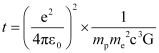
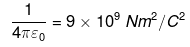
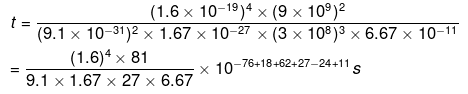
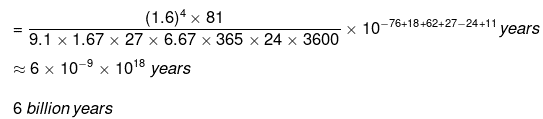
Q16: A great physicist of this century (P.A.M. Dirac) loved playing with numerical values of Fundamental constants of nature. This led him to an interesting observation. Dirac found that from the basic constants of atomic physics (c, e, mass of electron, mass of proton) and the gravitational constant G, he could arrive at a number with the dimension of time. Further, it was a very large number, its magnitude being close to the present estimate on the age of the universe (~15 billion years). From the table of fundamental constants in this book, try to see if you too can construct this number (or any other interesting number you can think of). If its coincidence with the age of the universe were significant, what would this imply for the constancy of fundamental constants?
Ans: One can combine fundamental constants to obtain a quantity with dimension of time. Dirac noted such large dimensionful combinations give time-scales comparable to the age of the universe. If such numerical coincidences were taken to be physically significant, they could suggest a relation among constants or indicate possible cosmic-time dependence of some constants. However, present understanding treats such coincidences cautiously; any claim of time variation of constants requires strong experimental evidence.
FAQs on NCERT Solutions: Units & Measurement
| 1. How do I convert between different units of measurement for NEET Physics? |  |
| 2. What's the difference between accuracy and precision in measurements? | |
| 3. Why do we use significant figures in scientific calculations and measurements? | |
| 4. What are the SI base units and why are they standardised for Class 11 Physics? | |
| 5. How do I use dimensional analysis to solve NCERT physics problems on units and measurement? | |





