NCERT Solutions: Locomotion & Movement

Q1: Draw the diagram of a sarcomere of skeletal muscle showing different regions.
Ans: The diagrammatic representation of a sarcomere is as follows:
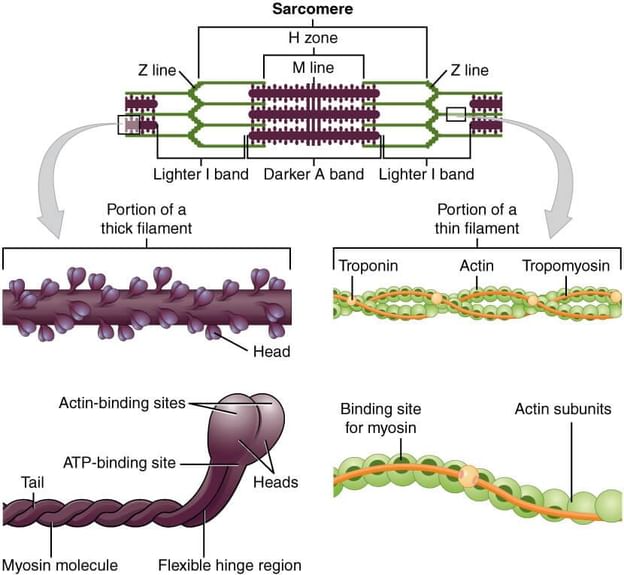 Sarcomere of skeletal muscle
- Z line: The boundary that defines the edges of a sarcomere and anchors the thin filaments.
- A band: The dark band in the middle, containing overlapping thick (myosin) and thin filaments; its length remains essentially constant during contraction.
- I band: The light band on either side of the A band, containing only thin (actin) filaments; it shortens during contraction.
- H zone: The central part of the A band where only thick filaments are present; this zone becomes narrower or disappears when the muscle contracts.
- M line: A thin fibrous structure at the centre of the A band that holds the thick filaments together.
A sarcomere is the functional contractile unit of a striated muscle fibre, located between two Z lines. When the muscle shortens, the Z lines move closer together; the I-band and H-zone reduce in width while the A-band remains largely unchanged. The coordinated shortening of many sarcomeres along a myofibril produces the overall contraction of the muscle fibre.
Q2: Define sliding filament theory of muscle contraction.
Ans: The sliding filament theory explains muscle contraction as shortening of sarcomeres produced by relative sliding of filaments rather than a change in filament length. The main points are:
- Muscle fibres show alternating light (I-band, mainly actin) and dark (A-band, mainly myosin) bands.
- The Z-line marks the boundary of each sarcomere and anchors thin filaments.
- The central region of the A-band without overlap is the H-zone.
- During contraction, myosin heads form cross-bridges with actin and pull the thin filaments towards the sarcomere centre.
- This sliding of thin over thick filaments brings the Z-lines closer, shortens the I-band and H-zone, and causes overall shortening of the sarcomere while the A-band length remains essentially constant.
Contraction is triggered by a nerve impulse that increases cytosolic calcium ions. Calcium binds to troponin, which shifts tropomyosin away from actin binding sites, allowing myosin heads to attach. Energy from ATP is used repeatedly by the myosin heads to pull actin filaments and detach for another cycle. When calcium is pumped back into the sarcoplasmic reticulum, binding sites are covered again and the muscle relaxes.
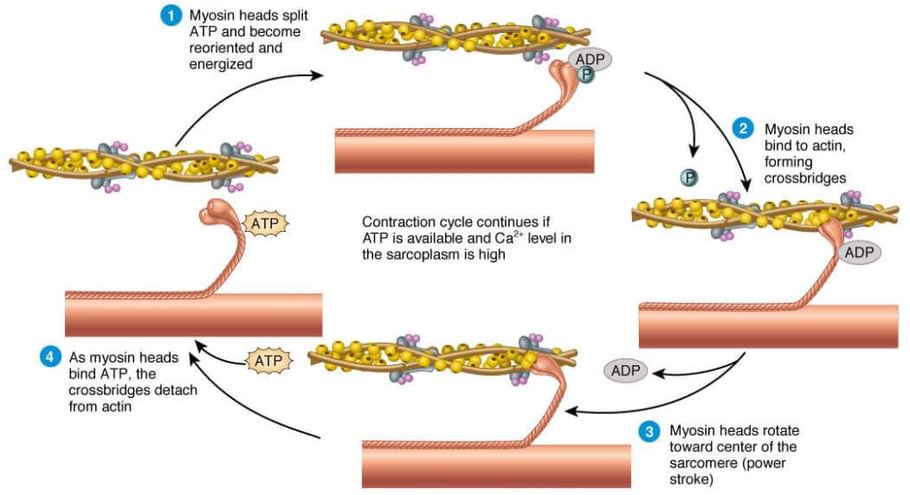 Sliding filament theory of muscle contraction
Q3: Describe the important steps in muscle contraction.
Ans: During skeletal muscle contraction, thick and thin filaments interact by repeated cycles of cross-bridge formation and release. The sequence is as follows.
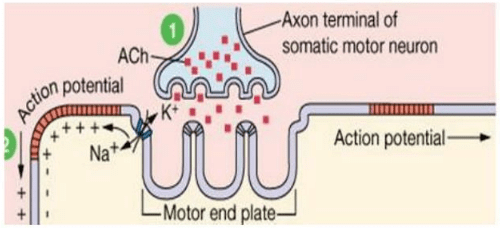 Steps in muscle contraction
- Step 1: A nerve impulse reaches the neuromuscular junction (motor end plate). This causes vesicles in the motor neuron to release acetylcholine into the synaptic cleft. Acetylcholine binds to receptors on the sarcolemma and triggers an action potential that travels along the muscle fibre membrane.
- Step 2: The action potential travels into the muscle fibre via T-tubules and stimulates release of calcium ions (Ca++) from the sarcoplasmic reticulum into the sarcoplasm.
- Step 3: Increased Ca++ concentration leads to calcium binding to troponin on the thin filament. This causes tropomyosin to move away from the actin binding sites, exposing active sites on actin for myosin attachment.
- Step 4: Myosin heads bind to the exposed sites on actin to form cross-bridges. Using energy from ATP hydrolysis, the myosin heads change conformation and pull the actin filaments towards the centre of the sarcomere, causing shortening (power stroke). The H-zone shortens as overlap increases.
- Step 5: After the power stroke, ADP and inorganic phosphate are released. A fresh ATP molecule binds to myosin, causing it to detach from actin. ATP is then hydrolysed to re-energise the myosin head for the next cycle.
- Step 6: These cycles of cross-bridge formation and breakage continue while Ca++ levels remain high and the nerve stimulus persists. When stimulation stops, Ca++ is actively pumped back into the sarcoplasmic reticulum, troponin-tropomyosin complex returns to block actin sites, cross-bridge cycling ceases and the muscle relaxes.
Q4: Write true or false. If false change the statement so that it is true.
(a) Actin is present in thin filament
(b) H-zone of striated muscle fibre represents both thick and thin filaments.
(c) Human skeleton has 206 bones.
(d) There are 11 pairs of ribs in man.
(e) Sternum is present on the ventral side of the body.
Ans:
Ans: (a) True
Explanation: Actin is the main component of the thin filament and is therefore present in the thin filament.
Ans: (b) False
Explanation: The H-zone contains only thick filaments (myosin). It does not include thin filaments; the H-zone is the central region of the A-band where thin filaments do not overlap.
Ans: (c) True
Explanation: The adult human skeleton normally consists of 206 bones.
Ans: (d) False
Explanation: Humans have 12 pairs of ribs. The statement should read: There are 12 pairs of ribs in man.
Ans: (e) True
Explanation: The sternum (breastbone) is located on the anterior (ventral) midline of the thorax.
Q5: Write the difference between:
(a) Actin and Myosin
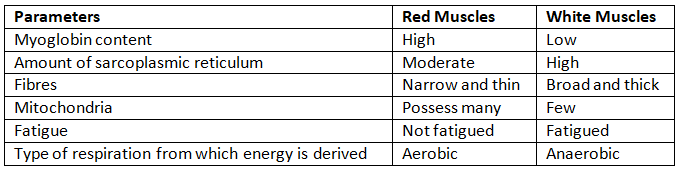
(b) Red and White muscles
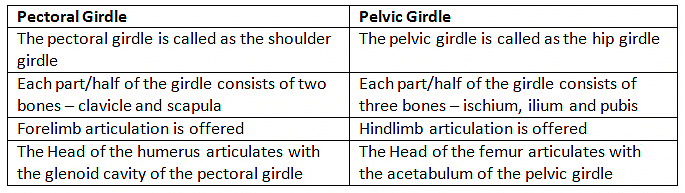
(c) Pectoral and Pelvic girdle
Ans:
(a) Actin and Myosin
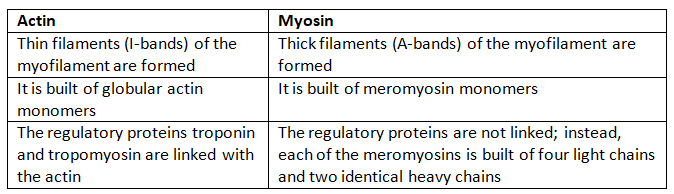
(b) Red and White muscles
(c) Pectoral and Pelvic girdle
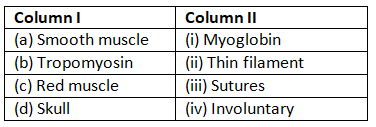
Q6: Match Column I with Column II:
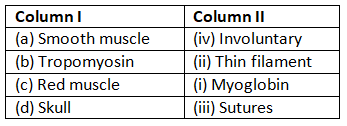
Ans:
Q7: What are the different types of movements exhibited by the cells of human body?
Ans: Movement is a characteristic feature of living organisms. The different types of movement exhibited by cells of the human body are:
- Amoeboid movement: Performed by cells such as leukocytes (white blood cells). They extend temporary projections (pseudopodia) to move through tissues and reach sites of infection or injury.
- Ciliary movement: Movement produced by the coordinated beating of cilia on epithelial cells. For example, cilia lining the fallopian tube help move the ovum toward the uterus, and cilia in the respiratory tract help clear mucus and debris.
- Flagellar movement: Seen in sperm cells, which move by a whip-like action of a flagellum (tail) to swim toward the ovum.
- Muscular movement: Performed by specialised muscle cells (myocytes) that contract to produce large-scale body movements, posture maintenance and movement of internal organs.
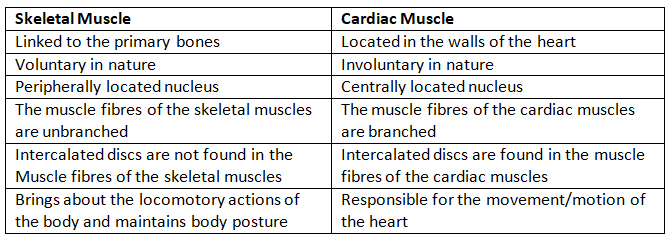
Q8: How do you distinguish between a skeletal muscle and a cardiac muscle?
Ans:
Q9: Name the type of joint between the following:
(a) atlas/axis
(b) carpal/metacarpal of thumb
(c) between phalanges
(d) femur/acetabulum
(e) between cranial bones
(f) between pubic bones in the pelvic girdle
Ans:(a) atlas/axis: Pivot joint
(b) carpal/metacarpal of thumb: Saddle joint
(c) between phalanges: Hinge joint
(d) femur/acetabulum: Ball-and-socket joint
(e) between cranial bones: Fibrous joint (sutures)
(f) between pubic bones in the pelvic girdle: Cartilaginous joint (symphysis pubis)
Q10: Fill in the blank spaces:
(a) All mammals (except a few) have __________ cervical vertebra.
(b) The number of phalanges in each limb of human is __________
(c) Thin filament of myofibril contains 2 'F' actins and two other proteins namely __________ and __________.
(d) In a muscle fibre Ca++ is stored in __________
(e) __________ and __________ pairs of ribs are called floating ribs.
(f) The human cranium is made of __________ bones.
Ans:
(a) All mammals (except a few) have seven cervical vertebrae.
(b) The number of phalanges in each limb of a human is 14.
(c) Thin filament of myofibril contains 2 'F' actins and two other proteins, namely troponin and tropomyosin.
(d) In a muscle fibre, Ca++ is stored in the sarcoplasmic reticulum.
(e) The 11th and 12th pairs of ribs are called floating ribs.
(f) The human cranium is made up of eight bones.
FAQs on NCERT Solutions: Locomotion & Movement
| 1. How do muscles work in the process of locomotion? |  |
| 2. What role do joints play in the movement of the body? | |
| 3. How does the nervous system control movement and coordination? | |
| 4. What are the different types of locomotion seen in animals? | |
| 5. How do skeletal and muscular systems work together to facilitate movement? | |





