NCERT Solutions: Plant Growth & Development

Q1: Define growth, differentiation, development, de-differentiation, redifferentiation, determinate growth, meristem, and growth rate.
Ans: (a) Growth: Growth is an irreversible and permanent increase in size, mass or number of cells of an organ or of the whole organism. It results from cell division and/or cell enlargement and leads to a measurable change over time. Growth can be measured by increases in parameters such as length, fresh weight or dry weight and is usually expressed per unit time.
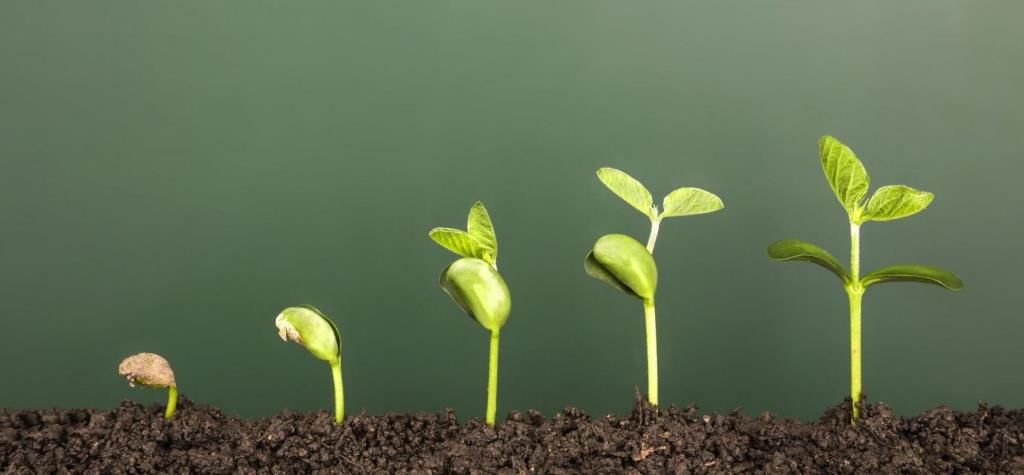 Growth in Plants
(b) Differentiation: Differentiation is the process by which cells produced by the apical meristem (at root and shoot tips) and by cambium undergo structural and functional changes to become specialised for particular functions; for example, xylem or phloem cells. Differentiation involves changes in cell shape, organelles and metabolic activity to perform specific roles.
(c) Development: Development denotes the sequence of changes that occur in an organism during its life cycle, from germination through growth, differentiation, maturation and finally senescence. It integrates growth with morphogenesis and physiological changes that lead to a mature organism.
(d) De-differentiation: De-differentiation is the reversal of differentiation when mature, specialised cells regain the capacity to divide under suitable conditions; this often leads to callus formation in tissue culture. De-differentiation provides a source of undifferentiated cells that can regenerate organs.
(e) Re-differentiation: Re-differentiation is the process by which de-differentiated cells resume a differentiation pathway and become specialised again, losing their dividing capacity as they mature. This process is essential during organ regeneration and repair.
(f) Determinate growth: Determinate growth is growth that stops after the organism or organ reaches a genetically determined size. Example: Many animals and plant leaves cease growth after attaining maturity; some flowers and fruits also show determinate growth.
(g) Meristem: A meristem is a region of actively dividing, undifferentiated cells in plants that is responsible for continuing growth. There are three types of meristems: apical meristem (for primary growth), lateral meristem (for secondary growth) and intercalary meristem (for growth at internodes). Meristematic cells have thin walls, dense cytoplasm and prominent nuclei.
(h) Growth rate: Growth rate is the increase in size, mass or number of cells of a plant or organ per unit time; it gives a measure of how fast growth proceeds. It can be expressed as absolute growth (units of size or mass per time) or relative growth (growth per unit existing size per unit time).
Q2: Why is not anyone parameter good enough to demonstrate growth throughout the life of a flowering plant?
Ans:Growth reflects changes in different aspects of the plant such as height, fresh weight, dry weight, cell number, cell size, leaf area and volume. These parameters change at different times and rates during the life cycle. For example, stem length may increase while dry weight remains low during early elongation, or cell number may rise before a measurable increase in mass. Because a single parameter cannot represent all phases and facets of growth, several measurements (for example, increase in dry weight together with cell number or leaf area) are needed to demonstrate growth accurately throughout the life of a flowering plant.
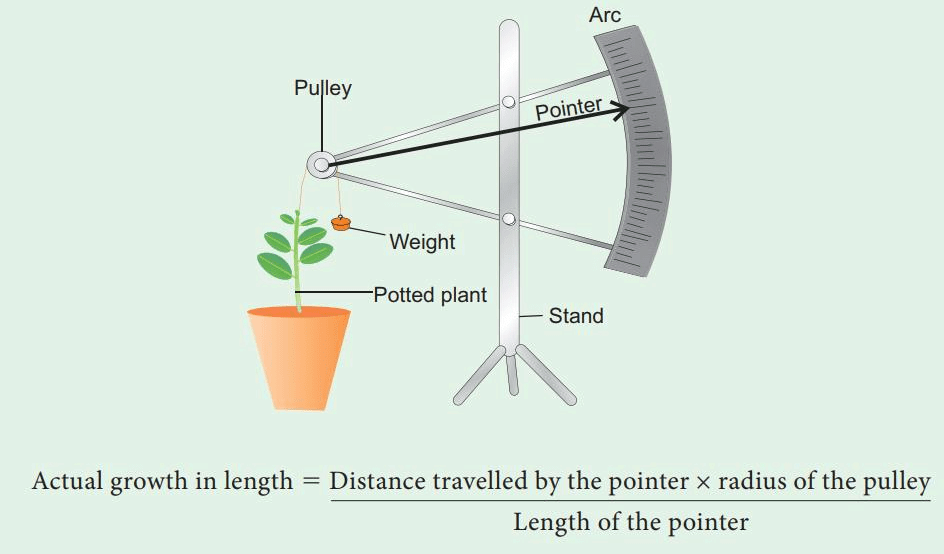 Measurement of Plant
Q3: Describe briefly:
(a) Arithmetic growth
(b) Geometric growth
(c) Sigmoid growth curve
(d) Absolute and relative growth rates
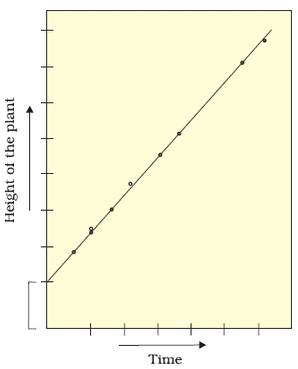
Ans: (a) Arithmetic growth: In arithmetic growth, an organ or part increases in length by a constant amount per unit time. This occurs when, after each division, only one daughter cell continues to divide while the other differentiates. Root elongation at a fairly constant rate is a common example. It can be expressed mathematically as:
Lt = Lo + rt
Lt = length at time 't'
Lo = length at time 'zero'
r = growth rate or elongation per unit time
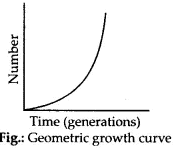
(b) Geometric growth: Geometric growth occurs when a quantity increases by a constant proportion in equal time intervals, so growth accelerates with time. This pattern is typical when daughter cells retain the ability to divide repeatedly; population growth under ideal conditions is an example. In plants, rapidly dividing tissues may show geometric-type increases until limiting factors slow the rate.
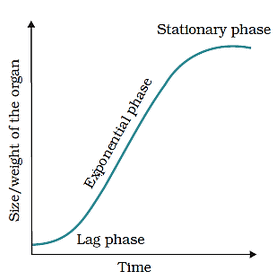
(c) Sigmoid growth curve: Natural growth of whole plants or many organs usually follows a sigmoid or S-shaped curve with three phases: an initial lag phase with slow growth, a log or exponential phase with rapid growth and accelerating rate, and a stationary phase where growth slows and levels off as nutrients, space or other factors become limiting. The sigmoid curve summarises how both the amount and the rate of growth change over time and is useful for comparing growth patterns.
(d) Absolute and relative growth rates: Absolute growth rate is the increase in size or mass per unit time (for example, cm per day or g per week). Relative growth rate (RGR) expresses growth per unit existing size per unit time (for example, g g-1 day-1), allowing comparison between plants or organs that start at different sizes. RGR is useful for comparing vigour or efficiency of growth.
Q4: List five main groups of natural plant growth regulators. Write a note on the discovery, physiological functions, and agricultural/horticultural applications of any one of them.
Ans: Plant growth regulators are internal chemical substances that regulate growth and development.
The five main groups of natural plant growth regulators (PGR) are as follows:
(i) Auxins
(ii) Gibberellins
(iii) Cytokinins
(iv) Abscisic acid
(v) Ethylene
These regulators are synthesised in various plant parts and control many developmental events.
Auxins
- Discovery
Early observations by Charles Darwin and Francis Darwin showed that coleoptiles bend toward light, suggesting a transmissible substance from the tip controlled bending. Later work led to the isolation of this growth-promoting substance, called auxin, from coleoptile tips of oat seedlings. - Physiological functions
(i) Control cell elongation and promote cell growth.
(ii) Maintain apical dominance by suppressing axillary bud growth.
(iii) Regulate vascular tissue differentiation and cambial activity.
(iv) Induce parthenocarpy (fruit development without fertilisation) and inhibit abscission of leaves and fruits. - Horticultural applications
(i) Used as rooting hormones to promote root formation in stem cuttings.
(ii) Synthetic auxins (for example, 2,4-D) are used as selective herbicides against broad-leaved weeds.
(iii) Applied to induce parthenocarpy in tomato and other crops.
(iv) Used to promote flowering in some crops such as pineapple and litchi by influencing development at the shoot apex.
Q5: Why is Abscisic acid also known as stress hormone?
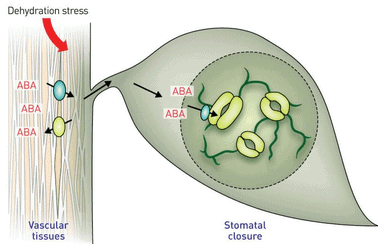
Ans: Abscisic acid is called a stress hormone because it mediates several protective responses when plants face adverse conditions:
- It increases plant tolerance to stresses such as drought and salinity by activating stress-response mechanisms and protective gene expression.
- It induces stomatal closure during water deficit, reducing water loss by transpiration and conserving internal water.
- It enforces seed dormancy and prevents premature germination until conditions become favourable.
- It helps seeds survive desiccation during maturation by promoting accumulation of protective proteins and osmolytes.
- It contributes to seasonal dormancy and can promote abscission of leaves, fruits and flowers under stress or at the end of the growing season, reducing the plant's metabolic load.
 Stress Hormone
Q6: 'Both growth and differentiation in higher plants are open'. Comment.
Ans: Growth and differentiation in higher plants are described as open because meristems - regions of continually dividing cells - are present at multiple sites (apices, cambium and intercalary regions). These meristems continue to produce new cells and tissues throughout the plant's life, permitting continuous increase in size and the formation of new organs such as leaves, flowers and secondary tissues. Openness therefore refers to the ongoing capacity for new growth and new differentiation rather than a fixed, limited developmental programme.
Q7: 'Both a short day plant and a long day plant can flower simultaneously in a given place'. Explain.
Ans:
- Flowering in short-day and long-day plants depends on the length of the daily light and dark periods (photoperiod). Each plant has a critical day length that determines flowering.
- Both types can flower at the same place and time if, during that period, they each experience the photoperiod appropriate for their flowering requirement. For example, seasonal changes or controlled light conditions can provide the required day/night cycles so that a short-day plant and a long-day plant receive the correct cues and flower simultaneously.
Q8: Which one of the plant growth regulators would you use if you are asked to:
(a) Induce rooting in a twig
(b) Quickly ripen a fruit
(c) Delay leaf senescence
(d) Induce growth in axillary buds
(e) 'Bolt' a rosette plant
(f) Induce immediate stomatal closure in leaves.
Ans:
(a) Induce rooting in a twig - Auxins
(b) Quickly ripen a fruit - Ethylene
(c) Delay leaf senescence - Cytokinins
(d) Induce growth in axillary buds - Cytokinins
(e) 'Bolt' a rosette plant - Gibberellic acid
(f) Induce immediate stomatal closure in leaves - Abscisic acid
These choices follow the principal actions of the regulators: auxins for rooting, ethylene for ripening, cytokinins for delaying senescence and promoting shoot formation, gibberellins for stem elongation and bolting, and abscisic acid for stomatal regulation under stress.
Q9: Would a defoliated plant respond to the photoperiodic cycle? Why?
Ans: No. Leaves are the primary sites for perception of day length and for the synthesis of the flowering-promoting signal (florigen). Without leaves, the plant cannot detect the duration of light and darkness effectively, so it will not mount the correct photoperiodic response and therefore will not flower in response to the photoperiodic cycle.
Q10: What would be expected to happen if:
(a) GA3 is applied to rice seedlings.
(b) Dividing cells stop differentiating.
(c) A rotten fruit gets mixed with unripe fruits.
(d) You forget to add cytokinin to the culture medium.
Ans:
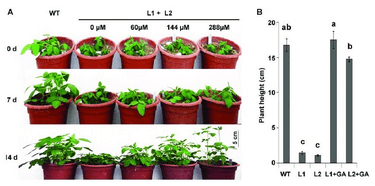
(a) If GA3 is applied to rice seedlings, the seedlings will show enhanced internode elongation and an overall increase in height due to stimulation of cell elongation and division in the stem; this can lead to taller, more elongated seedlings.
 GA3 effect on plants
(b) If dividing cells stop differentiating, organs such as leaves and stems cannot form their specialised structures; instead an undifferentiated mass of cells called a callus will accumulate and normal organ function and morphology will be lost.
(c) If a rotten fruit is mixed with unripe fruits, the ethylene produced by the rotten fruit will act as a ripening hormone and speed up ripening of the unripe fruits.
(d) If cytokinin is omitted from a culture medium, promotion of cell division and subsequent shoot differentiation will be impaired; in tissue culture this will reduce or prevent shoot formation and may bias the culture toward root formation or undifferentiated callus depending on the auxin:cytokinin balance.
FAQs on NCERT Solutions: Plant Growth & Development
| 1. What are the different stages of plant growth and development? |  |
| 2. How do plants respond to environmental factors during their growth and development? | |
| 3. What is photoperiodism and how does it affect plant growth and development? | |
| 4. How do hormones regulate plant growth and development? | |
| 5. What are some common factors that can affect plant growth and development negatively? | |





