NCERT Solutions: Complex Numbers & Quadratic Equations

Exercise 4.1
Que 1: Express the given complex number in the form a + ib : (5i)( -35 i)
Ans:
( -35 i) = -5 x -35 × i × i
= -3i2
= -3 × (-1) [i2 = -1]
= 3
Que 2: Express the given complex number in the form a + ib: i9+ i19
Ans:
i9 + i19 = i4×2+1 + i4×4+3
= (i4)2 · i + (i4)4 · i3
= 1 × i + 1 × (-i) [i4 = 1, i3 = -i]
= i + (-i)
= 0
Que 3: Express the given complex number in the form a + ib: i-39
Ans:
i-39 = i-4×9-3 = (i4)-9 · i-3
= (1)-9 · i-3 [i4 = 1]
= 1/i3 = 1/-i [i3 = -i]
= -1/i × i/i
= -i/i2 = -i/-1 [i2 = -1]
= i
Que 4: Express the given complex number in the form a + ib: 3(7 + i7) + i(7 + i7)
Ans:
3(7 + 7i) + i(7 + 7i) = 21 + 21i + 7i + 7i2
= 21 + 28i + 7 × (-1) [∵ i2 = -1]
= 14 + 28i
Que 5: Express the given complex number in the form a + ib: (1 - i) - (-1 + i6)
Ans:
(1 - i) - (1 + i6) = 1 - i + 1 - 6i
= 2 - 7i
Que 6: Express the given complex number in the form a + ib: ( 15 + i 25) - ( 4 + i 52 )
Ans:
( 15 + i 25) - ( 4 + i 52 )
= 15 - 4 + i 25 - i 52
= ( 15 - 4) + i( 25 - 52)
= -195 + i -2110
= -195 - i 2110
Que 7: Express the given complex number in the form a + ib:[ 13 + i 73 ] + [ 43 + i 13 ] - ( -43 + i)
Ans:
[ 13 + i 73 ] + [ 43 + i 13 ] - ( -43 + i)
= 13 + i 73 + 43 + i 13 + 43 - i
= ( 13 + 43 + 43) + i( 73 + 13 - 1)
= 173 + i 53
Que 8: Express the given complex number in the form a + ib: (1 - i)4
Ans:
(1 - i)4 = [(1 - i)2]2
= [12 + i2 - 2i]2
= [1 - 1 - 2i]2
= (-2i)2
= (-2i) × (-2i)
= 4i2 = -4 [∵ i2 = -1]
Que 9: Express the given complex number in the form a + ib: ( 13 + 3i)3
Ans:
( 13 + 3i)3 = 133 + (3i)3 + 3 13(3i)( 13 + 3i)
= 127 + 27i3 + 3i( 13 + 3i)
= 127 + 27(-i) + i + 9i2 [i3 = -i, i2 = -1]
= 127 - 27i + i - 9
= ( 127 - 9) + i(-27 + 1)
= -24227 - 26i
Que 10: Express the given complex number in the form a + ib: (-2 - 13 i)3
Ans:
(-2 - 13 i)3 = (-1)3(2 + 13 i)3
= -[ 23 + (13 i)3 + 3(2)( 13 i )(2 + 13 i)]
= -[ 8 + i327 + 2i( 2 + i3)]
= -[ 8 - i27 + 4i + 2i23] [i3 = -i, i2 = -1]
= -[ 8 - i27 + 4i - 23]
= -[ 223 + i( 10727)]
= 223 - 10727 i
Que 11: Find the multiplicative inverse of the complex number: 4 - 3i
Ans:
Let z = 4 - 3i
Then, z̅ = 4 + 3i and |z|2 = 42 + (-3)2 = 16 + 9 = 25
Therefore, the multiplicative inverse of 4 - 3i is given by:
z-1 = z̅|z|2 = 4 + 3i25
= 425 + 325 i
Que 12: Find the multiplicative inverse of the complex number :√5 + 3i
Ans:
Let z = √5 + 3i
Then, z̅ = √5 - 3i and |z|2 = (√5)2 + 32 = 5 + 9 = 14
Therefore, the multiplicative inverse of √5 + 3i is given by:
z-1 = z̅|z|2 = √5 - 3i14
= √514 - 314i
Que 13: Find the multiplicative inverse of the complex number: -i
Ans:
Let z = -i
Then, z̅ = i and |z|2 = |i|2 = 12 = 1
Therefore, the multiplicative inverse of -i is given by:
z-1 = z̅|z|2 = i1 = i
Que 14: Express the following expression in the form of a + ib.
(3 + i√5)(3 - i√5)(√3 + i√2) - (√3 - i√2)
Ans:
(3 + i√5)(3 - i√5)(√3 + i√2) - (√3 - i√2)
= (3)2 - (i√5)2√3 + i√2 - √3 + i√2 [(a + b)(a - b) = a2 - b2]
= 9 - 5i22i√2
= 9 - 5(-1)2i√2 [i2 = -1]
= 9 + 52i√2 = 14i2√2i
=

Miscellaneous Exercise
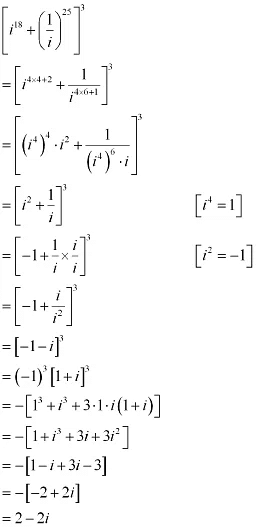
Que 1: Evaluate: 
Ans:
Que 2: For any two complex numbers z1 and z2, prove that
Re (z1z2) = Re z1 Re z2 - Im z1 Im z2
Ans:
Let z1 = x1 + iy1 and z2 = x2 + iy2
.∴ z1z2 = (x1 + iy1) (x2 + iy2)
= x1(x2 + iy2) + iy1(x2 + iy2)
= x1x2 + i(x1y2 + x2y1) + i2y1y2
= (x1x2 - y1y2) + i(x1y2 + x2y1)
.∴ Re(z1z2) = x1x2 - y1y2
.∴ Re(z1z2) = Re(z1) Re(z2) - Im(z1) Im(z2)
Hence, proved.
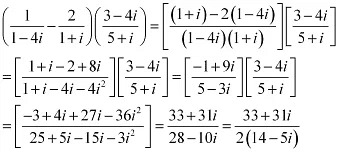
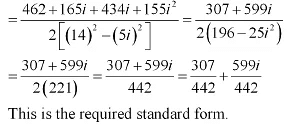
Que 3: Reduce 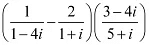 to the standard form.
Ans:
[ On Multiplying numerator and denomunator by (14 + 5i)]
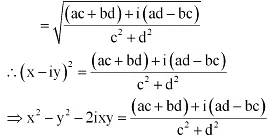
Que 4: If x - iy =  prove that
 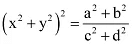 .
.
Ans:
[ On Multiplying numerator and denomunator by (c + id)]
(x2 + y2)2 = (x2 - y2)2 + 4x2y2
= (ac + bd)(c2 + d2) + (ad - bc)(c2 + d2)
= a2c2 + b2d2 + 2acbd + a2d2 + b2c2 - 2adbc(c2 + d2)2
= a2c2 + b2d2 + a2d2 + b2c2 + 2acbd(c2 + d2)2
= a2(c2 + d2) + b2(c2 + d2)(c2 + d2)2
= (c2 + d2)(a2 + b2)
= (a2 + b2)(c2 + d2)
Hence, proved.
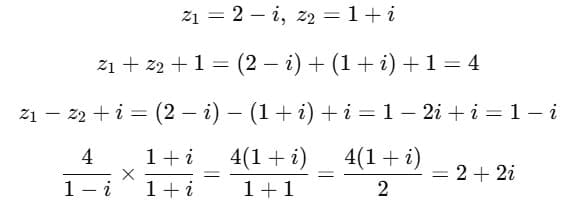
Que 5: If z1 = 2 - i, z2 = 1 + i, find z1 + z2 + 1z1 - z2 + i
Ans:
Que 6: If a + ib = (x + i)22x2 + 1, prove that a2 + b2 = (x2 + 1)2(2x2 + 1)
Ans:
a + ib = (x + i)22x2 + 1
= x2 + i2 + 2xi2x2 + 1
= x2 - 1 + i2x2x2 + 1
= x2 - 12x2 + 1 + i 2x2x2 + 1
On comparing real and imaginary parts, we obtain
a = x2 - 12x2 + 1, b = 2x2x2 + 1∴ a2 + b2 = (x2 - 1)2(2x2 + 1)2 + (2x)2(2x2 + 1)2
= x4 - 2x2 + 1 + 4x2(2x2 + 1)2
= x4 + 2x2 + 1(2x2 + 1)2
= (x2 + 1)2(2x2 + 1)2
∴ a2 + b2 = (x2 + 1)2(2x2 + 1)2
Hence, proved.
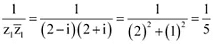
Que 7: Let z1 = 2 - i, z2 = -2 + i. Find:
(i) Re z1z2z1
(ii) Im 1z1z1
Ans:
z1 = 2 - i, z2 = -2 + i
(i)
z1z2 = (2 - i)(-2 + i) = -4 + 2i + 2i - i2 = -4 + 4i - (-1) = -3 + 4i
∴ z1z2z1 = -3 + 4i2 + i
(ii)
On multiplying numerator and denominator by (2 - i), we obtain:z1z2z1 = (-3 + 4i)(2 - i)(2 + i)(2 - i)
= -6 + 3i + 8i - 4i222 + 12
= -6 + 11i - 4(-1)22 + 12
= -2 + 11i5
= = -25 + 11i5
On comparing real parts, we obtain

(ii)
On comparing imaginary parts, we obtain


Que 8: Find the real numbers x and y if (x - iy) (3+5i) is the conjugate of -6 - 24i.
Ans:
Let z = (x - iy)(3 + 5i)z = 3x + 5xi - 3yi - 5yi2 = 3x + 5xi - 3yi + 5y
= (3x + 5y) + i(5x - 3y)
∴ z = (3x + 5y) - i(5x - 3y)
It is given that,
∴ (3x + 5y) - i(5x - 3y) = -6 - 24i
Equating real and imaginary parts, we obtain:
3x + 5y = -6 ... (i)
5x - 3y = 24 ... (ii)Multiplying equation (i) by 3 and equation (ii) by 5, and then adding them, we obtain:
9x + 15y = -18 ... (from i × 3)
25x - 15y = 120 ... (from ii × 5)Adding: 34x = 102
∴ x = 10234 = 3
Putting the value of x in equation (i), we obtain
3(3) + 5y = -6
⇒ 5y = -6 - 9 = -15
⇒ y = -3Thus, the values of x and y are 3 and -3 respectively.

Que 9: Find the modulus of 1 + i1 - i - 1 - i1 + i.
Ans:
1 + i1 - i - 1 - i1 + i = (1 + i)2 - (1 - i)2(1 - i)(1 + i)
= 1 + i2 + 2i - 1 - i2 + 2i12 - i2 = 4i2 = 2i
∴ 1 + i1 - i - 1 - i1 + i = |2i| = √22 = 2
Que 10: If (x + iy)3 = u + iv, then show that ux + vy = 4(x2 - y2).
Ans:
(x + iy)3 = u + iv
⇒ x3 + (iy)3 + 3·x·iy(x + iy) = u + iv
⇒ x3 + i y3 + 3x2yi + 3xy2i2 = u + iv
⇒ x3 - 3xy2 + i(3x2y - y3) = u + iv
∴ u = x3 - 3xy2, v = 3x2y - y3
On equating real and imaginary parts, we obtain:
∴ ux + vy = x3 - 3xy2x + 3x2y - y3y
= x(x2 - 3y2)x + y(3x2 - y3)y
= x2 - 3y2 + 3x2 - y2
= 4x2 - 4y2
= 4(x2 - y2)
∴ ux + vy = 4(x2 - y2)
Hence, proved.
Que 11: If α and β are different complex numbers with  = 1, then find
  .
.
Ans:
Let α = a + ib and β = x + iy
It is given that,


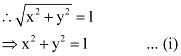
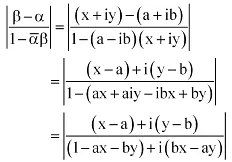

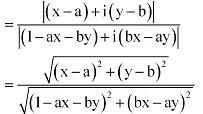
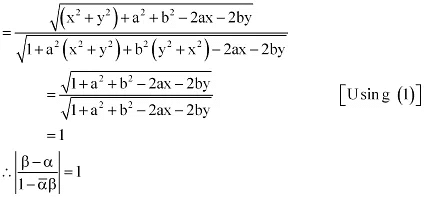
Que 12: Find the number of non-zero integral solutions of the equation  .
.
Ans:
|1 - i|x = 2x⇒ √(12 + (-1)2)x = 2x
⇒ (√2)x = 2x
⇒ 2x/2 = 2x
⇒ x 2 = x
⇒ x = 2x
⇒ 2x - x = 0
⇒ x = 0
Thus, 0 is the only integral solution of the given equation. Therefore, the number of non-zero integral solutions of the given equation is 0.
Que 13: If (a + ib) (c + id) (e + if) (g + ih) = A + iB, then show that
(a2 + b2) (c2+ d2) (e2 + f2) (g2 + h2) = A2 +B2.
Ans:
(a + ib)(c + id)(e + if)(g + ih) = A + iB
∴ |(a + ib)(c + id)(e + if)(g + ih)| = |A + iB|
⇒ |(a + ib)| × |(c + id)| × |(e + if)| × |(g + ih)| = |A + iB|
⇒ √(a2 + b2) × √(c2 + d2) × √(e2 + f2) × √(g2 + h2) = √(A2 + B2)
On squaring both sides, we obtain:
(a2 + b2)(c2 + d2)(e2 + f2)(g2 + h2) = A2 + B2
Hence, proved.
Que 14: If (1 + i)(1 - i)m = 1, then find the least positive integral value of m.
Ans:
(1 + i)(1 - i)m = 1
⇒ (1 + i)(1 - i) × (1 + i)(1 + i)m = 1
⇒ (1 + i)2(12 + 12)m = 1
⇒ (12 + i2 + 2i)2m = 1
⇒ (-1 + 2i)2m = 1
⇒ (2i)2m = 1
⇒ im = 1
∴ m = 4k, where k is some integer.
Therefore, the least positive integer is 1.
Thus, the least positive integral value of m is 4 (= 4 × 1).
FAQs on NCERT Solutions: Complex Numbers & Quadratic Equations
| 1. How do I find the modulus and argument of a complex number for JEE? |  |
| 2. Why do complex numbers have two solutions in quadratic equations? | |
| 3. What's the difference between real and imaginary parts in NCERT complex number problems? | |
| 4. How do I solve quadratic equations with complex roots using the discriminant formula? | |
| 5. Can I use Euler's formula to simplify complex number calculations for exams? | |





